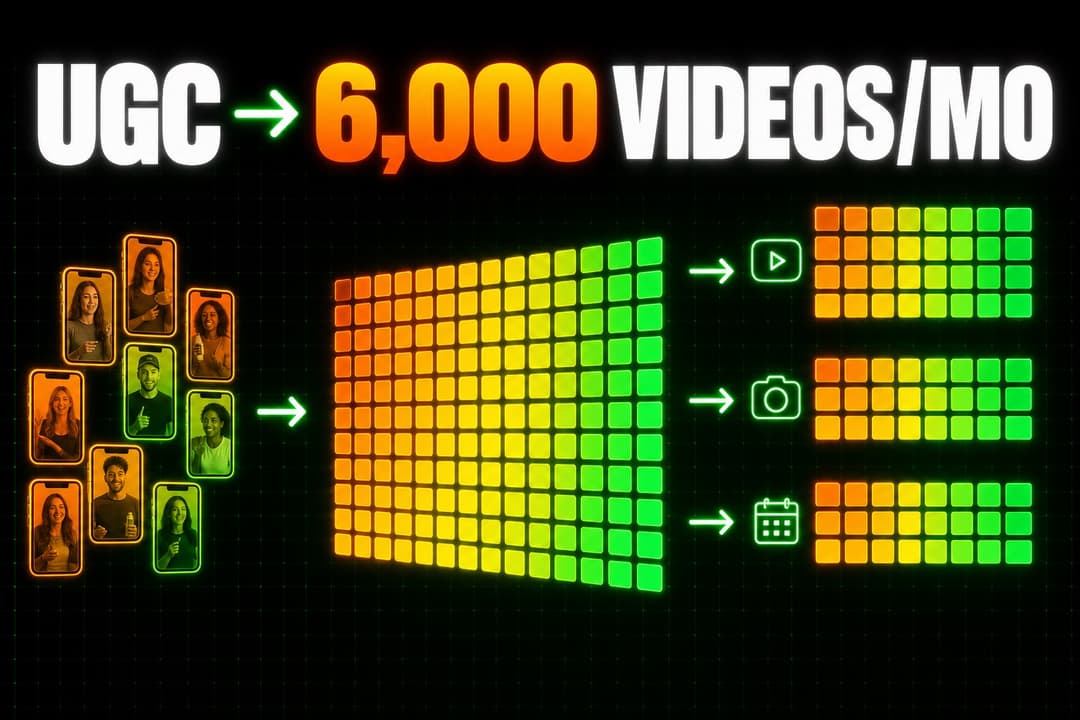
Six thousand videos a month. That is what one consumer app studio’s UGC strategy was publishing at its peak, and it is the reason a small team in the Christian app space ended up going toe to toe with app studios backed by more than $100M in funding.
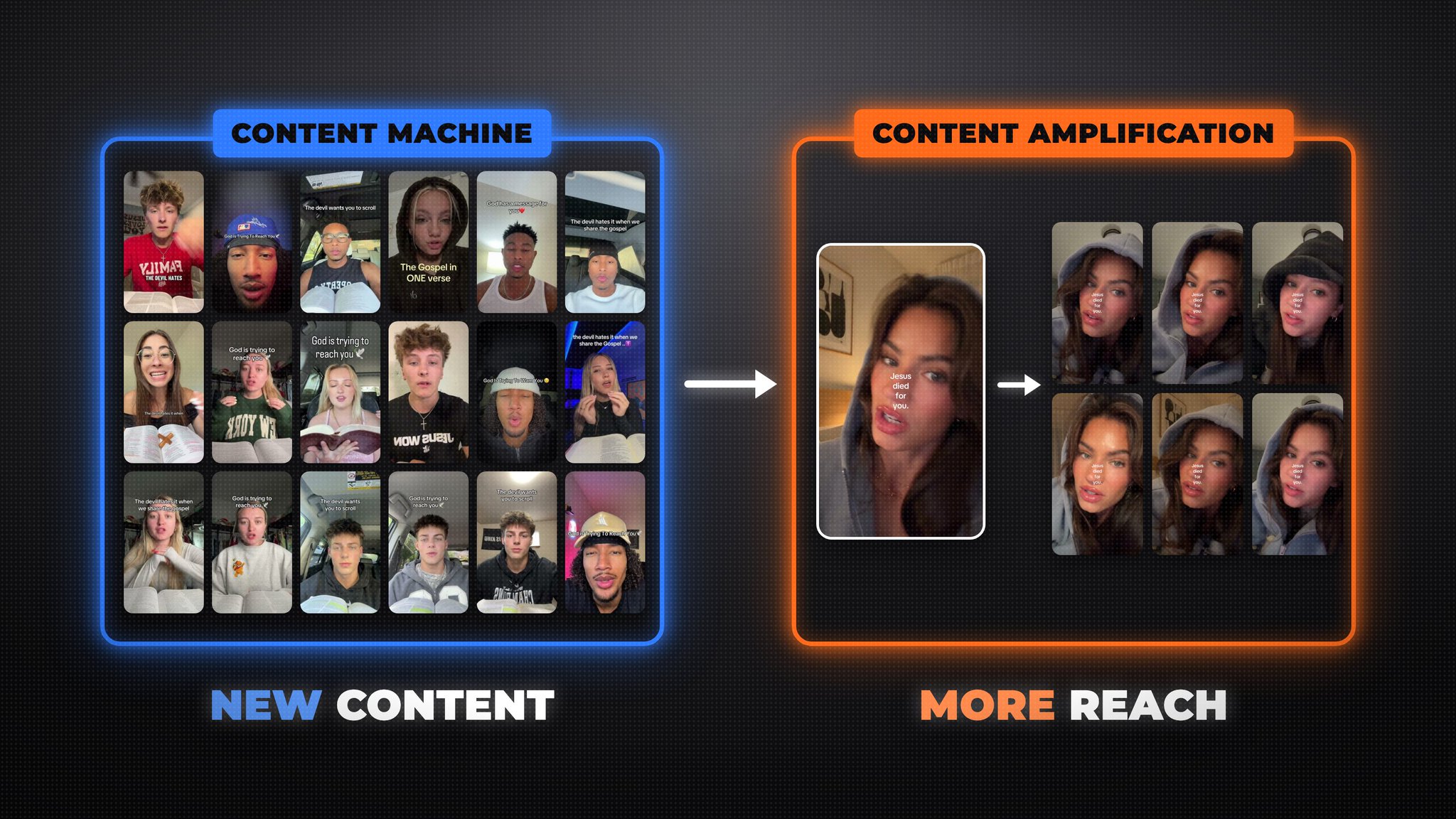
The volume was not luck and it was not one viral hit. It came from a UGC content strategy with two moving parts: a content machine that produced new videos every day, and a content amplification layer that pushed every winner across a network of theme pages. On top of both sat an AI agent and Postiz, which turned thousands of files into a calendar nobody had to fill by hand.
By the studio’s own numbers, that system drove the app to $150k a month in revenue, earned its creators three YouTube plaques, and helped build an app studio doing $1.7M a year. Below is the whole playbook, in the order it was built, with the real numbers behind each step.
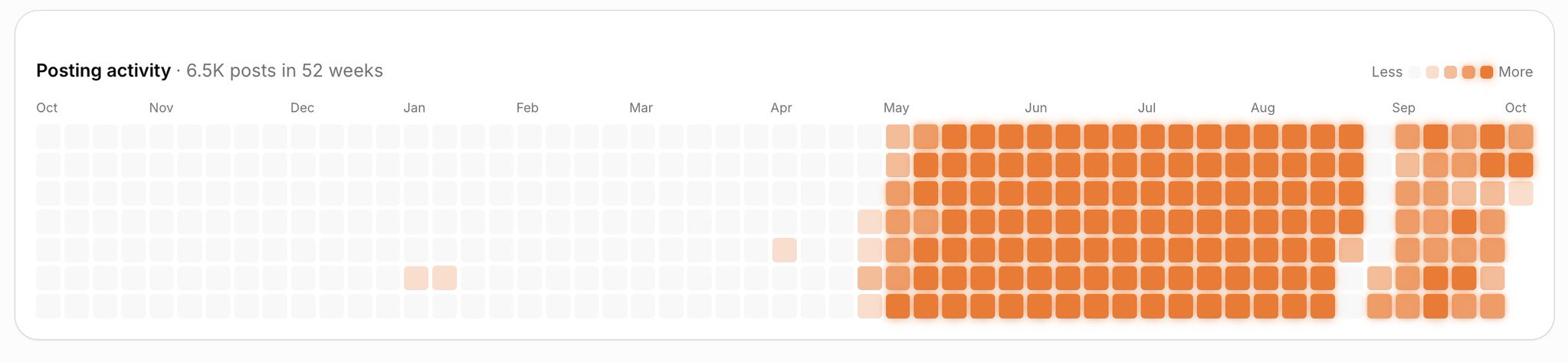
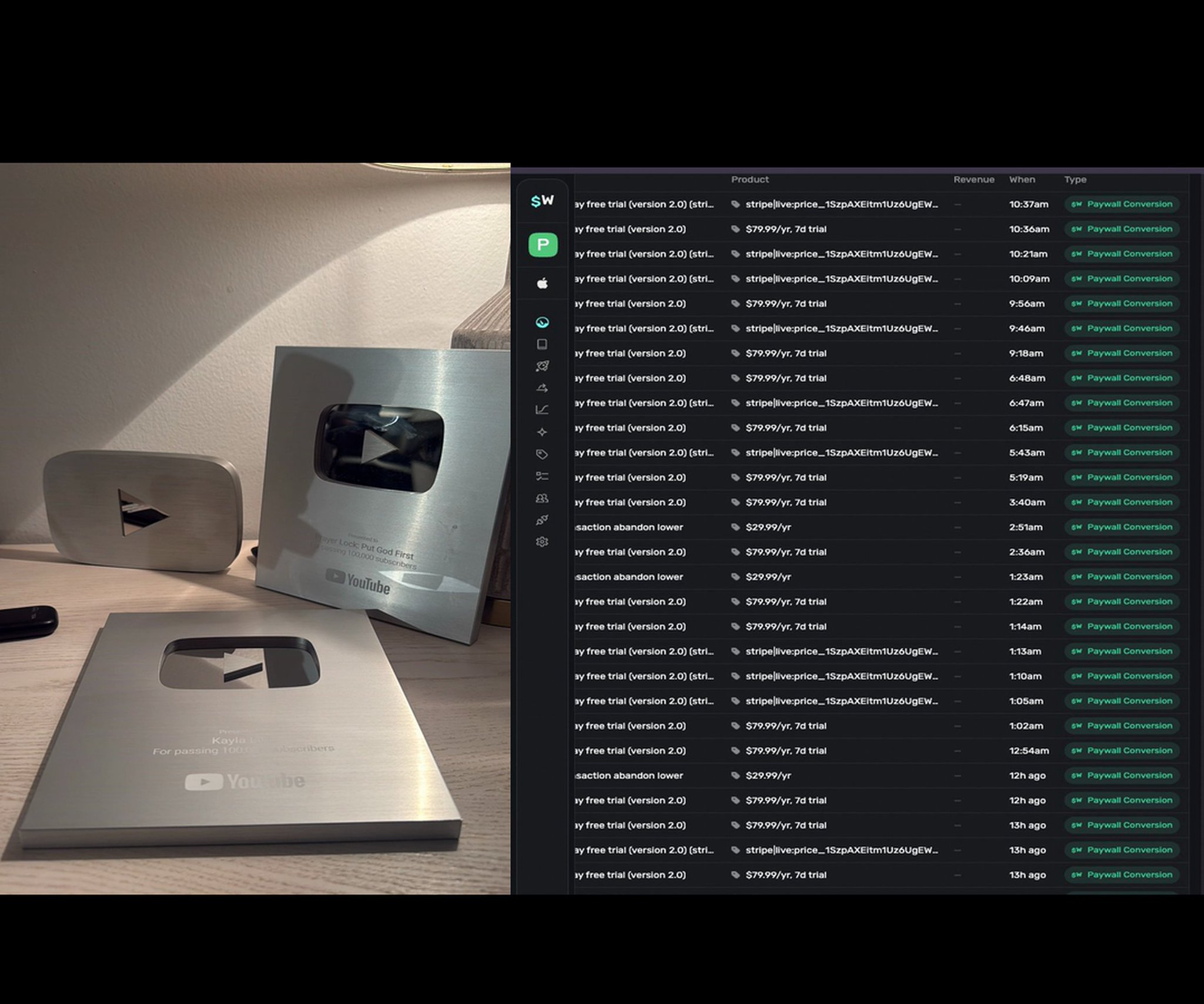
Posting activity before and after the system: a near-empty grid until April, then daily volume from May onward.Three YouTube Creator Award plaques earned by the app’s creators, next to a feed of paywall conversions on the $79.99/yr plan.
What is a UGC strategy that scales?
A scalable UGC strategy is a repeatable system that turns paid creators into a daily stream of short-form videos, then multiplies the reach of every video that works. It has two halves: a content machine (hiring, briefing and keeping creators) that produces new content, and content amplification (theme pages, AI replicas, reposts) that pushes proven winners to more accounts.
Most teams only build the first half. They hire a few creators, post each video once on one account, and wonder why growth stalls. The studio behind this playbook treated every viral video as raw material, not a finished post.
The playbook at a glance (TL;DR)
Bulk-hire UGC creators (60+ at once) instead of interviewing them one by one, then fire 5 to 10 a week until a core team of about 15 is left.
Hand creators everything: daily scripts, assets, examples from other creators and a content calendar. If a creator fails with that brief, it is a skill issue, not a brief issue.
Build a culture strong enough that $100M-funded studios cannot poach your best people.
Amplify with theme pages: AI replicas of your UGC, cinematic hook reposts of proven winners, and fully AI-generated story videos.
Let an AI agent run distribution: connect Postiz to Grok Bot, ChatGPT or Claude, and have the agent schedule every new video to TikTok, Instagram and YouTube each morning.
Manage all your social media in one place with Postiz
The two-part system: content machine and content amplification
To get to 6,000 videos a month, you need two things running at the same time, and they feed each other:
The content machine generates new content. This is your UGC team.
Content amplification takes that content further. It is a bit like clipping, but not quite: instead of cutting long videos into shorts, you rebuild short videos that already won into new versions for new accounts.
The order matters. Content amplification cannot work without a proper content machine first, because amplification only multiplies what is already proven. Amplify a flop and you get many flops.
The content machine produces new videos. Amplification turns one proven video into many.
Part 1: The content machine (UGC creators)
The content machine has one goal: consistently create viral content. For this studio, UGC was the main growth channel. Here is how they hired, managed and kept the team.
How to hire UGC creators: bulk-hire 60+ at once
Instead of hiring creators one at a time, the studio hired more than 60 UGC creators in one go through Sideshift, a creator hiring platform. It costs $299 a month, which feels steep at first, but the team found it worth every dollar for the speed.
Over the hiring push, the studio reports spending close to $100,000 on the creator team. The return, by its own numbers, was roughly five times that.
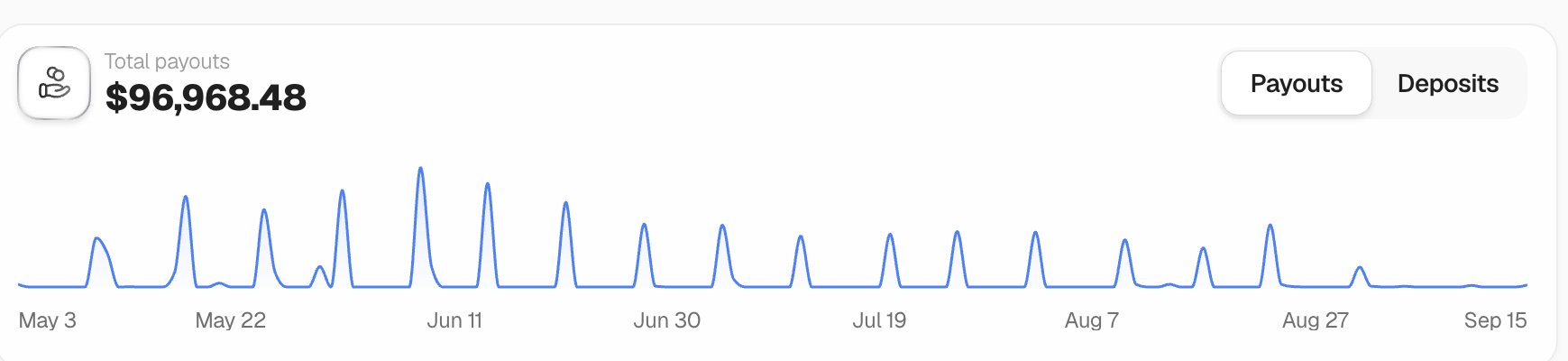
Creator payouts from May to September: $96,968.48 in total.
Why spend so much so fast? Because they hired far more creators than they needed on purpose. It was a financial sacrifice made for speed, and it paid off.
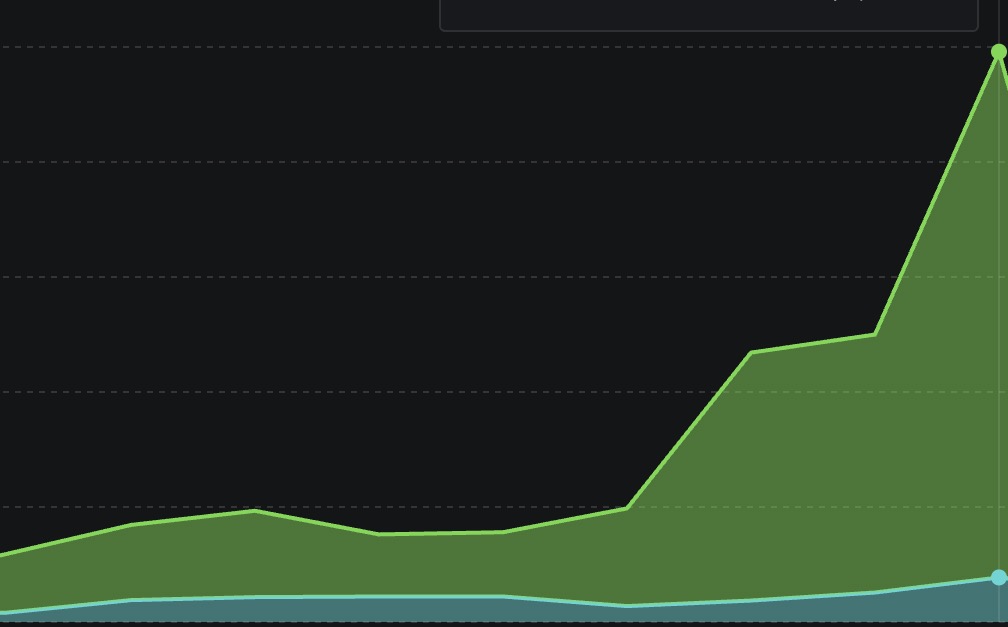
Growth after the bulk-hiring push.
Fire fast: 5 to 10 creators a week until 15 killers remain
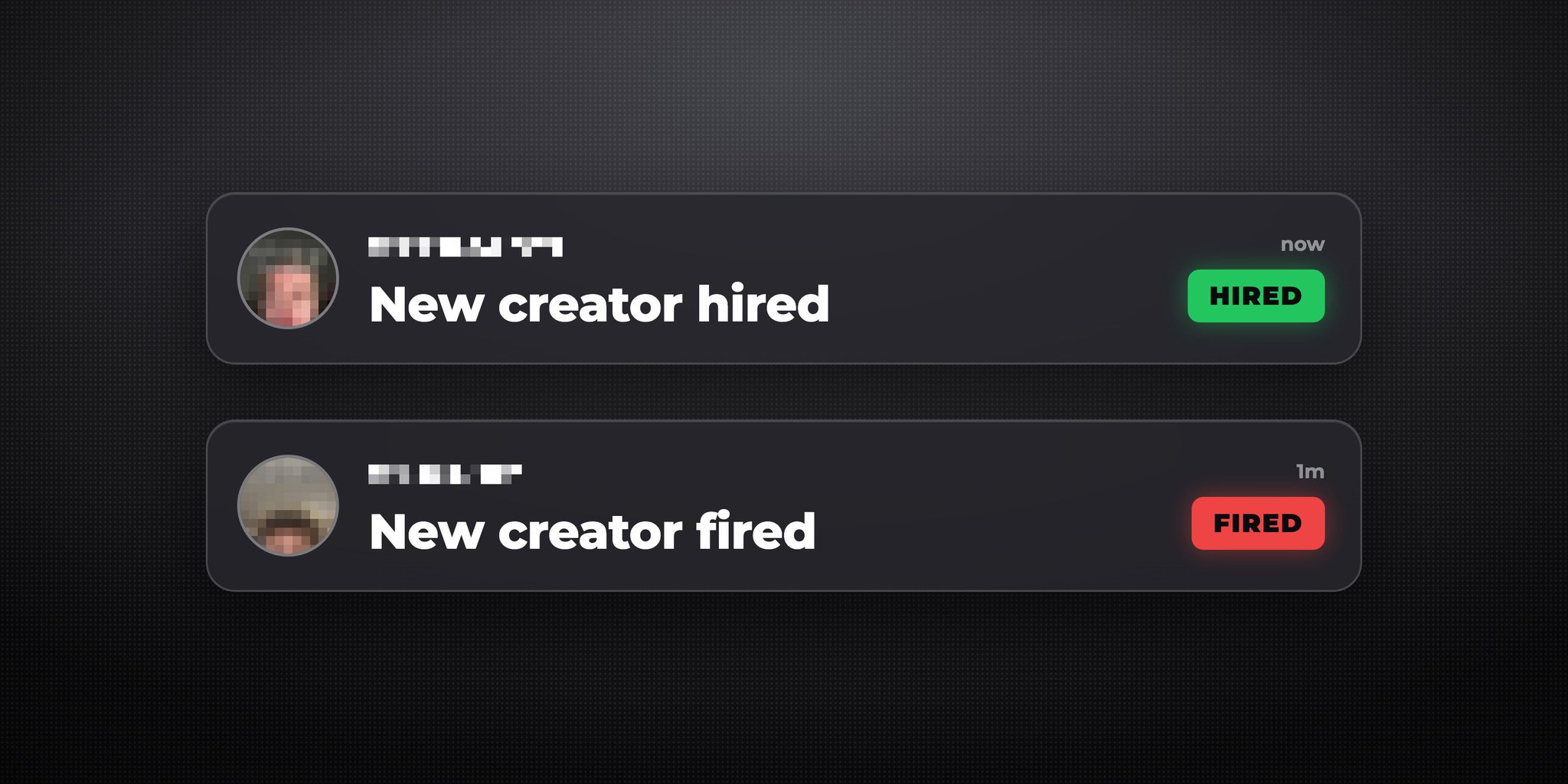
There were no discovery calls and no portfolio reviews. Every creator got the brief and was trusted to execute. Then, every week, the studio fired 5 to 10 creators until the roster was down to a team of 15 consistent performers.
Hire wide, then cut weekly. The top performers reveal themselves.
This only works because the formats were already proven. The studio had invented formats that went viral again and again, so as long as a creator followed instructions, results came down to execution. The best creators surfaced naturally, and a world-class team formed in weeks instead of months. That core team alone went on to generate more than 100M views.
On a smaller budget, go slower. Hire one or two creators at around $600 a month each and work your way up. The rule stays the same: fire quickly, and always have replacements ready.
The brief: give creators everything they need
The second reason this UGC team outperformed everyone else in the Christian app space was organization. Creators were not left to invent formats on their own. They were handed:
Daily scripts
All the assets to include in their videos
Examples from other creators
A content calendar telling them what to film and when
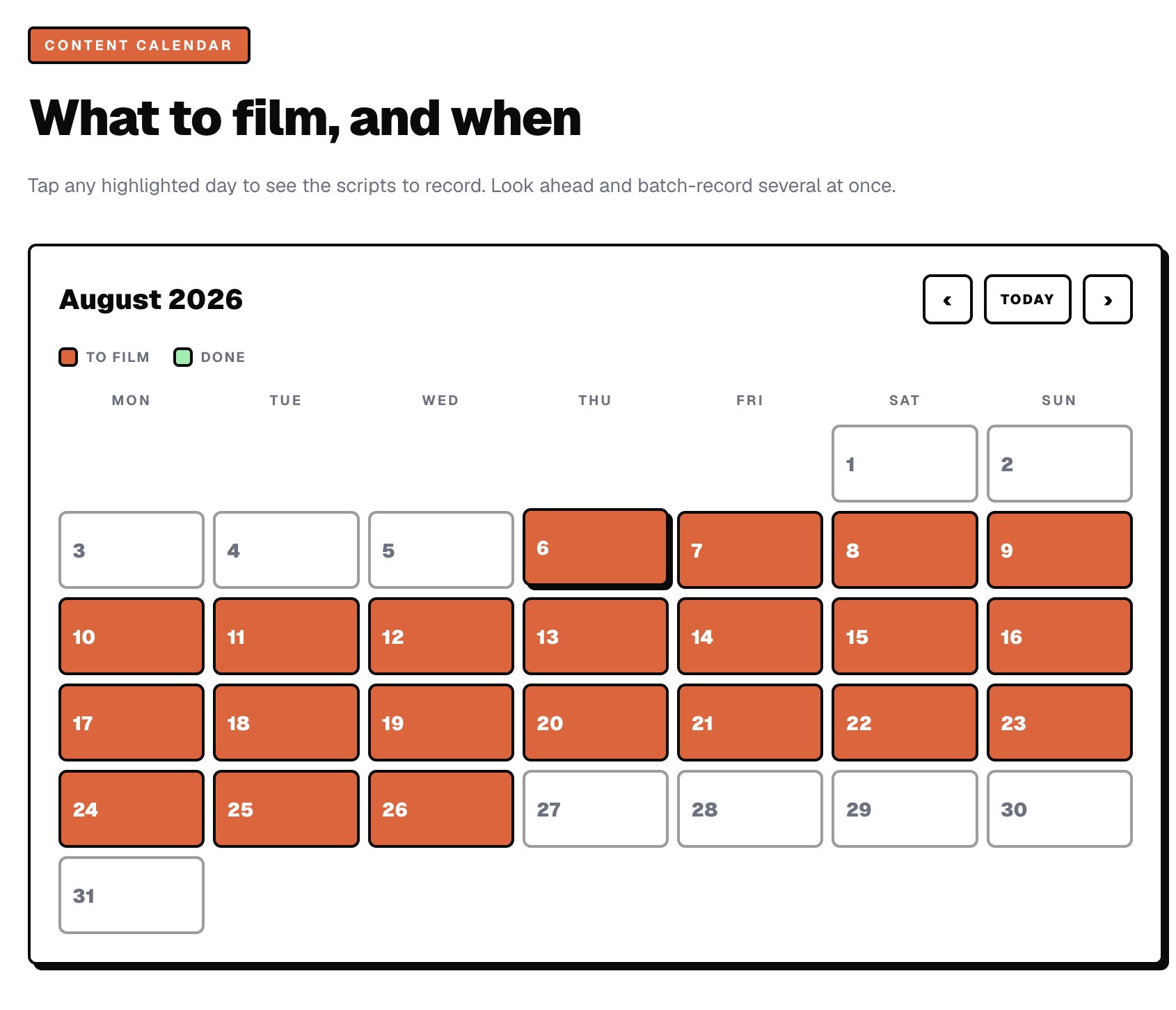
The creator-facing content calendar: tap a day to see which scripts to record, and batch-record ahead.
The philosophy behind it is blunt: your creators do not owe you anything, you owe them everything. Your job is to make their job as easy as possible, which means finding the viral formats yourself and showing creators exactly how to replicate them. With a brief that tight, a creator who fails has a skill issue, and you can replace them without guessing.
Across the whole program, the studio reports that bulk hiring plus airtight briefs produced more than 150M views in three months. If you want to sharpen the hooks inside those scripts, our guide to writing viral hooks breaks down the psychology.
Culture: why $100M studios could not poach the team
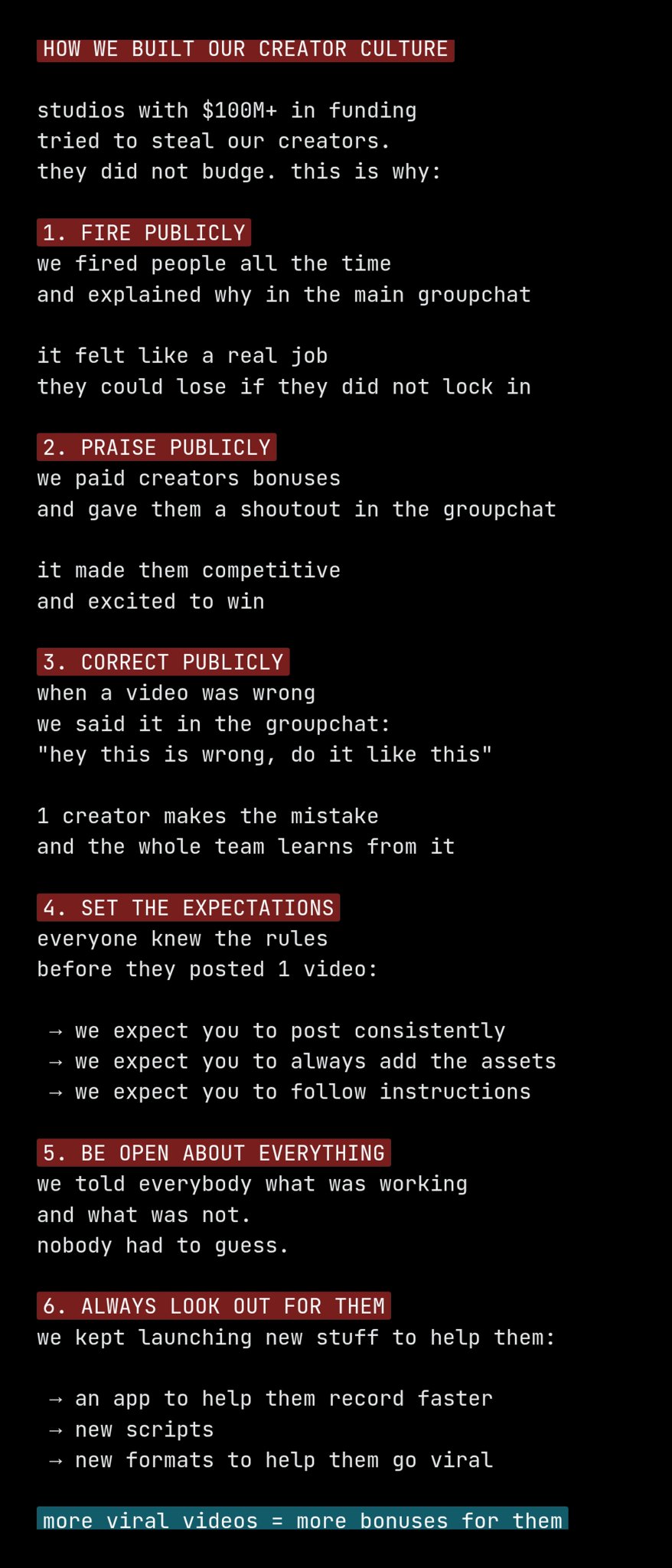
This part is rarely talked about. Studios with more than $100M in funding tried to steal the best creators and offered them more money. The creators did not budge, because the culture was worth more than the raise. The studio ran on six rules:
Fire publicly. Explain every firing in the main group chat. It made the gig feel like a real job you could lose if you did not lock in. Keep it about the work, never personal.
Praise publicly. Pay bonuses and give shout-outs in the group chat, so creators get competitive and excited to win.
Correct publicly. When a video was wrong, say so in the group chat. One creator makes the mistake and the whole team learns from it.
Set expectations before anyone posts a single video: post consistently, always add the assets, always follow instructions.
Be open about everything. Tell everyone what is working and what is not, so nobody has to guess.
Always look out for them. Keep shipping things that help creators win: an app to record faster, new scripts, new formats. More viral videos means more bonuses for them.
The six rules behind a creator team that would not leave.
That was the entire content machine: mass hiring to find the right talent, a killer brief built on proven viral formats, and a culture that kept creators motivated and on the team long term. With the machine running, it was time to amplify.
Part 2: Content amplification with TikTok and Instagram theme pages
Content amplification means taking everything your content machine makes and pushing it much further than one post on one account. Your UGC team makes the content. Amplification makes sure it gets seen as many times as possible. This studio did it with theme pages.
What are TikTok and Instagram theme pages?
Theme pages are TikTok, Instagram and YouTube accounts that a brand owns and runs around one topic, without a personal creator identity. Instead of a face people follow, the page posts a consistent style of content. For an app, that means accounts in the same niche that repost and remix your proven content in different formats, each one sending viewers back to the app.
The studio ran three types of theme pages:
AI replicas of their own UGC
Cinematic 3D hook reposts (Zack D Films style)
AI “slop” stories
One proven UGC video, three theme page formats: AI replicas, cinematic-hook reposts and AI story videos.
1. AI UGC: replicas of your best creators
The studio took its existing UGC library and used it to train an AI version of the format. They had Gemini analyze the body movements of all their creators, and that analysis is what let them crack hyper-realistic AI UGC.
The pipeline:
Arcads creates a new character sheet with GPT Image 2.
Seedance 2.5 brings the character to life on video.
Claude edits all the videos.
Postiz publishes them to Instagram, TikTok and YouTube, automatically.
Same hook, same structure, but an AI character instead of a human creator, at roughly one tenth of the cost. If you plan to model AI characters on your real creators’ delivery, put it in their contracts first. For a deeper build of this pipeline, see our full AI UGC army workflow.
The reference library: proven UGC frames used to model the AI replicas (faces blurred).
2. Cinematic 3D hook reposts (Zack D Films style)
This one is close to a cheat code. The studio took videos that had already gone viral on its UGC accounts and reposted them on the theme pages with a new opening: a short Zack D Films-style 3D animation clip as the hook, then a snap cut into the original video.
The cinematic clip is the bait, and the proven UGC is the payoff. Because every video in the format had already gone viral once, the studio reports this format generated more than 10M views. It is also one of the easiest formats to replicate: with Postiz connected to Claude, you can describe the edit and the schedule in plain language. Use hook clips you have the rights to, or generate your own in the same 3D style, so the theme pages stay safe from takedowns.
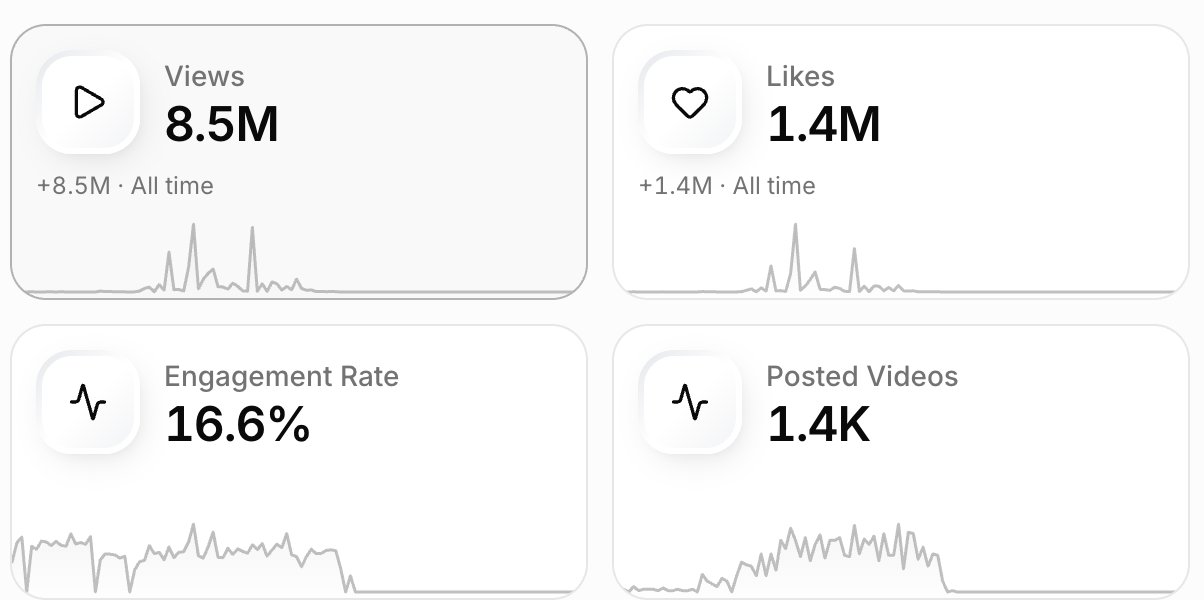
A snapshot of one theme page dashboard: 8.5M views, 1.4M likes and a 16.6% engagement rate across 1.4K posted videos.
3. AI slop stories
The third format is short stories made entirely with AI, written about the same problem the app solves. People call it slop. It still gets views, and it still converts. The studio automated this fully:
Claude writes the story.
Using an Arcads API key, Claude generates the story as a video with Seedance 2.5.
Proven hook and structure at about 10x lower cost per video
Cinematic 3D hook reposts
UGC videos that already went viral
Video editor or agent, Postiz
A scroll-stopping opening on content that has already proven it converts
AI story videos
The core problem your app solves
Claude, Arcads API (Seedance 2.5), Postiz
Fully automated volume in the same niche as your buyers
Start with cinematic hook reposts: they need no new footage, only a winner you already have. Add AI replicas and AI stories once you have enough proven UGC to model them on.
How to manage 6,000 videos a month with Postiz
Running this many accounts by hand is impossible. You cannot log in and out of dozens of TikTok, Instagram and YouTube accounts, upload each file, write each caption and pick each time slot. That is where Postiz comes in. The studio’s pipeline looks like this:
New UGC, AI replicas and AI stories land in one approved folder every day.
Proven winners get a cinematic hook added and are queued again for the theme pages.
Postiz publishes the result.
Postiz posts to every platform at once, so one video goes out to TikTok, Instagram and YouTube in a single step, and it supports 28+ channels if you expand beyond those three. More importantly, it is agentic: the studio’s AI agent schedules everything, and the team just reviews the calendar.
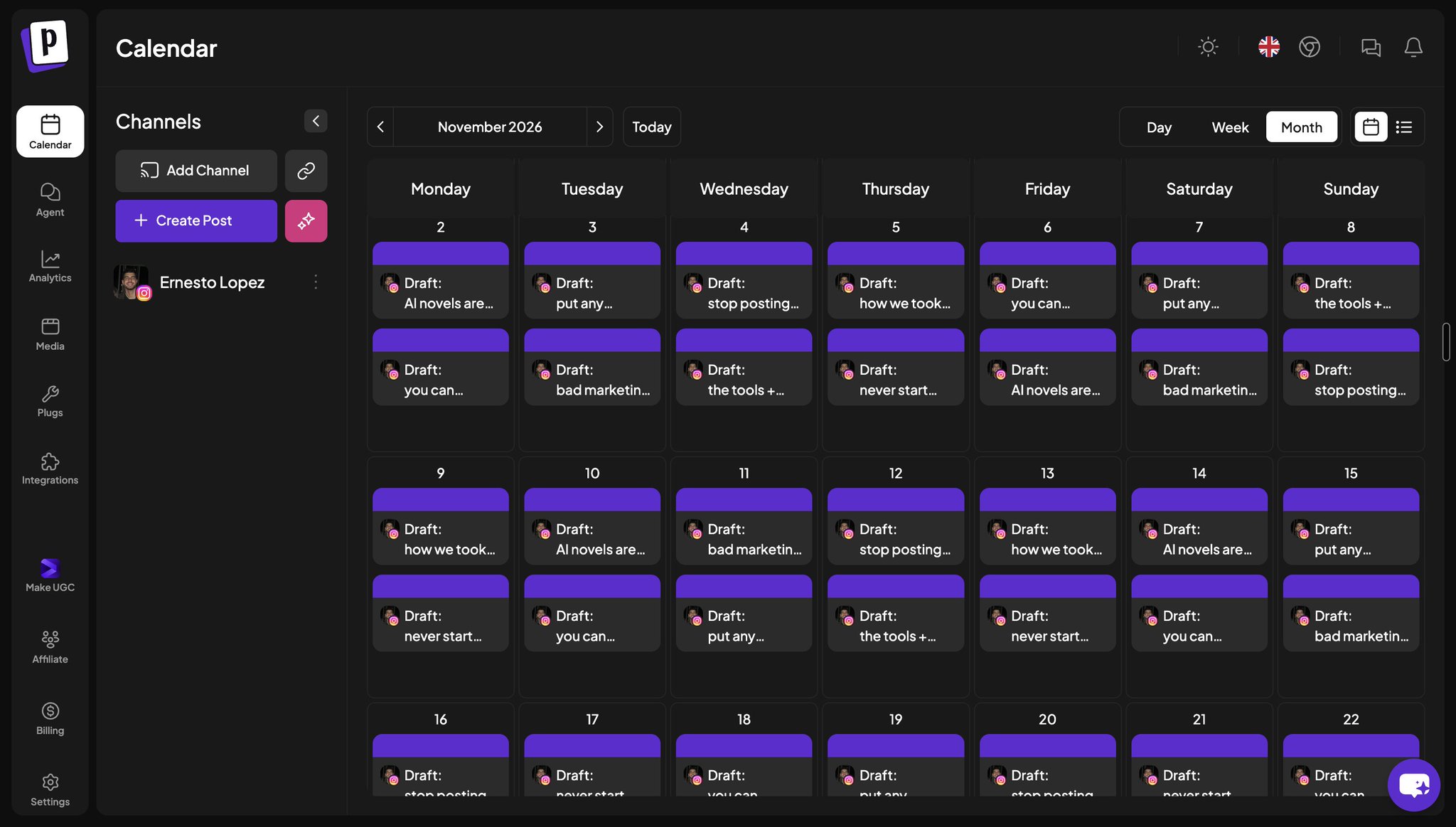
A month of theme page drafts in the Postiz calendar: two posts a day, scheduled by an agent.
How to automate it with Grok Bot, ChatGPT or Claude
You do not need to build your own posting system. Postiz has official connectors for the three biggest agents:
Connect it once, then set up a daily routine. Every morning, the agent takes the new videos and schedules them on every account through Postiz. You check the calendar, and that is it. Here is a routine you can paste into any of the three agents and adapt:
Every morning at 8:00:
1. Collect every new video in my "approved" folder from the last 24 hours.
2. For each video, write a short caption in the style of the account it is going to
   (keep the hook in the first line, no hashtag spam, one call to action).
3. Using Postiz, schedule each video to TikTok, Instagram Reels and YouTube Shorts
   for every theme page account, spaced at least 3 hours apart per account,
   between 9:00 and 21:00 in each account's timezone.
4. Create them as drafts, then send me a summary: how many posts per account,
   the first and last slot, and anything that failed.
The morning routine: the agent picks up new videos and fills the Postiz calendar across every platform.What the agent reports back: 60 drafts, November 1 to 30, two a day, no failures.
Prefer working from the terminal? The same flow runs from Claude Code or Codex through the Postiz MCP server or the Postiz CLI, and our Postiz agent page covers every way to plug an AI agent into your calendar.
How to copy this UGC strategy on a smaller budget
Find two or three formats that already went viral in your niche, and write the scripts and asset packs before you hire anyone.
Hire one or two UGC creators at around $600 a month each, with the full brief from day one. Add more as the formats prove themselves.
Cut quickly. Review results weekly and replace anyone who is not executing the brief.
Open your first theme page once a video goes viral, and start with cinematic 3D hook reposts of that winner. It is the cheapest format to run.
Connect Postiz to your agent (Grok Bot, ChatGPT or Claude), and give it the morning routine above so every new video is scheduled everywhere without you touching it.
Add AI replicas and AI story videos once you have enough winning UGC to model them on.
FAQ
What is a theme page on TikTok or Instagram?
A theme page is an account built around a topic or format rather than a personal creator identity. Brands use TikTok and Instagram theme pages to repost and remix their best-performing content in different styles, so one proven video reaches many audiences instead of one.
How many UGC creators do you need to scale?
This studio bulk-hired more than 60 creators to find talent fast, then fired 5 to 10 a week until about 15 strong performers remained. On a smaller budget, start with one or two creators at around $600 a month each and grow from there.
How much does a UGC creator team cost?
The studio reports spending close to $100,000 on its team during the hiring push, including over-hiring for speed, and earning roughly five times that back. A starter setup of one or two creators runs around $600 a month per creator, plus any hiring platform fees, such as Sideshift’s $299 a month.
What is content amplification?
Content amplification is taking content that already performed and pushing it further than one post on one account. Here, that meant theme pages running AI replicas of proven UGC, cinematic 3D hook reposts of viral videos and AI-generated story videos, all published through Postiz.
Can AI UGC replace human creators?
In this playbook it complements them. Human creators invent and prove the formats, then AI replicas reuse the same hook and structure at about 10x lower cost. The AI versions work because they copy something that already went viral with real people.
Where can I auto-publish UGC with scheduled social workflows?
Postiz auto-publishes UGC on a schedule to TikTok, Instagram, YouTube and 25+ other channels. Connect your accounts, then let an AI agent such as Grok Bot, ChatGPT or Claude schedule every new video through the official Postiz connectors, and approve everything from the calendar.
Give your content machine a distribution engine
The creative part of this playbook (finding formats, writing briefs, building a culture) stays human. The last mile does not have to. Once a video is approved, someone has to caption it, schedule it and spread it across every account on every platform, and at 6,000 videos a month that someone should be an agent.
Try Postiz for free, connect TikTok, Instagram and YouTube, plug it into Grok Bot, ChatGPT or Claude, and let your agent fill tomorrow’s calendar while you review it over coffee.
How a solo founder built a content distribution pipeline using AI agents, Notion, and Postiz that ships 8-15 posts/day across X, Instagram, TikTok, YouTube, and Facebook - hitting $1,300 MRR with no paid ads.
Updated LinkedIn post sizes for 2026. Learn the correct image, video, carousel, banner, and document dimensions to avoid cropping and boost engagement.
Master the Types of Social Media Contents that drive engagement. Learn what types of content are popular on social media, from Reels to Carousels, and build a winning strategy.