Clippers are quietly becoming the highest-paid people in the creator economy. Not the streamers. Not the podcasters. The kids slicing 30-second cutouts of those streamers and podcasters and dropping them onto every platform at once. Daniel Bitton paid out over $50,000 to clippers in a single week through Whop’s Content Rewards beta. MrBeast runs a clipper army of more than 1,000 people, paying $50 for every 100,000 views. Adin Ross and N3on between them spend close to $1 million a month on clipper payouts — one Adin Ross campaign hit 430 million views across 11,000 videos from 520 different clippers.
The catch is volume. To actually make $10K, $50K, or $100K a month from a clipping page, you need to be pushing roughly 60 uploads a day — 5 clips, 4 platforms, 3 accounts in the same niche. Nobody who clears that number is editing faster than everyone else. They’ve quietly built an agent stack that does the editing, captioning, scheduling, and posting while they sleep. Vadim Strizheus recently published the full blueprint for his — a Hermes Agent wired into a clipping tool and into Postiz, controlled entirely from one Telegram message — and it’s the cleanest example we’ve seen of where this corner of the market is heading.
What a clipping page actually is
A clipping page is the most boring-looking high-leverage asset on the internet. You take long videos from one creator or one niche — a Joe Rogan episode, a Kai Cenat stream, an Iman Gadzhi sales pitch — and cut them into 30 to 60-second clips. You slap captions on, and you post the clips across Instagram Reels, TikTok, YouTube Shorts, X, and Threads. That’s it. The clips collect views. The views collect payouts.
The payout shows up in three flavors at once: per-view bonuses from the platforms themselves, flat campaign payouts from creators who want their content clipped, and brand UGC deals where companies pay you to clip and distribute their own talking heads. A good clipping page collects from all three at the same time. That’s the part that turns a $200 laptop into $10K a month in two months — the 14-year-old in Ohio everyone keeps quoting did it slicing Twitch clipping streams into 60-second cuts.
Why this whole game is now an AI video clipping problem
The economics break the moment you try to scale by hand. Five clips a day across four platforms across three accounts is sixty uploads — and some of the operators Vadim points to are averaging 120. There is no editor on earth willing to do that as a job and there is no marketplace willing to pay you for it if you’re the bottleneck. The people clearing real numbers stopped editing a long time ago. They built a pipeline where one source video becomes ten captioned, platform-aware clips automatically, and where one prompt schedules all of them into the right slots on the right accounts.
That pipeline is what AI video clipping is really about. The clipping model picks the moments. A captioning model bakes burned-in subtitles. An agent harness ties the steps together so you never have to babysit them. And a scheduler handles the part that’s historically eaten the most of a clipper’s day — actually posting the clips, on time, on every account, on every platform, with the per-platform settings each one demands. The scheduler is where Postiz ends up sitting in almost every serious clipping operator’s stack, which is the part of Vadim’s post worth zooming in on.
Manage all your social media in one place with Postiz
Vadim’s stack collapses to three tools and one fact:
Vugola handles the AI video clipping itself — drop a long-form video in, get back 5 to 10 short clips with captions already burned in.
Postiz is the publishing layer. One API, 28+ social networks, every per-platform setting (TikTok privacy, YouTube playlist, Reddit flair, etc.) handled in the schema.
Hermes Agent from Nous Research is the orchestrator — an open-source CLI agent that holds the plan, calls Vugola, polls until the clips are done, hands them off to Postiz, and reports back via Telegram.
The fact that makes this work: every step has a real machine interface. Vugola exposes an API. Postiz exposes a public REST API, an MCP server, and a CLI. Hermes Agent has an MCP loader and a config file. None of this is held together by browser automation or scraped UIs — it’s every layer talking to every other layer through stable, versioned interfaces, which is why the whole thing keeps running while you sleep instead of crashing the moment a UI updates.
How one Telegram message fires the whole pipeline
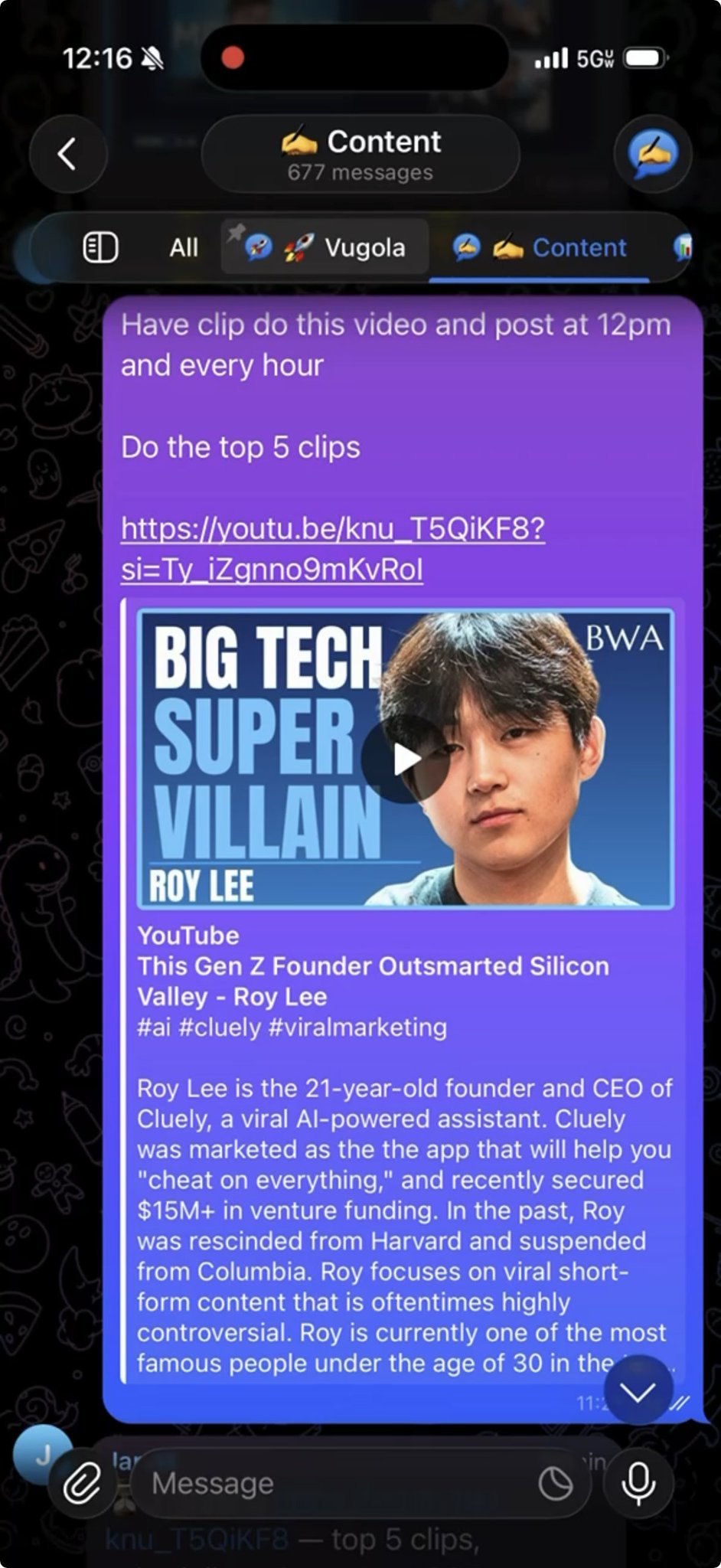
Once it’s wired up, the only thing the operator does is text Hermes. The message Vadim uses to demo the flow looks like this:
Clip the latest Lex Fridman podcast. Pull the 5 best moments. Schedule them across TikTok, Reels, YouTube Shorts, and X at 9am, 12pm, and 6pm CDT, spread across the next 3 days.
Hermes parses the intent and plans the call chain. It hits Vugola to start the clip job, polls until clips are ready, downloads them, and hands the file paths plus the desired schedule into the Postiz tool. Postiz takes care of the multi-platform scheduling — every clip queued into TikTok, Instagram Reels, YouTube Shorts, and X at the right times, with each platform’s required settings filled in. About 15 to 25 minutes after the message, Telegram pings back with a confirmation. The operator never touches a video editor or a posting UI.
The setup, step by step
1. Pick one niche, not five
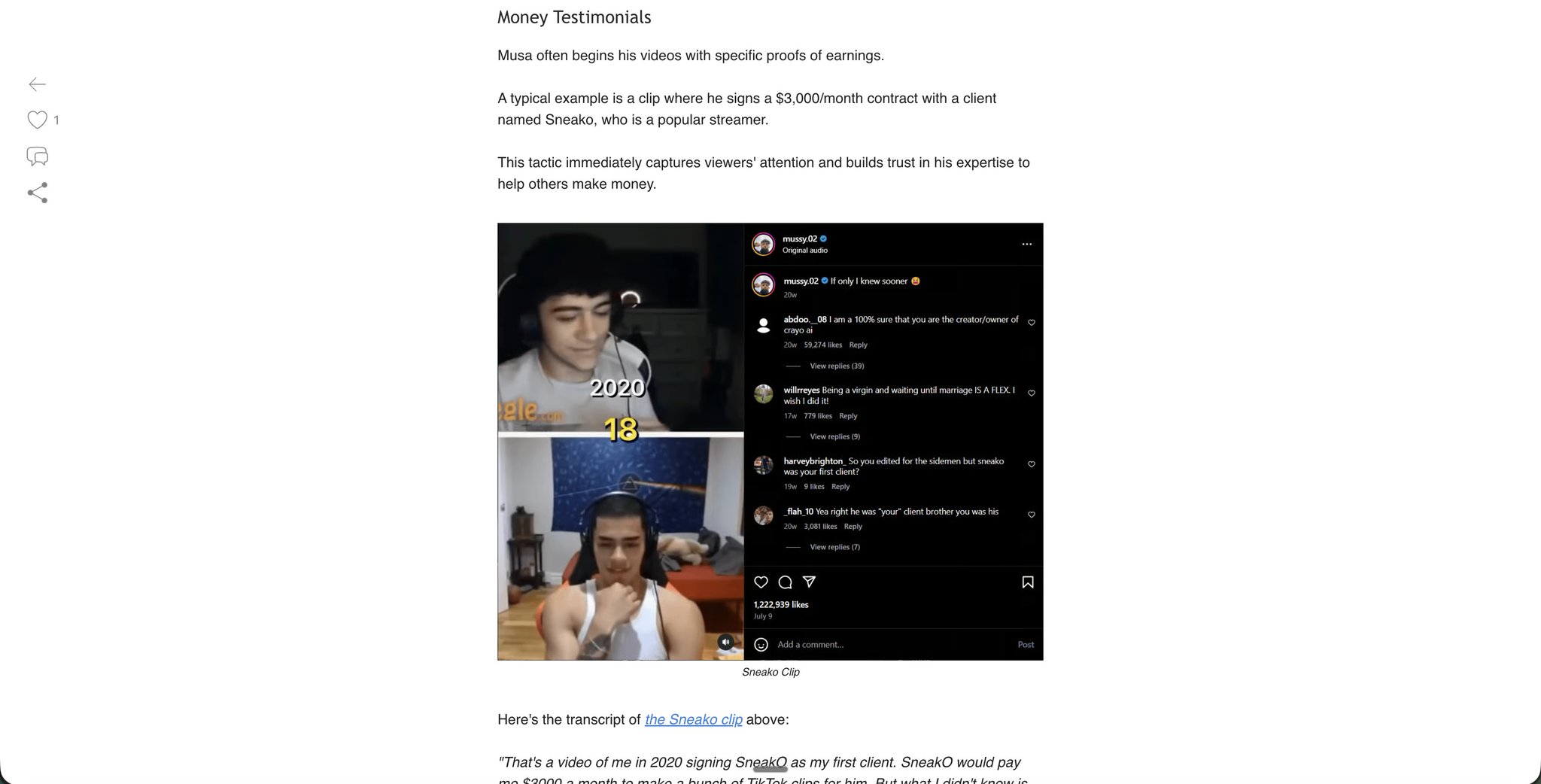
Streamer clips pay the highest per-view rates ($1 to $5 RPM territory) — Adin Ross, N3on, Sneako, Kai Cenat, Clavicular. Podcast clips are evergreen and never go stale: Rogan, Lex Fridman, Diary of a CEO, Theo Von, Shawn Ryan. The hustle and finance niche has the highest brand-deal CPM (anywhere from $1.50 to $8 on Whop Content Rewards): Hormozi, Iman Gadzhi, Hamza. Reddit story and fake-text accounts are the easiest to mass-produce because the source material is text-to-speech.
Pick something you can stand to listen to for ten hours a week. You’ll be near the content a lot, even with the editing automated.
2. Grab three API keys
Vugola — Sign in at vugolaai.com/dashboard/api-key. Starter is $14/mo, Creator is $21/mo and unlocks unlimited posting plus full API access. Keys look like vug_sk_....
Postiz — Settings → Developers → Public API. You can grab one in a couple clicks from the Postiz dashboard. Self-hosters: the same panel exists on your own instance.
Hermes Agent — Free, MIT-licensed, open source on GitHub at NousResearch/hermes-agent. No key needed for the harness itself; you pick a model provider during setup.
Why Hermes versus rolling your own agent loop: the harness ships with skills, memory, terminal access, MCP support, and 14+ messaging gateways already wired in. You don’t glue this together — you load it.
4. Wire the clipping tool into Hermes
Open ~/.hermes/config.yaml and add the Vugola MCP server block:
Hermes now has access to eight Vugola tools — clip_video, get_clip_status, caption_video, schedule_post, list_scheduled_posts, cancel_scheduled_post, download_clip, and get_credits. The clipping side of the pipeline is done.
5. Wire Postiz into Hermes
In the same config.yaml, add the Postiz MCP server. Postiz publishes its own MCP endpoint so an agent can use the full scheduling API as native tool calls:
That single block gives Hermes access to the Postiz MCP’s eight tools: integrationList, integrationSchema, triggerTool, schedulePostTool, generateImageTool, generateVideoOptions, videoFunctionTool, and generateVideoTool. The agent can list every connected social account, ask each one for its rules and character limits, fetch dynamic data like Discord channels or Reddit flairs, and finally schedule a post — all without you writing a single line of integration glue.
6. Add the Postiz agent skill
If you’d rather drive Postiz from the CLI instead of MCP — or you want a second, deterministic path for the agent to fall back to — install the Postiz agent skill. It hands the agent a clean CLI that outputs structured JSON, which LLMs handle better than free-text responses:
If integrations:list prints your connected socials, the agent is wired. From here, Hermes can call postiz posts:create, fan-out across every platform, and pull analytics back into the conversation. The CLI ships with strong defaults — every media file gets uploaded through postiz upload first so TikTok, Instagram, and YouTube see a verified URL instead of an external link (which they would reject), and every posts:create call validates the per-platform settings before sending.
7. Connect Hermes to Telegram
hermes gateway add telegram
Follow the bot setup prompts — it takes about 60 seconds. Discord, Slack, WhatsApp, Signal, iMessage, and plain email are all supported gateways too, but Telegram is the lowest friction on a phone.
8. Send the message that runs everything
Open Telegram, text your Hermes bot the natural-language brief — “clip the latest [creator] episode, pick the 5 best moments, schedule them across these platforms at these times across the next three days” — and walk away. Hermes plans the call chain, hits Vugola, polls until the clips render, downloads them, hands them to Postiz, and pings you when every clip is sitting in the right queue. Total wall-clock time: usually 15 to 25 minutes.
Why Postiz keeps showing up in the clipper stack
You can swap Vugola for any other clipping tool. You can swap Hermes for any other agent harness. The piece you almost can’t swap is the publishing layer, because the per-platform requirements are punishing once you’re running at clipper-scale volume. TikTok rejects every video that isn’t coming from a verified URL. Instagram and YouTube do the same. Reddit needs a flair object that’s specific to the subreddit. YouTube needs a playlist ID and a video title. LinkedIn pages need a company ID. Get any of these wrong and the post silently fails or — worse — the account gets flagged.
Postiz handles the long list. Every platform has a schema endpoint (integrationSchema in the MCP, integrations:settings in the CLI) that exposes the rules: max length, required settings, available helper tools. Every platform with dynamic data (Reddit flairs, YouTube playlists, Discord channels, LinkedIn companies) exposes a fetch tool the agent can call to pull current values, instead of hard-coding stale IDs. The agent reads the rules, fetches the helpers, and assembles a valid payload before it ever schedules — which is the difference between “runs while I sleep” and “burns down my accounts while I sleep.”
And because Postiz exposes the same surface three different ways — REST API, MCP server, CLI — the agent can pick whichever interface plays nicest with the model it’s using. Claude-class models tend to do best with MCP tool calls. Smaller models tend to do better with the CLI’s structured JSON output. Both work against the same backend.
The first 30 days, the way the operators actually run it
Week 1 — test signal, don’t change anything
Three clips a day across TikTok, Reels, and Shorts. Same content, same captions, no A/B yet. You’re only looking for which platform your niche lands on first. Some niches print on Shorts immediately and never wake up on Reels. Others are the opposite. You can’t tell from the outside.
Week 2 — double down on the winning platform
Whichever platform is winning by view count, push to 5 clips a day on it. Spin up a second account in the same niche with a different angle and different posting times. The agent stack is doing the heavy lifting on both accounts, so the marginal cost of adding the second one is roughly zero.
Week 3 — stack the payout networks
Sign up for Whop Content Rewards, Vyro (MrBeast’s marketplace), and Clipping.net. Filter campaigns by your niche. Some are paying $2 CPM right now with zero follower minimum — you’re leaving money on the table if you’re not entered into multiple networks at once.
Week 4 — scale or pivot
If the view counts are there, push to three accounts × five clips × four platforms = 60 posts/day. That’s only sustainable because Hermes is doing the labor. If the view counts aren’t there by week 4, the niche or the hook style is wrong — switch niches. Stay disciplined about not running four niches at once before any of them have signal.
The real lesson the loud version of this thread misses
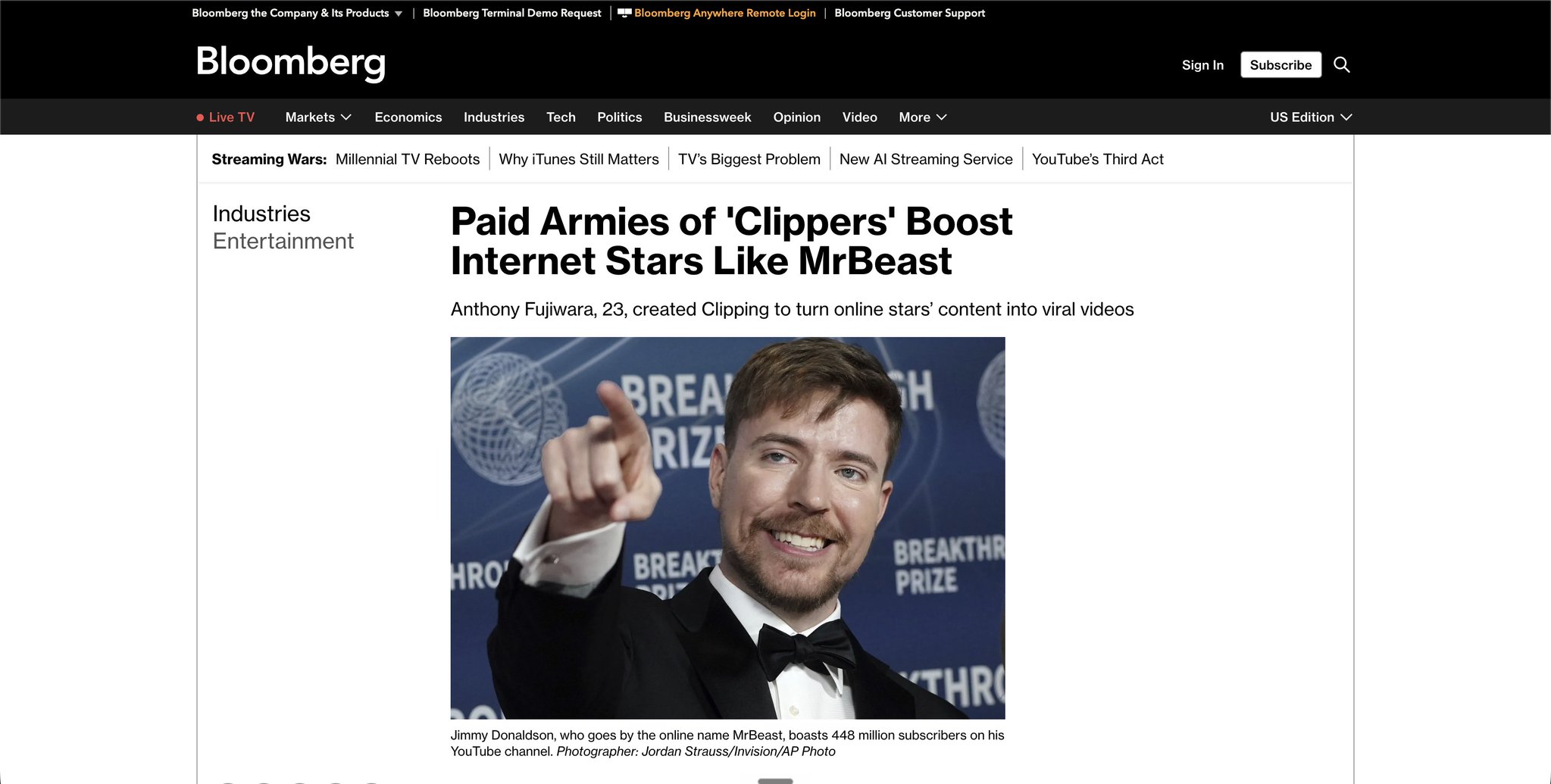
The agent doesn’t replace taste. It replaces labor. The operator still picks the niche, still writes the hook style, still decides which moments in a long-form video are actually worth clipping. The agent is doing the four hours of clicking that used to follow each of those decisions. That distinction matters because everyone is about to flood into this — Bloomberg covered the payouts, The Verge covered the payouts, every other Twitter thread this month is some version of “here’s how I built a clipping page.” The window for operators who can actually wire up a real stack is probably 12 to 18 months before platforms compress the payouts or change the rules. The people who run agents during that window will end up doing the same volume that today’s manual clippers do in 20 minutes a day, while collecting from twelve campaigns at once.
Most clippers won’t. They’ll keep editing one clip at a time, cap out around $2K to $3K a month, and burn out. The ones who treat this as an engineering problem first — niche + agent stack + payout network surface area — will be where the next round of indie creator-economy income concentrates.
Build the stack today
If you’re putting one of these together, the publishing layer is the part that has to be rock-solid from day one — because every platform is silently watching for malformed requests, missing settings, and unverified media URLs, and a single bad post can flag a brand new account. Postiz is the open-source scheduler the agent crowd has been moving toward exactly for that reason: 28+ platforms from one dashboard, a public REST API, an MCP server, a CLI, and a dedicated agent skill that hands LLMs structured JSON. Self-host it for free or grab the hosted plan and skip the setup.
Grab a Postiz API key today, drop it into your agent’s config, and let it run while you sleep. → Try Postiz