Most Instagram hashtag advice is stuck in the old mindset: if Instagram allows 30 hashtags, you should use 30 hashtags. That advice sounds practical, but it skips the core question.
The better question is not how many hashtags for instagram can you fit into a caption. It is what job do you need those hashtags to do.
A creator trying to reach new people needs a different hashtag count than a local business trying to attract qualified buyers. A Reel built for discovery behaves differently than a Story meant to warm up existing followers. And a polished brand account may protect caption readability more carefully than a meme page chasing broad exposure.
That is why blanket advice fails.
Some hashtag strategies increase reach. Others improve engagement quality. A few do both, but only when the content, audience, and goal line up. If you treat every post the same, you miss those trade-offs.
This guide cuts through that confusion. It gives you a practical framework for choosing the right hashtag count based on the outcome you want, then shows you how to build sets you can test and improve.
Stop Chasing 30 Hashtags and Start Being Strategic
Using all available hashtags can work in some cases. It is not the default move most accounts should make.
Instagram still permits up to 30 hashtags per post caption, but the platform's own creator guidance points in a much tighter direction. The smart shift is to stop asking, "How many can I add?" and start asking, "Do I want reach, cleaner engagement, stronger community signals, or a mix?"
Most struggling accounts make the same mistake. They save one giant hashtag block, paste it into every post, and hope the algorithm does the rest. That usually creates two problems.
First, the hashtag set becomes disconnected from the actual post. Second, the caption starts to feel mechanical, cluttered, or spammy.
A more useful way to think about hashtags is this:
Discovery tags help new people find you.
Context tags help Instagram understand the topic.
Community tags place your post inside a niche conversation.
Branded tags organize campaigns or user-generated content.
When you know which of those jobs matters most, the right hashtag count gets easier to choose.
Key takeaway: The right number of hashtags is a strategic choice, not a badge of effort.
In practice, most creators and brands do better when they build hashtag sets around a goal for each post. If the post is meant to travel, you can test a broader set. If the post is meant to convert or build trust, a smaller and sharper set often works better.
That is the effective 2026 mindset. Not maximum hashtags. Maximum relevance.
Manage all your social media in one place with Postiz
Instagram itself created the debate. The app still allows up to 30 hashtags per post, while its creator guidance pushes users toward a much smaller set. That gap led many marketers to chase a single "correct" number, even though the better question is what the post needs to do.
The key split is not quantity versus quality in the abstract. It is reach breadth versus engagement fit.
A larger hashtag set can give a post more chances to appear in search, topic feeds, and adjacent niche conversations. That makes sense when the goal is awareness, especially for educational content, trend-responsive Reels, or posts designed to introduce the account to new audiences. More tags can help classify a post from multiple angles, but only if every tag still matches the content.
That last part matters.
Once relevance drops, extra hashtags stop helping and start diluting intent. Broad, generic, or barely related tags may increase surface-level exposure, yet they often attract weaker clicks, lower-quality engagement, and people who never become followers or customers. If the post is meant to build trust inside a niche, a tighter set usually performs better because the audience match is cleaner.
I see this trade-off constantly in content audits. Posts built for discovery can justify a broader hashtag mix. Posts built for conversation, saves, replies, or conversion usually benefit from restraint.
When more hashtags make sense
Use a broader set when the post needs more discovery routes:
Educational Reels targeting non-followers
Top-of-funnel posts built for visibility
Content entering a new niche where Instagram needs clearer classification
Campaign posts where reach matters more than tight comment quality
When fewer hashtags usually work better
Use a smaller set when precision matters more than raw exposure:
Community-focused posts aimed at a specific niche
Authority content where topical alignment matters
Promotional posts that need qualified attention
Captions that already carry strong keyword signals
There is also a platform-direction signal here. Instagram has been moving away from old-school hashtag stuffing and toward clearer topical relevance. That does not mean larger sets never work. It means larger sets need a stronger reason.
The practical rule is simple. Choose more hashtags for discovery, fewer hashtags for precision. That gives you a usable framework instead of another vague "it depends" answer.
How the Instagram Algorithm Reads Your Hashtags
Think of hashtags as signposts, not fuel.
A hashtag does not force a post to perform. It helps Instagram classify the post and connect it with people likely to care about it. That classification job became more important after the platform moved away from the old chronological experience and toward engagement-based distribution.
Instagram's hashtag strategy changed sharply after the 2017 algorithm shift toward engagement, and the guidance has tightened since then. Early research pointed toward a moderate number of hashtags for reach, while later analysis of a large number of posts found that a few hashtags delivered a specific impression rate. In 2025 and 2026, Instagram has also been testing a stricter 5-hashtag cap for some accounts, according to Ned Potter's review of hashtag changes and historical data.
What hashtags tell Instagram
Hashtags help Instagram answer a few basic questions:
What is this post about
Which audience might care
Which topic bucket should it sit in
Whether the post belongs in a niche conversation
That makes hashtags useful for non-follower discovery. But they are just one signal.
Caption keywords, on-screen text, comments, saves, shares, and early engagement all shape where the post goes next. If you want a broader explanation of those ranking signals, this breakdown of the social media algorithm is a useful companion read.
Why generic tags underperform in practice
A broad tag may describe your post, but that does not mean it helps your post compete. If the hashtag is too generic, you enter a noisy pool and lose specificity.
A niche hashtag often does a better job because it gives Instagram a cleaner match. You are not just saying "this is about fitness." You are saying "this is for a very particular kind of fitness viewer."
Good hashtags reduce ambiguity. Bad hashtags add noise.
That is why hashtag strategy feels more nuanced now than it did years ago. The algorithm no longer rewards random volume by default. It rewards content that is easy to understand and easy to place in front of the right people.
Optimal Hashtag Counts for Posts Reels and Stories
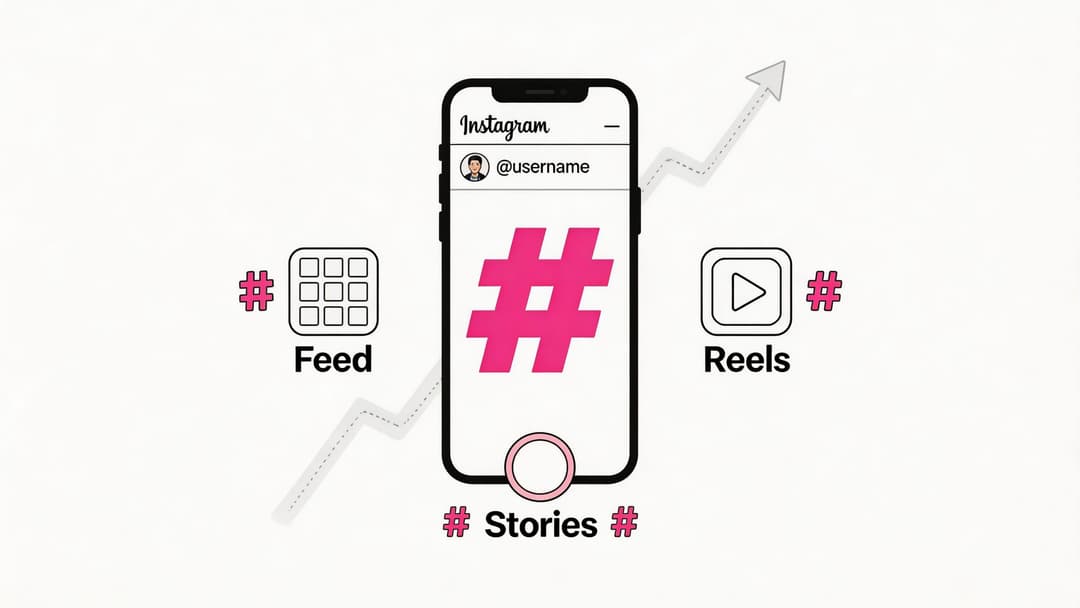
Different Instagram formats ask hashtags to do different work. A feed post often needs balance. A Reel usually needs discovery support. A Story rarely benefits from clutter.
The mistake is applying one fixed hashtag count to all three.
A large-scale study summarized by Foxy notes that posts using a higher number of hashtags can achieve maximum reach, while engagement often peaks at moderate counts. The same summary notes that Mention found a peak at a certain number of hashtags, while Instagram's Creators guidance recommends a few hashtags for a stronger engagement-to-reach ratio as the algorithm weighs other SEO signals more heavily, as covered in Foxy's overview of hashtag count research.
Recommended ranges by format
Content Type
Recommended Range
Primary Goal
Feed Posts
3 to 5
Engagement quality and topical clarity
Reels
5 to 11+
Discovery and reach
Stories
1 to 3
Context without clutter
These are starting ranges, not laws. The right move depends on what the content is trying to do.
Feed posts need restraint
Feed posts sit on your profile longer. They carry more brand weight. They also invite more scrutiny from followers and first-time visitors.
For most accounts, 3 to 5 hashtags is the strongest default for feed posts. That keeps the caption clean and gives the algorithm enough topical context without turning the post into a tag dump.
This works especially well for:
Product posts where clarity matters
Founder or personal brand content where tone matters
Carousel posts designed to drive saves and comments
If you are posting a highly searchable tutorial or niche educational asset, you can test beyond that range. But start clean.
Reels can support a wider set
Reels live in a more discovery-driven environment. That makes them the best place to test larger hashtag sets.
A practical range is 5 to 11+ hashtags. If the Reel is tightly niche and highly relevant, a larger set can make sense because you are giving Instagram more ways to place the content into recommendation buckets.
Still, relevance rules. A Reel about skincare ingredients should not suddenly carry broad lifestyle tags just to bulk up the count.
Stories should stay light
Stories are short-lived and interactive. They are less about broad search behavior and more about nudging attention from existing viewers or recent profile visitors.
For Stories, a minimal approach is usually better. One to three hashtags is often enough if you use them at all.
That matters even more when the Story includes polls, links, stickers, product tags, or direct calls to action. Too many hashtags make the frame feel busy.
If you schedule Stories in batches, use a workflow that lets you vary tags by campaign and timing. Tools that support planning and repeatable publishing help here. If you need that process, this guide on how to schedule Instagram Stories is useful.
A simple decision rule
Use this filter before you publish:
Want reach? Test the higher end of the range.
Want strong engagement quality? Stay toward the lower end.
Want profile aesthetics and readability? Keep the set short.
Want to enter a niche conversation? Add specific community tags, not generic extras.
The best hashtag strategy does not come from picking one universal number. It comes from matching the count to the format and the goal.
Building Hashtag Sets with the Funnel Method
A good hashtag strategy is not a random list. It is a layered mix.
The easiest way to build that mix is the funnel method. Consider it akin to using different net sizes. The top of the funnel casts wider. The bottom gets more precise.
The four layers
Start with these categories every time you build a set.
Broad tags
These are the widest terms in your niche. They describe the general topic but not the specific angle.
They can help with discovery, but they are also the easiest place to become vague. Use them sparingly.
Examples:
a general fitness tag
a broad small business tag
a wide travel tag
Niche tags
Most accounts should focus their efforts here.
Niche hashtags tell Instagram exactly which segment the post belongs to. They usually align more closely with the viewer intent behind the content.
Examples:
a tag for home Pilates rather than general fitness
a tag for handmade ceramics rather than general crafts
a tag for solo travel in Europe rather than travel
Community tags
These are conversation tags. They connect your post to a subgroup, challenge, identity, or recurring interest area.
They can be smaller, but they often attract better-fit viewers and stronger comments.
Examples:
creator communities
local business communities
challenge or participation tags
Branded tags
These are your own campaign, brand, or series tags.
They rarely drive cold discovery on their own, but they help organize content and support user-generated content, launches, and recurring themes.
How to combine them
There is no single fixed recipe, but a practical build looks like this:
1 to 2 broad tags for category context
2 to 4 niche tags for precision
1 to 2 community tags for relevance
1 branded tag when it serves a real campaign purpose
That mix works especially well inside a 3 to 5 hashtag approach because it forces discipline. If you decide to test a larger Reel set, expand from the niche and community layers first, not from broad generic tags.
A quick walkthrough helps.
If you run a coffee shop, "coffee" is broad. "specialtycoffee" is niche. A local city coffee tag is community. Your shop name or recurring event tag is branded.
Later in the process, video can help you visualize how to structure sets and keep them relevant over time.
Practical rule: When a hashtag does not clearly describe the post, the audience, or the conversation, cut it.
A small, disciplined funnel beats a bloated list copied from an old Notes app.
Advanced Hashtag Tactics for Maximum Impact
Once the basics are working, small tactical choices start to matter.
Caption versus first comment
For most practical purposes, this is a formatting decision more than an algorithm trick.
Putting hashtags in the caption keeps everything in one place and helps with publishing consistency. Putting them in the first comment keeps the caption cleaner, which some brands prefer for aesthetics.
The smarter question is not "Which one hacks the algorithm?" It is "Which one protects readability without breaking workflow?"
If your team publishes fast, caption placement is simpler. If visual polish matters more, the first comment can be cleaner.
Avoid broken or irrelevant hashtags
Some hashtags are poor choices even when they look popular.
Watch for:
Irrelevant tags that do not match the post
Overly broad tags that weaken categorization
Broken or restricted tags where recent content looks thin, odd, or unrelated
Before using a tag repeatedly, search it manually on Instagram. Check whether the top and recent posts match your topic.
Stop repeating the same set forever
A repeated hashtag block is one of the easiest ways to make your account look automated or lazy.
Rotate by topic, series, audience segment, or content pillar. A product tutorial should not use the same exact set as a founder story or customer testimonial.
Tools can help here. For example, Postiz includes scheduling and analytics features that make it easier to save multiple hashtag groups, reuse them selectively, and compare performance over time.
Advanced move: Build three to five hashtag sets per content pillar, then rotate them instead of recycling one master list.
That keeps your categorization tighter and expands the audience slices you can reach.
How to Test and Track Your Hashtag Performance
Hashtag strategy gets better when you stop guessing.
Inside Instagram Insights, look at the reach and discovery signals tied to each post, including reach from hashtags when that metric is available. Do not judge hashtags by likes alone. A post can attract decent likes from followers while contributing very little non-follower discovery.
A simple testing method
Run a clean test over several similar posts.
Keep the content style similar Test hashtags on posts with similar format, topic, and quality.
Change the hashtag approach, not everything at once Compare a shorter set against a broader set, or compare one funnel mix against another.
Track outcomes consistently Look at non-follower reach, saves, comments quality, profile visits, and whether the audience fit improved.
If you publish at scale, a dashboard helps you keep those comparisons organized. This overview of a social media analytics dashboard shows the kind of reporting workflow that makes hashtag testing easier to manage.
What to look for
The winning set is not always the one with the biggest raw reach.
Sometimes the better set brings:
more qualified comments
better profile actions
stronger alignment with your niche
cleaner repeatability across a content series
That is the ultimate goal. Not vanity reach. A hashtag system you can test, learn from, and improve.
Frequently Asked Questions About Instagram Hashtags
Can hashtags get you shadowbanned
People use "shadowbanned" as a catch-all term for suppressed reach. In practice, reach drops usually come from a mix of issues such as irrelevant hashtags, repetitive posting patterns, weak content-market fit, or using tags that do not match the post.
Should I use the same hashtag set on every post
No. Repeating one exact set across every post is a weak strategy. It reduces relevance, makes testing impossible, and can make your posting behavior look overly automated.
Is it okay to put hashtags in the first comment
Yes, if that fits your workflow. The main benefit is cleaner caption presentation. The main drawback is operational. If the comment is delayed or missed, your process breaks.
Should small accounts use more hashtags
Not automatically. Small accounts often benefit more from tighter, niche-specific hashtags than from large generic lists. Precision usually helps more than volume when the audience is still forming.
Are hashtags still worth using in 2026
Yes, but they are no longer the whole game. They work best when they support strong captions, clear positioning, solid visuals, and content that matches a real audience need.
If you want a cleaner way to organize hashtag sets, schedule Instagram posts, and review performance in one workflow, Postiz is one option to consider. It combines publishing, planning, and analytics, which makes it easier to test different hashtag strategies without managing everything manually.
Discover the top social media scheduler for small business in our 2026 guide. Save time with features, benefits, an evaluation checklist, and best practices.