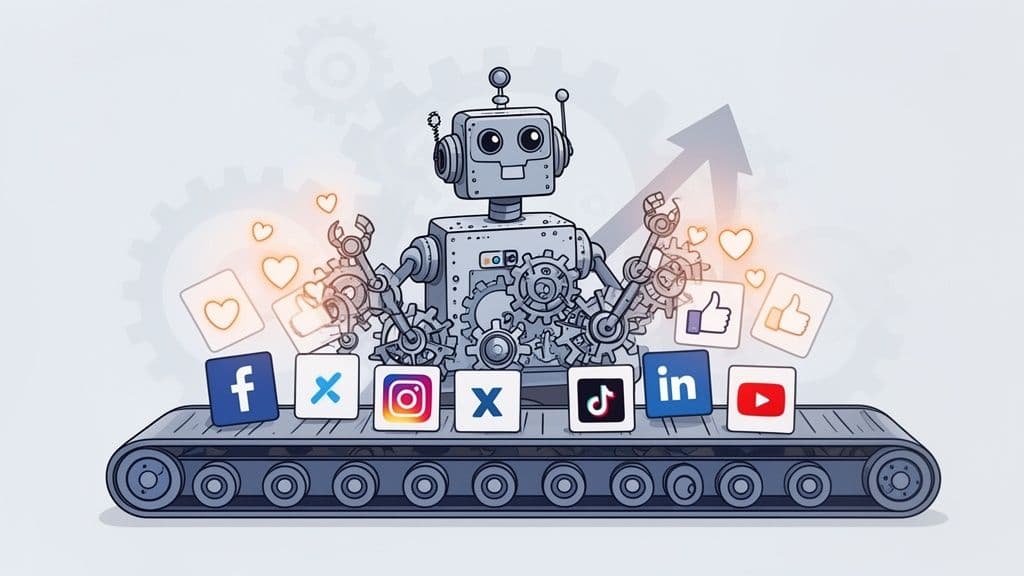
Ever wonder why your social media feed feels like it can read your mind? That’s the work of a social media algorithm. It's the powerful, behind-the-scenes system that decides exactly what you see every time you open the app.
What Is a Social Media Algorithm
Let’s cut through the tech speak. The easiest way to think about an algorithm is as your own personal content curator. Its one and only job is to sort through the billions of posts uploaded every day and hand-pick the ones it thinks you’ll find most interesting.
It wasn't always this way. In the early days, platforms like Facebook and X (formerly Twitter) showed you everything in chronological order. The newest post was always at the top. This worked fine when there were fewer users, but it quickly became an overwhelming firehose of content that was impossible to keep up with.
The algorithm's main goal is to keep you on the platform longer. It does this by showing you content it predicts you’ll interact with—whether that's a like, a comment, a share, or just pausing your scroll to watch.
This is why platforms moved from simple timelines to highly personalized feeds. They figured out that showing you the best content was far more engaging than just showing you the newest.
How the Algorithm Learns About You
So, how does it know what you consider "best"? It’s not psychic—it just pays very close attention to your behavior. Every single action you take on a platform is a clue. These clues are called ranking signals or ranking factors, and they’re what the algorithm uses to build a detailed profile of your interests.
Think of these signals as the secret ingredients in the algorithm’s recipe for your feed. Each like, share, and comment sends a clear message about what you enjoy.
Here are the key signals it’s always watching:
Your Interactions: What you like, comment on, save, and share. A share is a huge signal because it takes more effort than a simple like.
Your Relationships: Who you engage with the most. Content from close friends, family, and your favorite creators will almost always get a boost.
Time Spent (Dwell Time): How long you pause on a post or how much of a video you watch. If you stop scrolling, the algorithm takes note.
Content Type: The formats you prefer. If you’re always watching Reels, you’ll see more Reels. If you click on links, you’ll get more of those.
Timeliness (Recency): While chronological order is gone, new content still gets priority over posts from last week.
For instance, if you find yourself watching a bunch of dog training videos, the algorithm quickly figures out you’re a dog person. Soon enough, your feed will be filled with more training tips, cute puppy photos, and maybe even ads for dog food. On the flip side, if you always scroll right past political posts, it learns to show you fewer of them.
Once you understand these core ideas, you can stop feeling like you're fighting the algorithm. The key is to work with it by creating content that sparks genuine connection and engagement. This is the secret behind why one simple post can go viral while another one vanishes without a trace.
Manage all your social media in one place with Postiz
Remember when your social media feed was just… a list? It feels like a lifetime ago, but early on, platforms showed you everything in the exact order it was posted. No sorting, no magic, just a simple chronological timeline.
In the beginning, that was all anyone needed. When platforms like Facebook were just getting started, seeing the newest post first made perfect sense. But as these networks exploded from a few thousand users to millions, and then billions, the chronological feed became an absolute firehose of content. It was impossible to keep up.
That’s when platform engineers had a critical insight: showing people the newest stuff wasn't the same as showing them the best stuff. This idea completely changed the game, kickstarting the move from a simple timeline to the personalized, curated feeds we have today. The goal was no longer just about what was recent; it was about what was relevant.
The Birth of the Relevance-Based Feed
Facebook was way ahead of the curve here. Its News Feed was already using early algorithms back in 2006, but the real turning point was in 2009 when it fully committed to an algorithm-first model. Relevance officially took priority over recency.
This led to one of the first famous algorithms, a formula called EdgeRank, which they rolled out in 2011. Its job was to score every single post to figure out how important it was to you. While you can get a deep dive into the history of social media algorithms on RESO, the core concept was beautifully simple.
EdgeRank scored posts using three main signals:
Affinity: This was all about your relationship with the person or page posting. The more you liked their content, visited their profile, or sent them messages, the higher your affinity score. A high score meant you were much more likely to see their posts.
Weight: Not all engagement is created equal. EdgeRank knew this and assigned a different "weight" to every interaction. A comment was a bigger deal than a like, and a share was even more valuable because it took more effort.
Time Decay: To keep things fresh, every post had an expiration date. As a post got older, its value would slowly "decay," making it less likely to pop up in your feed. New content was always given a natural advantage.
EdgeRank really set the foundation for the complex algorithms we see today. It proved that our own behavior—who we interact with and how—is the best predictor of what we actually want to see.
A Trend That Reshaped Social Media
Facebook's switch wasn't a one-off event; it sent a shockwave through the entire industry. Other platforms saw how well it worked to keep people engaged and scrolling, and they wanted in.
Instagram held out for a long time, but finally made the switch in March 2016. The company explained that its users were missing a staggering 70% of all posts, including 50% of posts from their own friends. The chronological feed just wasn't working anymore. Twitter (now X) followed that same year, first with its "While You Were Away" feature and eventually with a fully algorithmic timeline.
Looking back, it’s clear that algorithms weren't invented to hide content from us. They were created to solve the massive problem of information overload. The core principles that EdgeRank established—prioritizing strong relationships, valuable interactions, and fresh content—are still the bedrock of how every major social media platform works today.
If you’re treating every social media platform the same way, you’re missing a huge opportunity. It’s a common mistake. While most platforms share the goal of keeping users engaged, each social media algorithm has its own unique rulebook and priorities.
Think of it this way: you wouldn't tell the same story at a formal business conference as you would at a casual backyard barbecue. Your content needs to fit the room. A one-size-fits-all strategy just doesn't cut it when each algorithm is looking for something completely different.
How Each Major Social Algorithm Ranks Content
Let's break down what each of the big players actually wants to see. Understanding these nuances is your key to creating content that feels right for the platform and gets rewarded with more reach.
The Facebook Algorithm: All About Connection
As the old guard of social media, the Facebook algorithm has had the most time to mature. Its original formula, EdgeRank, may have gotten more complex over the years, but its core philosophy hasn't really changed: it’s all about fostering meaningful connections.
The infographic below shows the basic building blocks of EdgeRank, which still influence how Facebook thinks about content today.
Even back then, the focus was on who you interact with (Affinity), the type of interaction (Weight), and how recent the post was (Decay). Today's algorithm simply digs deeper, working hard to spark genuine conversations between people.
What the Facebook algorithm looks for:
Meaningful Interactions: The algorithm values comments and shares far more than a simple Like. Long, thoughtful comments are like gold.
Relationship Signals: It prioritizes content from the friends, family, and Groups you engage with most often.
Original Content: Facebook has been very clear that it gives a nice boost to original content rather than just resharing things you found elsewhere.
The Instagram Algorithm: A Visual Prediction Engine
The Instagram algorithm is obsessed with predicting what you'll find interesting. It acts like a personal curator for your Feed, using your past behavior to decide which posts deserve that top spot.
Your activity is the number one driver. It keeps a close eye on what you like, share, save, and comment on. If you consistently interact with a certain creator, you can bet their next post will be waiting for you when you open the app.
On Instagram, your history dictates your future. The algorithm is constantly learning from your actions to refine its predictions and create a feed it thinks you'll love.
Here’s what the Instagram algorithm pays attention to:
User History: The kinds of posts and videos you’ve engaged with in the past.
Post Information: How popular a post is (likes, comments, shares, saves) and other details like when it was posted and its location.
Creator Relationship: How often you interact with the person who posted the content.
The TikTok Algorithm: The Ultimate Entertainment Machine
The "For You" page on TikTok is arguably the most powerful content discovery engine on the planet. Its algorithm is incredibly good at identifying niche interests and serving up a never-ending stream of videos you'll love—even if you didn't know you were looking for them.
On TikTok, watch time is king. If someone watches your video all the way to the end, that's a great signal. If they watch it more than once? That’s a massive green light for the algorithm to push your content to a much wider audience.
This is what makes TikTok so unique. It’s less about who you follow and more about the quality of the content itself. A video from a brand-new account with zero followers can absolutely go viral if it hits the right notes.
The X (Twitter) Algorithm: Built for Speed and Conversation
The feed on X (formerly Twitter) is a fascinating mix of real-time updates and algorithmic suggestions. While you can still view a purely chronological timeline, the default "For You" feed tries to surface Tweets it believes you’ll find most relevant.
The algorithm prioritizes a few key things:
Recency: What’s happening right now is still a huge factor. Newer Tweets get top billing.
Engagement: Likes, Reposts, and Replies are all strong indicators of a Tweet's relevance.
Rich Media: Tweets that include images, videos, or GIFs generally get more attention.
The platform is designed for fast-paced, real-time conversation, so the algorithm naturally favors posts that are current and actively sparking discussion.
The LinkedIn Algorithm: Professional Value and Expertise
The LinkedIn algorithm is a different beast entirely. It’s focused on showing you professionally relevant content and helping you build your industry network. This isn't the place for viral dance challenges; it's for sharing knowledge.
It also gives a natural boost to content from your immediate network. To increase your own visibility, one of the best things you can do is leave thoughtful comments on other people's posts to signal your activity and expertise.
Key Ranking Signals Across Major Social Platforms
To make things even clearer, this table breaks down the core priorities for each platform's algorithm. Notice how the primary signals and preferred content formats differ.
Understanding these distinctions is the first step. The next is to create a content strategy that plays to each platform's strengths instead of fighting against its algorithm.
Proven Strategies to Work with the Algorithm
Knowing how the social media algorithm works is one thing, but actually putting that knowledge to use is where the magic happens. It's time to stop posting and praying. Instead, you can start creating content with intention—giving the algorithm all the right signals.
This isn't about chasing a viral "hack" that dies out in a week. It's about building a solid, long-term strategy around the signals that truly matter: engagement, relationships, and relevance. Let's dig into the practical tactics you can use right away.
Spark Genuine Conversations in Captions
Let's be real: one-word captions just don't cut it anymore. Today's algorithms, particularly on Instagram and Facebook, are smart enough to recognize a real conversation. A post buzzing with comments is a clear sign that you've created something valuable.
Your mission is to write captions that start a dialogue. Don't just describe what's in the picture. Ask a question, take a stand, or tell a quick story that makes people want to jump in with their own experiences.
A "like" is a polite nod, but a comment is a conversation. Algorithms prioritize conversations because they signify deeper community engagement and keep people on the platform longer.
Think of your caption as the first line in a great conversation. Make it so compelling that your audience can't help but respond. This is one of the most powerful ways to show the algorithm your content is worth pushing to a wider audience.
Master the Art of Audience Retention
On video-first platforms like TikTok and Instagram, it's all about dwell time and completion rate. The algorithm loves—and rewards—videos that keep people watching from start to finish. If viewers are swiping away in the first few seconds, your reach is going to tank.
So, how do you get them to stick around?
Hook Them in the First Three Seconds: Open with a bold claim, a surprising visual, or a question that makes them curious. No slow, boring intros allowed.
Use Visual Cues and Text Overlays: Keep the screen interesting. Adding text helps people who watch without sound and makes your video more dynamic.
Tell a Story: We’re all wired for stories. Give your video a clear beginning, middle, and end. It’s more satisfying to watch and encourages people to see it through.
A high completion rate is a huge vote of confidence. And if someone re-watches your video? That’s like a standing ovation, telling the algorithm this is a masterpiece that needs to be seen by new faces.
Use Hashtags to Attract the Right Audience
Hashtags aren't just for show; they're discovery tools that help the algorithm categorize your content and put it in front of the right people. But just throwing them on a post won’t work.
Using massive, generic tags like #love or #happy is a waste of time—your content will disappear in a sea of millions. The trick is to use a strategic blend of broad and niche hashtags.
Try this simple framework:
Broad Category Tags (1-2): These cover your general topic (e.g., #SocialMediaMarketing).
Specific Niche Tags (3-5): These get more specific about your content (e.g., #InstagramStrategy, #ContentCreationTips).
Community Tags (1-2): These connect you with a specific audience (e.g., #SmallBusinessOwners, #MarketingManagers).
This layered approach gives the algorithm a crystal-clear picture of who your post is for, connecting you with people who are much more likely to engage. For more ideas on how to connect with your audience, you can learn more about how to boost your social media engagement with proven techniques.
Build a Community That Engages for You
At the end of the day, the single best way to work with any algorithm is to build a community that actually cares about what you post. When you have a core group of followers who consistently like, comment, and share, they send powerful signals to the algorithm on your behalf.
You can nurture this by engaging right back. Reply to every comment you can, answer DMs, and feature content from your followers. When people feel seen and valued, they become your biggest fans, creating a powerful cycle of engagement that the algorithm simply can't ignore.
Putting Postiz to Work for You: A Practical Guide to Beating the Algorithm
Figuring out the "rules" of the social media algorithm is just step one. The real challenge—and where most people get stuck—is consistently putting that knowledge into practice. This is where theory gets messy, and having the right tool can make all the difference between a strategy that lives on paper and one that actually gets results.
To really win, you need to be precise, efficient, and guided by data. That's exactly why we built Postiz. It’s designed to help you stop guessing what might work and start making smart decisions based on what is working.
Schedule Your Content for When It Matters Most
One of the easiest wins you can get with any algorithm is posting when your audience is online and ready to engage. Think about it: an active audience gives you instant feedback. Those immediate likes, comments, and shares are powerful signals that tell the algorithm your content is a hit and deserves a bigger audience.
Postiz’s content calendar turns this into a simple, set-it-and-forget-it process. Instead of logging on at random times and hoping you catch people, you can line up all your content to post during those "golden hours." This gives every single post its best shot at getting that initial wave of interaction, which is absolutely crucial for building momentum. If you want a deeper look at timing your content, check out our guide on how to schedule posts for maximum impact.
The first hour your post is live is everything. Strong engagement right out of the gate tells the algorithm your content is resonating, which can trigger it to push your post to a much wider audience. Scheduling ensures you never waste that opportunity.
By hitting these peak times over and over, you're giving the algorithm exactly what it's looking for: content that people are genuinely connecting with.
Create Content That Algorithms (and People) Love
Knowing when to post is half the battle; knowing what to post is the other. Every algorithm is hungry for content that gets people talking and keeps them on the platform longer. Postiz’s AI Assistant is your secret weapon for creating posts that do just that.
Instead of wrestling with writer's block, you can use the AI to spark ideas and draft compelling captions. Think questions, fun debates, or prompts that actually encourage your followers to leave a comment instead of just passively scrolling by. This directly feeds the algorithm's appetite for meaningful interactions.
On top of that, you can use the built-in design tools to create attention-grabbing visuals. Things like carousels and videos are proven to increase dwell time, another key signal. Combining engaging words with strong visuals is a surefire way to capture—and hold—your audience's attention.
Use Analytics to Find Your Winning Formula
You can't get better if you don't know what's working. The only way to know if your strategy is actually paying off is to look at the data. The analytics dashboard in Postiz takes out all the guesswork, giving you a crystal-clear picture of your performance across every platform.
This dashboard lets you see in an instant which posts are soaring and which are flopping. By digging into this data, you can spot patterns, figure out what the algorithm is rewarding, and simply do more of what works.
This means you can finally get solid answers to important questions:
Reach and Impressions: Is the algorithm showing your content to more people over time? A rising reach is a great sign that you're on the right track.
Engagement Rate: Are people actually interacting with your posts? A high engagement rate (calculated as total engagements divided by reach or followers) is one of the strongest signals of quality content.
Best Performing Content: Which posts got the most comments, shares, or saves? This is your roadmap for what to create next.
When you start tracking these key performance indicators (KPIs), you're no longer just throwing content at the wall. You’re building a system based on real-world feedback. This cycle of posting, measuring, and refining is the most reliable way to build momentum and finally get the algorithm working for you, not against you.
Frequently Asked Questions About the Algorithm
It’s easy to get lost in all the chatter about social media algorithms. Myths and misinformation spread like wildfire, making it feel like you're battling some invisible, unpredictable force.
But it doesn't have to be that complicated. Let's clear the air and tackle the most common questions we hear from creators and marketers every single day.
Is the Social Media Algorithm Punishing My Account?
It definitely feels personal when your reach suddenly tanks, but algorithms don’t hold grudges or "punish" accounts. They aren't programmed to have a "naughty list." Their one and only job is to show people more of what they like.
If your engagement drops, it’s not a penalty. It’s simply a reflection of audience behavior. Maybe your recent posts weren't as compelling, or maybe your followers' feeds just got more crowded. Instead of worrying about being in "social media jail," dig into your analytics. The algorithm is just a mirror reflecting what your audience wants—use it to your advantage.
Does Posting Too Often Hurt My Reach?
Spamming your audience with mediocre content will absolutely hurt you, but posting frequently with high-quality stuff won't. The key here is quality, not quantity. The algorithm doesn’t give out points for just showing up.
Think of it this way: posting five forgettable updates in a row teaches the algorithm that your content is easy to ignore. That can hurt the visibility of your next post, even if it’s a great one.
It's far better to publish one fantastic piece of content that sparks conversation than five mediocre posts that get ignored. Consistency in quality is more important than consistency in frequency.
A scheduling tool can help you find that perfect rhythm, letting you plan ahead so you never have to choose between posting consistently and posting something great.
How Long Until I See Results from a New Strategy?
Building real momentum is a marathon, not a sprint. While you might get lucky with a viral post overnight, a truly effective strategy needs time to prove itself and compound its results.
You should track your core metrics like reach and engagement every week, but give any new approach at least 30-60 days before making a judgment call. Patience is your best friend here. Making knee-jerk changes based on a few days of data will just send you in circles.
Do I Really Need a Different Strategy for Each Platform?
Yes, 100%. A one-size-fits-all approach is a recipe for failure. What crushes it on LinkedIn (like a long-form article on industry trends) would be dead on arrival on TikTok, which thrives on short, snappy, entertaining videos.
Users go to each platform with different expectations. You can absolutely repurpose the core message of a piece of content, but you have to repackage it. Adapt the format, change the caption, and tweak the tone to feel native to that platform. Show the algorithm—and the audience—that you get it.
Ready to stop guessing and start building a strategy that works? With Postiz, you get the scheduling, analytics, and AI-powered tools you need to create content that algorithms and audiences love. Master your social media strategy with Postiz today.
Discover the fastest growing subreddits with top subreddit growth tools. Learn how to find trending subreddits, analyze engagement, and track new Reddit communities.