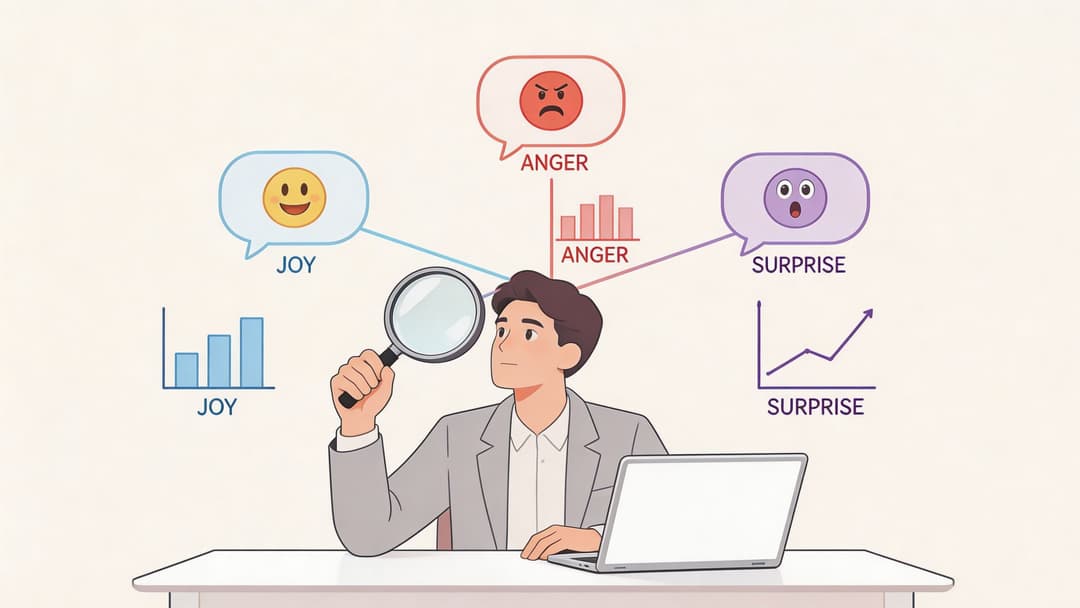
Your team just launched a campaign. Reach looks healthy. Comments are active. Shares keep coming in.
But the Slack thread still feels uneasy because the same question keeps surfacing: are people reacting well, or are they reacting loudly?
That gap matters more than most dashboards admit. A post can earn attention for the wrong reason. A product teaser can pull strong engagement while confusing buyers. A founder clip can get saved and shared while irritating existing customers. If you only track volume, you can miss the mood.
That’s where social sentiment tracking becomes useful. It helps a marketing team move from “people are talking” to “people are excited,” “people are skeptical,” or “people like the product but hate the pricing.” For non-technical teams, that shift is huge because it changes what you do next. You don’t just count reaction. You interpret it.
Beyond Likes and Shares What is Social Sentiment Tracking
A lot of marketers first run into sentiment tracking after a campaign that looked successful on paper.
A brand posts a launch video. The post takes off. Mentions spike. The social manager celebrates for an hour, then opens the comments and notices a pattern. People aren’t praising the launch. They’re joking about the tagline, questioning the price, and arguing about one screenshot in the ad.
The metrics say “strong response.” The audience is saying something else.
Social sentiment tracking is the practice of analyzing online conversations to understand the emotional tone behind them. Instead of stopping at likes, shares, or mention counts, it asks a more useful question: how do people feel?
What it looks for
At a basic level, a system reads posts, comments, replies, reviews, and sometimes news mentions, then labels them as:
Positive when people express approval, excitement, trust, or satisfaction
Negative when they show frustration, disappointment, anger, or concern
Neutral when they’re mentioning the brand without a clear emotional signal
More advanced systems go further. They can separate sentiment by topic, feature, or audience segment.
A comment like “Love the design, hate the battery” is a good example. A simple dashboard may treat that as mixed or neutral. A stronger sentiment workflow breaks it apart and reveals that design sentiment is positive while battery sentiment is negative.
Why marketers care
That distinction turns social data into something useful for decisions.
Practical rule: Engagement tells you that something happened. Sentiment tells you whether you should repeat it, fix it, or pause it.
This is why social sentiment tracking sits between social listening and strategy. Listening finds the conversation. Sentiment helps interpret it. Your team gets a clearer read on campaign reaction, product feedback, brand reputation, and customer mood.
For a smart marketing team, the point isn’t to replace human judgment. It’s to stop relying on surface metrics alone. Sentiment tracking gives you a faster first read so you know where to look, what to escalate, and what deserves a second post instead of a crisis meeting.
Manage all your social media in one place with Postiz
Why Decoding Your Audience's True Feelings Matters
The business case is simple. If your team publishes every day, your audience is constantly telling you what’s working. They just aren’t always saying it in neat survey language.
That’s one reason the category has grown so quickly. The global sentiment analysis market was valued at approximately $1.5 billion in 2021 and is projected to reach $5.2 billion by 2026, a projected 20.8% CAGR, according to this overview of sentiment tracking growth. Teams are investing because public opinion moves fast and raw mention volume doesn’t explain enough.
Brand health becomes visible sooner
Many teams know their follower growth, top posts, and click-through trends. Fewer know their current emotional baseline.
Sentiment tracking helps you answer questions like these:
Is the brand being discussed with trust or irritation
Did the new campaign improve perception or just increase attention
Are people talking warmly about the company but coldly about the product
Is one platform more supportive than another
That matters because brand health rarely breaks all at once. It usually drifts. Comments become a little sharper. Jokes become more cynical. Customer replies become less forgiving. By the time a team notices manually, the pattern is already established.
Crises usually whisper before they shout
Negative sentiment often appears before a formal crisis label does.
A dashboard can show a spike in mentions, but sentiment tracking can reveal whether that spike is praise, confusion, backlash, or concern. That gives social teams time to route issues before they spread into customer support, PR, and executive channels.
A useful workflow doesn’t need to be dramatic. Sometimes the win is noticing that a creator partnership is landing poorly, or that customers are reacting to shipping complaints under unrelated posts.
Product feedback gets more honest
People rarely write polished product briefs in comment sections. They complain in fragments. They praise weirdly specific details. They compare your feature to a competitor in slang.
That’s still valuable.
If your team already has a process for gathering customer feedback, social sentiment tracking adds an unsolicited layer. It captures what people say when they aren’t filling out a form and aren’t being prompted by a survey question. That kind of feedback is messy, but it’s often more direct.
Competitor analysis gets sharper
Watching competitors only by post format or follower growth is limiting.
Sentiment gives you a better lens. You can look at a rival’s launch and ask:
What you see
What sentiment helps reveal
High comment volume
Whether the attention is supportive or critical
A viral feature announcement
Which feature people actually praise or mock
Lots of creator mentions
Whether creators are genuinely positive or just participating in the trend
A team that understands audience feeling can react with more precision. You don’t just copy what got attention. You learn what earned trust, what triggered friction, and what opened a positioning gap.
Strong social strategy comes from reading tone, not just tallying activity.
The Technology Explained From Keywords to AI Understanding
The easiest way to understand sentiment technology is to compare it to organizing a library.
Some systems act like a simple index. Others act like a librarian who has seen thousands of books before. The most advanced ones act like a subject expert who can explain not just where a book belongs, but what it says about three different topics at once.
Start with that mental model and the tech becomes less intimidating.
Lexicon based systems
This is the keyword index approach.
The system relies on a dictionary of words that have already been tagged as positive, negative, or neutral. If a comment contains “love,” “great,” or “amazing,” that pushes the score positive. If it contains “awful,” “broken,” or “annoying,” that pushes the score negative.
It’s easy to understand and fast to run.
It also breaks in very normal social media situations.
Take these examples:
“Great, another update that changed everything.”
“This launch is sick.”
“I’m crying at this ad.”
A basic keyword system can misread all three because it doesn’t reliably understand intent, slang, or context.
Rule based systems
Rule-based models add grammar and logic on top of keywords.
They look for patterns such as negation, sentence structure, punctuation, or phrase combinations. A rule can tell the system that “not good” should not be treated the same as “good.” It can also help detect emphasis in phrases that include repeated punctuation or modifiers.
Think of this as a librarian following a sorting manual.
The rules improve consistency, but they still struggle when the audience gets creative. Social posts are full of sarcasm, memes, inside jokes, and half-finished sentences. A static rule set can’t keep up with every cultural shift.
Machine learning systems
Machine learning works more like a librarian who has learned from many examples.
Instead of relying only on predefined words or fixed rules, the model is trained on large sets of labeled content. It learns patterns from examples of positive, negative, and neutral text, then applies that learning to new content.
That gives it a better chance of catching phrases where meaning depends on the full sentence.
For marketers, the main benefit is practical. You don’t need the model to explain language theory. You need it to classify conversations more reliably than a simple keyword list.
Here’s a quick comparison:
Method
Strength
Common weakness
Best use
Lexicon based
Fast and simple
Misses context and sarcasm
Basic monitoring
Rule based
Better handling of structure
Rigid with changing language
Controlled environments
Machine learning
Learns from examples
Needs quality training data
Brand and campaign analysis
A short walkthrough helps make the difference clearer:
Transformer models and aspect based analysis
With modern AI models, sentiment tracking feels much more useful to a marketing team.
Modern AI models can look at relationships between words across the full sentence, which helps them interpret context better than older approaches. When teams talk about aspect-based sentiment analysis, they mean the system can detect sentiment about specific parts of a product, service, or campaign.
So instead of classifying a whole comment as one mood, it can split the opinion by aspect.
Example:
“The visuals are beautiful, but the message is confusing.”
A stronger model can mark:
visuals as positive
message clarity as negative
That’s a big jump in usefulness because action becomes obvious. The creative team doesn’t need to redo the design. The messaging team may need to rewrite copy.
According to Sprinklr’s overview of sentiment analysis tools, advanced AI-powered NLP engines for aspect-based sentiment analysis can achieve up to 85 to 90 percent accuracy in multilingual contexts by detecting nuances like sarcasm and irony. That doesn’t mean the machine is perfect. It means modern systems are much better at reading the messy language marketers deal with.
The more your team needs to know why people reacted, not just whether they reacted, the more aspect-level analysis matters.
What marketers should take from this
You don’t need to become an NLP specialist. You do need to know what kind of tool you’re using.
If your workflow only needs a rough positive versus negative pulse, simpler methods can help. If you need product insight, campaign diagnosis, or multilingual tracking, basic keyword scoring won’t be enough.
A good question to ask any platform is this: can it tell me what people feel about the specific thing I need to improve?
If the answer is no, it may be measuring noise more than sentiment.
Making Sense of the Data Essential Sentiment Metrics
Once your dashboard starts filling with sentiment data, the first risk is overreacting to a single number.
A brand rarely has one true mood. Different posts, products, and audiences create different emotional patterns. That’s why useful sentiment tracking relies on a small set of metrics read together, not one giant score.
Sentiment over time
This is the trendline teams should check first.
A daily or weekly sentiment view helps you spot change, not just status. A flat positive score can be less important than a steady decline. A neutral average can hide a sharp negative swing after a launch, update, or partnership post.
When the line moves, ask what changed around it:
Content change
Product event
Support issue
Creator mention
News cycle
Emotion breakdown
Positive and negative labels are useful, but they’re broad. Sometimes you need a more specific emotional split.
Some tools can generate emotion share graphs, such as 35% joy and 20% anger, and rising negative clusters can predict crises 48 hours early, reducing response time by 40% for many enterprise users, according to Respondology’s discussion of AI sentiment analysis tools.
That kind of breakdown matters because “negative” can mean very different things:
Anger may need fast public response
Confusion may need clearer messaging
Disappointment may point to product expectation mismatch
Share of voice with sentiment context
Share of voice on its own only tells you who dominates the conversation. Add sentiment and you learn who owns the positive conversation.
A competitor can have more mentions while also dealing with more criticism. Your brand can have fewer mentions but stronger trust. That’s a much more useful read for positioning.
If you’re already building a reporting stack, a good social media analytics dashboard should place sentiment next to engagement, reach, and campaign performance. This social media analytics dashboard guide is a useful reference for how teams structure that kind of view.
Topic and term signals
Many marketers experience an “aha” moment here.
Instead of reading only brand-level sentiment, you look at common themes attached to it. You may discover that:
customers love the content style
prospects dislike the pricing language
existing users are frustrated with onboarding
people keep praising one feature you barely mention in ads
A table like this can keep the team grounded:
Metric
What it tells you
Best question to ask
Sentiment trend
Direction of audience mood
Is perception improving or slipping
Emotion mix
Type of feeling present
Are people angry, confused, or delighted
Sentiment by topic
What specific issue drives the mood
What exactly should we fix or amplify
Sentiment share of voice
Brand perception versus competitors
Are we winning attention and approval
Don’t read sentiment data like a verdict. Read it like a set of clues.
A single negative spike isn’t always a problem. A repeat pattern attached to the same topic usually is.
Building Your Sentiment Tracking Workflow
Good social sentiment tracking doesn’t start with software. It starts with decisions.
A team needs to know what it wants to learn, where the relevant conversations happen, and how insights will move from dashboard to action. Without that, even a capable model turns into another feed of alerts people ignore.
Start with one business question
Don’t begin with “track our sentiment everywhere.”
Begin with a question the team can act on. For example:
Brand question. Are people reacting negatively to the new campaign message?
Product question. Which feature gets the most complaints after launch?
Community question. Are customer service concerns spilling into public comments?
The workflow changes with the goal. A campaign read needs different keywords and channels than a product feedback read.
Choose channels and signals carefully
Not every platform deserves equal weight.
If your customers complain on review sites, but your team only watches Instagram comments, you’ll get a distorted picture. If your audience uses Reddit for detailed criticism and TikTok for broad reaction, the sentiment patterns will look different by design.
A practical setup usually includes:
Brand terms such as company and product names
Campaign terms such as hashtags, taglines, and creator mentions
Topic terms tied to features, pricing, shipping, onboarding, or support
If you want a clean measurement plan, this overview of social media marketing metrics helps frame which signals belong in reporting and which ones are just noise.
Clean the incoming data
Raw social data is messy.
Spam, bots, repeated reposts, joke mentions, and irrelevant keywords can distort your read. A workflow should filter those out before the team treats the results as truth.
Common cleanup tasks include:
Removing duplicates so one repeated complaint doesn’t look like many separate issues
Filtering irrelevant mentions when your brand name overlaps with unrelated phrases
Separating owned from earned conversation so replies to your post aren’t mixed blindly with outside commentary
This step sounds boring, but it’s often where trust in the dashboard is won or lost.
Match the model to the job
Use the simplest model that still answers the question.
If you just need broad campaign pulse, a basic classifier may be enough. If you need to know whether users hate pricing but love usability, you need aspect-level analysis. If your audience switches languages or uses sarcasm heavily, you need stronger context handling.
A simple decision guide helps:
Need
Model level
Quick mood check
Basic sentiment classification
Campaign diagnostics
Machine learning model
Feature-level feedback
Aspect-based analysis
Multilingual, nuanced comments
Advanced NLP model
Build a review rhythm
The workflow isn’t finished when the score appears.
Teams should decide:
who reviews sentiment daily
what counts as a meaningful shift
when the social manager responds directly
when to notify PR, support, or product teams
A dashboard without a review rhythm becomes a screenshot generator.
The strongest workflows combine machine speed with human reading. Let software surface the patterns. Let people interpret the stakes.
Putting Insights into Action with Postiz
Sentiment tracking becomes valuable when it changes what the team does next.
That’s the gap many workflows miss. They gather emotional signals, display a chart, and stop there. A stronger setup connects those signals to publishing, response, and reporting decisions inside the same operating flow.
Use sentiment to shape scheduling
If a brand post performs well on reach but triggers frustrated replies, the team may want to pause similar scheduled content until the issue is understood. If a tutorial thread draws unusually warm reaction, the team may want more of that format in the queue.
In practical terms, this means your scheduler shouldn’t live in isolation from audience feedback. The publishing calendar should react to audience mood.
That’s especially relevant if your team already works inside a system for planning and publishing. This guide on how to schedule a post is useful because it shows the operational side of content timing, which becomes more effective when paired with sentiment signals.
Set alerts that reflect business reality
Not every negative comment deserves escalation.
Useful alerts focus on patterns:
A sudden drop in campaign sentiment
A repeated complaint tied to the same product feature
A high-visibility mention from a creator, journalist, or partner
A cluster of confusion around a launch message
The point is to reduce delay without creating panic.
Automation becomes practical at this stage. If your team is working on broader social media marketing automation, sentiment can become one of the triggers that shapes what happens next instead of one more report someone glances at on Friday.
Pair sentiment with engagement and response workflows
A healthy setup usually connects three layers:
Layer
What the team learns
What the team does
Publishing data
Which posts got reach and engagement
Repeat, revise, or retire formats
Sentiment data
How people felt about the content
Change messaging, visuals, or targeting
Response signals
Which comments need human review
Route to support, community, or PR
That connection matters because high engagement with poor sentiment is not a win. Low reach with strong positive sentiment may still be worth scaling. Sentiment gives context to performance.
Treat sentiment as a decision aid, not just a listening feature
One of the clearest proofs that sentiment can support real strategy comes from outside marketing. Context Analytics reports that portfolios filtered by sentiment-based historical performance statistics improved Long/Short returns by over 18% in under 1.5 years, showing how sentiment can support decision-making in high-stakes environments, as described in its performance benchmark discussion.
Marketing teams don’t need to trade securities to learn from that. The takeaway is simpler: when sentiment is tracked consistently and paired with historical patterns, it can help teams make better timing and prioritization decisions.
A platform such as Postiz can fit into that kind of workflow because it combines scheduling, automation, analytics, and audience management in one place. For a non-technical team, that matters. It means sentiment doesn’t have to sit in a separate specialist tool that nobody checks during actual campaign work.
For privacy-focused organizations, the self-hosting option matters too. If your team handles sensitive brand or customer data, keeping that workflow in-house can be part of the operational decision, not just a technical preference.
Navigating Common Pitfalls and Best Practices
Sentiment analysis can be sharp, but it isn’t magic.
The most common mistake is treating a sentiment score like a final answer. In practice, it’s a directional signal that still needs context, ownership, and a response plan.
Context changes everything
A word can look negative while the comment is supportive. A joke can look positive while the audience is mocking the brand. A customer can mention your company only to compare you with someone else.
That’s why teams should manually review samples from any major shift before acting on the chart alone.
A simple habit helps:
Check the top posts behind the shift
Read replies, not just original mentions
Separate criticism of the offer from criticism of the brand
Watch for irony, memes, and repeated jokes
Attribution is still a real problem
One of the hardest unresolved issues in social sentiment tracking is knowing what, exactly, the sentiment refers to when a brand appears across many channels and topics at once.
As noted in The Level AI discussion of sentiment analysis tools, a key unresolved issue is the “unclear opinion holder” challenge. Current tools struggle to attribute sentiment correctly when a brand is discussed across multiple channels, which affects response strategy.
That matters more than it sounds.
If someone says, “I’m done with this brand,” are they upset about:
the product
customer service
a political association
a comparison with a competitor
a viral comment they misunderstood
The dashboard may know the sentence is negative. It may not know the target of that negativity with enough confidence.
Read sentiment as a map of pressure points, not a perfect transcript of intent.
Best practices that keep teams grounded
A strong workflow usually includes a few simple safeguards:
Set a baseline first so you know what “normal” looks like for your brand
Review trends, not isolated posts because one loud thread can distort the picture
Combine quantitative and qualitative review so the team sees both patterns and examples
Assign action paths in advance so support, marketing, PR, and product know when they own the issue
The goal isn’t to eliminate ambiguity. It’s to handle it better than teams that only count mentions and hope for the best.
Frequently Asked Questions About Social Sentiment
What’s the difference between social listening and sentiment analysis
Social listening finds conversations about your brand, products, competitors, or industry. Sentiment analysis interprets the emotional tone inside those conversations.
Listening tells you what people are talking about. Sentiment tells you how they feel about it.
How accurate is automated sentiment analysis
It depends on the model, the language, and the kind of content you analyze.
Simple systems miss context more often. More advanced NLP systems do a better job with nuance, especially when they can separate sentiment by topic. Even then, no tool gets everything right. Teams should always review important shifts manually before making a major decision.
Can sentiment analysis understand sarcasm and emojis
Sometimes, yes. Sometimes, not well enough.
Modern models are better at handling sarcasm, irony, slang, and emojis than older keyword-based methods. But social language changes quickly, and culture-specific humor can still confuse the system. That’s why sarcastic spikes often deserve human review.
Should small teams bother with social sentiment tracking
Yes, if they can keep the process simple.
A small team doesn’t need a massive enterprise program. It needs a focused workflow that watches a few key channels, tracks a few important topics, and defines what deserves action. Even a lightweight sentiment habit can prevent missed warnings and reveal patterns that raw engagement metrics hide.
What should a team do first
Start with one use case.
Campaign reaction, product feedback, and reputation monitoring are all valid. Pick one. Track it consistently. Review examples behind the score. Build response habits before expanding the system.
If your team wants one place to schedule content, monitor performance, and work with sentiment alongside day-to-day publishing, Postiz is worth exploring. It gives marketers a practical way to turn audience reaction into workflow decisions instead of leaving sentiment trapped in a separate report.
Learn the best way of sharing reels to story to maximize your reach. This guide offers actionable tips to turn simple shares into powerful engagement drivers.