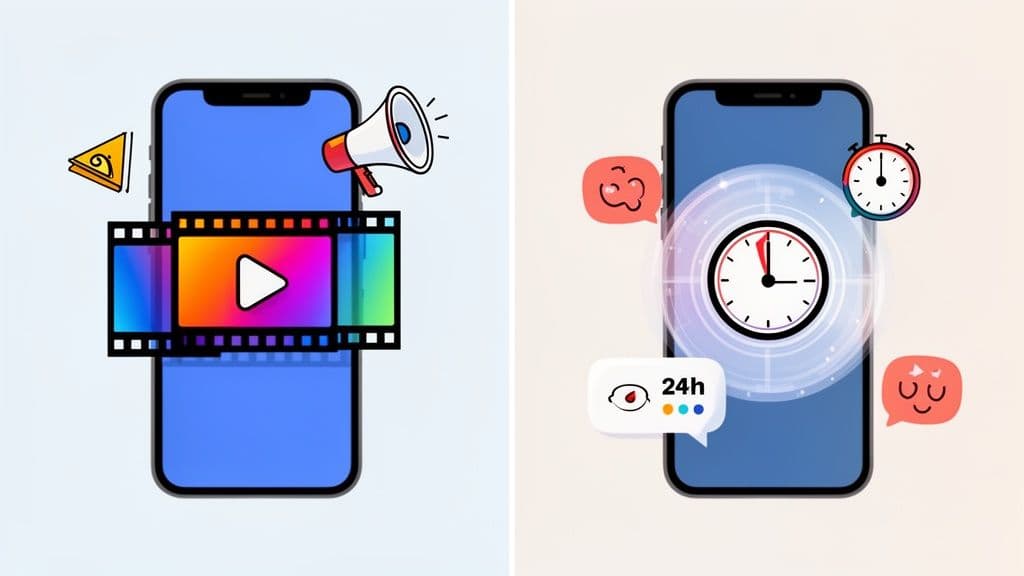
When you’re trying to figure out Instagram, one of the biggest questions is: Reels or Stories? The truth is, it’s not an either/or situation. The real difference between a reel and story boils down to their job descriptions—one is for growth, the other is for connection.
Think of it this way: Reels are for discovery. They are your permanent, polished highlight clips designed to get your content in front of people who don't follow you yet. On the flip side, Stories are for community. These are your casual, in-the-moment updates that disappear after 24 hours, perfect for building a deeper relationship with your existing audience.
A Reel's main purpose is to expand your reach and find new followers. A Story's purpose is to nurture the followers you already have. Get this part right, and your whole Instagram strategy will click into place.
Reels vs Stories Core Distinctions
To help you decide which format to use and when, let's lay out the fundamental differences. This quick table breaks down what makes each tool unique so you can pick the right one for the job every time.
Attribute
Instagram Reels
Instagram Stories
Primary Goal
Discovery & Reach (Attracting new followers)
Engagement & Nurturing (Connecting with current followers)
Lifespan
Permanent (Stays on your profile grid)
24 Hours (Disappears unless saved to Highlights)
Audience
Primarily non-followers via the Explore page & Reels tab
Understanding these distinctions makes your content planning much easier. Reels are your chance to make a great first impression, while Stories are where you build lasting loyalty.
The simplest way I explain it is by asking: "Are you trying to meet new people or talk to your friends?" Use Reels to introduce yourself to the world, and use Stories to have a conversation with your crew.
These strategic differences also influence technical details, from content style to the actual dimensions you use. For a complete technical breakdown, a guide to Instagram Ads Size and Specifications is a fantastic resource.
And remember, a strong content plan uses both. If you also manage a presence on Facebook, learning how to create a balanced Facebook content mix can provide even more perspective on building a well-rounded social strategy.
Manage all your social media in one place with Postiz
Comparing Lifespan, Visibility, and Audience Reach
The biggest thing separating a Reel from a Story comes down to how long it lives and who ends up seeing it. Getting this right is where you can really make a difference in growing your account and connecting with your audience.
A Story is all about the "here and now." It's designed to be temporary, disappearing after just 24 hours. That short lifespan creates a genuine sense of urgency, encouraging your followers to check in often so they don’t miss out. This makes Stories the go-to format for timely updates, spontaneous behind-the-scenes moments, and interactive fun like polls and Q&As.
Reels, on the other hand, are built to last. They live permanently on your profile grid and in the Reels tab, essentially becoming long-term assets. A Reel can keep racking up views and engagement for weeks, or even months, after you post it, working 24/7 to bring new people to your profile.
Audience Reach: Reels vs. Stories
The algorithms for Reels and Stories are playing two completely different games. Stories are mostly for your inner circle—the people who already follow you. They show up in that top bar on the feed, designed for an audience that has already decided they like your stuff.
This makes Stories perfect for nurturing your existing community. You can talk directly to your biggest fans, drop exclusive offers, or ask for feedback from people who are already invested in what you do.
Think of it this way: Reels are your handshake with a stranger, while Stories are the inside jokes you share with a friend. One is for discovery, the other is for loyalty. Your strategy needs both.
This is where Reels have a massive advantage as a growth tool. The Instagram algorithm actively pushes them out to people who don't follow you via the Explore page, the main Reels tab, and even in their regular feeds. In the battle for new eyeballs, Reels are the undisputed champion. It’s a total game-changer, with some reports showing that over 50% of Reel views can come from non-followers.
The data backs this up. Recent stats show Reels have an average reach rate of 30.81%, which is more than double what you'd see from other post types. You can dive into more Instagram Reels statistics to see just how powerful they are for expanding your visibility.
So, When Should You Use Each One?
This core difference naturally leads to different strategic uses. One is for broadcasting your message far and wide, and the other is for having a more focused conversation.
For Maximum Reach (Use Reels): This is where you put your best foot forward. Share your most valuable, polished, or entertaining content. Think evergreen tutorials, powerful brand stories, or a product highlight that can stop a new viewer mid-scroll.
For Deeper Connection (Use Stories): Save Stories for your time-sensitive material and interactive content. Announcing a flash sale with a countdown sticker or hosting an "ask me anything" session works perfectly here because it's aimed at people who are already paying attention.
Ultimately, a Reel is the billboard that attracts new visitors to your profile. A Story is the warm, personal welcome you give them once they decide to stick around and follow.
How to Measure Performance and Engagement
When it comes to Reels and Stories, success looks completely different. You can't use the same yardstick for both because they serve entirely different purposes. Reels are built for broad discovery, while Stories are all about connecting with your existing community. If you focus on the wrong numbers, you'll get a skewed picture of what’s actually working.
Measuring Reel Performance
With Reels, you're playing the discovery game. The metrics that matter are all public and directly signal to the algorithm that your content is worth showing to more people. This is how you find new audiences.
Here's what to keep a close eye on for your Reels:
Views: This is your baseline for reach. A high view count is the first sign that Instagram's algorithm is giving your Reel a shot.
Shares: When someone shares your Reel to their Story or sends it to a friend, they're giving it a personal endorsement. The algorithm loves this.
Saves: A save is a "super-vote" in the eyes of the algorithm. It tells Instagram your content is so valuable that someone wants to come back to it later.
Comments from Non-Followers: This is gold. It shows your content is breaking out of your bubble and sparking conversations with people who might become your next followers.
Measuring Story Engagement
Stories are a different beast entirely. Here, success is measured by the quality of your interactions, not the quantity of your views. The important metrics are more intimate because they reveal how loyal and engaged your current audience really is.
A Reel's success is measured by how many strangers it impresses. A Story's success is measured by how many friends it engages.
To see how well your Stories are building community, track these engagement signals:
Poll/Quiz/Slider Responses: These interactive stickers are your best friends for getting direct, measurable feedback. They show you who's paying attention and willing to play along.
Question Sticker Submissions: The number of questions you get is a direct measure of your audience's curiosity and their desire to connect with you on a deeper level.
Direct Message Replies: A DM reply is a high-intent action. It moves the conversation from public to private, signaling a strong connection with that person.
Link Clicks: If you have the link sticker, tracking taps is crucial. It’s the most direct way to measure how well your Stories are driving traffic off of Instagram.
Because Reels live on forever, they have a huge advantage in racking up engagement over time. Recent data shows Reels pull in an average engagement rate of 3.21%, which is a massive 198% higher than the 1.08% for Stories. This really highlights their power for long-term interaction. To get a deeper understanding of what to track, check out our guide on essential content performance metrics.
Choosing the Right Format for Your Marketing Goals
Knowing when to post a Reel versus a Story is the key to turning your Instagram strategy into actual results. It really boils down to what you want to achieve right now. Are you playing the long game, looking to grow your audience and build your reputation? Or do you need to spark a quick conversation and drive immediate action with the followers you already have?
Let's get practical and look at which format to use and when, so you can stop guessing and start posting with a clear purpose.
When to Use an Instagram Reel
Think of Reels as your long-term investments. They are your best shot at creating high-value, shareable content that can attract new followers for weeks or even months after you post. A great Reel works for you while you sleep.
Choose a Reel when you want to:
Build Authority in Your Niche: This is your chance to shine. Create a detailed tutorial, break down a complicated idea, or share a game-changing industry tip. This kind of content gets saved, shared, and positions you as the go-to expert.
Tell a Compelling Brand Story: Reels are perfect for connecting with new people on a deeper level. Share your "how it started" story, give a peek into your company's mission, or showcase a customer transformation.
Go for Maximum Reach and Visibility: The Reels algorithm is built for discovery. Jumping on a trending sound or a popular challenge—with your own unique twist, of course—is a fantastic way to get your content in front of a massive audience that doesn't follow you yet.
Stories are all about the here and now. Their 24-hour lifespan creates a natural sense of urgency, making them the perfect tool for authentic, in-the-moment updates and direct engagement with your current audience.
A Reel is your polished portfolio piece designed to impress new clients. A Story is your daily check-in, keeping your community in the loop and part of the conversation.
Lean on Stories when your goal is to:
Get Instant Feedback: Have a new product idea? Wondering which logo design your audience prefers? Toss up a poll or a question sticker. You'll get immediate input from the people who matter most.
Drive Time-Sensitive Action: Running a flash sale is the classic use case. Use a countdown sticker to build hype and the link sticker to send people straight to your shop. It’s direct, effective, and urgent.
Build a Stronger Community: Host a spontaneous Q&A, share behind-the-scenes clips that are a little less polished, or re-share content your followers have tagged you in. This is how you show the human side of your brand and build real trust.
To make this even clearer, here's a quick cheat sheet that connects common marketing goals directly to the right format and a content idea.
Matching Your Goal to the Right Instagram Format
Your Marketing Goal
Best Format
Content Example
Increase brand awareness & reach
Reel
A "day in the life" video using trending audio.
Drive traffic to a blog post
Story
Share a key quote from the article and add a link sticker.
Launch a new product
Reel + Story
Reel: A polished cinematic reveal. Story: Behind-the-scenes of the launch day, Q&As, and unboxing.
Build community & get feedback
Story
Use the poll or question sticker to ask, "What should we create next?"
Educate your audience (evergreen)
Reel
A step-by-step tutorial or a "3 common mistakes" video.
Promote a limited-time sale
Story
A flash sale announcement with a countdown sticker.
Ultimately, the best strategies use both formats together. Use Reels to draw new people in with valuable, entertaining content, and then use Stories to nurture those relationships and turn followers into a loyal community.
How to Integrate Reels and Stories in Your Workflow
Knowing the technical differences between a Reel and a Story is great, but the real trick is figuring out how to manage both without burning yourself out. The secret isn't just posting more—it's building a smart, sustainable system where your Reels and Stories actually work together.
Think of it this way: your best content deserves more than one shot to be seen. The most effective creators I know don't treat these formats as separate chores. They often lead with a high-effort Reel to grab attention and then use a series of low-effort Stories to keep the conversation going and pull people in deeper.
Streamlining Your Content Process
Your first move? Get everything onto a single content calendar. When you stop planning Reels and Stories in separate silos, you start seeing the bigger picture. This is where a platform like Postiz really shines, letting you schedule both formats from one dashboard so you can stay consistent without being glued to your phone.
Here’s a practical example:
Monday: Post a well-produced Reel designed to reach a new audience with a valuable tip or an entertaining hook.
Tuesday: Schedule a few Stories showing behind-the-scenes clips from making that Reel.
Wednesday: Follow up with a poll asking your audience what they thought about the Reel's topic or use a Q&A sticker to field questions.
The goal isn't just to cross-post; it's to create a content ecosystem. Your Reel is the main event that brings people in, and your Stories are the after-party that convinces them to stay.
Smart Repurposing Workflows
Repurposing is your best defense against content fatigue. Instead of always starting from scratch, look for ways to adapt one core piece of content for both formats. This strategy is all about maximizing the mileage you get from your best ideas.
This simple workflow visualizes how you can plan both formats from a central idea.
As you can see, the planning stage is the hub. From there, you can branch out to create a Reel for broad reach and Stories for immediate engagement, all stemming from the same initial concept.
Postiz is built for this kind of workflow. You can upload a single long-form video, use the editor to carve out a punchy Reel, and then pull several shorter, bite-sized clips from that same video to use as Stories later in the week. If you want to dive deeper into this, we have more strategic tips on sharing Reels to your Story.
By combining scheduling, a central content library, and design tools in one place, you can transform content creation from a chaotic daily scramble into a smooth, well-oiled machine.
Reels vs. Stories: The Final Verdict
So, when it comes down to it, should you post a Reel or a Story? The answer really hinges on one simple question: are you trying to grow your audience or connect with the one you already have?
Think of Reels as your engine for growth. If your main goal is to reach people who don't follow you yet, build brand awareness, and create content that keeps working for you long after you post it, Reels are non-negotiable. Their powerful discovery algorithm means a single, well-crafted Reel can land you on the Explore page, bringing in new followers for weeks or even months.
Nurture Your Community with Stories
Stories, on the other hand, are all about nurturing the community you've already built. They are your tool for building deeper relationships, getting quick feedback, and sharing what's happening right now. The 24-hour lifespan isn't a limitation; it's a feature that creates a sense of intimacy and urgency. This is the place for your raw, unpolished, and interactive content.
The smartest creators don't pick a favorite. They understand that Reels and Stories work together in a perfect marketing loop.
I always tell my clients to think of it this way: Reels are your brand’s billboard on a busy highway, designed to catch the eye of strangers. Stories are the engaging, personal conversations you have once you invite those strangers into your home.
A truly effective content plan leans on both formats to achieve different goals.
Post a Reel When You Want To:
Show Off Your Expertise: Share a quick tutorial, a valuable tip, or an industry insight that has a long shelf life. This is how you build authority.
Go Viral (or at least try to!): Create entertaining, relatable, or inspiring content that people will want to share. This is your ticket to massive reach.
Make a First Impression: Introduce your brand, your mission, or your personality in a polished, compelling video that serves as your digital handshake.
Post a Story When You Want To:
Get an Immediate Response: Running a flash sale? Use a countdown sticker. Want to drive traffic to a new blog post? The link sticker is your best friend.
Listen to Your Audience: Use polls, quizzes, and question boxes to get instant feedback from your most engaged followers.
Build a Real Connection: Share behind-the-scenes moments, celebrate user-generated content, or host a casual Q&A to show the human side of your brand.
It's a simple but powerful dynamic: use Reels to draw people in, and use Stories to make them want to stay.
Frequently Asked Questions
Even the most seasoned social media pros have questions about the little details between Reels and Stories. Let's clear up a few of the most common ones I hear all the time.
Can I Share a Reel to My Story?
Absolutely, and you definitely should. Think of it as giving your new Reel a head start.
When you share a Reel to your Story, you're putting it directly in front of the people most likely to engage with it right away: your current followers. That first burst of activity—the early likes, comments, and shares from your loyal community—sends a powerful message to the Instagram algorithm. It tells the platform your content is worth watching, which can help get it pushed out to a much wider audience on the Reels tab and Explore page.
Do Hashtags Work the Same on Reels and Stories?
Not at all. You need a completely different mindset for each. It really comes down to discovery versus context.
On Reels, your goal is discovery. You want to reach people who don't follow you yet. Use a healthy mix of popular, high-traffic hashtags related to your video's theme (#marketingtips, #homedecor) and a few smaller, niche ones. The algorithm uses these to figure out what your Reel is about and who to show it to.
On Stories, your goal is community engagement. Since Stories are mostly seen by your followers, use hashtags that add context or build community, like a branded hashtag or one for a specific event (#YourBrandLiveQA, #SummerSale2026). They help organize content for your existing audience but won't be your ticket to massive new reach.
Use broad hashtags on Reels to attract strangers to the party. Use niche hashtags on Stories to engage the guests who are already there.
Which Format Is Better for Driving Website Traffic?
For driving immediate clicks, Stories almost always win, provided you have the link sticker.
The sticker is a direct, tappable call-to-action that makes it incredibly easy for an interested viewer to visit your site. There's no navigating to your profile or searching for a link. Plus, the 24-hour lifespan of a Story creates a sense of urgency that encourages people to act now.
Reels can drive traffic, but it's a longer game. The call-to-action is usually "link in bio," which requires more effort from the user. A viral Reel can definitely send a flood of people to your profile over time, but for a direct, time-sensitive promotion, Stories are the clear winner.
Feeling like you're constantly jumping between formats? Postiz brings your Reels and Stories together under one roof. You can plan, schedule, and see what's working for both, all from a single dashboard. It’s time to build a cohesive content machine that gets real results. Start simplifying your social media management today.
Wondering how long do TikTok Stories last? Learn the 24-hour rule, what happens when they expire, and how to save or repurpose them for maximum impact.