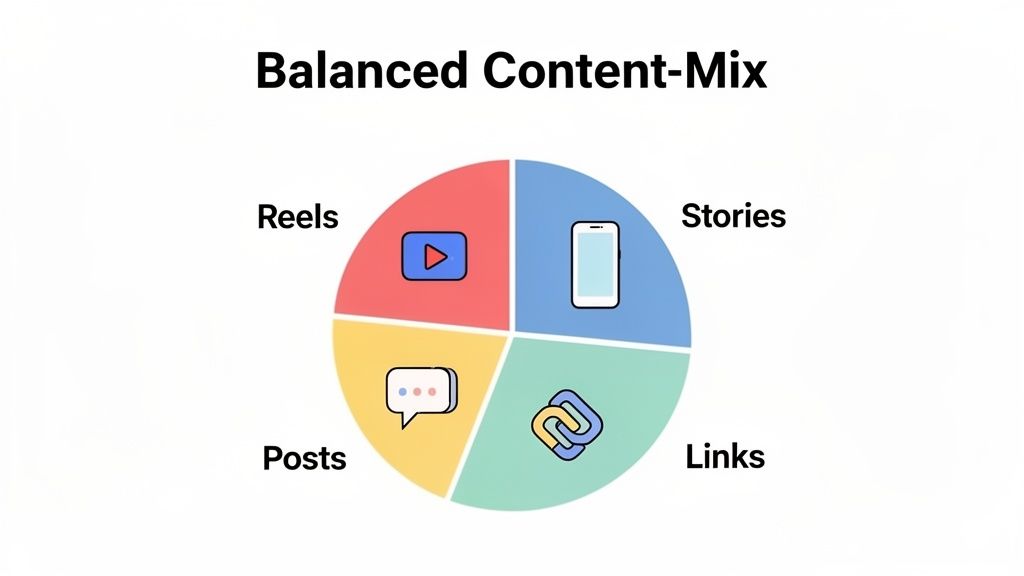
A successful Facebook content mix isn't just about posting regularly; it's about strategically balancing Posts, Reels, Stories, and Links to hit your specific goals. I've seen it time and time again: Reels are phenomenal for reaching fresh eyes, Stories are perfect for building those daily connections, and classic Posts get the conversation going. And, of course, Links are your go-to for getting people off of Facebook and onto your website.
The secret is realizing that each format has a specific job to do within your wider strategy.
Finding Your Winning Facebook Content Mix
So many businesses fall into the trap of treating their Facebook page like a one-note megaphone, pushing out the same kind of content day after day. That’s a fast track to nowhere because the algorithm is designed to reward variety and genuine interaction. You need to start thinking more like a media network and less like a solo act.
The bedrock of any solid content mix is tying each format directly to a business objective. Instead of waking up and wondering, "What should I post today?" the better question is, "What am I trying to achieve today?"
Aligning Formats with Business Goals
Every content choice you make should be a direct line back to your main marketing goals. Each format has its own unique strengths that make it a better tool for certain jobs.
Want Brand Awareness and Reach? Reels are the undisputed champion here. Their discovery-focused algorithm is built to show your content to people who don't even follow you yet, making them an absolute powerhouse for introducing your brand to a huge new audience.
Need to Build Community and Engagement? This is where traditional Posts (think text, photos, or carousels) really shine. They're perfect for starting conversations, asking questions, and sharing user-generated content to make your page feel like a real community hub.
Looking for Nurturing and Authenticity? Stories give you that raw, behind-the-scenes glimpse into your brand. Because they disappear in 24 hours, they create a sense of urgency and are fantastic for running quick polls, Q&As, and casual check-ins that build deep loyalty.
Driving Traffic and Conversions? Links are your direct pipeline to your website, blog, or product pages. While it's true the algorithm can sometimes limit their reach, they are absolutely essential for driving specific actions like sales or email sign-ups.
Your goal isn't just to fill a content calendar; it's to create a strategic system where each piece of content has a job. This turns your Facebook presence from a guessing game into a predictable engine for growth.
To really nail your content mix, it helps to zoom out and apply some essential social media management tips. A smarter workflow almost always leads to better results.
To make this crystal clear, here’s a quick-reference guide to help you pick the right format for your marketing objectives.
Manage all your social media in one place with Postiz
Starting conversations, sharing UGC, company news, questions
Comments, Likes, Shares, Engagement Rate
Links
Traffic & Conversions
Driving blog traffic, promoting landing pages, direct sales
Link Clicks, Click-Through Rate (CTR), Conversions
Think of this table as your playbook. When you know your goal for the day, you can instantly see which format will give you the best shot at success.
From Theory to Practice
So, how does this all come together in the real world?
Imagine a local bakery. They could use Reels to show off their mesmerizing cake decorating process, which is pure catnip for attracting new local followers. The next day, they might use Stories to run a daily poll like "Croissant or Muffin?" to get that new audience interacting.
Later in the week, a beautiful photo Post could announce a new seasonal flavor, asking followers to tag a friend they'd share it with. Finally, a Link post would direct customers to their online ordering page to lock in holiday pre-orders.
See how it works? Each piece of content plays a different role, guiding a potential customer all the way from discovery to purchase. For a deeper dive, you can explore our full guide on what type of content works best on Facebook.
Using Facebook Reels to Maximize Organic Reach
If you take one thing away from this guide, let it be this: Facebook Reels are, without a doubt, the most powerful tool for organic growth on the platform today. They're specifically designed to land in front of people who don't follow you yet, making them an absolutely essential part of your Facebook content mix.
Think of Reels as your brand's movie trailer. They give people a quick, engaging, and often entertaining snapshot of who you are, hooking new viewers and turning them into potential followers. The trick is to create content that feels natural to the format—short, punchy, and authentic.
Crafting Reels That Resonate
The best Reels never feel like old-school ads. They fit right into a user's feed, offering a quick hit of value or entertainment. So, instead of just pushing a product, think about building content around pillars that create a genuine connection and show off what you know.
Here are a few ideas that I've seen work time and time again:
Quick Tutorials: Can you teach someone something useful in under 60 seconds? A local coffee shop could show a simple latte art pour, or a software company could reveal a game-changing keyboard shortcut.
Behind-the-Scenes Glimpses: People love seeing how the sausage gets made. Show them your workspace, the process of making a product, or a day in the life of your team. This pulls back the curtain and builds a ton of trust.
Trend-Driven Clips: This is a big one. Tapping into trending audio or video formats tells the algorithm your content is fresh and relevant, which can seriously boost its chances of getting discovered.
The numbers don't lie. Across the globe, people watch over 140 billion Reels every single month. Even more telling is that user-generated Reels get 3.2 times more organic reach than videos just repurposed from other platforms. Brands that embrace them are seeing a 41% boost in their overall page engagement. It’s clear that creating content for the platform pays off.
Your one and only goal with every Reel is to stop the scroll. Grab their attention with a strong visual in the first three seconds, use trending audio, and keep your message dead simple.
Key Elements for Reel Success
Making a Reel that gets traction is about more than just hitting record. The little details are often what separates a video that fizzles out from one that reaches thousands.
Video Length and Pacing Facebook lets you make Reels up to 90 seconds long, but honestly, the sweet spot is usually much shorter. I'd recommend aiming for 15-30 seconds for most of your content. This respects people's short attention spans and actually encourages them to re-watch, which is a fantastic signal to the algorithm.
Trending Audio is Non-Negotiable Using trending sounds is basically a cheat code for getting more eyes on your content. The algorithm actively pushes videos that use popular audio. Just spend five minutes scrolling the Reels feed to see what’s hot, then brainstorm how you can put your own spin on it.
Captions That Spark Conversation Your caption is where you add context and, more importantly, drive engagement. Keep it brief, but always include a clear call-to-action (CTA). Ask a question, tell viewers to share their own stories, or prompt them to tag a friend. This is how you turn passive viewers into an active community.
And while we're focused on Facebook here, a lot of what works is universal. It’s worth checking out these Instagram Reels best practices for even more great ideas.
How to Use Posts and Links Without Killing Your Reach
Reels are fantastic for getting discovered, but good old-fashioned Posts and Links are still your go-to for building a community and driving sales. The trick is to use them without getting penalized by an algorithm that's hungry for native, super-engaging content. You can't just drop a link and pray for clicks anymore.
Let's face it: Facebook wants to keep people on Facebook. Every time you post a link to your blog or product page, you're essentially asking people to leave. The algorithm often sees this and throttles your reach. You have to work with this reality, not fight it.
Spark a Conversation, Don't Just Shout a Link
The best text and photo posts I've ever managed all do one thing really well: they start a conversation. They're not just announcements. Instead of leading with "Buy our new thing!", try starting with a question or a story people can relate to.
For instance, a marketing agency could post something like: "What's the one marketing task you always put off? For our team, it's organizing our Google Drive. Total chaos. What's yours?" It’s personal, it’s relatable, and it invites real people to comment. The algorithm eats that stuff up.
And the data backs this up completely. In the Facebook news feed, a massive 96.5% of views in the US came from link-free posts from friends and other organic content. In stark contrast, link posts get a tiny 0.03% engagement rate. That’s a powerful reason to focus on connection first. If you want to dive deeper, you can discover more about these Facebook stats and see just how much the platform prioritizes personal interaction.
Tell a Story with Photo Albums and Carousels
A single photo is okay, but a photo album or a carousel post is way better for telling a story and holding someone's attention. That extra "dwell time" is a strong signal to Facebook that your content is interesting.
Here are a few ways to do it:
Walk them through a process: A local bakery could post a five-photo album showing the steps of making their famous sourdough, from starter to finished loaf.
Highlight your customers: A B2B software company could create a carousel featuring three client success stories, each with a headshot and a killer quote.
Offer a quick tutorial: A fitness coach could use a four-image carousel to break down the proper form for a squat, with simple instructions overlaid on each image.
The whole point is to make the post itself a valuable piece of content, not just a billboard pointing somewhere else. Give them something good right there in the feed, and they'll be far more likely to engage, which helps your Page's health across the board.
How to Actually Get Clicks on Your Links
When you absolutely must send traffic to your website, you have to be smart about it. Just posting a raw link is asking for the algorithm to ignore you.
The Classic "Link in Comments" Trick This is a tried-and-true method. You create a great, engaging post without a link in the main caption—just text, a photo, or a carousel. Then, you immediately drop the link in the first comment. In the caption, you just say something like, "You can grab the full guide at the link in the comments!"
This little maneuver keeps the main post "native" in the eyes of the algorithm, helping its initial reach.
You can even set this up ahead of time. This screenshot from Postiz shows how you can schedule the post and automatically have the link pop into the first comment right as it goes live.
Using a scheduler with a "first comment" feature like this is a lifesaver. It keeps your workflow smooth and helps you share links without sacrificing that crucial initial engagement.
Using Stories to Build Daily Connections
If Reels are how you get discovered, Facebook Stories are how you build real, everyday relationships. They vanish after 24 hours, which creates a super low-pressure space to show the human side of your brand. Think of them less like a polished ad and more like a casual, ongoing chat with your most loyal followers.
This temporary format is perfect for getting people to interact right now. It makes your audience feel like they're getting an exclusive, inner-circle peek into your world. It’s the digital version of a friendly conversation, building loyalty one tap at a time. This ephemeral magic is exactly why Stories are a critical piece of a balanced Facebook content mix.
Fostering Interaction and Getting Feedback
The real power of Stories comes from their interactive stickers. Don't mistake them for fun little add-ons; they're powerful tools for getting instant engagement and doing some light market research on the fly. You can get immediate feedback from your audience without ever making them leave the app.
Polls: Perfect for quick, easy engagement. A boutique could ask, "Which of these new dresses should we stock?" or a cafe could post a simple, "Matcha or Espresso this morning?" It instantly makes your followers feel like their opinion matters.
Q&As: This is your chance to open the floor and build authority. A financial advisor could host a "Money Myth-Busting Monday" Q&A, or a personal trainer could answer follower questions about staying motivated. It’s all about providing real value.
Quizzes: Get creative and make something fun and on-brand. A bookstore could run a "Guess the Classic Novel from Emojis" quiz—it’s pure entertainment that’s directly tied to what they sell.
The whole point is to turn your followers from passive viewers into active participants. Every poll response or question they submit strengthens their connection to you. They feel seen, and they feel heard.
Showing the Authentic Side of Your Brand
Stories are the best place to ditch the corporate polish and show the real people and processes behind your business. That kind of transparency is gold for building trust.
A software company could share a messy whiteboard from a brainstorming session. A restaurant could post a quick, candid video of the chefs prepping for a busy dinner service. This is the stuff that makes your brand relatable and human. It proves you're more than just a logo—you're a team of passionate people.
Given that Facebook has 3.07 billion monthly active users, Stories are a huge part of the platform's ecosystem. Their 24-hour lifespan creates a sense of urgency that makes features like polls and Q&As incredibly effective. Plus, as a key ad format, they play a massive role in driving revenue for countless businesses. Discover more insights about Facebook ads statistics.
Creating a Simple and Effective Content Schedule
Alright, so you know what you should be posting on Facebook. That’s a great start. But the real game-changer is figuring out when to post it all. Sporadic updates just won’t cut it; consistency is the engine that shows the algorithm your page is an active, valuable place to be. You need a schedule you can actually stick to.
Instead of just posting whenever you feel like it, think about your week in terms of a balanced ratio. This simple structure helps you hit all your key objectives—from reach and engagement to nurturing your audience and driving traffic—without feeling completely overwhelmed. A fantastic starting point I recommend to most businesses is the 40/30/20/10 rule.
A Balanced Weekly Content Ratio
This framework is a lifesaver. It gives you a blueprint for the week, making content planning feel a whole lot less like guesswork. It’s designed to put your effort where it will make the biggest splash, based on what’s working on Facebook right now.
Here’s a quick look at how it breaks down:
40% Reels: This is your top priority for growth and reaching new eyeballs. Dedicate the biggest chunk of your time to creating these short, punchy videos.
30% Stories: This is where you nurture your existing followers. Use daily, interactive content like polls, Q&As, and behind-the-scenes glimpses to build genuine connections.
20% Posts: Your classic photo or text posts are perfect for sparking conversations, sharing content from your fans (user-generated content), and building a strong community vibe.
10% Links: Save a small, strategic slot for posts that send people off of Facebook. This ensures you can drive traffic without torpedoing your overall engagement.
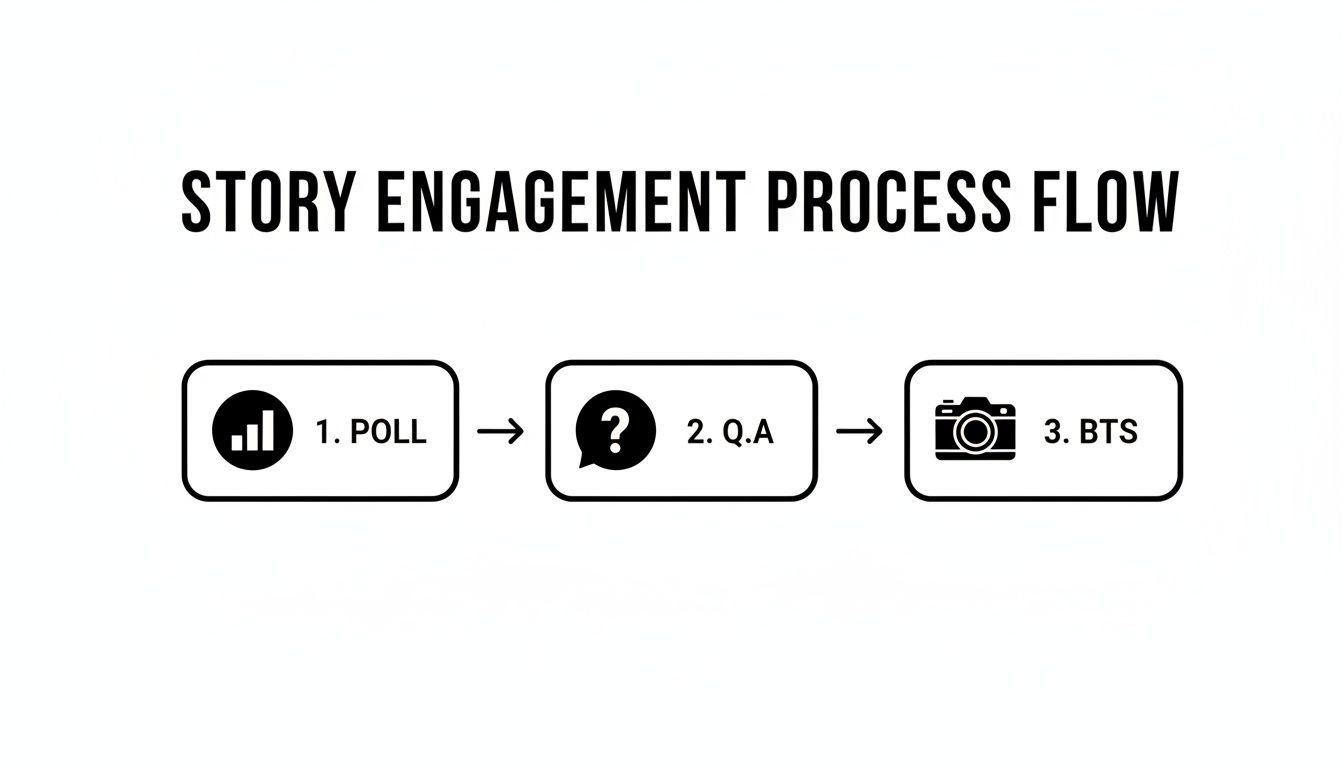
This simple flow chart shows how you can use Stories—your 30% allocation—to draw people in and get them talking.
As you can see, something as simple as a poll can lead to deeper interactions, like a Q&A session, which then opens the door for trust-building behind-the-scenes content.
Map Out Your Week and Work Smarter
Once you have this ratio in mind, your weekly calendar practically writes itself. If you're posting five days a week, that might look like two Reels, a couple of multi-part Stories, one high-quality Post, and a carefully placed Link post.
Here’s a sample schedule to give you a clearer picture of how this could look in practice.
Sample Weekly Facebook Content Calendar
Day
Morning Slot (e.g., 9 AM)
Afternoon Slot (e.g., 2 PM)
Evening Slot (e.g., 7 PM)
Monday
Reel #1: Quick tip/hack related to your niche.
Story: Interactive poll ("Which do you prefer?").
Tuesday
Community Post: Ask a question or share a user photo.
Story: "Ask Me Anything" based on yesterday's poll.
Wednesday
Reel #2: Behind-the-scenes or product demo.
Story: Share answers from the Q&A.
Thursday
Link Post: Share blog/product (link in comments).
Friday
Reel Recap: Edit Reels into a compilation.
Story: Fun Friday "This or That" or weekend preview.
Community Post: Celebrate a win or share a quote.
This table is just a template, of course. The key is to find a rhythm that works for you and your audience. This approach stops you from getting stuck in a rut and posting only one type of content. For a deeper dive into scheduling, check out our guide on how to create a content calendar for social media.
Now, here's the secret to making all of this manageable: smart content repurposing. One single idea can fuel your content for the entire week.
Don’t create brand-new content for every single format. Instead, adopt a "create once, distribute everywhere" mindset. This is the key to maintaining a powerful presence without overwhelming your team.
Let’s say your main piece of content this week is a new blog post titled "5 Tips for Better Home Organization."
The Link Post (10%): Start by sharing the blog post itself. In the caption, tease the most valuable tip and tell people the link is in the first comment.
The Reels (40%): Take each of those five tips and turn them into their own quick, 15-second Reel. Use a trending song and some snappy text overlays to make them engaging.
The Post (20%): Design a simple, clean carousel post that summarizes all five tips with graphics. In the caption, ask your audience which tip they plan to try first to get a conversation going.
The Stories (30%): Spread this out through the week. Show behind-the-scenes footage of you actually doing one of the tips, run a poll asking followers which room is their biggest mess, and then host a Q&A to answer their organizing questions.
Just like that, one idea has been transformed into a full week of varied, engaging content that perfectly aligns with your Facebook content mix.
Measuring What Works and Optimizing Your Strategy
Having a solid plan for your Facebook content is a great first step, but the real magic happens when you start paying attention to what your audience actually does with it. If you’re just posting and hoping for the best, you're leaving a ton of potential on the table.
The goal is to stop guessing and start making informed decisions. By digging into your analytics, you can see exactly what resonates, what falls flat, and where you should focus your energy next. This is how a good content strategy evolves into a great one.
What to Track for Each Content Type
Every format—Reels, Stories, posts, and links—has its own set of signals that tell you if it's hitting the mark. Don't get lost in a sea of data; just focus on the handful of metrics that truly matter for your Facebook content mix of posts, reels, stories, and links.
Reels: Views are nice, but Watch Time and Shares are what really count. A long watch time signals to the algorithm that people are hooked, and a share is the ultimate compliment—it means someone found your content so valuable they put their own name on it.
Stories: These are all about creating a connection. Look at the Completion Rate to see how many people are sticking around for your entire Story. Also, keep an eye on the Interaction Rate from polls, quizzes, and question stickers. This shows people aren't just watching; they're actively participating.
Posts: This is your community-building space. The most important metrics here are Comments and overall Engagement Rate. A post that sparks a real conversation in the comments is far more valuable than one with a hundred quiet likes.
Links: It doesn't get more straightforward than this. The number one metric is your Click-Through Rate (CTR). This tells you point-blank how well your image and caption did their job of getting someone to leave Facebook and check out your website.
Make it a habit to block out time every month to review your best-performing content. Look for patterns. Is there a certain style of Reel that always takes off? Do posts with a question always get more comments? These are clues telling you exactly what to do more of.
A Simple Way to Start A/B Testing
Once you have a baseline understanding of your performance, you can start running simple experiments to see what moves the needle. "A/B testing" sounds complicated, but it's really just changing one small thing at a time to see what your audience likes better.
For instance, say you're sharing a link to a new blog post. You could try two completely different headlines in the Facebook post. Run one version on Tuesday morning and the other on Thursday morning. After a few days, check which one got the higher click-through rate.
These little tests, done consistently over time, add up. They give you concrete proof of what works for your specific audience, helping you fine-tune every part of your strategy for better and better results.
Ready to manage your content schedule and analytics all in one place? Postiz gives you the tools to plan, publish, and measure your entire Facebook content mix without the headache. Start making smarter, data-driven decisions today at https://postiz.com.
Daniel Ch gave one Grok Bot three X accounts and got 69.8M impressions, 321K likes and a 7.1M-view post from an eight-word caption. Get the exact research-and-angle prompt, the two plays behind every idea, the SendShort video loop, and the five terminal commands that connect Grok Bot to Postiz so drafts land on your calendar.