Most reels don’t die because the content is bad. They die because the first two seconds are forgettable — and every algorithm on the planet is trained to notice.
Creator mentor Dominik recently sat down with more than a thousand short-form hooks from real creators and ran them through the same filter every scroll-tired brain uses: “pattern, pattern, pattern… wait, what?” What came out on the other side was a surprisingly short list of fixable mistakes — the kind that turn a 300-view reel into a 30,000-view one without changing the content itself.
This is the story of those mistakes, the fixes, and what it takes to turn a weak opener into the kind of first frame the algorithm actually rewards.
The feed is on autopilot — your hook has to trip it
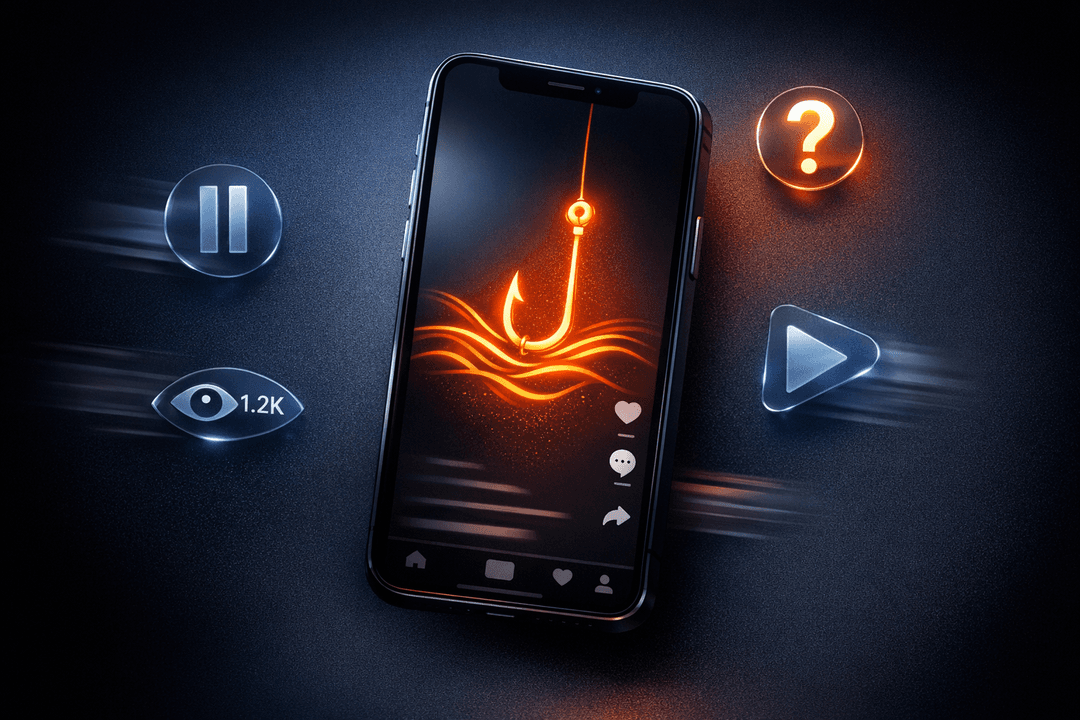
Think about how you scroll. You’re not watching. You’re swiping. Your thumb is in motion before your conscious brain has registered what’s on the screen, and the only thing that stops you is something that breaks the pattern — a sudden color, a strange sentence, a question you didn’t know you wanted answered.
That’s the game. Every hook is a pattern interrupt competing against an index finger that’s already 20% of the way to the next video.
Dominik frames it as opening loops and refusing to close them. A loop is any unanswered question you plant in the viewer’s mind. The second the viewer feels the loop is resolved, they’re gone. The longer you keep loops open — ideally opening a new one every time you close an old one — the longer they stay.
This is a surprisingly mechanical thing once you hear it out loud. And it maps directly onto the metric every platform optimizes for: average watch time. If your hook opens a loop in the first second, your retention curve holds. If it doesn’t, your retention curve is a cliff.
Problem one: hooks that skip context
The most common failure Dominik flagged wasn’t weak writing. It was missing context.
He walked through a reel from a creator named Max — the cover said “things I don’t do being lean over 40” — which sounds promising. But the actual opening frame was Max standing in a kitchen saying, “and I definitely don’t drink any…” with no setup. The viewer has no idea what’s being talked about, no idea who’s talking, and no reason to stay.
The analogy Dominik used was so good I have to steal it:
Imagine walking into a hardware store and a stranger looks you in the eye and says, “I never pull out.” You’re not curious. You’re scared. What they meant was that they always finish projects once they start a screw — but without the context, the sentence is just borderline criminal.
A shocking opener without context isn’t a hook. It’s noise. People don’t lean in when they’re confused; they swipe.
The fix is almost embarrassingly simple: give the viewer just enough context in the first frame to understand what the video is about, and then drop the pattern-interrupt line. That can be a bold text overlay, a single-line caption in a “safe zone,” or a quick visual establishing shot. Dominik’s example rewrite was “Lean at 45, and I eat carbs every day” — which gives you a person, an age, a claim, and a tension all in one breath.
Manage all your social media in one place with Postiz
The second failure pattern is the generic “who can relate?” opener — the kind of hook that tries to be relatable to everyone and ends up landing with no one.
Dominik pulled up a photographer’s account where the reels opened with exactly that phrase. On paper it feels safe. In practice it’s a dead hook.
His diagnostic question is the one you should tape to your monitor: What is the need you fulfill for your target audience? Not “who could possibly care?” but “what specific question am I planting in the head of the one person I’m actually talking to?”
For a photographer in 2026, “here are my travel photos” is a dead hook because there are a million photographers with travel photos. The thing that makes a photographer stop another photographer is the story behind the photo, the ten-year growth arc, the client journey, the creative frustration. That’s the loop. That’s what gets people to comment and argue and stitch.
The generic hook is scared to choose a side. The good hook knows exactly who it’s for and what question it’s planting.
Problem three: hooks that give away the ending
The third failure — and this is the one Dominik spent the most time on — is the hook that accidentally closes its own loop.
He used a morning-coffee creator named Ella as the example. Her reel opened with something like “vanilla blueberry iced latte” over the first frame. On the surface it describes the drink. In practice, it tells the viewer everything they need to know. The curiosity gap is closed before it opens. Swipe.
Watch how he rewrites it:
“This coffee should not taste good.”
That’s it. That’s the hook. It doesn’t tell you what the drink is. It doesn’t tell you why it’s weird. It plants a very specific loop — wait, why wouldn’t it taste good? What’s in it? — and forces the viewer to stay for the reveal. The ingredients become the payoff, not the setup.
The trick is to identify the single most interesting thing about your content and hide it until the last possible moment. The job of the first frame is to make the viewer want to see that thing, not to show it to them.
The framework, compressed
Everything Dominik flagged across a thousand hooks collapses into four questions you should be able to answer before you post anything:
Who is this for? Name one real person in your target audience. If you can’t, your hook will be too generic.
What loop am I opening? What unanswered question is the viewer carrying into the second frame?
Does the first frame have context? Can a stranger who’s never seen your feed understand what kind of video they’re watching in under a second?
Am I saving the reveal? Is the most interesting thing in my content hidden until later in the video, or am I giving it away in the hook?
Any reel that doesn’t have clean answers to all four is costing you views.
The part Dominik didn’t cover: testing hooks at scale
Here’s the follow-up problem. Once you actually understand hooks, you realize you need to run a lot of them to find the one your audience reacts to. One reel is a coin flip. Ten reels across four platforms with slightly different hooks, captions, and thumbnails is data.
This is where the craft of hook writing meets the infrastructure of publishing, and it’s the gap most creators never close — they write good hooks, but they don’t have a system for testing them.
A practical workflow looks like this:
Write three to five hook variants for the same piece of content.
Film once, recut the first three seconds per variant.
Stagger them across Reels, Shorts, TikTok, and LinkedIn with slightly different copy underneath.
Wait 72 hours and look at watch-time retention, not just views.
Keep the winning hook format in a running “vault” so your next video starts from proven patterns, not guesses.
That loop — write, cross-post, measure, iterate — is exactly what tools like Postiz were built for. You can draft the hook variants once, schedule them across every platform in one calendar, and read the retention data in the same place without bouncing between five dashboards. The AI agent and MCP integration will even let you generate hook alternates from a single prompt (“give me four loop-opening hooks for this reel about iced coffee”), schedule them, and track which one earned the longest watch time.
The point isn’t the tooling. The point is: hooks are a testable craft, and if you’re still treating them like a creative vibe you either have or don’t, you’re leaving views on the table.
Try it on your next reel
Pick your next piece of short-form content and do one thing: rewrite the first two seconds using Dominik’s filter.
Does it give the viewer context in under a second?
Does it open a loop and refuse to close it?
Is it speaking to one specific person, not everyone?
Is it hiding the juiciest part of the content, not announcing it?
If you can say yes to all four, you’ve probably just unlocked a retention curve you’ve never seen on your own account before.
And if you want to turn that craft into a repeatable system — hook variants, cross-platform scheduling, analytics that actually show you which hook earned the watch time — give Postiz a try. It’s the fastest way to take the lessons from a thousand analyzed hooks and actually run them on your own content, at scale, without another dashboard to babysit.
Updated LinkedIn post sizes for 2026. Learn the correct image, video, carousel, banner, and document dimensions to avoid cropping and boost engagement.