Buyers no longer rely on cold calls, catalogs, or trade shows to choose suppliers. Instead, they research online, compare vendors digitally, and form opinions long before sales ever gets involved.
Social media is no longer a “nice-to-have” for manufacturers. It’s a core channel for building trust, demonstrating technical expertise, and staying visible throughout the modern B2B buying journey.
Why Social Media Is a Must-Have for Modern Manufacturers
Modern B2B buyers—including engineers, procurement managers, and executives—are doing their homework online, especially on platforms like LinkedIn, long before they ever pick up the phone.
It’s a huge misconception that manufacturing is too “boring” or technical for social media. The reality is that your audience is there, actively looking for partners they can trust. A strong social presence has become a powerful signal of that trust.
Think of your company’s LinkedIn page as your digital handshake.
After someone visits your website, it’s often the very next place they look. An empty or inactive profile can make your company seem out of touch.
A feed filled with helpful content and real project highlights positions your brand as modern, credible, and forward-thinking.
How the Modern B2B Buyer Researches Manufacturing Suppliers
Today’s buyers are incredibly self-sufficient. They’re watching videos, reading articles, and vetting your capabilities long before they ever engage with your sales team. Your social media channels are critical stops along that journey.
They give you a direct way to:
Showcase expertise Share technical deep-dives, case studies, and insights from your engineering team to prove you know your stuff.
Humanize your brand Highlight employee spotlights, behind-the-scenes facility content, and your company culture.
Build credibility Share client testimonials, successful projects, and new certifications that validate your expertise.
A simple video tour of your facility or a detailed case study on LinkedIn can attract more qualified leads than a traditional ad campaign. Social media directly connects your expertise to tangible business opportunities.
How Social Media Is Replacing Traditional Manufacturing Marketing
The transition from old-school methods to modern digital ones isn’t just about changing tactics; it’s about getting better results. This table breaks down how social media transforms traditional manufacturing marketing.
Similar shifts are happening in adjacent industrial sectors, as seen in this guide on social media marketing for construction companies, where digital visibility is replacing traditional outreach.
This shift allows manufacturers to be more targeted, measurable, and cost-effective in their outreach, turning marketing from a cost center into a direct driver of revenue.
Manage all your social media in one place with Postiz
Ultimately, this isn’t just about posting updates. It’s about building a powerful lead-generation engine that works for you around the clock, filling your sales funnel with informed prospects who already see your value. If you’re looking for more ways to make this happen, our guide on how to increase sales offers a deeper dive.
How to Build a Goal-Oriented Social Media Strategy for Manufacturing
Before you even think about posting, you need a solid game plan.
Too many manufacturers treat social media like a bulletin board for random updates. That’s a mistake.
Effective social media marketing for manufacturing companies is about intentional, strategic action tied directly to business goals.
Every single piece of content, from a LinkedIn post to a YouTube video, needs a purpose. It should be a small step toward a much larger objective.
That means we have to stop chasing vanity metrics. Likes and follower counts are nice for the ego, but they don’t keep the lights on. Your strategy has to be built around tangible outcomes that the C-suite actually cares about.
Define Your Core Objectives
Let’s get specific. What, exactly, do you want social media to do for your company? A vague goal like “increase brand awareness” is nearly impossible to measure and, frankly, doesn’t mean much.
Instead, tie your social media efforts to concrete business results. Think in terms of numbers and deadlines.
Here are a few examples of what strong, goal-oriented objectives look like for a manufacturer:
Generate Qualified Leads: Let’s aim to increase qualified form submissions from LinkedIn by 20% over the next quarter.
Drive Website Traffic: How about we boost referral traffic from our social channels to key product pages by 15%?
Attract Top Talent: We need to increase applications for engineering roles that cite social media as a source by 25% this year.
Establish Thought Leadership: Let’s land three speaking gigs or podcast interviews for our lead engineer after sharing their technical insights on social platforms.
Here’s a pro tip from years in the trenches: Focus on one or two primary goals at a time. Trying to be a lead-gen machine, a recruiting powerhouse, and a thought leader all at once just dilutes your efforts and leads to mediocre results across the board.
To give your lead generation a boost, you might want to look into some of the top AI lead generation tools that can help automate the process. And if you need a framework to pull all this together, our guide to creating a social media marketing plan template is a great starting point.
Understanding Your Manufacturing B2B Audience
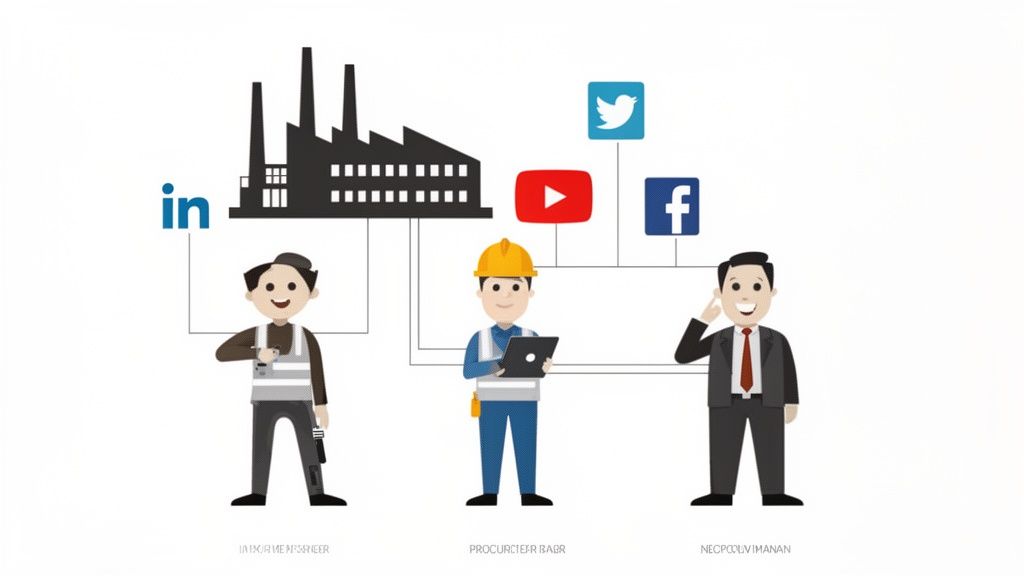
Remember who you’re talking to. This isn’t B2C marketing where you’re selling to a general audience. You’re communicating with highly specialized professionals, and to get their attention, you have to understand what makes them tick. This is where creating detailed buyer personas is non-negotiable.
Don’t just write down “engineers.” That’s not good enough. You have to go deeper.
Persona: The Procurement Manager
Their world: Responsible for sourcing reliable suppliers and negotiating strong contracts
What keeps them up at night: Supply chain risk, quality failures, budget pressure
What they want: Long-term partners who deliver consistently and without friction
Content that helps: Case studies, certifications (ISO), production capacity transparency
Persona Example: The Design Engineer
Their World: They’re in the weeds, designing new products and specifying every last component.
What Frustrates Them: Finding materials that meet ridiculously strict technical specs and trying to keep up with new manufacturing techniques.
What They Want: A supplier who is also a technical expert—someone who can offer innovative solutions, not just take an order.
Content That Helps Them: Detailed technical white papers, material data sheets, and videos that actually show your complex machining processes in action.
When you build out these personas, you stop guessing. Your content starts speaking directly to the right people, answering their questions before they even ask.
Finally, it’s time to do a little recon. See what your competitors are up to online. A competitive analysis isn’t about copying what they do; it’s about spotting their weaknesses and finding opportunities to make your own brand shine.
Here’s a simple audit I recommend:
Identify 3-5 key competitors. This should include your direct rivals and maybe a company in an adjacent industry that you admire.
Analyze their platforms. Where do they hang out? Are they all-in on LinkedIn? Do they have a strong YouTube presence?
Evaluate their content. What are they actually talking about? Is it dry corporate news, technical deep dives, or all sales-focused?
Look for the gaps. This is where the gold is. What are they not talking about? Where is their content just plain boring? That’s your opening.
Maybe you’ll notice all your competitors just post press releases. Perfect. That’s your chance to share behind-the-scenes factory tours or employee spotlights, giving your brand a human voice in a sea of corporate jargon. This groundwork is what separates a truly effective social media presence from one that just makes noise.
Choosing the Right Platforms and Content That Resonates
Let’s be realistic. You can’t be everywhere at once on social media, and trying is a surefire way to burn out your marketing team with little to show for it. The real secret to social media marketing for manufacturing companies isn’t about being on every platform; it’s about dominating the right ones.
For most industrial B2B businesses, this means being highly selective. You need to go deep where it matters, not wide where it doesn’t. This sharp focus ensures every piece of content you create has the best possible chance to get in front of the engineers, procurement managers, and C-suite executives you need to reach.
Start with the Powerhouses: LinkedIn and YouTube
If you only have the time and budget to focus on two platforms—and that’s the reality for most of us—make them LinkedIn and YouTube. These two are the undisputed heavyweights for industrial marketing, and they work together beautifully.
LinkedIn: Your Digital Sales Hub
Think of LinkedIn as your 24/7 trade show booth. It’s where professionals go to vet suppliers, network, and keep a pulse on the industry. It’s non-negotiable for any serious B2B manufacturer.
If LinkedIn is a core channel for your growth, following a structured LinkedIn marketing strategy helps manufacturers turn visibility into qualified leads.
It’s the perfect place to:
Establish Expertise: Share detailed technical articles, case studies, and insights from your engineering team. This is how you stop being seen as just another vendor and start being seen as an essential partner.
Pinpoint Decision-Makers: LinkedIn’s advertising tools are incredibly powerful for our industry. You can get your content directly in front of a “Director of Engineering” at a specific list of target companies.
Fuel Your Talent Pipeline: Let’s face it, finding skilled labor is tough. Use your LinkedIn page to showcase what makes your company a great place to work, helping you attract top-tier talent.
YouTube: Your Virtual Facility Tour
Nothing shows off your capabilities like video. A well-shot demonstration can explain a complex machining process or a piece of equipment far better than any brochure ever could.
Use YouTube to create:
Product Demos in Action: Show your equipment solving the exact problems your customers face. Highlight the key features and benefits in a clear, compelling way.
Virtual Plant Tours: Pull back the curtain and give prospects a look inside your facility. Showcasing your clean shop floor, advanced machinery, and rigorous quality control builds instant trust.
Technical How-To’s: Create helpful tutorials or troubleshooting guides for your products. This not only supports current customers but also proves your expertise to potential ones.
Where Other Platforms Fit In
While LinkedIn and YouTube are your core, a few other platforms can serve specific, strategic roles.
Facebook: While not a primary lead generator for B2B manufacturing, Facebook is fantastic for employer branding. Your HR department will love it for promoting job openings and giving potential hires a genuine feel for your company culture. To stay consistent without manual posting, using a Facebook post scheduler helps manufacturing teams plan employer-branding and culture content in advance.
Instagram: Do you do visually stunning work, like intricate CNC machining, massive fabrication projects, or high-tech robotics? Instagram can be a powerful visual portfolio. Use high-quality photos and short-form Reels to offer a behind-the-scenes look at your innovation.
A rookie mistake is to copy and paste the same content across every platform. A technical white paper that performs brilliantly on LinkedIn will die a silent death on Instagram. Always tailor the message to the medium.
To make this easier, here’s a quick guide to matching your content to the right platform.
Platform and Content Matchup for Manufacturers
This table breaks down which platforms are best for your goals and what kind of content will get you there.
Ultimately, the goal is to create a content ecosystem where each platform plays to its strengths to support your larger business objectives.
Content That Actually Connects with a Technical Audience
Once your platforms are set, it’s time to create content that speaks the language of your audience. Forget the generic marketing fluff—it won’t fly here. Engineers and technical buyers value expertise, proof, and practical information that helps them do their jobs better.
The game has changed. A staggering 66% of manufacturer marketers now have a formal content strategy designed to build credibility and generate leads. And it works. With 40% of B2B buyers saying they only need to see three to five pieces of content before they’re ready to talk to sales, you can’t afford to get this wrong. You can find more great stats on how manufacturing marketing trends are shaping lead generation at salesmate.io.
So, what kind of content actually works?
Behind-the-Scenes Glimpses: Show your machines running, highlight a tricky part of your quality control process, or walk through a custom fabrication job. This transparency builds massive trust.
Employee Spotlights: Your people are your biggest asset. Interview a lead engineer about a new technology or feature a veteran machinist sharing a tip. This humanizes your company and puts your deep bench of talent on display.
No-Nonsense Product Demos: Don’t just show the shiny finished product; show how it works. Use screen recordings for software or tight, close-up shots for mechanical components to really dive into the details.
Case Studies That Tell a Story: Social proof is everything. Share a quick video testimonial or write up a detailed case study that outlines a customer’s problem, your solution, and the measurable results.
Technical Deep Dives: Unleash your subject matter experts. Ask an engineer to write a short post or record a quick video explaining a complex industry concept. This is the kind of high-value content your competitors probably aren’t bothering to create.
Creating a Sustainable Content Workflow and Calendar
Consistency is the real engine behind social media success. If you want your social media marketing for manufacturing companies to work, you need a steady drumbeat of content—not just random posts when you have a spare moment. This doesn’t mean you need a giant marketing team or a bottomless budget. It just means you need a smart, sustainable workflow.
The whole point is to shift away from that frantic, “what on earth are we going to post today?” mindset. Instead, you’ll have a proactive, organized plan that saves time, cuts down on stress, and makes sure every single post actually supports your business goals. It’s all about building a system that works for your team, whether that’s one person or ten.
Building Your Content Calendar
Think of a content calendar as your roadmap. It’s more than just a schedule; it’s a strategic tool. It helps you visualize what you’re posting, plan out campaigns ahead of time, and ensure you’re hitting all your key themes throughout the month or quarter. Most importantly, it kills the last-minute scramble for good.
You don’t need anything fancy. Honestly, a shared spreadsheet is a perfectly good place to start.
Here’s what I’d include in a simple calendar:
Date: When the post goes live.
Platform(s): Where you’re publishing it (LinkedIn, YouTube, etc.).
Content Pillar: The core theme, like “Technical Expertise,” “Company Culture,” or “Product in Action.”
Post Copy: The actual text, tweaked for each specific platform.
Visuals: A link to the image, graphic, or video file.
Status: A simple tracker like “Draft,” “In Review,” “Approved,” or “Scheduled.”
The best content calendar is the one your team actually uses. Start simple. You can always add more detail later if you need it. The goal here is clarity and accountability, not building a system so complicated that nobody wants to touch it.
In manufacturing, it’s not always as simple as writing a post and hitting “publish.” Content often needs a quick check from a technical expert or a compliance review before it sees the light of day. This is where workflows often get bogged down and create frustrating bottlenecks. A clear, streamlined approval process is absolutely essential to keep things moving.
First, get crystal clear on roles. Who drafts the content? Who provides the technical specs? Who has the final say? Documenting this flow from the start prevents a world of confusion and delays down the road.
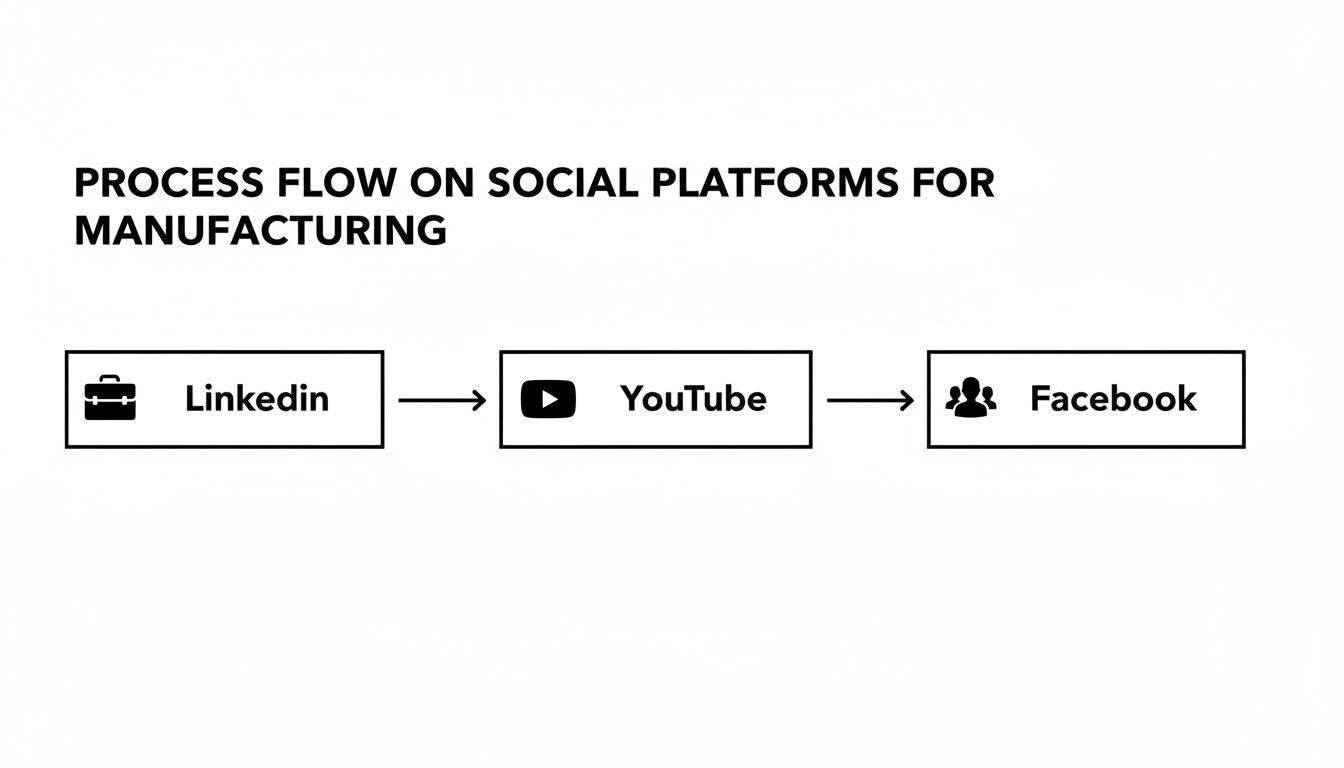
This flow chart gives a good visual of how you can direct different types of content to the most effective platforms.
As you can see, professional content really belongs on LinkedIn, while in-depth demos are perfect for YouTube, and culture-focused posts fit well on a platform like Facebook. It’s all about matching the message to the audience.
Next, you have to try content batching. This is a massive time-saver. Instead of creating one post at a time, block off an afternoon once or twice a month to create and schedule everything for the upcoming weeks. It’s so much more efficient than constantly switching gears between creative work and administrative tasks.
Leveraging a Content Library for Efficiency
Not every post has to be brand new. A well-organized content library is a goldmine for any busy team. It lets you repurpose your best assets and easily fill any gaps in your calendar.
Think of it as your central hub for all approved marketing materials—your evergreen content headquarters.
Here’s what you should be storing in there:
High-Quality Visuals: Professional shots of your facility, your machinery in action, finished products, and your team.
Video Clips: Short snippets from longer videos. A quick shot of a CNC machine running or a 15-second clip from a client testimonial can be incredibly powerful.
Evergreen Information: Details about your core capabilities, company history, key certifications, and safety protocols.
Client Testimonials: A collection of approved quotes and success stories you can pull from.
Approved Boilerplate Copy: Standard company and service descriptions that can be quickly adapted for various posts.
When you have these assets ready to go, you’re never scrambling for something to post on a quiet day. You can grab a great photo, pair it with an approved quote, and have a quality post ready to go in just a few minutes.
Measuring Success and Proving Your ROI
So, you’re creating great content and engaging with the right people. Now for the hard part: how do you prove that any of this is actually moving the needle? This is where a lot of manufacturers get stuck, but it’s the most critical piece of building a strategy that lasts.
Proving your return on investment (ROI) is how you justify the budget and show leadership that social media is a revenue driver, not just a cost center.
The key is to look right past the vanity metrics. Likes, shares, and follower counts feel good, but they don’t mean much to your CFO. You have to connect your social media activity to tangible business outcomes.
Identify KPIs That Matter to Leadership
If you want buy-in, you have to speak the language of the C-suite. That means focusing on metrics that directly impact the bottom line. It’s time to stop reporting on impressions and start tracking key performance indicators (KPIs) that tell a clear story about growth.
Here are the KPIs that really resonate with manufacturing leadership:
Website Referral Traffic from Social: How many people are actually clicking through from LinkedIn or YouTube to your website? You can track this easily in Google Analytics. It’s a direct measure of how well your content is generating real interest.
Lead Conversion Rates: Of the traffic that lands on your site from social media, what percentage fills out a “Request a Quote” form or downloads a technical spec sheet? This is where you connect social activity directly to lead generation.
Cost Per Qualified Lead (CPL): If you’re running paid campaigns, this is your north star. Just calculate the total ad spend and divide it by the number of qualified leads you generated. A low CPL proves efficiency and a strong ROI.
Engagement on Technical Posts: Pay close attention to the comments, shares, and click-through rates on your deep-dive content. High engagement here is a strong signal that you’re reaching the right technical audience—the engineers and buyers who actually make purchasing decisions.
Build a Simple Analytics Dashboard
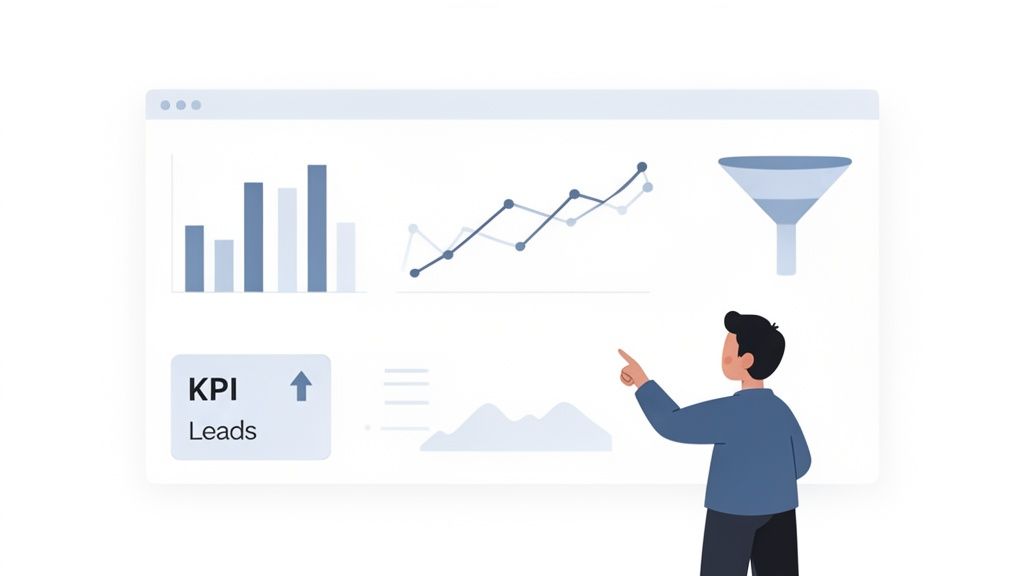
You don’t need some complex, expensive software to track your progress. A simple dashboard, even one built in a spreadsheet or a free tool like Google Looker Studio, can be incredibly effective for showing your data and sharing results.
Your dashboard should be a one-page snapshot that answers three essential questions:
What did we do? (e.g., “Published 8 technical posts on LinkedIn, ran one lead-gen campaign.”)
What happened? (e.g., “+15% website traffic from LinkedIn, generated 12 qualified leads at a CPL of $75.”)
What’s next? (e.g., “Boosting our top-performing post to a wider audience of design engineers.”)
Keep it simple and visual. Use charts and graphs to highlight trends. Your goal isn’t to overwhelm stakeholders with a data dump, but to give them a clear, immediate understanding of the value you’re delivering.
This straightforward reporting structure makes your updates easy to digest and immediately shows the connection between your team’s efforts and real business results.
Connect Social Activity to Sales Inquiries
The ultimate goal is to draw a straight line from a social media campaign to a new sales order. This is where tracking and attribution become your best friends.
Let’s walk through a real-world scenario. Imagine your company launches a new CNC machining service.
The Campaign: You run a highly targeted LinkedIn ad campaign promoting a downloadable case study about the new service. The ad is shown only to “Mechanical Engineers” and “Procurement Managers” in the aerospace industry.
The Tracking: The link in that ad uses a UTM code, which is just a simple tag that tells Google Analytics exactly where that website visitor came from.
The Conversion: An engineer at a major aerospace firm clicks the ad, downloads the case study, and a week later, their company submits an RFQ through your website for a project using that exact service.
The Proof: By looking at your CRM and analytics, you can directly attribute that $50,000 RFQ back to your $500 LinkedIn campaign. That’s the kind of tangible, undeniable ROI that gets everyone’s attention and secures your marketing budget for years to come.
Answering the Tough Questions About Social Media in Manufacturing
Jumping into social media can feel a lot like installing a new piece of CNC equipment—you know it’s powerful, but there are a lot of questions and a few potential hazards. Over the years, I’ve heard the same handful of concerns from manufacturing leaders. Let’s get right to them and clear the air.
This isn’t about abstract marketing theory. It’s about giving you the confidence to build a smart social media presence that actually helps your business.
How Much Should We Really Budget for This?
Short answer: it depends on your goals.
Budgeting for social media marketing in manufacturing typically breaks down into two areas: internal resources and ad spend
There’s no magic number, but we can break it down logically into two buckets: your internal resources and your ad spend.
Resources (Your People and Tools): Who’s going to run this? If you’re tasking an existing marketing person or even an engineer, their time is the biggest part of your investment. You’ll also want to budget for a good scheduling tool or some basic design software—nothing too crazy.
Advertising Spend: This is where you put money behind your content, like boosting a key post on LinkedIn to reach a specific list of design engineers. You can start small and be effective. Even $500 to $1,000 a month, when targeted correctly, can bring in high-quality leads and valuable feedback.
Stop thinking of social media as a cost. It’s an investment in your sales pipeline, your recruiting efforts, and your company’s credibility. My advice? Start with a modest, measurable pilot program to prove the ROI to yourself and your leadership team. Once you see what works, you’ll have a clear case for scaling up.
What Happens When We Get Negative Comments?
It’s going to happen. And how you respond says everything about your company. The absolute worst thing you can do is ignore it or delete it (unless it’s spam or truly offensive, of course). A negative comment is actually a golden opportunity to show everyone watching how you handle problems.
Here’s a simple, three-step playbook I always recommend:
Acknowledge It Quickly and Publicly: Jump on the comment with a calm, professional reply. Let them know you hear their frustration and thank them for bringing it to your attention.
Move the Conversation Offline: Your goal is to solve the problem, not have a debate in the comments. Offer to take it private. Something like, “We’re sorry you had this experience. Could you please send us a direct message with your contact info? We want to connect with you directly and make this right.”
Actually Follow Through: This is the step that matters most. Get in touch with them and do the work to solve their problem.
When you do this, you show everyone else that you take feedback seriously and stand behind your work. That builds far more trust than if the comment never happened in the first place.
Aren’t Our Products Too “Boring” for Social Media?
This is easily the biggest myth in social media marketing for manufacturing companies. Your products aren’t boring to the exact people you need to reach. A process engineer looking for a specific custom-molded component will find a detailed video of your injection molding process completely fascinating. A procurement manager will find a case study about your supply chain reliability incredibly compelling.
Remember, you’re not trying to become a viral sensation for the general public. You’re trying to educate and build trust with a very specific professional audience.
Shift your focus to the process, the precision, and the people that make your products.
Show off the incredible engineering behind what you do.
Put a spotlight on the skill of your veteran machinists.
Break down how your QC process prevents costly failures for your customers.
That’s the stuff that truly connects and establishes you as an expert, not just another vendor in the pile.
How On Earth Do We Find the Time for This?
For a small team—or a team of one—this is a very real challenge. The solution isn’t to work more hours; it’s to work smarter. Trying to post something new every single day on every platform is a fast track to burnout.
Instead, build your strategy around efficiency and consistency.
Go Deep, Not Wide: Get really good at one or two platforms where your customers live (like LinkedIn and YouTube) instead of trying to be mediocre on five.
Batch Your Content: Block out one afternoon a month to plan, shoot, write, and schedule all of your posts. It’s so much more efficient than scrambling for an idea every morning.
Repurpose Absolutely Everything: That new case study you just put on your website? That’s a killer LinkedIn post, a script for a short video, and a handful of bullet points for future updates.
Consistency will always beat frequency. Two thoughtful, valuable posts a week on LinkedIn are far more powerful than five rushed ones. It’s about making a sustainable impact, not just making noise.
Ready to stop guessing and start scheduling with confidence? Postiz provides the tools you need to plan, create, and publish your manufacturing content efficiently. With our intuitive content calendar, AI-powered assistants, and streamlined approval workflows, you can build a powerful social media presence without the overwhelm. See how we can help at https://postiz.com.
What are the dimensions of an Instagram post? This 2026 guide covers every format—square, portrait, Reels, and Stories—to help you optimize your content.
Stop guessing! Find the best time to post on Instagram Story using 6 proven, data-backed strategies. Maximize your reach and skyrocket engagement today.
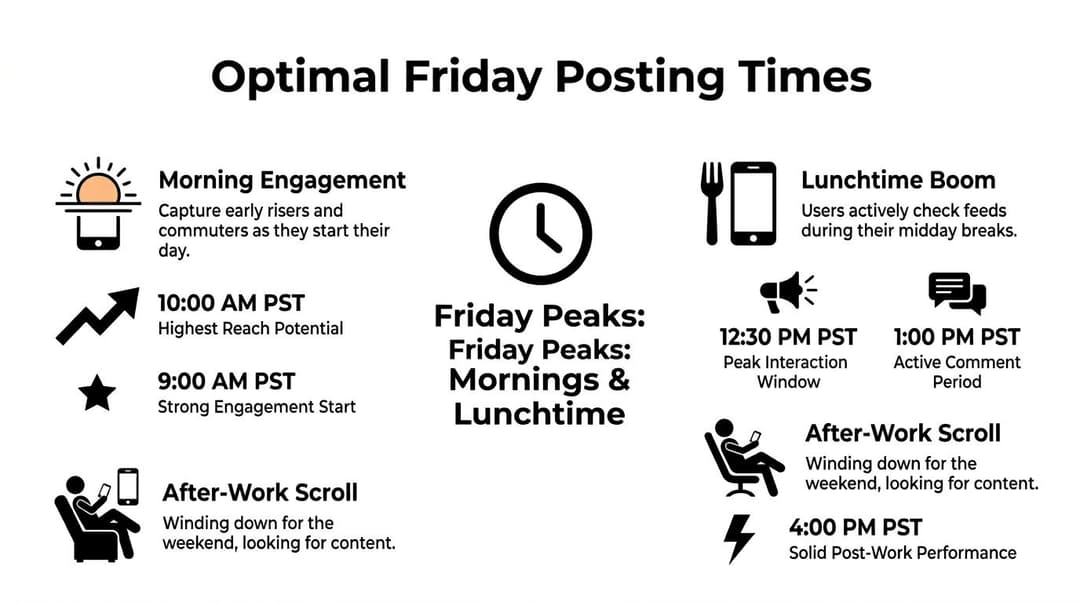
Best time to post on instagram on friday - Maximize Friday engagement! Get data-backed best times to post on Instagram on Friday. Find your personal peak postin