Effective social media marketing for mortgage brokers is not about posting more. It is about clarity, trust, and consistency.
Borrowers are making one of the biggest financial decisions of their lives. If they do not immediately understand who you help, what you do, and why they should trust you, your content will not convert.
This guide shows how to use social media to educate borrowers, build authority, and generate qualified mortgage leads consistently.
What Is Social Media Marketing for Mortgage Brokers?
Social media marketing for mortgage brokers is the use of platforms like Facebook, Instagram, LinkedIn, and YouTube to educate borrowers, build trust, and generate qualified mortgage leads through compliant, value-driven content.
Effective strategies focus on:
Borrower education instead of sales pitches
Local market expertise
Compliance with NMLS regulations
Consistent content and follow-up systems
Why Is Social Media Important for Mortgage Brokers?
Social media helps mortgage brokers:
Build trust before the first conversation
Educate borrowers on complex financial decisions
Stay top-of-mind during long buying cycles
Generate local leads without relying only on referrals
Know Your Ideal Mortgage Client
Before creating content, you need a clear picture of your ideal borrower. Without this, even high-quality posts will miss the mark.
Different borrower types have very different motivations:
First-time buyers worry about hidden costs and making mistakes
Investors care about speed, ROI, and financing flexibility
Refinancers focus on monthly savings and timing
Renovators need guidance on specialized loan products
When you know exactly who you are speaking to, your messaging, visuals, and ad targeting become sharper and far more effective.
The same audience-first approach applies across regulated industries. We use a similar framework in our guide on social media marketing for doctors, where trust and compliance are just as critical.
Polish Your Social Profiles to Perfection
Focus on four essentials:
Professional headshot that feels approachable
Clear bio explaining who you help and where
Simple contact options (link, call, email)
Visible NMLS ID and disclosures
Key takeaway: Compliance is not just a legal requirement. It is one of the strongest trust signals you can show potential borrowers.
Manage all your social media in one place with Postiz
You don’t need to be everywhere. You just need to be where your ideal clients are. A first-time buyer scrolling through Instagram has a completely different mindset than a real estate investor browsing LinkedIn.
This table breaks down where to focus your energy for maximum impact.
If LinkedIn is a core channel for reaching investors and referral partners, using a dedicated LinkedIn post scheduler can help you stay consistent without manually posting every day.
Platform Focus for Different Borrower Avatars
By matching your message to the platform, you stop wasting time and start generating qualified leads much faster.
Keep Compliance Front and Center
Let’s be clear: navigating compliance on social media is non-negotiable. It protects your license and builds the confidence borrowers need before they’ll even think about reaching out.
Always include your NMLS ID in your bio or profile footer.
Never quote specific rates in a public post without the required disclosures (APRs, terms, etc.). It’s a regulatory minefield.
When a conversation turns to personal financial details, move it to a secure channel like DMs, email, or a phone call immediately.
Now let’s turn that foundation into a repeatable content system
We see the same compliance-driven strategy work well in other licensed professions, including our breakdown of social media marketing for dentists, where education consistently outperforms promotion.
How to Create Content That Actually Builds Your Authority
If you’re just randomly posting rate updates or generic “buy now” messages, you’re on a fast track to being ignored. Let’s be honest, that’s not a strategy; it’s just noise. To be effective on social media, you need to stop thinking like a salesperson and start acting like the trusted, local mortgage advisor you are. This shift starts with defining your core content pillars.
Think of content pillars as the 3-5 foundational topics you’re going to own. These are the key themes you’ll talk about over and over again. This approach creates a repeatable system that not only saves you a ton of time but also cements your reputation as the go-to expert in your market. Your audience will know exactly what to expect from you: value.
Find Your Core Content Pillars
Think of content pillars as the topics you want to be known for. They keep your content focused and consistent.
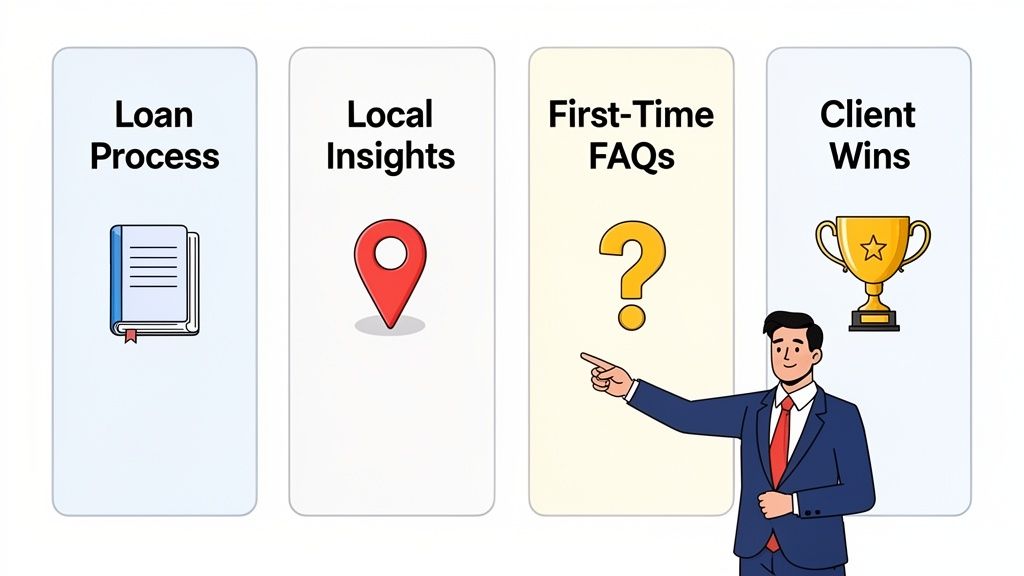
Your core pillars should include:
Loan process education
Local market insights
Borrower FAQs and myth-busting
Client success stories
This structure turns random posting into a repeatable authority-building system.
Brainstorming Post Ideas That Get Noticed
Once your pillars are set, brainstorming content ideas becomes so much easier. The goal is to create posts that educate, build trust, and subtly highlight why you’re the best choice, without ever having to say it.
Let’s break down some specific ideas for each pillar.
For “Demystify the Loan Process”
Video: Film a quick 60-second Reel explaining the real difference between a pre-qualification and a pre-approval.
Infographic: Create a simple graphic showing the 5 main steps from application to closing day. People love visuals.
Carousel Post: Use a multi-slide post to break down what “escrow” really means in plain English.
For “Share Local Market Insights”
Live Q&A: Go live on Instagram or Facebook with a local real estate agent you trust to discuss the current market.
Data Post: Grab a chart showing the average home price change in a key zip code over the last quarter.
Community Spotlight: Post about a local coffee shop or restaurant you love. It shows you’re invested in the community, not just the transactions within it.
Pro Tip: When you share market data, don’t just post a graph and walk away. Add your own interpretation. Explain what those numbers actually mean for a potential buyer or seller in your town. This is what positions you as an expert, not just a news feed.
For “Answer Borrower FAQs”
Myth-Busting Post: Create a post titled “Do I Really Need 20% Down?” and then explain the various low-down-payment options available.
Checklist: Design a simple, shareable graphic listing the documents needed for a mortgage application.
Text-Based Post: Sometimes simple is best. Write a direct, text-only post explaining how credit scores impact interest rates.
These pillars give you a solid foundation to build from. If you’re looking to connect with professionals like real estate investors or financial advisors, platforms like LinkedIn are a goldmine. For a deeper dive on that, check out our guide on creating a powerful LinkedIn marketing strategy. By consistently showing up with valuable content across these themes, you’ll build a powerful online presence that attracts and converts the exact clients you want to work with.
Using Video to Create Real Connections
Static images and text posts have their place, but in a business built on trust, video is your secret weapon. It’s the best way to cut through the digital noise and let potential clients see the real person behind the NMLS number. Nothing humanizes you and your brand faster.
And you don’t need a Hollywood budget or fancy equipment to make it work. Your smartphone is all you need to get started. Honestly, authenticity will always win against a polished, corporate-style video. People want to connect with a genuine expert, not a perfect actor.
Even more telling, 80% of millennials and Gen Z—a massive chunk of the homebuying market—find services on video-first platforms. That makes video a non-negotiable part of your strategy.
Embrace Short-Form Video for Maximum Reach
Short-form video is designed for quick hits of information and high engagement, which is perfect for a busy mortgage broker. Platforms like Instagram Reels, TikTok, and YouTube Shorts are built for this stuff, and their algorithms will push your content out to a wider local audience.
The trick is to be direct, valuable, and fast. You’ve got about three seconds to hook someone before they swipe on. Start with a sharp question or a bold statement to grab their attention and then get straight to the point.
Here are a few ideas you could film this week:
The 60-Second Mortgage Myth Buster: Pick a common misconception, like “You need 20% down,” and bust it with simple facts. This immediately positions you as a trustworthy expert.
“Closing Day Walkthrough” Reel: Next time you’re at a closing (with your client’s permission, of course!), film a quick video explaining what’s happening. It demystifies the process and shows you get deals done.
“Rate Update, Explained” Video: Don’t just post a number. Get on camera and briefly explain why rates are moving and what it means for local buyers. Your expert take is what provides the real value.
Key Takeaway: The goal with short-form video isn’t to explain the entire mortgage process. It’s to drop a single, valuable nugget of information that builds trust and makes people think, “This person really knows their stuff.”
Create Longer Videos to Build Deeper Trust
While short videos are fantastic for getting eyeballs, longer-form content on platforms like Facebook and YouTube is where you build deep, lasting rapport. This is your stage for hosting more in-depth discussions that establish you as a true authority in your market.
Think of these longer videos as your virtual seminars. They give you the space to collaborate with partners and tackle complex topics head-on, delivering huge value to serious prospects who are further along in their homebuying journey.
Compelling Ideas for Longer-Form Video
Running Smart Local Ad Campaigns
Organic social media is fantastic for building your brand and nurturing relationships over the long haul. But when you need to connect with qualified local buyers right now? That’s where paid advertising comes in. A smart ad strategy cuts through the noise and puts your message directly in front of people who are already thinking about buying a home.
Let’s break down how to run effective ad campaigns on platforms like Facebook and Instagram. The good news is you don’t need a massive budget to see real results; you just need to be strategic and targeted.
Setting Up Your First Ad Campaign
First things first, you need to tell the platform what you want to achieve. For getting new clients, the Lead Generation objective is your best friend. This lets you create a simple form that pops up right inside the app, making it incredibly easy for people to send you their contact info without ever leaving Facebook or Instagram.
Once you’ve chosen your objective, the real magic begins with targeting. This is where you go from shouting into the void to speaking directly to your ideal clients.
Location Targeting: Don’t just target your whole city. Get granular. You can zero in on specific zip codes or even drop a pin on a map to advertise within a certain radius of a neighborhood you know well.
Demographic & Interest Targeting: Now, layer on the details. Think about who your best clients are. You can target people who have shown interest in Zillow, Trulia, or topics like “first-time homebuyer grants.” You can even target based on life events, like “newly engaged” or “recently married”—both strong signals that a home purchase is on the horizon.
Your ad needs to offer something of genuine value right away. Instead of just a generic “Call me for a mortgage!” ad, offer a helpful resource in exchange for their contact information. We call this a “lead magnet,” and it’s a proven way to attract high-quality leads.
Here are a couple of compliant ad ideas you could run:
Example 1: The ‘First-Time Homebuyer’s Guide’
Headline: Stop Renting in [Your City]!
Body: Feeling overwhelmed by the homebuying process? Our free guide breaks down everything you need to know, from credit scores to closing costs. Download the [Your City] Homebuyer’s Guide and take the first step with confidence.
Call to Action: Download Now
Example 2: The ‘Pre-Approval Checklist’
Headline: Get Pre-Approved Faster
Body: Want to make a winning offer on your dream home? Our simple Pre-Approval Checklist shows you exactly which documents you need to gather for a smooth and speedy process. Get your free checklist today!
Call to Action: Get Checklist
Critical Compliance Note: Never, ever promise specific rates or “guaranteed approval” in your ads. Keep your message educational and helpful to stay on the right side of regulations. The goal is to start a conversation, not to make a binding offer in an ad.
While the rules for mortgage and real estate marketing have their differences, the core ideas of local targeting and value-first advertising are very similar. You might find some useful parallels in our guide on social media marketing for real estate agents.
Setting a Smart Budget and Tracking What Matters
So, how much should you spend? You can start small. I’ve seen brokers get great results from local campaigns spending as little as $10-$20 per day. Run an ad for a week, see what happens, and then you can decide if you want to put more money behind it.
When you’re running ads to get leads, forget about vanity metrics like likes and shares. There is only one number that truly matters: Cost Per Lead (CPL).
The formula is simple: Total Ad Spend / Total Number of Leads = CPL.
Your CPL tells you exactly what you’re paying to get a potential client’s name, email, and phone number. By keeping a close eye on this metric, you can test different ad images, headlines, and audiences to see what brings your cost down. This data-driven approach turns advertising from a guessing game into a predictable lead-generation machine for your business.
Turning Followers Into Qualified Leads
The secret sauce here is something called a lead magnet. Think of it as a high-value piece of content you give away for free in exchange for an email address. Instead of just shouting, “Call me!” into the void, you’re offering an immediate solution to a problem someone is wrestling with right now.
This simple exchange—your expertise for their contact info—is the crucial first step. It moves the conversation off the crowded social media feed and into your own sales funnel. It’s a helpful, non-pushy approach that starts building trust from the get-go.
Creating a Lead Magnet That Actually Converts
For this to work, your lead magnet has to be something your ideal client can’t resist. You need to get inside their head, figure out their biggest pain points, and create a resource that hits them right where they live. Generic guides just get ignored; specificity is what gets people to act.
Here are a few lead magnet ideas that I’ve seen work wonders for brokers:
The First-Time Homebuyer’s Credit Score Guide: A simple PDF that breaks down the exact steps a potential buyer can take to bump up their credit score and qualify for a better rate.
The Ultimate [Your City] Mortgage Application Checklist: A clean, one-page checklist of every single document a borrower needs to gather for a smooth application in your specific market. No more last-minute scrambling.
A 5-Minute Video on Down Payment Assistance Programs: A quick, pre-recorded video explaining local and state programs that can help buyers come up with their down payment. Most people don’t even know these exist.
These resources are incredibly valuable, easy to digest, and directly connected to the service you provide. You don’t need a huge budget for this—a simple PDF or a quick video shot on your phone can be more than enough to get started.
Building Your Simple Lead Capture System
Okay, so you’ve got a great lead magnet. Now you need a simple way to deliver it and capture those leads. This really only requires two things: a landing page and a follow-up email.
Landing Page: This is a single webpage with one very specific job: convince visitors to download your guide. It needs a killer headline, a few bullet points spelling out the benefits, and a simple form for their name and email. That’s it.
Automated Email: The second someone hits “submit,” they should instantly get an automated email with a link to download the resource. This gives them what they want right away and confirms they’re in your system.
This two-step process is the foundation of solid lead generation. If you want to dive deeper into more advanced strategies, our guide on social media lead generation has some great next-level ideas.
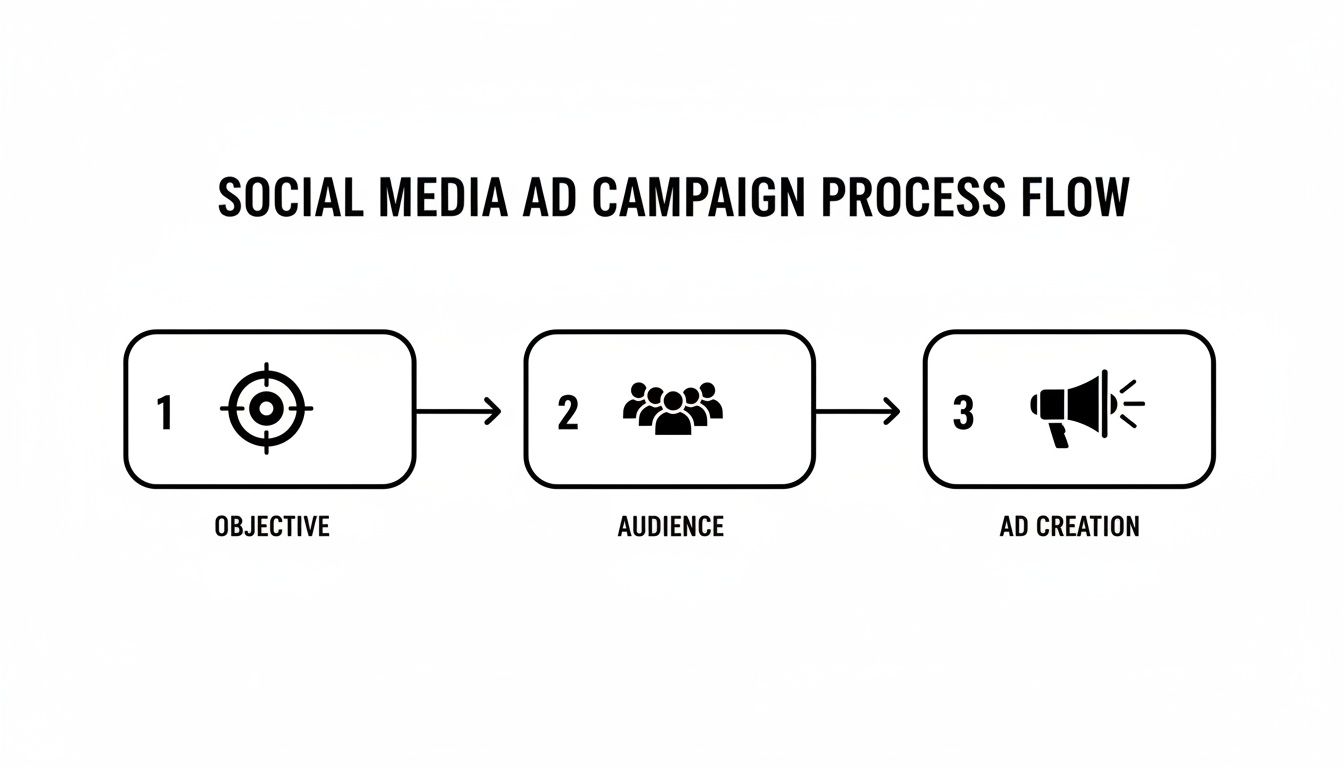
To get people to your landing page, a streamlined ad campaign is usually the most efficient engine. The basic flow looks something like this:
As you can see, a winning campaign always starts with a clear objective, is fueled by super-specific audience targeting, and is delivered through an ad that truly connects.
Nurturing Leads with Automated Follow-Ups
Getting the lead is just the beginning. The real magic, and where most of the money is made, is in the follow-up. This is where you nurture that new contact until they’re actually ready to have a conversation about a loan. A simple automated email sequence is your best friend here.
After that first email delivers the lead magnet, you’ll want to set up a short series of 3-4 more emails to go out over the next week or two.
Key Insight: The point of this follow-up sequence isn’t to sell. It’s to keep providing value. Each email should offer another helpful tip, answer a common question, or share a client success story. You’re building trust and staying top-of-mind.
For instance, your sequence might look like this:
Email 1: Delivers the lead magnet.
Email 2 (2 days later): “3 Common Mistakes First-Time Buyers Make.”
Email 3 (4 days later): A short video testimonial from a happy client.
Email 4 (7 days later): “Ready to see what your numbers look like? Let’s book a quick, no-pressure chat.”
This little automated system works for you 24/7, building relationships at scale. It ensures that when your prospects are finally ready to pull the trigger on a mortgage, you’re the first person they think of.
Your First 30 Days: A Social Media Action Plan
The goal for your first month is simple: establish consistency and provide real value. Forget about the follower count for now. Just focus on putting out a solid mix of helpful advice, client success stories, and a bit of your own personality. That’s how you build trust.
Here’s a pro tip: a scheduling tool like Postiz will be your best friend. You can sit down for an hour or two and schedule out an entire week’s worth of posts. This frees you up to spend just 15-20 minutes a day on what really matters—engaging with people in the comments and DMs. That’s where the relationships are built.
Week 1: A Sample Content Calendar
Your first week is all about setting the tone and showing people what you’re all about. This is your chance to introduce your core content pillars and prove you’re here to help, not just sell.
Sample Week 1 Content Calendar
Here’s a look at what your first week could look like. It’s a simple schedule designed to build consistency and keep you from feeling overwhelmed while engaging your audience from day one.
See how this schedule offers a healthy mix? It immediately positions you as a knowledgeable local expert who is generous with their expertise.
Key Takeaway: In the beginning, focus on your output, not the outcome. Just commit to the schedule. The leads and consultations will come once you’ve built that foundation of authority and trust.
Don’t underestimate the power of local. When you combine local SEO with a strong social media presence, you tap into a huge source of high-intent leads. In fact, properly optimized profiles with location-specific content can bring in 2.5x more qualified inquiries than generic, broad campaigns.
Remember, you don’t need to be everywhere. Pick one or two platforms where your ideal clients hang out and go all in. Just being consistent with your posting can boost your visibility by as much as 50%. If you want to dive deeper, it’s worth checking out some of the latest mortgage marketing trends.
Ultimately, your first 30 days are about laying the groundwork. Track what matters—the number of lead form submissions and actual calls booked, not just the vanity metrics like likes and shares.
Got Questions? We’ve Got Answers.
When it comes to social media for mortgage brokers, a lot of the same questions pop up. Let’s get right to them and clear things up so you can get back to what you do best.
How Much Time Does This Actually Take Every Week?
Let’s be realistic. You’re busy. The goal here is consistency, not just logging hours.
You can get it all done in about 3-5 hours a week. Seriously. Spend an hour or two on a Monday morning batching and scheduling your posts for the week. Then, it’s just about checking in for 15-20 minutes each day to reply to comments, answer DMs, and engage with others. That daily check-in is pure gold—it’s where relationships are built.
What are the Biggest Compliance Landmines to Avoid?
I see brokers stumble into the same few traps all the time. The big ones are:
Advertising specific rates without the proper disclosures.
Making any kind of promise about “guaranteed” approval.
Forgetting to put your NMLS ID in your bio.
My best advice? Keep your public posts educational and helpful. Talk about the process, not specific products. When someone is ready for the nitty-gritty details on rates, guide them into a private DM or a compliant landing page. This keeps you safe and serves the client better.
Should I DIY This or Hire an Agency?
When you’re just starting out, I always recommend doing it yourself. It’s the only way to truly find your voice and figure out what resonates with your local community. Following the steps in this guide will give you a solid foundation to build from.
Down the road, once you have a good rhythm and are ready to seriously ramp up your paid ads, that’s the time to think about bringing in a specialized mortgage marketing agency.
How Long Before I Actually See Leads Coming In?
Social media is a marathon, not a sprint. Sure, you might get lucky and snag a lead in your first week, but don’t count on it.
Realistically, it takes about 3-6 months of consistent, valuable content to build the trust you need for a steady stream of inquiries. Think of it like planting seeds. You have to nurture your audience and provide value upfront. Once you do that, the business will absolutely follow.
Ready to save hours each week and build a social media machine that works for you? Postiz gives you the scheduling, content creation, and analytics tools to turn those followers into actual leads. Start simplifying your social media marketing by visiting https://postiz.com.