For doctors and medical practices, it’s a powerful way to build your reputation, connect with people in your community, and share genuinely helpful information. It’s about creating valuable, HIPAA-compliant content on platforms like Facebook and Instagram to show the human side of your practice and build real trust.
Why Social Media Is Your New Front Door
Today’s patient journey doesn’t start with a phone call; it starts with a thumb-scroll through a social media feed.
Prospective patients are digging deeper than just a list of services on a website. They’re looking for connection, expertise, and a sense of reassurance. Your social media profiles offer a genuine window into your practice’s personality, your values, and the level of care you’re committed to providing.
Building Trust Before the First Appointment
It’s where people form their first impressions long before they ever step into your office. They’re checking your credentials, seeing how you talk to your community, and deciding if you feel like the right fit for them and their family.
An active, authentic presence helps break down the clinical barrier, making your practice feel less like an institution and more like a trusted health partner.
And the numbers back this up. A staggering 41% of people say a doctor’s social media presence directly influences their choice of a provider. We’ve seen practices that post consistently report a real, tangible uptick in patient inquiries and appointment bookings.
Reducing Patient Anxiety Before They Ever Walk In
For many patients, anxiety is one of the biggest barriers to booking an appointment. Social media gives medical practices a powerful way to reduce that fear before the first visit ever happens. By explaining procedures, showing what an appointment actually looks like, and answering common questions in advance, you remove uncertainty and build confidence.
Simple content like “What to expect during your first visit,” short walkthrough videos of your clinic, or explanations of common procedures help patients feel informed instead of intimidated. Practices that proactively address patient concerns online often see higher conversion rates because patients arrive already reassured and ready to take the next step.
The Modern Patient’s Journey
This table breaks down how social media plays a crucial role at each stage of a patient’s decision-making process.
How Patients Use Social Media to Choose a Doctor
Patient Journey Stage
Social Media’s Role
Example Action
Awareness
Discovering new providers outside of direct need.
Seeing a friend share an educational video from your practice about seasonal allergies.
Consideration
Actively researching and vetting potential doctors.
Searching for local pediatricians and reviewing your clinic’s Instagram for patient testimonials and “meet the team” posts.
Decision
Finalizing the choice based on trust and accessibility.
Comparing your helpful, engaging profile against a competitor’s silent one and deciding to book with you.
Manage all your social media in one place with Postiz
The goal isn’t just to throw generic health tips out into the void; it’s about creating a truly valuable resource that makes your practice the first place people in your community think of.
You need a solid game plan that pulls people in while strictly following all HIPAA guidelines. That means every single post, video, and story has to be planned with care.
The Foundation of Trustworthy Content
Your biggest advantage online is the trust people already have in medical professionals. In a world swimming with bad information, your voice has real authority. In fact, 60% of social media users say they trust posts from doctors more than any other group.
To build on that trust, everything you post should be:
Authoritative: Stick to what you know. Share accurate, evidence-based information that showcases your expertise.
Accessible: Ditch the medical jargon. Break down complicated health topics into plain English that anyone can grasp.
Empathetic: Tune into the real-world worries and questions your patients have. Show them you get it.
Consistent: Show up regularly. A steady posting rhythm keeps you on your audience’s radar and builds momentum.
Structuring Your Strategy with Content Pillars
Trying to come up with new post ideas every day is a fast track to burnout. A much smarter way to work is by using content pillars—three to five core themes you’ll talk about over and over again. These pillars become the backbone of your content calendar, making sure everything you post is on-brand and on-message.
Examples of Content Pillars for a Medical Practice
Content Pillar
Description
Example Post Idea
Myth-Busting Mondays
Debunk common health myths and bad advice floating around in your specialty.
A quick video explaining why cracking your knuckles doesn’t actually cause arthritis.
Wellness Wednesdays
Offer practical, can-do-today tips for living a healthier life.
An infographic showing five simple stretches to undo the damage of sitting at a desk all day.
Behind-the-Scenes
Show the human side of your practice by featuring your team, new tech, or office life.
A carousel post introducing a new nurse with a few fun facts about them.
Patient Education
Explain common conditions, procedures, or treatments in a simple, visual way.
An animated graphic that shows how a particular vaccine works in the body.
This approach makes planning so much easier. Instead of staring at a blank calendar, you just ask, “What myth can we tackle this Monday?” To get more tactical, you can learn how to create a social media content calendar that maps all this out beautifully.
Navigating HIPAA and Patient Privacy
Compliance is non-negotiable. One small slip-up can destroy trust and land you in serious legal trouble. The golden rule is simple: never, ever post anything that could identify a patient without their explicit, written consent. This goes for names, photos, specific details about their case, or any other personally identifiable information (PII).
Even if a post feels anonymous, tiny details can piece together a patient’s identity. Always play it safe. General health advice is your friend; specific patient stories are a minefield.
Here are the hard and fast rules.
Do:
Share general health information that educates your entire audience.
Post “day-in-the-life” content featuring your staff (always with their permission, of course).
Answer general questions from your audience, but never give personal medical advice.
Get signed, detailed consent forms if you feature a patient testimonial. They must understand exactly where and how their story will be used.
Don’t:
Post photos or videos of patients in your office, even if they’re just in the background.
Discuss specific patient cases online, no matter how educational you think it might be.
Reply to comments with medical advice for one person’s situation. The only right answer is, “Please book a private consultation so we can help you properly.”
By keeping your focus on education, your team, and general wellness, you can build a social media presence that’s vibrant, engaging, and 100% compliant. For more tips on building an efficient system, check out our expert insights on content creation best practices.
Choosing the Right Platforms for Your Practice
One of the biggest mistakes doctors make on social media is trying to be everywhere at once. Spreading yourself thin across five different platforms is a fast track to burnout and lackluster results. The real key to growth is focusing your energy where your ideal patients are already hanging out.
Instead of just signing up for everything, pause and think about your practice’s goals and who you’re trying to reach.
Matching Platforms to Your Practice and Patients
Every social media platform has its own vibe, audience, and content style. A dermatologist trying to connect with a younger crowd using visual before-and-afters will feel right at home on Instagram. On the other hand, a medical device consultant building a professional network of hospital administrators will get much more value from LinkedIn.
What’s your main objective? Are you trying to educate your local community about preventative care? Attract new patients for a specific high-value procedure? Or establish yourself as the go-to expert in your field? Your answer will point you to the right digital home.
Here’s a practical look at the major players:
Facebook: It’s still a titan, especially for reaching adults aged 30 and over. This is the perfect place to build a local community, share patient success stories (with explicit consent, of course), and post day-to-day practice updates. The Events feature is also fantastic for promoting things like health seminars or open house events.
Instagram: This is a visual-first platform, making it a goldmine for specialties like dermatology, cosmetic surgery, and preventative wellness. Think high-quality photos, engaging Reels, and behind-the-scenes Stories that show the human side of your practice and make procedures less intimidating.
LinkedIn: This is the professional’s network, period. If your goal is to connect with colleagues, recruit top-tier staff, or market your services to other businesses (like corporate wellness programs), you need to be on LinkedIn. It’s built for sharing research, industry insights, and professional milestones.
TikTok: Welcome to the world of short-form video, dominated by a younger audience. It’s a surprisingly powerful tool for busting common health myths, sharing quick wellness tips, and jumping on trends in a creative, educational way. A pediatrician, for example, could make short, fun videos about kids’ health that parents would love.
YouTube: This is the king of long-form educational video. If you enjoy teaching, you can create detailed videos explaining complex medical conditions, walking through treatment options, or covering wellness topics. These videos are search-friendly and can serve as a valuable patient resource for years to come.
Building a Sustainable and Compliant Presence
Once you’ve picked one or two main platforms, remember this: consistency beats frequency. A steady, predictable posting rhythm builds trust and keeps your practice on people’s minds. This doesn’t mean you have to be glued to your phone 24/7. Using a social media scheduling tool like Postiz can save you countless hours by letting you plan and schedule your posts in one go.
Consistency matters more than frequency. Using a Facebook post scheduler helps medical practices plan compliant content in advance while staying active without daily manual posting.
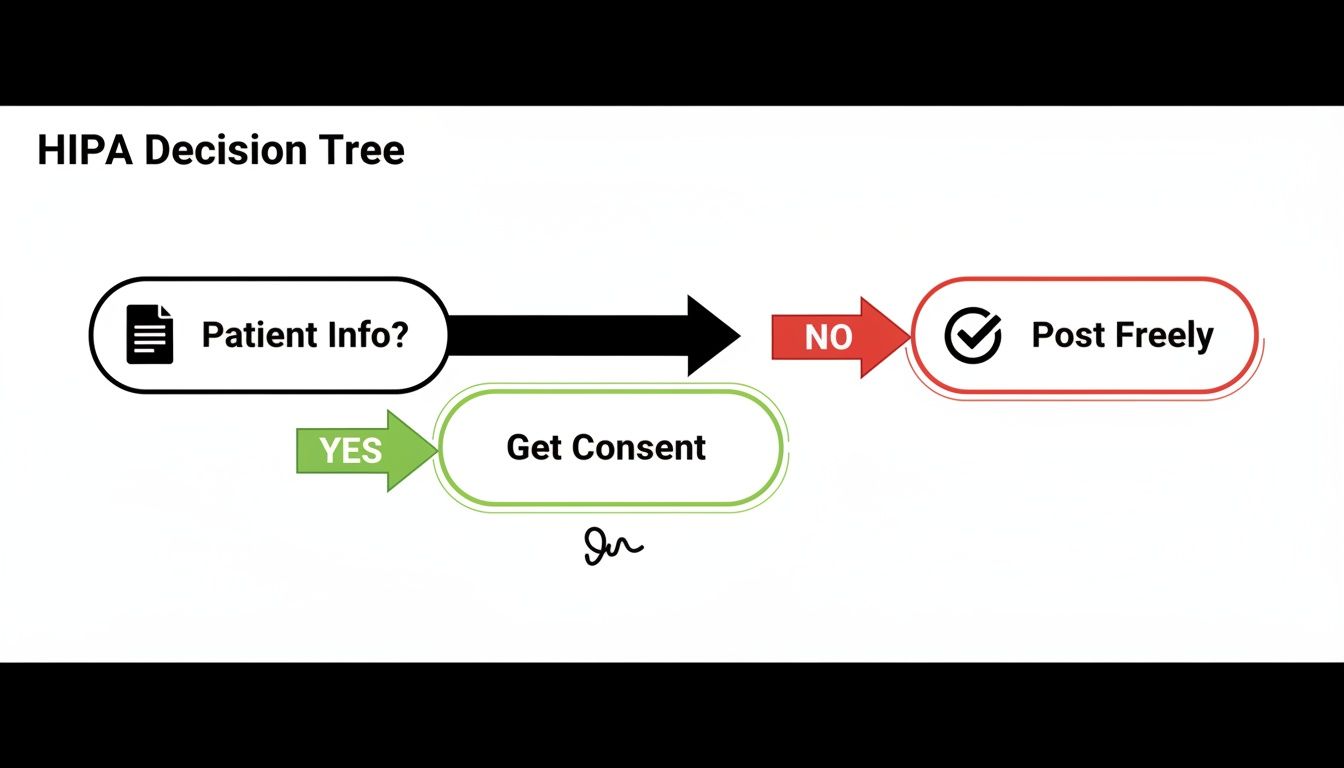
To make this easier, here’s a simple decision tree to run through before you post anything related to patients.
This chart drives home the golden rule: if any piece of information could even remotely identify a patient, you absolutely must get explicit, written consent before sharing. When in doubt, just stick to general, educational content. It’s always the safest bet.
Don’t just post—engage. The real magic of social media happens in the conversation. Carve out a little time each day to respond to comments and messages. This is how you turn a simple profile into a thriving community hub.
By zeroing in on the platforms that truly align with your practice’s goals, you create a focused and effective online presence. Deciding where to invest your time is a fundamental part of any good multi-channel marketing strategy, making sure all your hard work translates into real patient growth and stronger community trust.
Building a Community and Managing Your Reputation
Engaging with your audience turns followers into advocates. Every comment, message, and review is a chance to show you’re listening, answer questions, and put a human face to your practice.
Fostering a Helpful and Compliant Community
Your comments section is a direct line to your patients and your local community. When you respond promptly and thoughtfully, you build incredible trust. It shows you care.
Of course, every interaction has to be handled carefully to stay HIPAA compliant. The golden rule is to be helpful without ever giving out specific medical advice.
Here are a few common situations you’ll run into:
A user asks a general health question: Someone might ask, “What are the common symptoms of seasonal allergies?” This is a great opportunity to provide a helpful, educational answer that benefits everyone reading.
A user asks for personal medical advice: If a comment says, “I have a sharp pain in my knee, what should I do?” your response needs to be firm and clear. A simple, “We can’t provide medical advice online, but we’d be happy to help. Please call our office to schedule a consultation” is the perfect, compliant way to handle it.
A user shares positive feedback: Don’t let these moments pass by! Acknowledge and thank them. A quick, “Thank you for the kind words, we’re so glad we could help!” goes a long way in making people feel valued.
This kind of proactive engagement turns your social media page from a simple advertisement into a go-to resource people can rely on.
Navigating the World of Online Reviews
Online reviews are a fact of life for any modern medical practice. In fact, research shows that 9 out of 10 patients use them to evaluate doctors, which makes managing them a top priority.
For doctors, solid healthcare reputation management is non-negotiable. How you respond to feedback—good or bad—is on display for every potential patient who looks you up.
Think of every online review as a public conversation. Your response isn’t just for the person who wrote it; it’s for everyone else watching to see how you handle feedback.
A Framework for Responding to Reviews
Having a plan in place before you need it is key. A consistent approach ensures every review is handled with professionalism and empathy.
Handling Positive Reviews
Reply Promptly: Try to respond within 24-48 hours. It shows you’re paying attention and appreciate them taking the time.
Personalize Your Thanks: Instead of a generic “Thanks,” reference a detail they mentioned. For example, “We’re so glad you had a great experience with our front desk team!”
Keep it General: Even if they share details, never confirm they are a patient or discuss their visit. Avoid disclosing PHI by keeping your response appreciative but general.
Handling Negative Reviews
Acknowledge and Empathize: Always start by validating their feelings. A simple, “We’re sorry to hear your experience didn’t meet your expectations,” can de-escalate the situation immediately.
Take it Offline: Your goal is to move the conversation to a private channel. Say, “We take patient feedback very seriously. Please call our practice manager at [Phone Number] so we can address this directly.”
Stay Professional: Never get defensive or argue online. It’s a battle you can’t win. A calm, professional response that moves the conversation offline is always the right move.
Mastering these skills builds a resilient online presence that not only protects your reputation but also fosters the kind of patient loyalty that helps your practice grow.
Many local businesses rely on community-driven engagement to build trust and visibility. These local social media marketing strategies show how consistent interaction strengthens reputation over time.
Using Paid Ads to Reach More Patients
Building up your social media presence organically is a fantastic way to earn long-term trust, but let’s be honest—it can be a slow, frustrating climb. Paid advertising on platforms like Facebook and Instagram is your shortcut. It lets you skip the line and put your practice right in front of the specific patients you want to attract.
First Things First: What’s Your Goal?
Before you even think about putting a credit card on file, you have to know what you want to achieve. A campaign without a clear goal is just expensive noise. Your objective will shape every other decision you make, from the ad’s headline to the audience you target.
For a medical practice, your goals will likely boil down to one of these:
Lead Generation: This is all about getting contact info. You’re not going for the direct booking just yet. Instead, you might offer a “Free Guide to Managing Seasonal Allergies” in exchange for an email address.
Direct Bookings: The most straightforward goal. The call-to-action is simple and urgent: “Book Your Annual Check-Up Now.”
Promoting a New Service: Did you just bring in a new laser or start offering a specialized procedure? Ads are the quickest way to get the word out. Your ad might announce, “Now Offering Laser Skin Rejuvenation at Our Clinic.”
Building Community Awareness: Sometimes, the aim is broader. You just want to be the go-to, trusted practice in your area. These campaigns often promote a helpful blog post or an educational video, establishing your expertise.
My advice? Stick to one goal per campaign. Trying to get leads and promote a new service in the same ad just confuses people and weakens your message.
Targeting Your Ideal Audience with Precision
This is where the magic really happens. The targeting tools on social media are incredibly powerful, letting you zero in on specific groups with pinpoint accuracy. You can go way beyond basic demographics and connect with people based on their location, what they’re interested in, and even their recent life events.
Let’s walk through an example. Say a cosmetic dermatologist in Austin, Texas, wants to promote a new line of anti-aging treatments. Instead of blasting her ad to everyone in the city, she can get incredibly specific.
She could set her ad to reach:
Women
Aged 35-60
Who live within a 10-mile radius of her clinic’s zip code
And have shown interest in topics like “skincare,” “luxury beauty,” or follow pages of high-end cosmetic brands.
This kind of detail ensures her budget isn’t wasted on people who aren’t a good fit. She’s only paying to reach those most likely to be interested, which dramatically increases her return on investment.
The real power of paid ads is in the precision. You’re not just shouting into the void; you’re having a direct conversation with a hand-picked audience that’s already looking for the solutions you offer.
There’s a reason the healthcare industry is leaning into this so heavily. In 2024, 72.2% of total healthcare ad budgets went to digital, with spending projected to hit nearly $20 billion. The investment is happening because it delivers results. One clinic, for instance, ran a social media campaign targeting 35-54-year-olds and saw a 28% lift in appointments at 4x ROI. For doctors, these numbers show that dedicating a part of your marketing budget to targeted social ads is a proven strategy for growth. You can find out more about how doctors are using marketing statistics to fuel growth.
When you combine a crystal-clear objective with precise audience targeting, even a modest ad budget can pack a serious punch. It’s a vital tool in your social media marketing toolkit, helping you connect your expertise with the patients who need you most, right when they need you.
How to Measure Social Media’s Impact on Patient Growth
Likes and followers are easy to track, but they don’t tell you if social media is actually growing your practice. What matters most is patient action. Medical practices should focus on tracking appointment requests, phone calls, contact form submissions, and direct messages that originate from social platforms.
Simple steps like using platform-specific booking links, asking new patients how they found you, or tracking link clicks from social profiles give you clear visibility into what’s working. Over time, this data helps you double down on the content and platforms that consistently bring in real patients, not just engagement.
Common Questions About Social Media for Doctors
Diving into social media can feel like a big step for any medical professional. It’s totally normal to have questions, especially when you’re balancing patient privacy and your professional reputation. Let’s walk through some of the most common concerns I hear from doctors.
How Much Time Does This Actually Take?
The fear of this becoming a massive time-suck is probably the number one reason doctors hesitate. But here’s the good news: an effective social media presence is built on consistency, not constant, round-the-clock activity. You don’t need to be glued to your phone to make a real impact.
With a smart workflow, you can handle everything in just a few hours a week. The trick is to batch your work. Block out one afternoon a month to map out your main topics, draft a batch of posts, and get them all scheduled in advance using a tool like Postiz. Suddenly, what felt like a daily chore becomes one manageable task.
What if I Get Negative Comments or Reviews?
Look, no one likes getting negative feedback. But on the internet, it’s going to happen eventually. The most important thing is to have a game plan before it does. How you respond says far more about your practice than the original comment ever could.
A single angry comment can feel like a personal attack, but it’s critical to meet it with professionalism and empathy. Remember, you aren’t just replying to that one person; you’re showing every potential patient watching how you handle criticism.
Here’s a simple, three-step approach I always recommend for handling negative feedback:
Acknowledge and Empathize: A simple, “We’re sorry to hear your experience wasn’t what you expected,” goes a long way. It immediately shows you’re listening.
Take it Offline: Never, ever get into a public debate. The goal is to move the conversation to a private channel. Something like, “We take this very seriously and want to address your concerns directly. Could you please call our practice manager at…” is the perfect way to do it.
Don’t Argue: It can be tempting to defend yourself, but don’t. A calm, professional reply that moves the conversation private is always the winning play.
Is It Possible to Violate HIPAA Accidentally?
This is the big one, and for good reason. The legal and ethical lines around patient privacy are crystal clear and must be respected. The great news is that staying compliant is entirely achievable if you have clear guidelines in place for you and your team.
The absolute golden rule is this: never post anything that could potentially identify a patient without their explicit, signed, written consent. This isn’t just names or photos. It can be small details about a case that, when pieced together, could reveal who you’re talking about.
I find it helpful to think of content in two distinct buckets:
Safe Zone (No Consent Needed): This is where you’ll spend most of your time. Think general health info, wellness tips, myth-busting videos, and introducing your staff (with their permission, of course). This content builds your authority and connection.
Consent Required Zone: This includes things like patient testimonials, case studies, or before-and-after photos. For any of this, you absolutely need a detailed consent form that clearly states how and where their information and images will be used.
When in doubt, always play it safe. If you focus on general education and building community, you’ll create an engaging presence without ever putting patient privacy on the line. Social media marketing for doctors is built on a foundation of trust, and strict HIPAA adherence is non-negotiable.
Postiz gives you the tools to schedule posts, engage with your audience, and stay compliant, all in one spot. Streamline your entire process and start building a powerful online presence today at https://postiz.com.