When it comes to restaurants, it goes beyond taking beautiful food photos on social media. It’s more about creating your brand, reaching out to your community, and, as a result, getting more people into your restaurant. It’s about being that nondescript spot everyone forgets about as opposed to being a buzzed-about spot that everyone goes to.
Building Your Social Media Foundation
This foundational work is about making smart choices about who you’re trying to reach and where they hang out online.
Let’s get one thing straight: the fact that people discover restaurants today has changed dramatically. So, about 82% of establishments have a presence on social media. It’s nohidden reason; it’s because that’s where their customers are. And get this: 74 percent of people today use social media as a platform for choosing where they want to dine. Yeah, more than half are Instagramming and Facebooking as they search for what they want to munch on.
Defining Your Ideal Diner
Seriously though, who are you catering to? The response to that question will inform every single status update, story, and ad you put out. You’re looking to pique the interest of someone who does lunch, someone who does brunch on the weekend, or someone who needs a quick and easy supper solution on a weekday night?
Business Professionals: They are interested in lunch specials, online ordering, and happy hour spots where they can unwind after work. You would either find them on LinkedIn or via very targeted ads on Facebook.
Brunch Crowd: Their focus is on viewing and aesthetic appeal. Their demands include food pictures worth Instagramming, reposts of their own photos (hello, user-generated content!), and photos from local influencers they love on Instagram.
Families: They’re looking for family-friendly menus, value for money, and an inviting ambiance. First, they turn to local Facebook pages for advice.
Knowing your audience lets you speak their language instead of just shouting into the digital void. This is the heart of any good small business social media strategy.
Choosing the Right Platforms
Here’s a secret: you don’t need to be everywhere. Trying to manage a profile on every single platform is a classic mistake that will burn you out fast. Focus your time and energy where it will actually make a difference. To really get this right, you need to understand some social media marketing fundamentals.
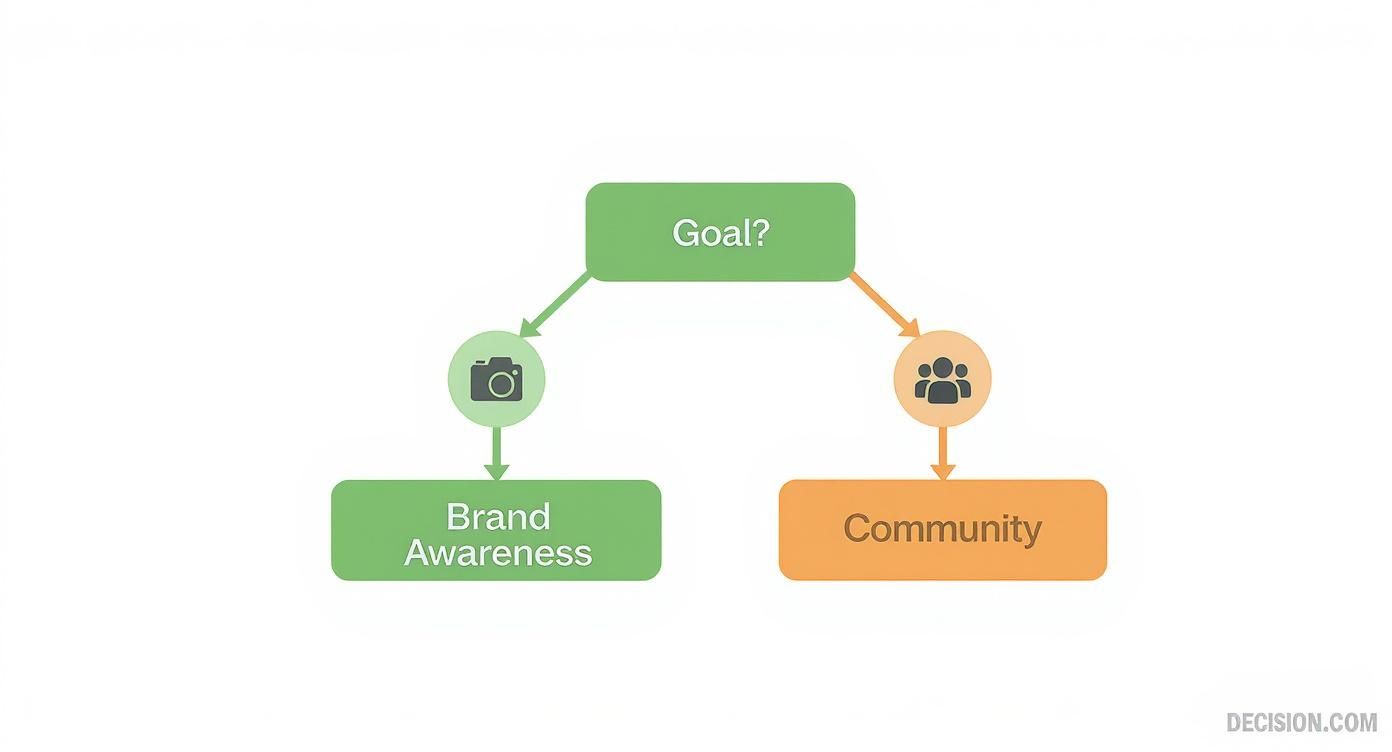
This simple decision tree can help you match your goals to the right platform.
Whether your main goal is getting your name out there or building a loyal following, this helps you choose the right path and avoid wasting time.
Tools like Postiz make it easy to schedule Facebook posts in advance, ensuring your events, promotions, and updates go live even during busy service hours.
Manage all your social media in one place with Postiz
Choosing where to invest your time can feel overwhelming. This table breaks down the top platforms to help you decide where your restaurant will shine.
Community building, local targeting, event promotion
Broad, especially Gen X & Boomers (30-65+)
Events, customer reviews, community group engagement, targeted local ads
TikTok
Going viral, showing personality, reaching Gen Z
Gen Z & younger Millennials (16-25)
Short, trendy videos, recipe clips, “day in the life” content, staff fun
X (Twitter)
Real-time updates, customer service, local news engagement
News-savvy users, professionals, other media
Quick updates on hours, menu changes, engaging in local conversations
Yelp/Google
Driving immediate traffic, managing reputation
Diners with high purchase intent
Responding to reviews, updating hours/menu, posting professional photos
Ultimately, the best platform is the one where your ideal diner spends their time. Start with one or two, master them, and then consider expanding.
How Social Media Boosts Your Google Maps & Local Search Visibility
Social media not only drives engagement but helps with your local search visibility. When people search for your restaurant on Google Maps, there’s a high chance that they click on your Instagram or Facebook page before making an ultimate decision. Creating regular social media posts, updating your profile links and picture postings, and backing it up with new images will help build trust signals that will inspire people to visit your restaurant. Asking people to tag your location and leave reviews will increase your social proof and Google Maps business’s performance.
If you want a broader framework beyond restaurants, many of these principles are also covered in our guide to social media marketing for local businesses, especially when it comes to local discovery and community engagement.
Crafting a Recognizable Brand Voice and Aesthetic
Your brand personality should shine through with everything you put on your page. Are you a loud and lively taco spot or a mellow and upscale bistro? Your online presence should be reflective of that.
Your social media profile should be your online storefront. It should offer an experience that your online customer would receive if they walked into your front door. Your consistency with your colors and your photo aesthetic will make your brand remembered.
Crafting a Content Strategy That Makes People Hungry
Excellent social media isn’t something that occurs on its own. It’s based on content that pauses people from scrolling and gives them something they crave. Your strategy on all platforms should be considered your restaurant’s virtual window display. It should offer diversity, it should be delicious, and it should have an engaging message that makes people interested and wanting more.
Your Core Content Pillars
Imagine your social feed as a multi-course meal. You need appetizers, entrées, and desserts to keep your audience engaged. Just posting one type of content is like a restaurant that only serves bread—it gets old, fast. A solid plan for social media marketing for restaurants is built on a few key pillars.
Drool-Worthy Food & Drink Shots: This is your bread and butter, no question. High-quality visuals of your dishes are non-negotiable. We’re talking vibrant, well-lit photos that make people’s stomachs rumble just by looking at them.
Behind-the-Scenes Action: Roll back the curtain and let your audience see some magic. It could be a quick video of your chef assembling your signature dish, your bartender mixing your latest drink special, and yes, it could even be your produce arriving at your restaurant from a local farm.
Your People and Vibe: It’s people who attract people, not business logos. Give your audience a meet-and-greet with your people. A shout-out about your head chef’s anniversary at your restaurant or a fun clip of your wait staff getting ready for a busy night will add a personal touch that will turn followers into a community.
Client Photos (User-Generated Content): Seeing a customer share an amazing photo they took from dinner at your restaurant and posting it on your site—with their permission, and then reposting it with tags—is pure gold. It’s as authentic as it gets. It inspires your own customers to start taking photos because they get recognized.
How to Take Great Food Photos with Just Your Phone
You don’t need to hire a professional photographer for every post. Today’s smartphones have amazing cameras, and if you know a few simple tricks, you can capture incredible food shots that look polished and delicious.
My Go-To Tips for Better Food Photos:
Find the Natural Light: This is rule number one. Seriously. Set your dish up near a window to get that soft, beautiful daylight. Stay away from harsh overhead restaurant lights—they create nasty shadows and make food look flat and unappetizing.
Play with Angles: Don’t just take one shot and call it a day. Get an overhead shot for a flat-lay of the whole table. Try a 45-degree angle to show off the texture and layers of a burger. Or get in close for a macro shot of that melty cheese.
Keep the Background Simple: Let the food be the star. A clean, uncluttered background—like a simple wooden table or a neutral placemat—keeps the focus right where it should be: on your incredible dish.
A Quick Edit Makes a Big Difference: Use your phone’s built-in editing tools for a final touch-up. A little bump in brightness, contrast, or saturation can make the colors pop and take your photo from good to mouthwatering.
How to Promote Your Menu Without Repeating Yourself
Posting your menu doesn’t mean showing the same dish over and over. Rotate formats instead of items: close-ups one week, plating videos the next, staff favorites another week, and customer reactions after that. Seasonal menus, limited-time offers, and chef recommendations give you endless angles without overwhelming followers. This keeps your feed fresh while reinforcing what you actually sell.
Don’t Sleep on Short-Form Video
Static images are essential, but short-form video on platforms like Instagram Reels and TikTok is how you truly bring your restaurant’s personality to life. There’s something hypnotic about motion—a perfect cheese pull, a slow-motion sauce drizzle, a steak sizzling on the grill. These clips grab attention in a way photos can’t.
Short-form video is your restaurant’s highlight reel. It captures the energy, the sounds, and the atmosphere that a photo just can’t convey. Think of it as a 15-second invitation to come experience it all in person.
Keep your videos short, punchy, and engaging. Slap some trending audio on there to boost your reach, and always add captions—so many people watch with the sound off.
Using Instagram Story Highlights to Convert Viewers Into Guests
Instagram Highlights act as permanent landing pages for your restaurant. Instead of disappearing after 24 hours, they allow new visitors to instantly understand your menu, vibe, and experience. Highlights like “Menu,” “Brunch,” “Reviews,” “Events,” and “Behind the Scenes” help customers decide faster. Think of them as your digital concierge, answering common questions before anyone needs to message you.
Plan Your Content Calendar
Consistency is what keeps you top-of-mind. A content calendar is your secret weapon for planning posts ahead of time, ensuring you always have a steady flow of great content that hits all your key pillars. It doesn’t have to be fancy; a simple spreadsheet works great.
For instance, a simple weekly schedule could look like this:
Monday: Behind-the-scenes video of your team prepping for the week.
Wednesday: A stunning photo of your weekly special.
Friday: Reshare a great user-generated photo from a happy customer to kick off the weekend.
Using a tool like Postiz lets you schedule everything in advance, which is a massive time-saver and ensures you never miss a beat. A well-planned calendar is the foundation of any good content strategy for social media.
Remember, the visuals you share directly impact foot traffic. In fact, 40% of people have chosen to visit a restaurant simply after seeing tempting food photos online. This just goes to show how critical high-quality, enticing imagery is for pulling in new customers.
Turning Followers Into a Loyal Community
Getting people to hit that “follow” button is a great start, but it’s just that—a start. The real magic happens when you stop broadcasting your menu and start building a genuine community of regulars and advocates. This is where your social media presence transforms from a billboard into a conversation.
From Broadcasting to Engaging
Your job isn’t just to post; it’s to listen and respond. Active community management means diving into the comments, answering questions, and letting the personality behind your brand shine through. It’s the difference between a static digital flyer and a lively, welcoming conversation.
So when someone comments, “That burger looks amazing!” don’t just “like” it and move on. Jump in with something real. “Thanks! Our chef is obsessed with that one, especially with the garlic aioli. You should come try it this week!” That simple interaction makes people feel seen and valued.
A follower might see your food, but a community member feels your hospitality. Every reply, share, and interaction is a chance to extend that hospitality beyond your four walls.
This back-and-forth is the bedrock of a loyal base. The more you genuinely engage with your audience, the more they’ll engage with you, creating a positive feedback loop that boosts your visibility across the platform.
Community-driven strategies like this aren’t unique to restaurants. Similar approaches are also used in industries built on trust and relationships, such as social media marketing for real estate agents.
Turning Social Media DMs Into Reservations
For many diners, sending a DM feels easier than calling or filling out a form. Restaurants that respond quickly to messages often win the booking by default. Set up saved replies for common questions like hours, parking, and reservations, and use auto-responses to guide users to your booking link. Fast, friendly DM responses can turn casual interest into confirmed tables.
Sparking Conversation and User-Generated Content
The best part? You don’t always have to be the one starting the conversation. You can empower your guests to become part of your story by actively encouraging user-generated content (UGC). When a customer tags you in a beautiful photo of their meal, it’s one of the most powerful and authentic endorsements you can get.
Here are a few simple ways to get the ball rolling:
Run simple contests: Ask followers to share their favorite memory at your restaurant with a special hashtag. The prize? A gift card for their next visit.
Ask engaging questions: Post a photo of two popular cocktails and ask, “Happy hour is calling. Which one are you choosing tonight?”
Feature your guests: Dedicate a weekly post to your favorite customer photo. Just be sure to ask for permission first and give them a proper shout-out.
These tactics do more than just fill your content calendar. They make your guests feel like stars and inspire others to start sharing their own experiences, too.
Managing Your Online Reputation
Your online reputation is built one review and one comment at a time. It’s no longer just about word-of-mouth; online reviews are the new currency of trust. In fact, 88% of diners now trust online feedback as much as personal recommendations.
Gracefully handling all feedback—the good, the bad, and the lukewarm—is a huge part of building community.
Reputation management is critical across many industries. For example, professionals in highly trust-based fields like social media marketing for lawyers use similar review and response frameworks to protect credibility and win new clients.
A Simple Framework for Responding to Reviews
Review Type
Your Goal
A Real-World Response Example
Glowing 5-Star
Show appreciation & encourage loyalty
“Thank you so much, [Name]! We’re thrilled you enjoyed the [Dish Name]. We can’t wait to see you again soon!”
Vague 3-Star
Gather more info & show you care
“Hi [Name], thanks for taking the time to leave feedback. We’d love to learn more about how we can make your next visit a 5-star experience.”
Critical 1-Star
Acknowledge, apologize, & take it offline
“Hi [Name], we’re so sorry to hear this. This isn’t the standard we aim for. Please send us a DM so we can get more details and make this right.”
Handling a negative review with empathy and professionalism can honestly be more powerful than a dozen positive ones. It shows potential customers that you’re committed to great service and that you actually listen. That trust is the foundation of any strong community.
Using Social Media During Service Issues or Unexpected Closures
When things go wrong, social media becomes your fastest communication channel. Whether it’s a last-minute closure, staff shortage, or delayed service, proactive updates build trust. Clear, honest posts reduce frustration and show professionalism. Restaurants that communicate early and transparently protect their reputation even during difficult moments.
Driving Bookings With Targeted Social Ads
Organic posts are great for building your brand, but let’s be real—they won’t always fill your seats on a slow Tuesday night. That’s where a smart, paid social ad strategy becomes your secret weapon. This isn’t about throwing money at Facebook and hoping for the best; it’s about surgically targeting potential diners in your neighborhood and giving them a reason to book a table right now.
Think of paid ads as your digital sandwich board, but one that magically appears only in front of people who are already hungry and looking for a place just like yours. It’s a direct line to new customers and a powerful way to drive immediate revenue.
Finding Your Diners With Hyper-Local Targeting
The magic of platforms like Facebook and Instagram Ads is their incredible targeting. You can get so specific, ensuring every dollar you spend is reaching the right people. Forget casting a wide, national net; your goldmine is right in your local community.
Start by targeting users within a 3-5 mile radius of your restaurant. This simple geographic filter immediately ensures you’re only talking to people who can realistically stop by.
From there, you get to layer on interests and behaviors. For example, if you run an Italian restaurant, you could target users who:
Live within your 5-mile radius.
Have shown an interest in “Italian cuisine,” “fine dining,” or “wine.”
Follow pages like Food & Wine or popular local food bloggers.
Are celebrating a recent anniversary or have a birthday coming up.
This level of detail means you aren’t just reaching locals; you’re reaching locals who are already primed to love what you do. It’s the difference between shouting in a crowded stadium and having a quiet, persuasive conversation with your ideal customer.
Designing Ads That Stop the Scroll
You have maybe two seconds to grab someone’s attention as they fly through their feed. Your ad creative—the photo or video—is your most important hook. A static image can work if it’s absolutely stunning, but video is where the real engagement is.
A short, 15-second video of a chef plating a beautiful dish, a perfect cheese pull on a pizza, or a bartender crafting a signature cocktail is infinitely more compelling than a still photo. It captures energy and sells an experience, making people feel hungry and inspired.
Your ad copy needs to be direct and punchy, with a crystal-clear call-to-action (CTA). Don’t just say “Come visit us!” Tell them exactly what to do next.
For Reservations: Use a “Book Now” button that links directly to your Resy, OpenTable, or website reservation page.
For Takeout/Delivery: Use an “Order Now” button that goes straight to your online ordering platform.
For a Special Offer: Use a “Learn More” button that sends them to a landing page with all the details.
Keep the text short. Lead with the most exciting part, like “Weekend Brunch is here! 🍳 Book your table before we’re full.”
Planning Seasonal and Event-Based Social Campaigns
Seasonal moments create urgency. From Valentine’s Day dinners to summer patio launches and game-day specials, time-based campaigns give people a reason to act now. Build short social campaigns around holidays, local events, and even weather changes. A rainy-day comfort meal post or a sunny-weekend brunch reminder can drive immediate traffic when timing is right.
The Power of Retargeting
What about all those people who visited your website, scrolled through the menu, but never made a reservation? Don’t just let them walk away! This is where retargeting comes into play.
By placing a pixel on your website (a tiny snippet of code), you can serve specific ads to people who have already shown interest in your restaurant. These “warm” leads are far more likely to convert because they’re already familiar with you.
A simple retargeting ad could feature your most popular dish with copy like, “Still thinking about our lasagna? It’s waiting for you. Book your table tonight!” It’s a gentle, effective nudge that reminds them why they were interested in the first place, putting your ad spend toward the people most likely to become paying customers.
This shift to paid strategies is happening across the industry. Global spending on social media advertising in the restaurant sector is projected to hit a massive $276.7 billion by 2025. Even platforms like Pinterest show huge potential, as 80% of its weekly users discover new brands there—proving just how critical paid visibility has become. You can find more restaurant advertising trends on cropink.com.
Measuring What Matters for Your Restaurant
So, how do you know if all this social media effort is actually paying off? It’s really easy to get mesmerized by likes and a growing follower count, but those numbers don’t necessarily fill tables on a Tuesday night. Real success comes from tracking the right data—the key performance indicators (KPIs) that connect what you’re doing online to your restaurant’s bottom line.
You have to look past the “vanity metrics.” A huge follower count looks great on paper, but it doesn’t mean much if those people aren’t commenting, clicking to your website, or making reservations. The goal isn’t just to be popular online; it’s to be profitable.
This means you need to shift your focus to metrics that actually tell you something about customer behavior. Are people clicking the link in your bio to check out the new menu? How many reservations came directly from your Instagram profile last week? Answering these questions shows you the true return on your time and investment.
Identifying Your Most Important KPIs
To get a clear picture of what’s working, you need to track a few specific metrics that tie back to your actual business goals. Instead of getting overwhelmed by a giant spreadsheet of data, just concentrate on the handful of KPIs that have the biggest impact. These are the numbers that will shape your strategy and tell you what your audience really cares about.
Here are the metrics I always tell restaurant owners to watch:
Engagement Rate: This is all about how much your audience is interacting with your content. You can figure it out by dividing your total interactions (likes, comments, shares, saves) by your total followers. A high engagement rate is a fantastic sign that your content is resonating and building a real community.
Website Clicks: This one is huge. Tracking how many people click the link in your bio to visit your website is a direct measure of their interest. It shows you how well your posts are convincing people to take that next step, whether it’s to view your menu or find your address.
Reach and Impressions: While they aren’t everything, these numbers are still important. They show you how many unique people saw your content (reach) and the total number of times it was viewed (impressions). If these are growing, it means you’re successfully getting in front of new potential customers.
Reservation or Order Clicks: For most restaurants, this is the money metric. Platforms like Instagram let you add “Book Now” or “Order Food” buttons right on your profile. Tracking clicks on these buttons draws a straight line from a social media post to potential revenue.
Using Platform Analytics to Your Advantage
You don’t need to buy some fancy, expensive software to get started. Both Instagram and Facebook have powerful, free analytics tools built right into their business accounts. These insights dashboards are your secret weapon for understanding what your audience truly loves.
Don’t just post and hope for the best. Set aside 15 minutes every week to dive into your analytics. Check out your top-performing posts. Was it that behind-the-scenes Reel of your chef, a slick photo of a new cocktail, or a customer’s photo you re-shared? This data is your roadmap for what to create next.
This simple review habit is the backbone of a smart social media strategy. It gives you a clear framework for doing more of what works and ditching what doesn’t. When you’re constantly tweaking your approach based on real data, you’ll start to see tangible results from your restaurant’s social media.
This isn’t just talk, either; it has a real impact on the bottom line. Recent studies show that restaurants saw an average 9.9% increase in revenue directly connected to their social media efforts. And for those who really went all-in on social? That number jumped to 14.1%. You can discover more insights on this from Deloitte Digital.
Before we wrap up, let’s put the most important metrics into a simple table to help you keep track of what really moves the needle for your restaurant.
Key Social Media Metrics for Restaurants
This table breaks down the essential KPIs every restaurant owner should be tracking. It clarifies what each metric measures and, more importantly, why it’s a critical piece of the puzzle for growing your business.
Metric
What It Measures
Why It Matters for Restaurants
Engagement Rate
The percentage of followers actively interacting with your posts (likes, comments, shares, saves).
Shows content quality and community health. High engagement means your audience is connected and paying attention.
Website Clicks
The number of users who click the link in your social media bio to visit your website.
A direct indicator of interest. These clicks lead to menu views, online reservations, and location lookups.
Reach
The total number of unique accounts that have seen one of your posts.
Measures brand awareness. Growing reach means you’re getting in front of new potential diners.
Reservation Clicks
Clicks on “Book Now” or similar call-to-action buttons on your profile.
The ultimate conversion metric. Directly ties social media activity to potential in-house revenue.
Follower Growth
The rate at which you are gaining new followers over a specific period.
Indicates the growing appeal of your brand and content. It’s a good sign, but should be looked at alongside engagement.
Video View Time
The average duration people spend watching your video content (Reels, Stories).
Signals how captivating your video content is. Longer view times mean people are hooked on your story.
By keeping a close eye on these specific numbers, you move beyond guesswork. You’ll have a clear, data-backed understanding of how your social media is directly contributing to a busier, more profitable restaurant.
Your Top Restaurant Social Media Questions, Answered
Getting started with social media can feel overwhelming. You’re juggling a kitchen, staff, and customers—who has time to figure out algorithms? It’s completely normal to have questions. Here are the answers to the ones I hear most often from restaurant owners.
How Often Should I Be Posting?
This is easily the most common question, and the answer isn’t about posting more, it’s about posting better. Consistency will always beat frequency. Blasting your followers with a dozen so-so posts a week is a surefire way to get muted or unfollowed.
A great starting point for platforms like Instagram and Facebook is 3-5 high-quality posts per week on your main feed. That’s enough to stay on your customers’ minds without them feeling spammed. It’s a manageable rhythm that lets you focus on creating photos, videos, and captions that actually get people excited to visit.
For things like Instagram Stories or TikToks, you can post more often—even daily. These are perfect for the spontaneous, behind-the-scenes stuff: the chef plating a new special, a bartender mixing a colorful drink, or just the team having a good laugh. Remember, three fantastic posts that get people talking are worth so much more than seven rushed ones that get ignored.
What’s the Best Way to Handle Negative Comments or Reviews?
Seeing a negative comment stings. It’s personal. But your response is a public test of your customer service, and you can absolutely turn it into a win. The golden rule is simple: respond publicly and quickly, then take the conversation private.
Whatever you do, don’t delete the comment (unless it’s truly offensive or spam). A public reply shows everyone—not just the unhappy customer—that you’re listening and you care.
A solid response has three simple parts:
Acknowledge them: “Thanks for bringing this to our attention.”
Apologize: “We’re sorry to hear your experience didn’t meet our standards.”
Offer a solution: “Could you send us a DM or an email? We’d love to make this right.”
For instance: “Hi Sarah, thank you for the feedback. We’re so disappointed to hear your meal wasn’t perfect. Please send us a direct message with your contact info so we can sort this out for you.” This approach validates their frustration publicly while moving the nitty-gritty details offline. It builds trust with everyone watching.
Should My Restaurant Work With Local Food Influencers?
Absolutely, but you need a game plan. Just handing out free meals to anyone with a camera won’t get you very far. The right influencer partnership can put your restaurant in front of the exact local diners you want to attract.
Look for local micro-influencers. These are the folks with smaller, but incredibly dedicated, followings right in your city. Their audience trusts them, so their recommendation feels more like a tip from a friend than a paid ad.
Don’t just slide into their DMs with an offer. Build a real connection first. Follow them, like their posts, and comment on their content. Then, invite them in for a meal on the house, no strings attached. If they genuinely love your food and vibe, they’ll probably share it anyway.
If you do move forward with a paid collaboration, get everything in writing. A simple agreement should cover what you expect (e.g., one grid post, three stories), how you can use their photos, and the payment details. The best collaborations feel authentic, so pick partners who genuinely fit your restaurant’s style.
How to Measure ROI From Food Influencer Collaborations
To know if an influencer partnership worked, track more than likes. Monitor follower growth after the post, profile visits, website clicks, and reservation spikes within 48–72 hours. Offering influencers a unique booking link or promo code makes attribution easier. The best collaborations don’t just look good, they drive measurable foot traffic.
Ready to stop guessing and start growing your restaurant’s social media presence? Postiz gives you all the tools to plan, schedule, and measure your marketing in one place. With an AI content assistant and easy team workflows, we make social media simple and effective. Start your free trial of Postiz today and see how easy it can be.
Whop clipping pays $2–$3 per 1,000 views — and AI clippers plus a social media scheduler turn it from a side hustle into a real system. Here's the full workflow.
Discover the best free social media management tools to plan, schedule, and automate your content. Compare features and pick the right tool for your brand.