Let’s cut to the chase: for lawyers, social media marketing is no longer an option. It has become an integral part of how successful firms find new clients and grow their practices. For many professionals, a smart online strategy is proving far more effective at building brand authority and generating qualified leads than old-school advertising. It’s all about meeting potential clients where they’re already spending their time.
Why Social Media Is a Must-Have for Today’s Law Firms
It’s time to stop thinking of social media as a distraction. For any modern law firm, it’s a powerful business development tool. I know plenty of attorneys are still skeptical, seeing platforms like Facebook or LinkedIn as unprofessional or a waste of billable hours. But that mindset misses a huge shift in how clients now research, vet, and ultimately choose their legal counsel.
A strong presence in social media will directly affect the level of your firm’s credibility and visibility. This isn’t just about branding; it’s a tried-and-proven approach that allows you to reach out to prospective clients on the same platforms they are using daily for recommendations, research, and more.
Build Authority and Trust
Rather than just pouring money into traditional advertisements, you can actually use social media to actively demonstrate your expertise. Think about it: by sharing helpful insights, breaking down complex legal topics, and commenting on relevant news, you establish your firm as a go-to authority. This fosters trust a long time before a person even realizes they need a lawyer.
A great social media presence does something traditional marketing can’t: it humanizes your practice. When you share glimpses of your firm’s culture, introduce your attorneys, or even highlight community involvement, you help those potential clients put a face to the law degree. That makes your firm far more approachable.
Generate High-Quality Leads
The numbers do not lie. Social media has become a legitimate source of new business for law firms. Recent studies show that 71% of lawyers generate leads directly from social media. And for professional networking, a platform like LinkedIn is the top choice for 77% of firm owners who want to connect with clients.
This isn’t about chasing likes; this is targeted outreach. By this means, you get to connect with your ideal clients in a strategic way and nurture relationships with valued referral sources, such as accountants or financial advisors, in a way that stuffy networking events simply cannot emulate.
To give you a clearer understanding, here is a basic breakdown of what a good social media strategy can bring to the table.
Manage all your social media in one place with Postiz
Puts your firm in front of thousands of potential clients in your specific geographic area and practice niche.
Authority Building
Establishes your lawyers as experts by sharing valuable legal insights and commentary.
Lead Generation
Directly connects you with individuals and businesses actively seeking legal help or referrals.
Relationship Nurturing
Allows you to stay top-of-mind with past clients and professional contacts, encouraging repeat business and referrals.
Reputation Management
Gives you a platform to control your firm’s narrative and showcase positive client outcomes and testimonials.
Ultimately, a well-managed social media presence gives you a competitive edge and a direct line to the clients you want to attract.
Stay Competitive and Relevant
Let’s face it: if your competitors are online engaging with potential clients and you’re not, you’re handing them business. A proactive social media strategy keeps your firm visible and in the conversation. It lets you control your own story, manage your reputation, and drive a steady stream of targeted traffic right back to your website, which is also a nice boost for your search engine optimization.
How Social Media Supports Google Maps Visibility for Law Firms
Social media doesn’t just build awareness, but it also strengthens your local visibility in Google Search and Maps: When potential clients search your firm name or see your Google Business Profile, they will often click through to your LinkedIn or Facebook page before making contact. An active professional social presence reinforces trust signals like legitimacy, consistency, and brand authority. By encouraging reviews, posting location-tagged content, and keeping your profiles fresh, you boost branded searches and engagement, meaning greater local discovery over time.
Many of these visibility signals apply beyond legal services. The same local discovery principles are also used in social media marketing for local businesses, where trust, reviews, and proximity strongly influence conversions.
Navigating the Ethical Minefield of Online Marketing
Let’s get one thing straight before you even think about your first post: social media for lawyers isn’t like social media for anyone else. Every tweet, LinkedIn article, and even a casual comment is subject to a maze of strict ethical rules from your state bar. Getting this wrong is not just a slap on the wrist; it can put your license and your firm’s reputation on the line.
The real trick is that social media is built to be fast, informal, and conversational. Legal advertising rules are the exact opposite. It’s a mismatch that can easily trip up even the most careful attorneys. My goal here isn’t to scare you off these platforms, but to give you the confidence to use them the right way.
Don’t Accidentally Form an Attorney-Client Relationship
This is probably the biggest and most common pitfall I see. A would-be client DMs you with a long story about their legal issue. You, wanting to be helpful, fire back some quick reply. Boom—they may now think you’re their lawyer. That’s a serious ethical line you never want to cross.
You need to be disciplined and systematic about these things. Create one firm policy with regard to how you process any kind of online inquiry.
Never, ever give legal advice; what you’ll be writing is generic, for a wide audience, and not about any one individual case. Do not answer direct questions anyone might make about their legal situation in the comments or DMs.
The direction in this case could be politely shifted to other topics. If someone asks for specific help, then it should be referred to a more formal, confidential channel. A simple “Thanks for reaching out. I can’t offer legal advice online, but you can schedule a proper consultation through the link in my bio” would work perfectly.
Put disclaimers everywhere. Every profile bio across every platform should read that your content is for informational purposes and doesn’t create an attorney-client relationship.
How to Handle Social Media Inquiries Without Ethical Risk
DMs can be a great source of leads, but only if handled correctly. DMs should never be used by law firms as a channel for consultations. Use saved replies or auto-responses that politely acknowledge the message and direct the person to a formal intake form or consultation booking page. This maintains confidentiality, avoids accidentally creating attorney-client relationships, and normalizes all inquiries. Social media should open the door, not replace your intake process.
You Have to Back Up Every Single Claim
Most state guidelines at the level of advertising are based on the American Bar Association’s Model Rules of Professional Conduct, and the model rules certainly have little ambiguity regarding false or misleading statements.
That means you can’t say whatever sounds good. Social media may move at the speed of light, but you still have to be careful about unrealistic expectations in language and claims that you are able to deliver results that are never promised.
If you say it, you have to be able to prove it. For example, you can’t call yourself a “certified expert” unless your state bar has a formal certification in your practice area, and you have obtained it. It is far safer-and more accurate-to say you “focus on” or are “experienced in” a particular field. Remember this: your social media is advertising.
Every single post needs to pass the same ethical sniff test as a TV commercial or a billboard. There’s simply no room for vague promises or over-the-top claims.
How to Write Copy That’s Both Compliant and Compelling
It’s a fine line between marketing yourself confidently and crossing into an ethical gray area. Promising outcomes is absolutely off-limits. So, instead of making guarantees, talk about your process, your experience, and your commitment to your clients.
Here’s a quick cheat sheet for reframing those risky marketing claims:
Instead of This (High-Risk)
Try This Instead (Compliant)
“We guarantee a win in your case.”
“We have a track record of diligently representing clients in complex cases.”
“The best personal injury lawyer in the city.”
“Our firm has received positive client reviews for our personal injury representation.”
“Get the maximum settlement possible!”
“We are committed to pursuing the full compensation our clients are entitled to under the law.”
See the difference? The compliant examples are about your actions and dedication, not about promising a result you can’t control.
Your Essential Disclaimer Checklist
Finally, disclaimers are not optional. You absolutely must have them. The exact language can differ from state to state, so check your local rules, but these are the non-negotiables for any law firm’s social media.
Attorney Advertising Notice: Many states require your content to be clearly labeled as “Attorney Advertising” or “Advertising Material.”
No Attorney-Client Relationship: State that interacting with your page or posts does not make you someone’s lawyer.
Informational Purposes Only: Make it obvious that your content is general information, not legal advice for a specific situation.
Past Results Disclaimer: Always include a line like, “Past results do not guarantee a similar outcome.”
Work these into your profile bios and consider adding them to posts where it makes sense. This isn’t just about covering your bases; it’s about being a responsible professional as you build your presence online.
Choosing Where to Practice Online: Your Platform Strategy
The biggest mistake I see lawyers make with social media is treating it like an all-you-can-eat buffet. Trying to be everywhere at once—Facebook, LinkedIn, Instagram, TikTok, X—is a surefire path to burnout and getting absolutely nowhere.
Effective social media for law firms isn’t about blanketing the internet. It’s about being in the right places, consistently. Your time is far too valuable to spread thinly across five different platforms. You’ll just end up making zero impact on any of them.
The real goal? Pick one or two key platforms where your ideal clients actually are and build a commanding presence there.
Using Paid Social Ads Safely and Effectively for Law Firms
Paid social advertising allows law firms to reach highly targeted audiences, but it must be executed carefully. Platforms like Facebook and LinkedIn allow geographic, demographic, and interest-based targeting that aligns well with most practice areas. Ads should focus on experience, areas of practice, and educational value rather than promises or outcomes. Retargeting website visitors with compliant messaging is especially effective, helping firms stay visible to users who have already shown interest without crossing ethical boundaries.
Aligning Platform with Practice Area
The secret to a winning strategy is surprisingly simple: go where your clients hang out. A corporate lawyer trying to connect with tech startups isn’t going to find them in local Facebook mom groups. By the same token, a family law attorney will have a tough time finding clients if they’re only posting on LinkedIn.
Think of each platform as a different kind of networking event.
LinkedIn: This is the digital boardroom. It’s perfect for B2B practices like corporate law, intellectual property, or employment law. It’s also the single best place to build referral networks with other professionals like accountants and financial advisors.
Consistency is critical on LinkedIn, especially for thought leadership. Using LinkedIn content scheduling allows attorneys to stay visible and professional without posting manually during billable hours.
Facebook: With its massive user base and community-focused Groups, Facebook is a powerhouse for B2C practices. We’re talking personal injury, family law, estate planning, and real estate—any area where you’re targeting individuals in a specific local area.
Instagram & TikTok: These visual-first platforms are fantastic for humanizing your firm. They shine for practices that can use storytelling and quick, educational tips, like an immigration lawyer explaining a visa process or a criminal defense attorney sharing “what to do if you’re pulled over.”
How Social Media Strategy Changes by Practice Area
Not all law firms should use social media the same way. A personal injury practice benefits from Facebook ads, local community content, and testimonials, while a corporate or employment lawyer will see stronger results on LinkedIn through thought leadership and professional networking. Family and immigration lawyers often succeed with educational short-form videos that explain processes in plain language. Aligning your platform choice, content style, and call-to-action with your specific practice area dramatically improves relevance and lead quality.
LinkedIn: The Digital Boardroom
For attorneys in corporate law, M&A, intellectual property, or commercial litigation, LinkedIn is non-negotiable. This is your direct line to C-suite executives, in-house counsel, and business owners. It’s less about flashy ads and more about positioning yourself as a genuine thought leader.
Your content here should be professional and insightful. Share articles on recent regulatory changes, offer sharp commentary on industry news, or publish thoughtful posts on complex legal issues facing businesses. The entire objective is to demonstrate deep expertise and build professional credibility. You want to be the attorney other professionals immediately think of for a referral.
A common question is whether to focus on a personal profile or a company page. While a company page is a must-have for your firm’s brand, the real networking magic on LinkedIn happens when individual attorneys build their personal brands. To dig into the strategic differences, check out our detailed comparison of a LinkedIn company page vs. a personal profile.
Facebook: The Community Hub
If your clients are individuals living in your local community, then Facebook is your digital town square. A personal injury lawyer can join local groups to share helpful safety tips (without soliciting, of course!), while a family lawyer can run ads targeted to people in their city who have shown interest in parenting resources.
The tone on Facebook needs to be more conversational and community-focused. Success here usually involves:
Sharing helpful, easy-to-understand legal info.
Highlighting your firm’s involvement in the community, like sponsoring a little league team.
Posting client testimonials (with their explicit permission!) to build trust and social proof.
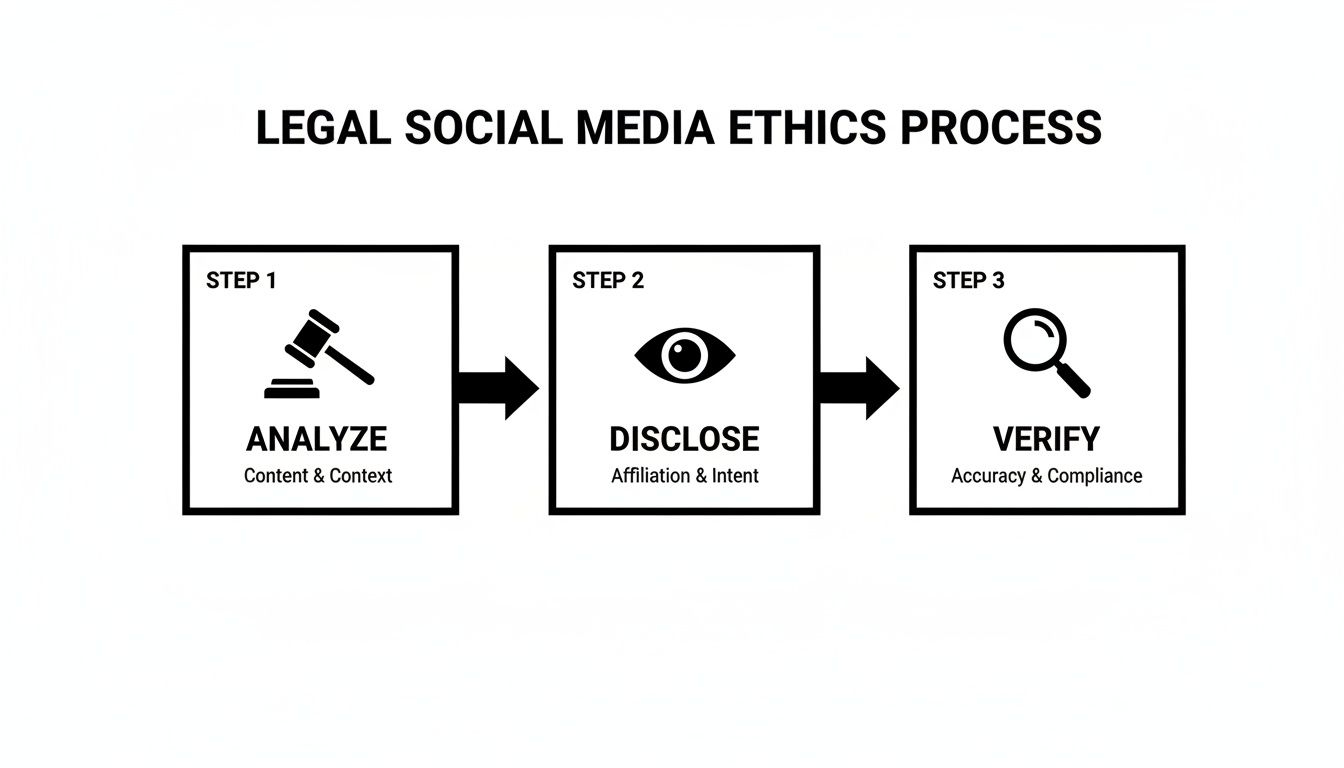
No matter which platform you choose, ethical considerations are paramount. This simple, three-step process is a great way to make sure your posts stay compliant.
This Analyze, Disclose, and Verify model acts as a quick mental checklist before you hit “publish.” It’s a simple habit that can help you steer clear of the most common ethical tripwires.
Creating a Professional Visual Identity on Social Media
Consistency matters just as much visually as it does ethically. Law firms that use a clear visual system across social media appear more credible and established. This includes consistent brand colors, readable typography, professional imagery, and repeatable post templates. A polished visual identity helps your content stand out in crowded feeds while maintaining the professionalism expected of a legal practice. You don’t need flashy design, just clarity, consistency, and restraint.
What to Post? Creating Content That Builds Authority, Not Just Noise
Alright, you’ve picked your platforms. Now for the million-dollar question: what on earth do you actually post? I’ve seen countless law firms make the same mistake—treating their social media feed like a digital billboard.
Yelling “Call us for a free consultation!” into the void is the fastest way to get scrolled past and forgotten.
The real goal is to become a trusted resource long before someone even thinks they need a lawyer. You want to provide so much value that when a legal issue does come up, your firm is the only one they think of. The best way I’ve found to do this consistently is by building everything around a few core content “pillars.”
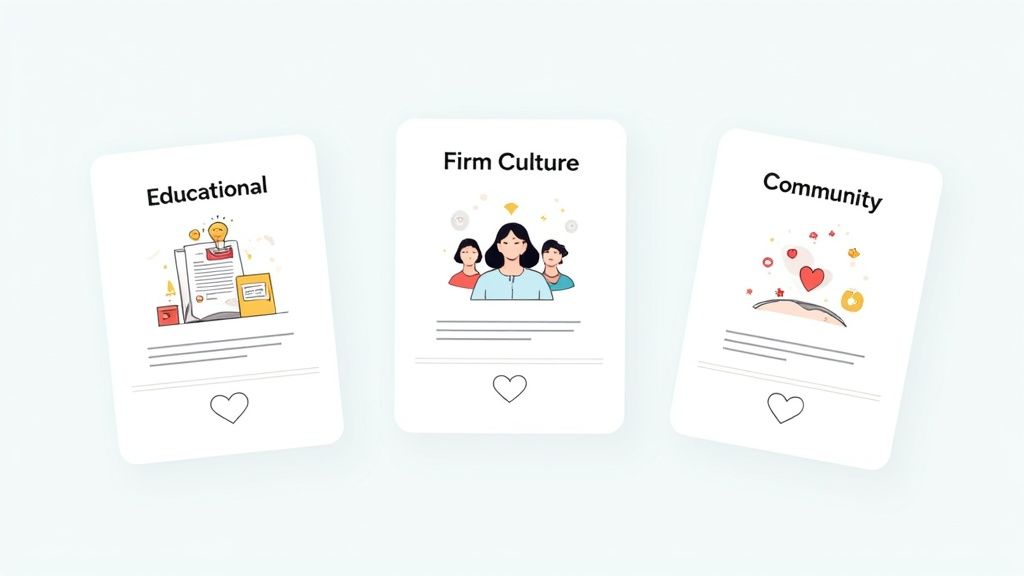
Your Three Essential Content Pillars
Think of these pillars as the foundational themes of your social media. They’re the topics you’ll circle back to time and again, keeping your content focused, relevant, and aligned with your firm’s brand. For nearly every law firm I’ve worked with, these three pillars are the perfect place to start.
Educational Content: This is where you flex your expertise. You’re answering the questions your ideal clients are already Googling, demystifying the law and providing clarity.
Firm Culture Content: This is what makes you human. It pulls back the curtain to show the real people behind the firm, making you more approachable and relatable.
Community Focus Content: This is how you plant your flag locally. It shows you’re invested in the community you serve, building rock-solid local trust and name recognition.
By rotating through these three, you create a balanced, engaging feed that educates and connects without feeling like a constant sales pitch.
The most successful legal content strategy I’ve seen operates on a simple principle: Give, give, give, then ask. Offer valuable, helpful information 80-90% of the time, and you’ll earn the right to occasionally post a direct call to action.
Bringing Your Educational Content to Life
This pillar is your workhorse for building authority. The entire point is to translate your legal knowledge into content that is genuinely helpful and easy to digest. Drop the dense legal jargon—speak like a human.
Here are a few practical ideas you can steal:
Short Explainer Videos: Film a 60-second video on your phone explaining a recent change in local landlord-tenant law. Title it something like, “New Rule for Renters in [Your City] You Need to Know.”
FAQ Graphics: Use a simple tool like Canva to create a branded graphic answering a common question. For a family lawyer, this could be, “Top 3 Things to Consider in a Prenuptial Agreement.”
Myth-Busting Posts: Tackle a common misconception head-on. A personal injury lawyer could post: “Myth: You have to pay a lawyer upfront for an injury case. (Here’s the truth…)”
This kind of content immediately positions you as a helpful expert, not just someone trying to get a new case.
How to Repurpose Legal Content Across Social Platforms
One of the biggest mistakes law firms make is creating content once and letting it die on their website. Your blog posts, FAQs, and legal explainers can easily be repurposed into multiple social formats. A single article can become a LinkedIn post highlighting a key takeaway, a short video answering one common question, and a carousel breaking down the main points. Repurposing content saves time, maintains consistency, and ensures your expertise reaches people who may never visit your website directly.
Showcasing Your Firm’s Culture
At the end of the day, people hire people, not faceless law firms. This pillar is your chance to show the human side of your practice, breaking down the intimidating lawyer stereotype and helping potential clients feel a real connection.
Try some of these content ideas:
Meet the Team Spotlights: Post a great photo of a paralegal or associate with a short, fun Q&A. Ask them things like, “What’s the best part of your job?” or “Favorite local coffee shop?”
Behind-the-Scenes Glimpses: Snap a photo of your team collaborating on a project (no confidential details, of course!) or celebrating a firm anniversary. It shows teamwork and a positive environment.
Celebrating Achievements: Did an attorney speak at a local bar association event or get an award? Share it! This is a fantastic way to showcase expertise while celebrating your team.
Authenticity is everything here. Let your team’s personality shine through.
Building Your Community Focus
For most firms, clients live right around the corner. This pillar shows that you’re not just a business in the community—you’re part of it. This is how you build deep local trust and stay top-of-mind.
Here’s how to put this into practice:
Highlight Community Involvement: Is your team volunteering at a food bank or running in a charity 5K? Post a picture! It shows you genuinely care.
Sponsorship Shout-Outs: If your firm is sponsoring the local little league team or a community festival, share the news and tag them. It reinforces your local commitment.
Partner with Local Businesses: Do a post featuring another local business you love, like a great restaurant near the office. It’s a goodwill gesture that often leads to cross-promotion and referrals.
Stick to these three pillars, and you’ll transform your social media from a static profile into an active, authority-building machine for your firm. You shift the entire conversation from “hire us” to “here’s how we can help,” which is the secret to making social media actually work for lawyers.
6. Measure What Actually Moves the Needle
Let’s be honest: likes and follower counts feel great, but they don’t pay the firm’s bills. When it comes to social media for lawyers, the only numbers that really count are the ones you can trace back to tangible business outcomes. It’s time to stop chasing vanity metrics and start focusing on the key performance indicators (KPIs) that prove your online efforts are actually working.
This shift requires asking better, tougher questions. How many people who saw your LinkedIn post actually clicked through to your firm’s contact page? Did that Facebook series on estate planning result in any real consultation requests? To find these answers, you have to look beyond the surface-level stats the social platforms hand you.
Looking Past the Likes
Your first move is to consciously ignore the metrics that don’t signal real interest or potential client action. High engagement is nice, but it’s not the ultimate goal. A post can get a thousand likes and still not generate a single qualified lead.
Instead, your focus should be on tracking concrete actions. These are the numbers that justify the time, effort, and money you’re pouring into your social media strategy.
Here are the KPIs that truly matter for a law firm:
Website Clicks: How many people are you successfully pulling from a social media platform over to your website? Getting them into your own digital space is a huge step.
Consultation Form Fills: This is the gold standard. Can you directly trace a new contact form submission back to a social media referral? That’s a clear line from a post to a potential new case.
Direct Messages with Intent: Keep an eye on the DMs you receive. A message asking, “Do you handle business litigation?” is a high-value signal and a critical KPI to track.
Referral Partner Growth: On a platform like LinkedIn, connecting with a local CPA or financial advisor who could send business your way is a massive win for your practice.
Key Performance Indicators (KPIs) for Law Firm Social Media
Tracking the right metrics is the only way to measure the true impact of your social media marketing. This table breaks down what to watch and why it’s important.
Metric
What It Measures
Why It Matters for a Law Firm
Website Referral Traffic
The number of visitors who arrive on your website from a social media link.
Shows your content is compelling enough to make someone leave the platform and learn more about your firm.
Lead Form Submissions
The number of “Contact Us” or “Case Evaluation” forms filled out by social visitors.
The most direct link between social media activity and a potential new client. This is a primary conversion goal.
Click-Through Rate (CTR)
The percentage of people who saw your post and clicked on the link.
A high CTR indicates your copy and visuals are effective at grabbing attention and prompting action.
Cost Per Lead (CPL)
The total cost of a paid ad campaign divided by the number of leads generated.
Essential for paid advertising. It tells you exactly how much you’re spending to acquire each potential client.
Follower Demographics
The professional and geographic data of your audience.
Helps confirm you’re reaching the right people in the right locations for your practice areas.
Engagement Rate
The percentage of your audience that interacts (likes, comments, shares) with a post.
While not a direct business metric, it indicates your content is relevant and resonating with your audience.
Direct Message Inquiries
The number of legitimate, service-related questions received via DM.
These are often high-intent prospects who prefer a private channel to a public comment or a formal inquiry.
By focusing on these KPIs, you can move beyond guessing and start making data-backed decisions about your social media strategy.
Tying Social Media Activity to Your Bottom Line
Ultimately, measuring these KPIs is about understanding the financial return on your efforts. Research from seoprofy.com shows that law firms typically allocate around 10% of their marketing budgets to social media. With platforms like Facebook and LinkedIn reporting average ROI rates around 29% and 16% respectively, it’s vital to measure your own firm’s specific return.
The goal isn’t just to be active online; it’s to generate a positive return on your investment. When you track the right things, you can confidently say, “We spent X hours on social media this month, which brought in Y qualified leads and resulted in Z new clients.”
This data-driven approach turns social media from a time-consuming marketing task into a predictable engine for growing your firm. It empowers you to do more of what works (like that video series that drives tons of website traffic) and cut back on what doesn’t.
Figuring out a precise ROI can feel complicated, but even a basic understanding is crucial for making smart decisions. To help you dive deeper, we’ve put together a comprehensive guide on tracking social media ROI that walks you through the entire process. By focusing on what truly matters, you ensure your social media marketing is a powerful tool for building your practice, not just busywork.
Your Top Social Media Questions, Answered
When I talk to lawyers about social media, the same questions always come up. It’s completely understandable—you’re worried about the time commitment, the ethical tightrope of advertising, and what actually works. Let’s get right into the practical answers for the things attorneys ask me most.
How Much Time Does This Realistically Take Each Week?
For a solo lawyer or a small firm just starting out, a dedicated 2-3 hours per week is a great, manageable goal. Remember, consistency is everything. It’s far better to show up for a few minutes every day than to binge-post for three hours once a week and then disappear.
Here’s how that time breaks down in the real world:
Planning & Scheduling: Block out an hour or two at the start of your week. Use this time to map out your content and get it scheduled in a tool. Get it done, and you don’t have to think about it again.
Daily Check-in: Set aside just 15-20 minutes a day. That’s all it takes to reply to comments, engage with colleagues in your network, and answer any direct messages.
Can We Actually Run Paid Ads Without Getting into Ethical Trouble?
Yes, you absolutely can. You just have to be smart about it. Think of it this way: every single state bar rule that governs your website, TV commercial, or print ad also applies to your social media ads. That means no misleading claims, no promising a certain outcome, and no language that creates unrealistic expectations.
Your ad copy must be professional and factual. For example, instead of a headline like, “The Best Personal Injury Lawyer in Town,” a much safer and more effective approach is, “Experienced in Handling Complex Personal Injury Cases.” And don’t forget the disclaimers. If your state bar requires it, make sure “Advertising Material” is clearly visible.
The single biggest mistake attorneys make is treating social media like a billboard. Constantly posting “Call us for a free consultation!” without offering any real value is the fastest way to be ignored. The goal is to educate, inform, and build relationships.
What’s the Biggest Mistake Lawyers Are Making on Social Media?
Hands down, the most common pitfall is selling instead of serving. Your social media channels should be a valuable resource for your community, not just a constant sales pitch. When your feed is just an endless stream of self-promotion, you’re not building the trust that actually brings clients through the door.
The secret is to give value first. Share genuinely helpful information, answer the questions people are already asking, and let your expertise shine through naturally. When someone eventually does need legal help, you’ll be the first person they think of because you’ve already built that foundation of credibility and goodwill. If you’re looking for a solid foundation, understanding general social media best practices that prioritize value is the perfect place to start.
Ready to streamline your social media and ensure your content strategy is both ethical and effective? With Postiz, you can schedule your posts, collaborate with your team, and automate engagement, all while staying compliant. Start building your firm’s authority today by visiting https://postiz.com.
Discover 10 actionable community building strategies for social media. Learn to foster engagement, loyalty, and growth with our expert guide for creators.
Learn 10 key content creation best practices for 2025 to boost engagement and growth. Use actionable tips and tools like Postiz’s LinkedIn post scheduler to plan and automate your content.
Indie founder Robin Faraj open-sourced a Claude Code + Postiz + Apify pipeline that scrapes viral posts on one platform, rewrites them in his voice, renders the slides, and schedules everything across LinkedIn, TikTok, and Instagram. Here's exactly how it works — and how to wire the same scheduling layer up yourself.