Think of your social media profiles less like a page and more like the front door to your dealership. For a huge number of potential buyers, this is their very first impression. It’s your digital showroom, and it has the power to either pull in a serious customer or send them scrolling right past you to a competitor.
Today’s car buyers are researching more than ever before. Studies show the average shopper spends over 13 hours online before stepping foot in a dealership, and more than 80% of that research happens on social media and video platforms. This means your online presence isn’t just an extension of your dealership — it’s now the primary showroom experience. Every Reel, Story, and TikTok you post becomes part of the buyer’s decision-making journey, shaping what they think about your dealership long before they ever speak to a salesperson.
Build Your Digital Showroom on Social Media
The influence these platforms have on car buying is no longer up for debate. By 2025, it’s expected that 76% of users will have made a purchase directly after seeing a social media post. That number alone should tell you everything you need to know: having a professional, engaging, and trustworthy online presence isn’t just a good idea—it’s essential for survival.
Choosing The Right Platforms
A common mistake I see dealerships make is trying to be everywhere at once. That just stretches your team too thin and dilutes your message. The smarter play is to focus your energy where your actual customers are hanging out online.
Facebook:
Best for ad targeting
Pinpoint in-market buyers by zip code
Ideal for inventory posts, reviews, and service specials
Instagram:
Visual-first platform
Great for walk-around Reels & behind-the-scenes content
Helps show personality + build aspiration
TikTok:
Best for reaching younger audiences
Performs well with authentic, fun videos
Use quick feature highlights or salesperson day-in-the-life clips
Another major shift happening in the industry is the rise of social-first shopping behavior. Over 55% of shoppers say they prefer discovering vehicles through short-form videos instead of traditional listings, and 41% say that a dealership’s social media content directly impacts whether they trust that dealer. This is why consistency matters — not posting for two weeks can make your dealership look inactive, outdated, or disconnected from buyers who expect fast, modern communication.
Manage all your social media in one place with Postiz
Tailoring your content to the platform and its audience is how you turn casual scrollers into active leads.
Optimizing Your Profile for Conversions
Once you’ve picked your platforms, it’s time to get them ready for business. A sloppy, incomplete profile screams unprofessionalism and can cost you leads before you even post anything.
Your bio needs to be short, sweet, and to the point. Tell people exactly who you are, what you sell, and where you’re located. Most importantly, give them something to do next. A clear call-to-action like “Shop Our New Inventory” or “Book Your Test Drive” with a direct link is a must.
Key Takeaway: A fully optimized social media profile is non-negotiable. It needs a crisp logo for the profile picture, a branded cover photo, and accurate contact information. Keeping this consistent everywhere you have a presence builds instant recognition and trust.
Don’t forget about your visual brand. Using the same colors, fonts, and logo placement across all your posts creates a polished and recognizable feed. This consistency should carry over into everything, including your videos. If you’re creating content for Reels or Stories, getting the sizing right is crucial for a professional look. We’ve got a simple guide on vertical video dimensions that will make sure your content always looks sharp.
Get to Know Your Local Car Buyers
Before you even think about posting, you have to answer the most important question: who are you actually talking to?
Throwing your inventory out into the social media void is a waste of time and money. Real success comes from connecting with real people in your community—people with specific needs, budgets, and lifestyles. If your content is generic, it’s just noise.
The best place to start is with the data you already have. Seriously, your CRM is a goldmine. Pull your sales history from the last 12 months. What patterns jump out? Are you consistently selling SUVs to families in a specific suburb? Maybe you’re the go-to spot for recent college grads buying their first reliable ride. This is your foundation.
One thing many dealerships overlook is the difference between online behavior and in-person buying behavior. The people who like or comment on your content aren’t always the ones who actually purchase — and that’s normal. Social media often influences buyers silently. In fact, over 70% of automotive shoppers report that social content impacted their decision, even if they never interacted with a single post. This is why understanding your local market’s lifestyle patterns, commute habits, family dynamics, and seasonal needs gives you a competitive edge that generic ads can’t match.
Dig Into Your Social Analytics
Every platform, from Facebook to Instagram, gives you a peek behind the curtain with its analytics. This is where you can see who’s actually following you right now, which might be a totally different crowd than who’s buying from you.
Look for a few key things:
Age & Gender Mismatch: Followers may be 25–34, but actual buyers may be families needing SUVs
Location Insights: Identify top neighborhoods for geo-targeted ads
Engagement vs. Buyer Intent: Lots of likes ≠ lots of car buyers
These numbers give you a clear snapshot of your current online audience. Now you can decide whether to double down on what’s working or pivot to attract the customers you really want.
Create Buyer Personas That Actually Work
Okay, you’ve got the data. Now it’s time to turn those numbers into people by creating buyer personas. Think of them as fictional characters who represent your ideal customer segments. Giving them a name, a job, and a story makes it a million times easier to create content that speaks directly to them.
Pro Tip: This isn’t a creative writing exercise. Your personas need to be built on a foundation of real data from your CRM and social analytics. The whole point is to get out of your own head and understand what truly motivates your customers to walk through your doors.
If you need a hand getting started, our guide on how to create buyer personas breaks down the entire process step-by-step.
A Look at Two Common Car Buyer Personas
You don’t need a dozen of these to start. Just creating two or three distinct personas can bring incredible clarity to your content strategy.
Here’s what that might look like:
Persona Profile
First-Time Buyer Frankie
Growing Family Grace
Demographics
24 years old, single, renter, first full-time job
35 years old, married with two kids, homeowner
Goals
An affordable, reliable car with good fuel economy and cool tech.
A safe, spacious SUV with room for car seats, strollers, and sports gear.
Pain Points
Feels intimidated by the whole car-buying process and is nervous about financing.
Absolutely needs a third row but dreads driving a “boring” minivan.
Social Habits
Scrolls Instagram and TikTok for hours; trusts video reviews from real people.
Active in local Facebook parent groups; relies heavily on customer testimonials.
See how this changes everything? Now you know exactly what to do. You create quick, energetic TikTok videos showing off the infotainment system for Frankie. For Grace, you share a Facebook post highlighting the five-star safety rating and testimonials from other local families.
This is what a targeted social media strategy looks like. It all starts here.
Build a Content Strategy That Actually Sells Cars
Alright, you’ve figured out who you’re talking to. Now it’s time to build the engine of your social media machine: the content itself. A winning strategy isn’t about just posting random pictures of cars. It’s a deliberate mix of content that guides someone from being a casual follower to a customer walking through your showroom doors.
The way people buy cars has completely changed. In the US, almost half of all buyers—around 45%—are now open to purchasing their next vehicle directly through a social media platform. That number jumps to a staggering 67% for people who bought a car recently. The takeaway is clear: social media isn’t just for brand awareness anymore; it’s a critical part of the sales funnel. You can dig into more of the data on this trend in this report on automotive social media buying.
This means your content needs to pull its weight. It has to do more than just show off shiny metal. It needs to build trust, answer questions before they’re asked, and make your dealership the only logical choice when it’s time to buy.
If you want a deeper framework for structuring your posts, this guide on building a strong content strategy for social media breaks down the process step-by-step.
Your Four Essential Content Pillars
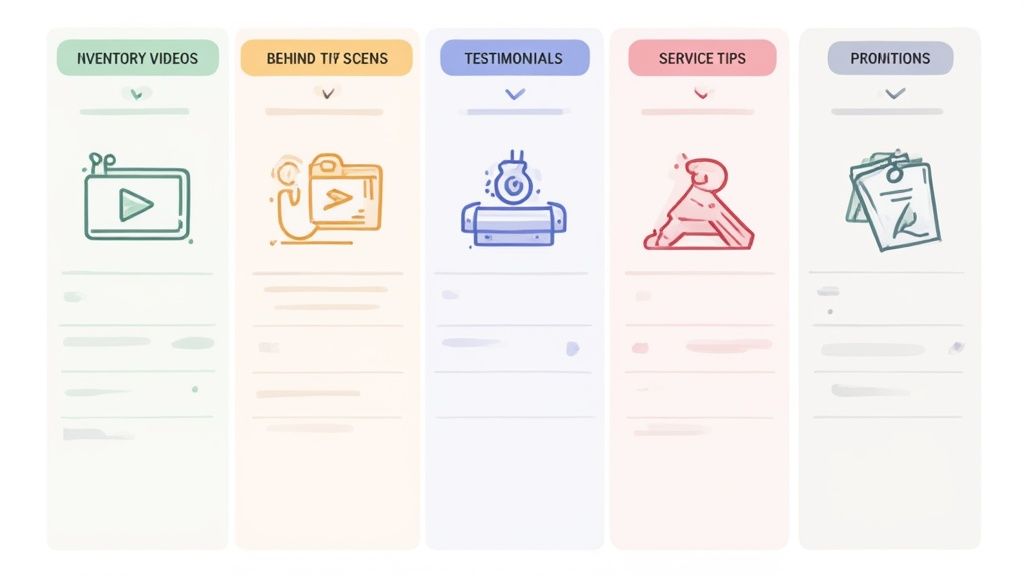
Think of your social media as having four main pillars holding it up. If you consistently mix these four types of content, your feed will stay interesting, provide real value, and, most importantly, drive sales. This framework keeps you from becoming a one-trick pony that just yells “Buy now!” until everyone tunes you out.
Inventory Showcase
Use short, vertical walk-around videos
Highlight 2–3 standout features
Perform better than highly produced ads
Behind-the-Scenes & Team Spotlights
Introduce service techs or sales staff
Show authenticity & local personality
Builds trust with the community
Customer Stories & UGC
Repost customer photos
Share video testimonials
Acts as strong social proof
Educational & Service Tips
Offer maintenance tips
Seasonal car care advice
Positions your dealership as the trusted local expert
Planning Your Content with a Simple Calendar
Consistency is everything on social media. A basic content calendar is your best friend—it ensures you’re always posting fresh, relevant content without the last-minute scramble. You don’t need fancy software. A Google Sheet or a simple spreadsheet will do the trick.
Here’s a sample weekly layout:
Day
Content Pillar
Example Post Idea
Platform
Monday
Inventory Showcase
Reel: 15-second walk-around of a new SUV.
Instagram, Facebook
Tuesday
Educational Tip
Graphic: “3 Winter Car Care Myths Busted.”
Facebook, Instagram Stories
Wednesday
Behind-the-Scenes
Photo: “Meet Mike, our lead service technician!”
Facebook, LinkedIn
Thursday
Inventory Showcase
Carousel: Detailed photos of a used truck.
Facebook Marketplace, Instagram
Friday
Customer Story
Repost a customer’s photo with their new car.
Instagram, Facebook
Saturday
Promotional Offer
Story: “This weekend: 0% APR on select models!”
Instagram, Facebook Stories
This kind of structure ensures you hit all your key messages each week, striking the right balance between selling and serving your community.
Key Takeaway: The goal is a balanced feed. A good rule of thumb is the 80/20 rule. Make 80% of your content helpful, entertaining, or community-focused. Only 20% should be a direct sales pitch.
You can also streamline your workflow using an open source social media scheduler, which helps automate posting and keep your content consistent across platforms.
Creating Eye-Catching Visuals on a Budget
Forget the idea that you need a Hollywood production crew. Your smartphone is more than capable of creating fantastic social media content.
Get a Gimbal: A simple smartphone gimbal (a device that stabilizes your phone) costs less than $100 and will instantly make your walk-around videos look smooth and professional.
Use Natural Light: Don’t worry about fancy lighting kits. The best light is free. Film your inventory videos outside on a bright but overcast day—it provides soft, even light that makes cars look great.
Use Free Design Tools: Platforms like Canva have tons of free, professionally designed templates for social media. You can create branded graphics for service tips or promotions in just a few minutes.
Focus on Audio: People will forgive shaky video, but they won’t tolerate bad audio. A small lavalier microphone that clips to your shirt can be found for under $30 and will make your videos sound a million times better.
If your team is active on community channels, using a Discord post scheduler can help automate updates and keep your dealership’s announcements consistent across platforms.
By focusing on these core pillars and planning your content, you can build a social media presence that not only engages your town but also drives real, measurable results for your dealership.
Launch Ad Campaigns That Generate Qualified Leads
Organic content is fantastic for building your brand and connecting with your community. But when you need to really turn up the volume and get a steady stream of high-quality leads, paid advertising is your gas pedal. Social media ads are a direct line to local buyers who are in the market for a new vehicle right now. This is how you break out beyond your current followers and get your inventory in front of the right people at the right time.
There’s a reason dealership marketing budgets are shifting. We’re seeing more and more dealers smartly move funds into social media advertising because it just plain works. The returns are strong and, just as importantly, they’re measurable. In fact, 65% of automotive advertisers have recently upped their social media spend, realizing it’s one of the best ways to engage buyers and show off inventory. For a deeper dive, check out some of these automotive advertising trends.
This isn’t just a fleeting trend; it’s a core part of running a successful dealership in today’s market.
Master Automotive Inventory Ads
One of the most powerful tools in your arsenal is Meta’s Automotive Inventory Ads (AIA). Forget the old days of manually creating an ad for every single car on your lot—what a headache. AIA plugs directly into your vehicle catalog and automatically spins up ads for each car, then shows them to people who have already shown interest in similar vehicles.
Honestly, it’s a game-changer. An AIA campaign can serve up a beautiful carousel of your used sedans to someone who was just browsing similar models on another site. This dynamic, automated setup means your ads are always relevant and up-to-date, saving your team countless hours of tedious work.
Key Takeaway: If you do only one thing with paid ads, make it this: set up Automotive Inventory Ads. They handle the heavy lifting of promoting your inventory and put your specific cars in front of the most qualified local buyers.
Advanced Targeting to Find Your Best Customers
The real magic of social media advertising is in the targeting. You can get unbelievably specific, making sure your ad budget is spent only on people who are genuinely likely to walk through your doors. That precision is what makes it so much more effective than casting a wide net with traditional ads.
Here are a few powerful targeting strategies I recommend every dealership use:
Custom Audiences from Your CRM: You can securely upload a list of past customers to create a Custom Audience. From there, you can either retarget them with service specials or—my personal favorite—create a Lookalike Audience. The platform then finds brand new users who share traits and behaviors with your best customers. It’s like cloning your ideal buyer.
Website Retargeting: By placing the Meta Pixel on your website, you can run campaigns that specifically target people who’ve already visited. You can even get more granular, showing ads for that exact Ford F-150 to someone who viewed its page but didn’t fill out a form. It’s the perfect gentle nudge.
Detailed & Behavior Targeting: You can layer targeting options to zero in on in-market buyers. This means targeting users based on their interests (like “Ford Motor Company” or “pickup trucks”) and behaviors (like “likely to engage” with auto content). Always combine this with tight geographic targeting—a 15-20 mile radius around your dealership is usually the sweet spot.
These strategies ensure you aren’t just shouting into the void; you’re having a conversation with the right people. You can find more on these tactics in our complete guide on social media lead generation.
Structuring Your Ad Campaigns for Success
To get the best results, you need a plan. Don’t just “boost” posts and hope for the best. You need to think about the customer’s journey and build campaigns that meet them at each stage.
When you’re setting up campaigns, you’ll have a few different objectives to choose from. Here’s a quick breakdown of the most useful ones for a dealership.
Ad Campaign Type Comparison
Campaign Type
Primary Goal
Best For
Key Metric
Lead Generation
Capture contact info directly on the platform
Promoting specific inventory, test drive offers, trade-in valuations
Cost Per Lead (CPL)
Traffic
Drive users to your website’s VDPs (Vehicle Detail Pages)
Showcasing your full inventory, promoting blog content
Cost Per Click (CPC)
Retargeting
Re-engage warm leads who have already shown interest
Users who visited specific car pages or abandoned a lead form
Conversion Rate
Brand Awareness
Increase visibility and reach within your local area
Announcing new models, sharing community involvement stories
Reach & Impressions
My advice? Start with a Lead Generation campaign. Pick a popular model, attach a compelling offer like a special financing rate, and use a simple, mobile-friendly form that pre-fills their info. The easier you make it for them, the more leads you’ll get.
Crafting Ads That Stop the Scroll
Your targeting can be flawless, but it won’t matter if your ad creative is a snoozefest. In a fast-scrolling social feed, you have maybe two seconds to grab someone’s attention.
Here are a few tips that have worked for our clients time and time again:
Use Vertical Video: Optimized for Reels, Stories, TikTok
Write Clear Copy: Highlight key benefits, not long feature lists
Include Strong CTAs: “Get Quote,” “Book Now,” “Learn More”
A/B Test Everything: Headlines, creative, audiences
And please, always be testing. Run two versions of an ad with different headlines or images to see what your audience responds to. This simple process of A/B testing is how you continuously improve, lower your cost per lead, and make your ad budget work smarter.
Bridge the Gap: Get Social Media Leads to Your Sales Team, Fast
Getting a lead from a social ad is a great first step, but it’s just that—a first step. The real win is getting that lead into the hands of a salesperson who can act on it right now. In the car business, speed is everything. After all, over 55% of car buyers go to just one dealership before they buy.
This is where so many dealerships fumble the ball. A lead comes in from a Facebook ad, but it just sits there—buried in a notification tab or a forgotten email inbox. Hours go by. By the time someone finally sees it, that potential customer is already scheduling a test drive with your competitor down the road.
The solution is to build a direct, automated bridge from your social media ads straight into your dealership’s CRM.
Automate Your Lead Flow into the CRM
Let’s be honest: manual data entry is slow, tedious, and a great way to lose hot leads. Your goal is to create a seamless handoff. When someone fills out a Facebook Lead Ad, they should instantly appear as a new contact in your CRM, triggering your team’s follow-up process without a single person having to lift a finger.
Most modern CRMs—think DealerSocket, VinSolutions, or Elead—have direct integrations with platforms like Meta (for Facebook and Instagram). Getting this set up should be at the top of your to-do list.
Link Your Accounts: Head to your CRM’s settings. You’re looking for a section called “Integrations” or “Apps.” From there, you’ll connect your dealership’s Facebook Business Page.
Map the Fields: This is where you tell the systems how to talk to each other. You’ll match the fields from your Facebook form (like “First Name,” “Email,” and “Phone Number”) to the corresponding fields in your CRM’s contact records.
Tag the Lead Source: This is critical. Make sure every lead coming from this pipeline is automatically tagged with a source like “Facebook Lead Ad.” You’ll need this data later to prove your ROI.
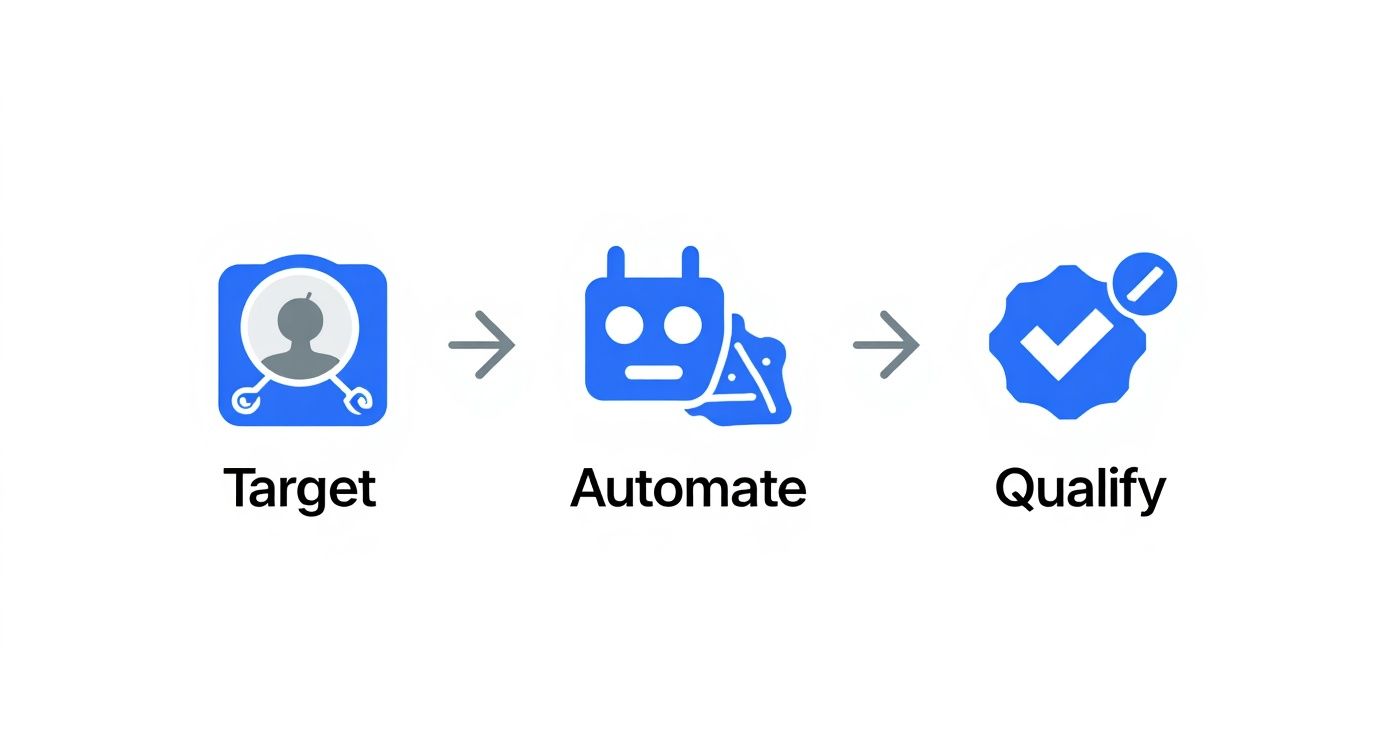
This simple workflow—targeting a user, automating the data transfer, and getting the lead to your team for qualification—is a game-changer.
When you automate this connection, you kill the delay. Every single lead gets attention while they’re still fired up about that new car.
Best Practices for Rapid-Fire Follow-Up
The moment that lead hits your CRM, the clock starts ticking. A fast, professional response is your biggest advantage.
Key Insight: I’ve seen it time and time again: the odds of qualifying a lead plummet after the first five minutes. A simple, automated text or email confirming you got their request is a great first touch. But it has to be followed immediately by a personal call from a real salesperson.
Work with your BDC or sales team to create a solid script for that first call. This isn’t the time for a hard sell.
Example First Contact Script (Phone Call):
“Hi [Lead’s Name], this is [Salesperson’s Name] from [Dealership Name]. I saw you were just checking out the [Car Model] on our Facebook page and wanted to see if I could answer any quick questions for you. Are you free to take it for a spin sometime this week?”
This approach works because it’s helpful, it’s direct, and it immediately references how they found you. The call feels relevant, not random. This is how you turn a simple click on a social media ad into a customer driving off your lot.
Is Your Social Media Actually Selling Cars? Let’s Talk ROI
Let’s be honest. Likes and shares are great for the ego, but they don’t move metal off the lot. To keep your social media budget secure and growing, you need to prove it’s making the dealership money. It’s all about connecting your activity on Facebook and Instagram directly to your bottom line.
The goal is to answer one simple question: for every dollar we put into social media, how many dollars are coming back in profit? Figuring this out is the only way to build a social media strategy that lasts.
Focus on the Metrics That Matter
To get a real sense of what’s working, you have to track the right data. It’s time to look past follower counts and zero in on the numbers that show real buyer intent. These are the KPIs that should be front and center in every report you run.
Here are the essentials for any dealership:
Cost Per Lead (CPL): The most important metric
Appointment Set Rate: Shows lead quality
Show Rate: Reveals breakdowns in communication
Sales Attribution: Connects social spend to actual sold units
Tracking these KPIs changes the conversation entirely. You go from saying, “We got a lot of engagement this month,” to “Our Instagram campaign brought in 15 qualified leads and sold two cars last month.” That’s a conversation that gets attention.
Always Be Testing
Your first ad is almost never your best ad. The only way to get better results and a lower CPL is to be constantly testing. This just means running two slightly different versions of an ad at the same time to see which one gets the job done better.
You can test just about anything, but I’d recommend starting with the big-impact items:
The Creative: Pit a casual walk-around video against a slick, professional photo carousel.
The Headline: Try a question like, “Ready for a new truck?” against a direct offer like, “0% APR on New F-150s!“
The Audience: Test a Lookalike Audience based on your past customers against a broader audience built on interests like “off-roading” or “pickup trucks.”
Even small tweaks can make a huge difference in your results.
To really get a grip on what your social media is worth, it helps to use tools that can map it all out. For instance, you can get a clearer financial picture by using Salestable’s ROI Calculator to project potential returns. When you combine consistent testing with tracking the right KPIs, your social media stops being an expense and starts becoming a predictable, profit-driving machine for your dealership.
Got Questions? We’ve Got Answers.
When we talk to dealer principals and marketing managers, the same questions pop up again and again. Let’s tackle them head-on with some straight-up, practical advice.
What’s a Realistic Social Media Ad Budget for a Dealership?
There’s no one-size-fits-all answer, but if you’re a mid-sized dealership, a good starting point is usually somewhere between $1,500 and $5,000 per month. That’s enough juice to run a solid mix of brand awareness campaigns and specific, lead-focused ads for your inventory.
The real key here is to treat it like a test. Start with a budget you’re comfortable with, obsess over your Cost Per Lead (CPL), and then double down on what’s actually bringing in customers. Never “set it and forget it.”
What Kind of Content Actually Sells Cars on Social?
Hands down, authentic video is king. We’re not talking about high-production-value commercials. Simple, vertical walk-around videos of specific cars on your lot, shot on a smartphone, work incredibly well. They give potential buyers a real, up-close look without ever leaving their couch.
A Tip from the Trenches: Don’t sleep on customer testimonials. A quick photo or a short video clip of a happy customer with their new ride is pure gold. It’s the kind of social proof that builds instant trust and gets new prospects to take that next step.
Do We Really Need to Be on TikTok and Everywhere Else?
Absolutely not. It’s a classic case of quality over quantity. You’ll get much better results by mastering one or two platforms where your customers actually are, rather than spreading yourself thin and burning out.
For almost every dealership out there, these two are the non-negotiables:
Facebook: You just can’t beat its massive local audience and incredibly detailed ad-targeting capabilities. It’s a must.
Instagram: Perfect for telling visual stories. Think high-quality photos and Reels to connect with a slightly younger crowd.
Only think about adding a platform like TikTok if you have the time and a team member who genuinely gets the platform and can create content that feels native to it.
Ready to stop guessing and start selling? Postiz gives you the tools to schedule your content, manage your ad campaigns, and see exactly what’s working—all in one place.
Agencies and multi-location dealerships can also scale their workload using white label social media management solutions to streamline posting for multiple accounts.
Take control of your dealership’s social media strategy today at https://postiz.com.