Before you post a single thing on social media, you need a solid foundation.
This isn’t about chasing viral trends, growing follower counts, or obsessing over likes. None of that pays the bills.
Effective social media for consultants is methodical. It starts with defining exactly who your ideal client is, crafting messaging that speaks directly to their real problems, and building a value proposition that makes you the obvious choice.
Get this groundwork right, and social media stops feeling like shouting into the void. Instead, it becomes a predictable way to start real conversations with the right people and turn attention into high-value contracts.
Laying the Groundwork for Social Media Success
Jumping on LinkedIn or Twitter without a clear strategy is a surefire way to waste time. You’ll put in a ton of effort but likely end up with nothing to show for it. For consultants, every minute you spend on marketing has to count. The goal isn’t just to be “active” online; it’s to build a reliable system that consistently brings in the right kind of clients.
Without a clear strategy, social media becomes:
A time sink
A source of frustration
A channel that looks active but produces zero leads
This initial phase is, without a doubt, the most critical part of your entire social media plan. It’s where you decide who you’re talking to and what you’re going to say, making sure every post, comment, and connection request has a clear purpose.
Moving Beyond Generic Client Personas
Most marketing guides will tell you to create a client persona, which often leads to a useless, generic profile like “Marketing Mary, age 45, CMO at a mid-sized tech company.” That’s not nearly specific enough to help you create content that resonates.
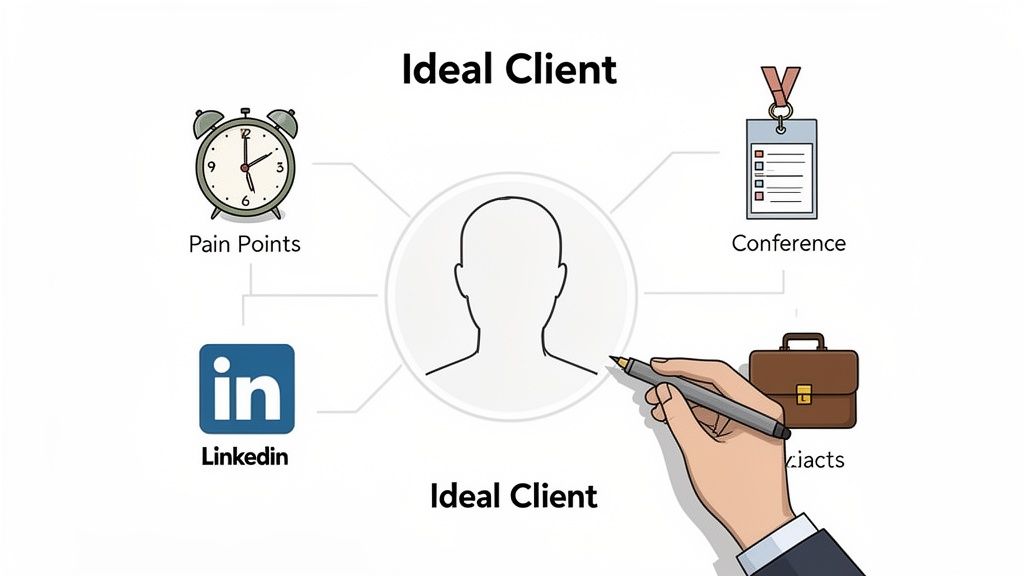
You need to go deeper and build a hyper-detailed Ideal Client Avatar (ICA). Think of it as profiling one real person—the perfect client you wish you could clone and work with over and over. Get into the weeds of their professional life.
To build a real Ideal Client Avatar, get specific:
Exact job title: VP of Operations, Director of Product, COO
Industry: SaaS for logistics, B2B fintech, manufacturing
Professional goals: cost reduction, growth targets, system implementation
Publications they read: IndustryWeek, Supply Chain Dive
Events they attend: Gartner Symposium, MODEX
This level of detail changes everything. Suddenly, you’re not just creating content for “executives.” You’re writing directly to a VP of Operations who is stressed about rising shipping costs and reads Supply Chain Dive on his lunch break. That’s a person you can actually connect with.
The most effective social media marketing for consultants feels like a one-on-one conversation. Building a detailed Ideal Client Avatar is the only way to know exactly who you’re talking to and what they desperately need to hear.
Manage all your social media in one place with Postiz
Once you know who you’re talking to, you have to sharpen what you’re going to say. Your Unique Value Proposition (UVP) isn’t a simple list of services. It’s the core promise you make to your clients. It has to be a clear, concise answer to the question: “Why you?”
A weak UVP sounds vague and forgettable: “I offer operational efficiency consulting for businesses.”
A strong UVP is specific and focuses on results: “I help mid-sized manufacturing firms cut their inventory carrying costs by up to 20% in six months by implementing a just-in-time inventory system.”
See the difference? This statement is powerful because it:
Names the target client (mid-sized manufacturing firms).
Hits on a specific pain point (high inventory costs).
Promises a tangible result (20% cost reduction).
Explains the “how” (just-in-time system).
This UVP becomes the North Star for all of your social media content. Every single post should, in some way, reinforce this core message. It’s the common thread that ties your entire online presence together, making you instantly recognizable and memorable to your ideal clients as they scroll.
Getting this foundational work done upfront is the key to making sure your efforts are focused, efficient, and, ultimately, far more profitable.
Choosing the Right Platforms to Find Your Next Client
One of the classic mistakes I see consultants make is trying to be everywhere at once. Spreading yourself thin across every social media app is a surefire way to burn out with very little to show for it. Smart social media is about precision, not a scattered presence.
If your ideal client isn’t on the platform, your content doesn’t matter.
The real secret is to go where your ideal clients already are and concentrate all your firepower there.
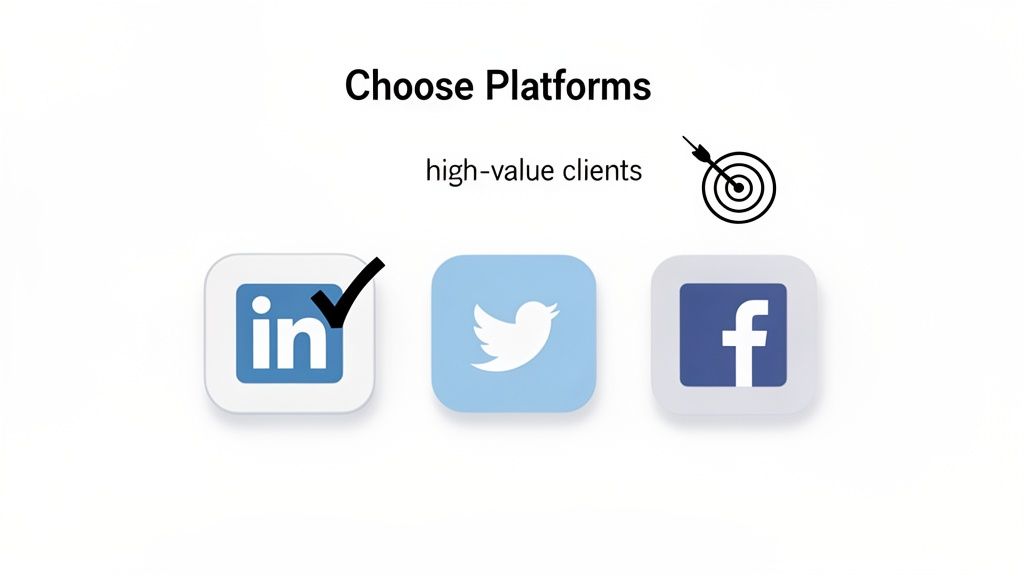
For most B2B consultants, that means one platform stands head and shoulders above the rest.
The same strategic principles apply across industries, but execution changes depending on who you’re targeting. For example, social media marketing for gyms, accountants, and doctors requires different content angles, trust signals, and platforms based on how each audience evaluates expertise and credibility.
85% of B2B marketers say LinkedIn delivers the highest ROI
AI-assisted outreach messages are 44% more likely to be accepted
Users are actively looking for business solutions, not entertainment
Trying to find a Fortune 500 COO on TikTok is like trying to fish in a desert. You have to go where the fish are. For business consultants, LinkedIn is the ocean.
Simply having a profile isn’t enough, though. A focused strategy turns your profile from a static resume into a lead-generating machine. To really dig in, our complete guide to building a winning LinkedIn marketing strategy will give you the tactical steps you need.
Strategic Use Cases for Other Platforms
While LinkedIn should be your home base, other platforms can play powerful supporting roles. The trick is to use them for specific, targeted goals instead of trying to build a huge general following.
X (formerly Twitter) for Real-Time Industry Conversations:X is perfect for tapping into live industry conversations, following key journalists, and engaging with other thought leaders in your space. Use it for quick-fire insights and to show you have your finger on the pulse.
Targeted Facebook Groups for Community Building: A general Facebook business page won’t get you much organic reach. Niche Facebook Groups, however, can be goldmines. Find and join groups where your clients hang out, like “SaaS Founders” or “Manufacturing Operations Leaders.” Your goal isn’t to sell; it’s to answer questions and become a trusted expert.
YouTube for Demonstrating Deep Expertise: If your consulting work is complex, a YouTube channel is an incredible asset. You can create short videos walking through a framework you use or breaking down a common client challenge. It’s an unmatched format for building trust and showing people how you think.
Your platform choice always comes back to your Ideal Client Avatar. If you’ve determined your target client is a 55-year-old CFO in the logistics industry, your time is far better spent on LinkedIn than on learning the latest Instagram Reels dance. This laser focus ensures every minute you spend on social media is a direct investment in landing your next client.
Building Your Content Strategy Around Client Problems
Let’s be honest, a killer social media presence for a consultant comes down to one thing: consistently creating content that actually helps people. It’s time to stop posting randomly about your services and start building a real strategy—one that tackles the biggest problems keeping your ideal clients up at night.
Think of yourself as the go-to resource in your niche, not just another consultant trying to sell something. When you generously share your expertise and solve small problems for free, you build the trust needed for potential clients to hire you to solve their big ones. This is how you turn followers into leads.
Establishing Your Content Pillars
Every solid content strategy needs a foundation. We call these content pillars—the 3-5 core topics where your deep expertise meets your client’s most urgent challenges. These aren’t just a list of your services; they are the big-picture themes you want to be known for.
For instance, a supply chain consultant I know focuses their entire online presence on these pillars:
Inventory Cost Reduction: Sharing practical strategies for slashing carrying costs and eliminating waste.
Logistics Optimization: Offering insider tips on negotiating with carriers and smart route planning.
Supplier Relationship Management: Giving advice on how to build more resilient, reliable supply chains.
Warehouse Efficiency: Detailing best practices for everything from layout to process flow.
These pillars act as your North Star. Before you create anything, ask yourself a simple question: “Does this post tie back to one of my pillars and solve a real problem for my ideal client?” This keeps every single thing you post laser-focused and builds your authority brick by brick. Of course, a core part of this is knowing how to create engaging social media content that people actually want to read and share.
Brainstorming and Validating Your Pillars
So, where do these pillars come from? They’re hiding in plain sight—in your own experience. Dig through your old client emails, proposals, and project notes. What questions pop up over and over again? What are those “aha!” moments your clients always have?
Once you have a draft list, go validate it. Don’t just guess. Spend some time lurking on LinkedIn or in industry forums where your clients hang out. Listen to the exact language they use to describe their frustrations. This is the same deep-dive work you’d do to build a client avatar, which is critical for making sure your message lands. If you need a refresher on that, our guide on how to create buyer personas is a great place to start.
The most powerful content pillars aren’t about what you want to sell; they’re about what your clients desperately need to solve. Frame your expertise through the lens of their pain points.
Choosing Formats That Build Authority
With your pillars locked in, it’s time to think about how you’ll deliver your insights. As a consultant, your main goal is to build trust and prove you know your stuff. Using a mix of content formats is key to keeping your feed fresh and appealing to how different people like to learn.
Here are a few formats that work incredibly well for consultants:
Case Study Breakdowns: Go beyond a simple testimonial. Create a carousel post that tells a story: here was the client’s problem, here’s the framework we used to fix it, and here’s the incredible result (e.g., “Reduced production downtime by 15%“).
Insightful “How-To” Carousels: Take a complex process and break it down into simple, actionable steps. Think “5 Steps to Audit Your Current Logistics Network.” Easy to digest, easy to save.
Short-Form Video Clips: You don’t need a film crew. Just pull out your phone and record a 60-second video sharing one powerful tip. Authenticity wins over slick production every time.
Text-Only Posts with Bold Statements: On platforms like LinkedIn, a strong, slightly controversial opinion can spark a massive conversation. State your take and ask people what they think.
Client Pain Point Polls: Use a LinkedIn poll to ask your audience about their biggest challenges in a specific area. This creates instant engagement and, better yet, hands you a goldmine of ideas for future content.
When you start mapping these formats to your content pillars, you’ll have a simple yet powerful content plan. Your social media feed will transform from a digital brochure into an essential resource that potential clients can’t afford to ignore.
How to Build a Social Media Workflow That Actually Works
Let’s be honest. As a consultant, a brilliant social media strategy is useless if you can’t execute it. The real enemy isn’t a lack of ideas—it’s the clock. The biggest hurdle I see consultants face is finding the time to show up consistently.
The secret is to stop thinking like a daily content creator and start acting like a media company. You need a system.
A solid workflow lets you knock out a month’s worth of high-quality, authority-building content in just one or two sessions. This frees you up to focus on what actually pays the bills: your client work.
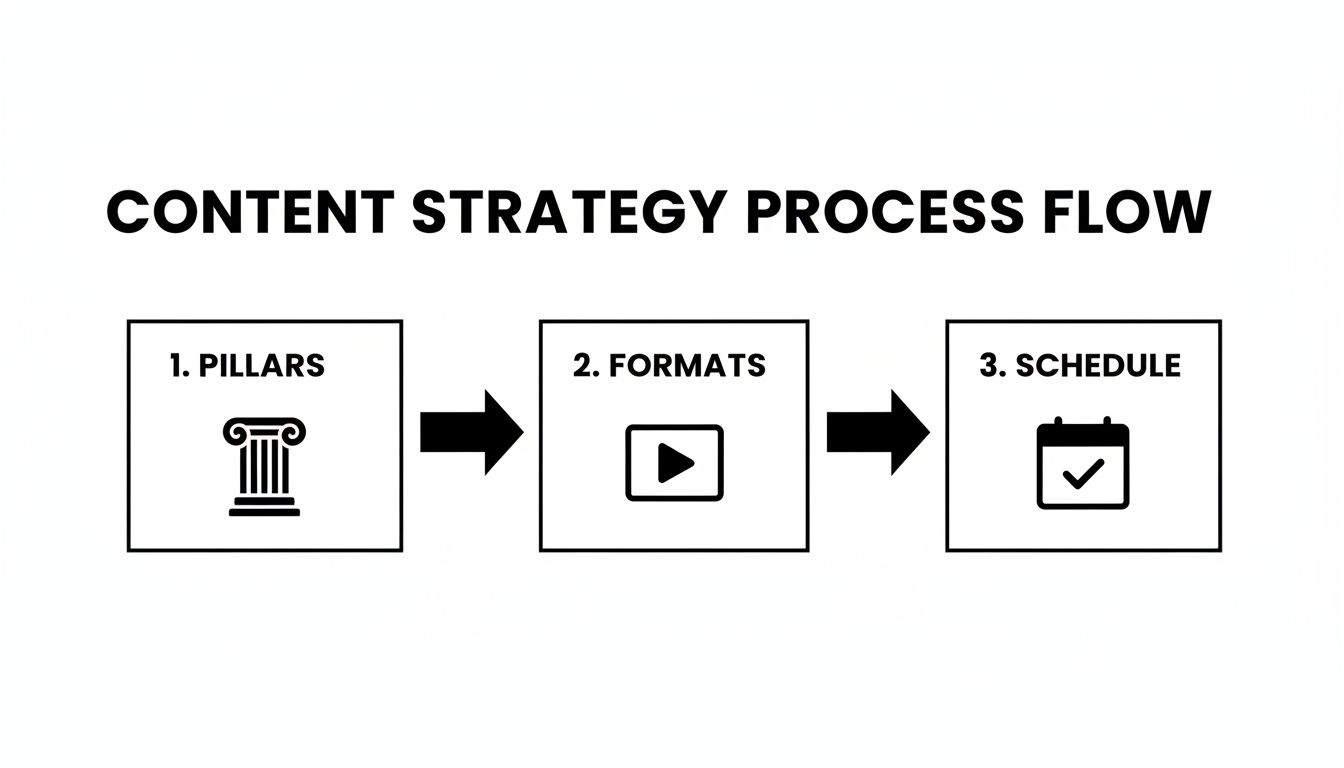
The process is simpler than you think. It boils down to defining your core pillars, deciding on your content formats, and then building a schedule.
This simple flow is your ticket to a sustainable and impactful presence—one that doesn’t burn you out.
A simple monthly workflow looks like this:
Define content pillars
Batch content once per month
Schedule everything
Engage daily for 15–20 minutes
The Magic of Batching Your Content
If you take one thing away from this section, make it this: content batching. It’s the cornerstone of any efficient social media operation. Instead of waking up and thinking, “What should I post today?”, you dedicate one block of time to create everything for the month ahead.
Block out four hours on your calendar—say, the first Friday of the month—and just create.
This approach is a total game-changer:
You get in the zone. Focusing on one task allows for deeper, more creative thinking. Your ideas will be much more cohesive.
Consistency becomes effortless. With everything planned and scheduled, you never go dark. That consistency is what builds trust with your audience.
You reclaim your time. The stop-start nature of daily posting is a massive productivity drain. Batching eliminates it.
During your batching day, just work through your content pillars. If “Supply Chain Optimization” is a pillar, brainstorm four weekly topics around it. Then, write the copy, create or find your visuals, and load it all into your scheduling tool. Done.
Use Scheduling and Automation to Your Advantage
Once the content is created, scheduling tools are your new best friend. Platforms like Postiz, Buffer, or Hootsuite let you upload everything at once and schedule it to publish at the best times over the coming weeks.
Essentially, you put your content distribution on autopilot.
You can be deep in a client project while your LinkedIn and X profiles are busy sharing your expertise. Smart content workflow management is all about building systems that do the heavy lifting for you.
The point of a social media workflow isn’t to spend more time on social media. It’s to get better results in less time by working smarter. Automation is how you get there.
Using a free auto post to social media tool makes it easier to stay consistent without spending hours manually publishing content across platforms.
Master the Art of Repurposing
The most efficient consultants I know don’t create more content; they just get more out of the content they already have. This is content repurposing: taking one core idea and spinning it into multiple different formats. For time-strapped consultants with deep expertise, this is non-negotiable.
Imagine you just wrapped up a project where you helped a client cut their operational costs by 18%. That single client win is a content goldmine.
Here’s how you can slice it up:
Long-Form LinkedIn Article: Draft a detailed case study (anonymized, of course). Outline the client’s problem, the methodology you used, and the measurable results.
Carousel Post: Pull out the 5 key steps from your methodology and turn them into a slick, visual carousel for LinkedIn.
A Few Tweets: Extract three powerful stats or quotes from the case study and post them as standalone tips on X.
Short Video Script: Grab your phone and record a 90-second video explaining the single most critical change you implemented for that client.
Boom. One client success story just became a full week of high-value content. This doesn’t just save you an incredible amount of time; it hammers your core message home across different platforms, cementing your authority.
Using Paid Ads to Fast-Track Lead Generation
Organic social media is a marathon, not a sprint. It’s fantastic for building your brand and earning trust over the long haul. But what happens when you need results now?
Maybe you need to fill seats for an upcoming webinar, get a new case study in front of decision-makers, or simply book more discovery calls this month. That’s when you bring in paid social advertising.
Think of paid ads as your express lane. You get to skip the line, bypass the algorithm, and put your best content directly in front of your ideal clients. It’s not about broadcasting a message to the masses; it’s about strategically whispering in the right person’s ear at exactly the right time.
What Do You Actually Want to Accomplish?
Before you even think about opening your ad manager, you need to get crystal clear on your goal. “Get more leads” is a wish, not a strategy. A real campaign objective is specific, measurable, and directly tied to a business result you can take to the bank.
Your main goal will shape everything that follows—the type of campaign you run, the ad format you use, and the call-to-action you present.
For consultants, campaign goals usually fall into one of these buckets:
Growing Your Email List: Offering a high-value lead magnet like a checklist, industry report, or whitepaper in exchange for an email address.
Filling Your Webinar: Driving sign-ups for a live training where you can demonstrate your expertise to a highly engaged audience.
Booking Consultations: Getting qualified prospects to schedule a discovery call with you or someone on your team.
Don’t get distracted by vanity metrics. Boosting a post just to get more “engagement” is a waste of money for a consultant. The only numbers that matter are the ones that lead to conversations and clients, like your Cost Per Lead (CPL) and Cost Per Acquisition (CPA).
Hyper-Targeting on LinkedIn
For just about any B2B consultant, LinkedIn is the undisputed king of paid advertising. The targeting options are surgically precise, letting you zero in on prospects based on who they are professionally.
Forget about broad demographics like age or location. On LinkedIn, you can build an audience using incredibly powerful filters:
Job Title: Target “Chief Financial Officer” or “VP of Human Resources.”
Industry: Focus only on companies in “Financial Services” or “Medical Devices.”
Company Size: Pinpoint organizations with 100-500 employees.
Member Skills: Reach people who list skills like “Lean Six Sigma” or “Change Management” right on their profile.
This level of precision means your ad budget goes toward reaching the actual decision-makers who can hire you. You aren’t wasting a dime on irrelevant audiences. As global social media ad spend is projected to hit $275.98 billion in 2025, and with 84% of small business owners seeing positive results from PPC, having a sharp strategy is no longer optional. You can dig into more B2B social media statistics to see just how important this is.
A great campaign marries this sharp targeting with ad copy that speaks directly to a prospect’s most pressing problems.
For example, instead of a generic ad that says, “We help businesses improve,” try this: “Is your manufacturing facility struggling with production bottlenecks? Our 5-step framework helps VPs of Operations reduce downtime by 20%.”
See the difference? It calls out the specific audience, names their pain point, and offers a concrete, compelling solution. That’s an ad that gets clicked.
Measuring What Matters and Optimizing for Growth
Is your time on social media actually paying off? An active feed is nice, but a profitable one is what keeps the lights on. This is where we shift from just creating content to seeing a real business impact. It’s all about making smart, data-driven decisions that actually grow your consulting practice.
It’s so easy to get caught up in the vanity metrics—things like follower counts and post likes. While they might give you a little ego boost and suggest some brand awareness, they don’t directly translate to revenue. For business consultants, the whole point of social media is to track the numbers that directly affect your bottom line.
Metrics that actually matter for consultants:
Website clicks
Lead magnet downloads
Consultation bookings
Qualified DMs
Moving Beyond Vanity Metrics
To get a true read on your success, you need to zero in on the metrics that signal a potential client is ready to take the next step. Chasing a bigger follower count is a fool’s errand; the real win is attracting the right followers who eventually become clients.
Here are the key performance indicators (KPIs) that actually matter for consultants:
Website Clicks: How many people are intrigued enough to leave the social platform and check out your website? This is a huge sign of genuine interest.
Lead Magnet Downloads: Are people grabbing your free checklists, whitepapers, or case studies? This tells you they see you as an expert worth learning from.
Consultation Bookings: This is the big one. How many discovery calls or meetings came directly from a social media link or conversation?
Direct Message Inquiries: A steady stream of qualified inquiries sliding into your DMs is a powerful signal that your content is hitting the mark with your ideal clients.
Your social media dashboard shouldn’t be a popularity contest. It should be a sales funnel. Every metric you track should answer one question: “Is this activity leading me closer to a new client contract?”
Creating a Simple Monthly Review
You don’t need a complex or expensive analytics suite to figure out what’s working. The built-in analytics on each platform are a goldmine of information if you know what to look for. All it takes is about an hour at the end of each month to do a quick review. To really dig in and understand what’s moving the needle, it’s crucial to know how to analyze content performance.
Just pull up your analytics and ask yourself a few simple questions:
Which posts drove the most website clicks? This shows you which topics are compelling enough to make someone stop scrolling and take action.
What content format (video, carousel, text-only) got the most saves or shares? This is your audience telling you exactly how they prefer to consume your expertise.
Which topics sparked the best conversations in the comments or DMs? This is direct, unfiltered feedback on your clients’ biggest challenges.
This straightforward monthly audit helps you stop guessing and start making strategic moves. You can confidently double down on the content topics and formats that drive real business results and tweak your strategy for consistent, sustainable growth.
Your Top Social Media Questions, Answered
Let’s tackle some of the most common questions I hear from consultants who are trying to make social media work for their business.
How Much Time Should I Realistically Spend on Social Media Each Week?
You can make a real impact with 3-5 hours of focused work per week. The key isn’t to be online constantly; it’s to be smart and consistent with the time you do have.
The most effective strategy I’ve seen is to block out one session a month to create all your content in a batch. Get it all done at once. Then, plug it into a scheduling tool and let it run automatically.
From there, all you need is 15-20 minutes a day for the important stuff: engaging with your network. That means replying to comments, answering DMs, and sparking actual conversations. This focused, consistent effort on one or two platforms will beat scattered, random posts across five channels every single time.
What’s the Biggest Mistake Consultants Make on Social Media?
Hands down, the most common mistake is selling too aggressively. Your social media presence should feel like a valuable resource, not a non-stop sales pitch. The goal is to build your authority and earn trust by sharing your expertise freely.
I always advise clients to follow the 80/20 rule. Make 80% of your content genuinely helpful—teach something, offer a new perspective, or solve a small problem for your ideal client. The other 20% can be your “ask”—promoting a webinar, a downloadable guide, or your services. Build the relationship first, and the sales will come much more naturally.
How Do I Actually Measure the ROI from All This?
Forget about vanity metrics like likes and followers. The only ROI that matters is a direct line to new business. You have to connect your social media efforts to actual client wins.
Here’s how to do it without overcomplicating things:
Track Clicks to Your Site: Use UTM parameters on the links you post. This is just a small tag you add to your URL, and it tells your website analytics exactly who came from LinkedIn, Twitter, etc. It’s a simple way to see what’s driving traffic.
Watch for Conversions: Look at how many people who come from social media end up taking a key action, like signing up for your newsletter or filling out your contact form.
Just Ask: This is the most underrated but powerful method. Make it part of your new client onboarding to ask, “How did you first hear about me?” When they say “I saw your posts on LinkedIn,” you have the clearest ROI possible.
Ready to put this all into a streamlined workflow? Postiz gives you an open-source platform with AI-powered content creation, smart scheduling, and the analytics you need to see what’s working. Stop guessing and start building authority that attracts clients. Take control by visiting https://postiz.com to see how it works.
Compare top social media management tools like Hootsuite, Buffer, Sprout Social, Later, and Loomly to simplify scheduling, analytics, and team collaboration.