If your construction company is not active on social media, you are leaving trust on the table. Owners, developers, and project managers check your work online long before they invite you to bid.
Social media is not “extra marketing.” It is proof. Proof of quality, safety, reliability, and the team behind the build.
This approach works especially well in adjacent industries like construction and engineering, where trust and expertise matter long before a contract is signed, as shown in our guide on social media marketing for engineering firms.
Why Social Media Matters for Construction Companies
Let’s get straight to the point. A smart social media plan solves real-world problems. It helps you get in front of potential clients and build trust long before they even think about putting out a formal bid, which can seriously shorten those traditionally long sales cycles.
It’s also one of your best tools for tackling the skilled labor shortage. You get a direct line to showcase your company culture, your commitment to safety, and the quality of your team, making you the place the best talent wants to work.
Turn Job Sites Into Proof (Projects, Process, People)
Think of your social media feed as a 24/7, all-access pass to your best job sites. You can’t physically walk every potential client through a project in progress, but you can bring the project to them through a well-shot video on Instagram or a detailed project update on LinkedIn.
A well-crafted social media presence doesn’t just show what you build; it tells the story of how you build it. It’s your opportunity to highlight the precision, safety, and craftsmanship that set your company apart from the competition.
This is how you turn an abstract claim of “quality work” into tangible proof. When future clients see your standards in action, they feel more confident choosing you. A steady stream of project updates, behind-the-scenes moments, and team spotlights creates a compelling story of reliability and excellence.
Construction Social Media Strategy Blueprint (Goals, Platforms, Content, KPIs)
We’re not talking about vanity metrics here. The goal is to treat social media as a core business asset, not some marketing fluff. The real value is measured in outcomes that make your entire operation stronger.
Here’s a look at the essential components you’ll need to create a winning strategy.
Your Core Blueprint for Construction Social Media Success
By focusing on these core areas, you ensure every action has a purpose tied to a real business objective.
A strong digital foundation supports your business in very concrete ways:
Building Credibility: Nothing speaks louder than finished projects and glowing client testimonials. Social media is the perfect place to put that proof on display.
Attracting Top Talent: When you highlight your crew, your safety record, and what makes your company a great place to work, you become an employer of choice.
Generating Qualified Leads: The right content will grab the attention of project managers, developers, and property owners who are actively looking for a contractor they can trust.
The impact is real. One construction brand focused on creating authentic, educational content from their job sites and saw incredible results: over 100 million organic video views and 95% positive sentiment from people in the trades. This effort alone generated $1.1 million in earned media value, proving that smart digital engagement translates directly to the bottom line.
To get started, the first step is always knowing exactly who you’re talking to. If you need a hand with that, check out our guide on how to create buyer personas.
Manage all your social media in one place with Postiz
Jumping onto social media without a clear plan is like starting a build without blueprints. It’s a surefire way to waste time, money, and a whole lot of effort. Before you even think about posting your first project photo, you need to nail down exactly what you want social media to do for your construction company. A vague goal like “getting more followers” just won’t cut it.
Your social media activity has to be tied to real business results. For most construction firms, that means focusing on one of three core objectives that genuinely move the needle.
We’ve seen the same goal-driven approach work in other service-heavy industries, including social media marketing for recruitment agencies, where trust and talent acquisition are critical.
Choose Your Primary Objective (Pick One to Start
Start with one goal. Social media works best when it supports a single business priority.
Generate qualified leads: attract the right buyers and drive them to a quote or consultation.
Build trust and credibility: prove quality, safety, and reliability with real project evidence.
Recruit skilled talent: show culture, standards, and growth paths to bring in better applicants.
Pick one primary goal first. You can add the others later.
Define Your Audience (Commercial Buyers vs Homeowners vs Talent)
Once you’ve locked in your primary goal, the next step is to get crystal clear on who you’re talking to. The audience you need to reach for lead generation is completely different from the one you need for recruitment. If you try to talk to everyone, you’ll end up connecting with no one.
You wouldn’t use the same pitch for a commercial developer as you would for a homeowner planning a kitchen remodel. Your social media needs to be just as specific.
This is where creating detailed audience personas is a game-changer. A persona is just a simple profile of your ideal customer or hire, based on real-world data and a bit of educated guesswork. It goes beyond simple demographics to get at what truly motivates them and what problems keep them up at night.
Let’s look at a couple of real-world examples:
Goal: Commercial Leads. Your target persona might be “David, the Project Manager.” He’s around 45, works for a regional development firm, and spends his time on LinkedIn. His biggest headaches are contractors who blow past deadlines and create safety issues on-site. The content that will grab his attention is anything that proves your efficiency, shows how you solved complex problems on past jobs, and highlights a stellar safety record.
Goal: Residential Leads. Here, your persona could be “Sarah, the Homeowner.” She’s 38, lives in an affluent neighborhood, and scrolls through Facebook and Instagram for design ideas. Her main fear is hiring a shady contractor who won’t communicate and will leave her house a mess. She’ll respond to beautiful before-and-after photos, glowing client testimonials, and posts that break down the renovation process in a way she can actually understand.
By building out these simple personas, you can start tailoring every single post, photo, and video to speak directly to the people you need to reach. This makes your social media marketing far more effective and a whole lot less like shouting into the void.
Choosing the Right Tools for the Job
Let’s be real: trying to be on every single social media platform is a recipe for burnout. A much smarter play for construction companies is to pick your battles and focus your efforts where they’ll actually move the needle. You’ll get far more traction by being great on a couple of key platforms than by being mediocre on all of them.
Think of each platform as a tool in your truck. You wouldn’t grab a sledgehammer to cut trim, right? The same logic applies here. Success on social media comes from matching the right tool—the right platform—to the specific job you’re trying to do.
Selecting Your Core Platforms
You do not need every platform. Choose based on your buyers and hiring needs:
Instagram (visual proof): before/after, progress, craftsmanship, team on site.
Facebook (local demand): community trust, reviews, local targeting, residential.
To manage posting consistently, many teams rely on a Facebook post scheduler to plan updates, reviews, and project highlights in advance.
YouTube (deep credibility): walkthroughs, time-lapses, process explanations.
If you can only commit to two: LinkedIn + Instagram is usually the best starting pair.
Establishing Your Four Content Pillars
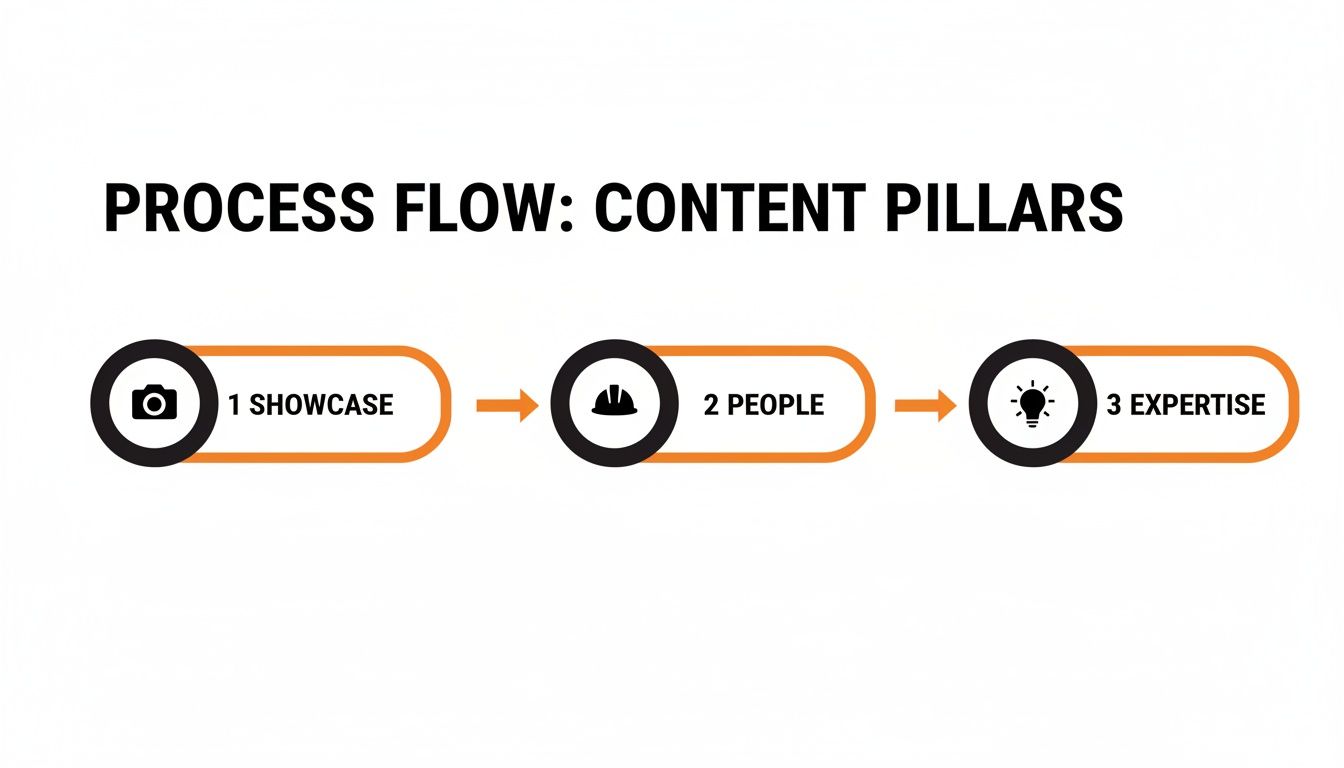
Once you know where you’ll be posting, you need a plan for what you’ll be posting. This is where content pillars come in. They’re the main themes you’ll hit on again and again to create a consistent and engaging presence. Having pillars stops you from staring at a blank screen wondering what to post today.
For a construction company, these four pillars are a rock-solid foundation:
1. Showcase Your Work
This is the bread and butter. It’s your direct proof of quality. But don’t just post a pretty picture of a finished building—tell the story behind it. What problem did you solve for the client? What was the biggest challenge?
Idea: Post a carousel on Instagram showing the before, during, and jaw-dropping after of a major kitchen remodel.
Idea: Create a slick time-lapse video showing the complex installation of a commercial HVAC system.
2. Spotlight Your People
Your crew is your biggest asset. Putting them in the spotlight builds a huge amount of trust with potential clients and also makes your company a place where people want to work. It shows the human side of the hard hats and steel-toed boots.
Idea: Run a “Meet the Crew Monday” series with a quick photo and a fun fact about a team member.
Idea: Post a shout-out celebrating a project manager who just earned a new safety certification.
3. Share Your Expertise
You’re an expert, so act like one. This pillar is all about educating your audience and answering their questions before they even ask. It builds incredible credibility and positions you as a trusted advisor, not just another contractor.
Idea: Film a short video on your phone explaining the pros and cons of different roofing materials.
Idea: Write a LinkedIn article about how your company is adapting to new sustainable building codes.
4. Build Community Trust
At the end of the day, construction is a local game. Show that you’re invested in your community and that your past clients are thrilled with your work. This is how you prove you’re a reliable local partner.
Idea: Screenshot a glowing Google review and share it with a caption thanking the client.
Idea: Post photos of your team volunteering at a local food drive or sponsoring the town’s little league team.
Within these pillars, don’t sleep on video. Short, punchy clips of a project coming to life can do wonders for your reach. A simple 30-second video of a deck build that highlights “New composite deck built in 72 hours” is far more captivating than a static photo, all while showing off your speed and quality. By sticking to these core platforms and content pillars, you’ll build a social media plan that actually works.
Building a Content Workflow That Actually Works
Let’s be honest: having a list of great content ideas is one thing. Actually creating and posting that content consistently is a whole different ball game. For most construction companies, the real challenge isn’t a lack of ideas, but a lack of time and process.
Without a solid workflow, social media becomes that nagging task you only remember when you have a spare moment—which is basically never. A repeatable system is what turns random posts into a reliable marketing engine that works for you, not against you.
The goal here is to make content creation feel like a normal part of your operations, just like a weekly progress meeting or a safety toolbox talk. It shouldn’t be a frantic scramble.
Use a Weekly Posting System (Simple Content Calendar)
Forget those overwhelming, multi-tabbed spreadsheets. A simple, themed content calendar is often the most effective tool. By assigning a theme to each day of the week, you give yourself structure and guarantee you’re touching on all the key aspects of your business.
This approach helps you build a well-rounded brand story by hitting on your core content pillars: showcasing your work, highlighting your people, and sharing your expertise.
Here’s what a practical weekly schedule could look like for a busy construction firm:
Project Progress Monday: Kick off the week showing you’re on the move. A quick video of a concrete pour, a photo of the first wall going up, or a milestone reached on a commercial job. It’s an instant visual that says, “We’re active and getting things done.”
Team Safety Tuesday: Your crew is your biggest asset, so put them in the spotlight. Post a shot from the morning safety huddle, highlight a new piece of gear, or share a quick safety tip. This shows you’re a professional outfit that cares.
Client Story Thursday: Nothing sells your work better than a happy customer. Share a powerful quote from a recent client alongside a great photo of their finished project. This builds trust like nothing else.
Expertise Friday: End the week by sharing some of your hard-earned knowledge. This could be a “Pro-Tip of the Week” graphic about selecting durable materials or a quick video explaining a complex framing technique.
This simple structure kills the daily “what on earth should I post?” dilemma and ensures you’re consistently showing off your projects, your people, and your know-how.
A 4-Step Workflow Example (Capture, Create, Review, Schedule)
So, how does this actually play out, especially if you don’t have a dedicated marketing person? Let’s take that “Expertise Friday” post.
First, you need the actual tip. Instead of racking your brain, you could use an AI assistant right inside a tool like Postiz. A simple prompt like, “Give me five pro-tips for homeowners planning a kitchen remodel,” gets you instant ideas. You spot a great one: “Pro-Tip: Always plan for 20% more lighting than you think you’ll need.” Perfect.
Next, you need a graphic to make it pop. Using a simple design tool, you can create a branded image in minutes. Just drop in your logo, apply your company colors, and lay out the text. It immediately looks polished and professional.
With the draft ready, it’s time for a quick gut-check. You can assign the post to a project manager for review. They’ll get a notification, pop in, and leave a quick comment: “Looks great. Good to go.”
Finally, with the green light, you schedule the post to go live automatically on your LinkedIn and Facebook pages at 10:00 AM on Friday. The whole thing is done and dusted. No last-minute panic, no logging in and out of different social media sites.
By building a system, you move from being reactive to being proactive. You’re no longer just doing social media; you’re managing a social media strategy.
Once you have this foundation, you can build a practical social media content strategy that connects with your ideal clients. And if you want to dive deeper into systemizing your efforts, our guide on building a content creation workflow has even more tactical advice.
Construction Social Media KPIs (What to Track and What to Ignore)
A busy social media page feels good, but feeling good doesn’t pay the bills.
It’s incredibly easy to get caught up in “vanity metrics” like follower counts and likes. They give you a nice little ego boost, but they don’t tell you if your social media efforts are actually making your business stronger.
To turn social media into a real asset, you have to connect your posts directly to bottom-line business goals. This means shifting your focus from fuzzy numbers to hard data that answers one simple question: Is this working?
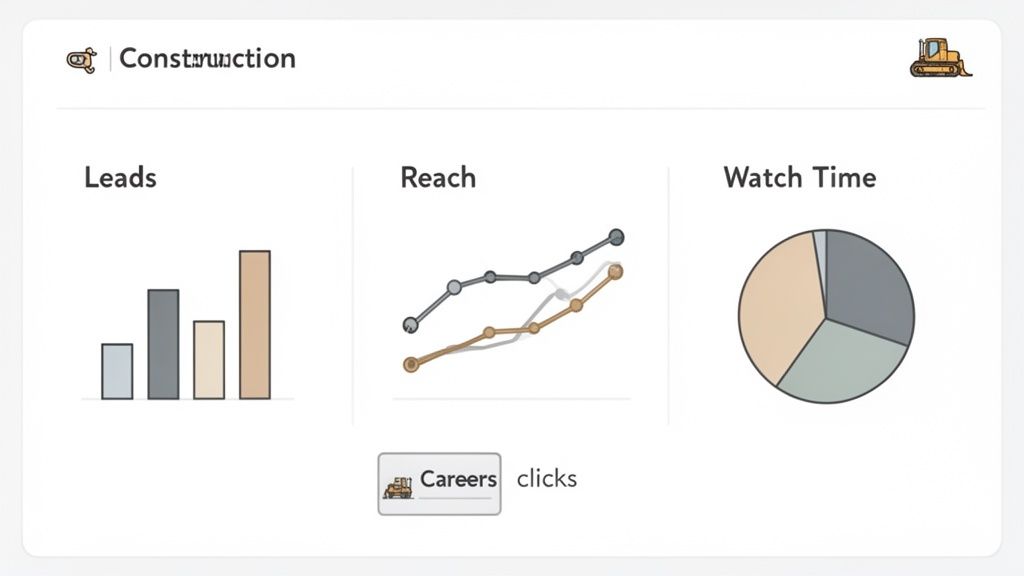
Match Each Goal to the Right Metrics
The first step is to match your main business objectives with specific Key Performance Indicators (KPIs). A KPI is just a measurable value that shows how effectively you’re hitting a target. Instead of chasing likes, you’ll be tracking metrics that prove you’re generating leads, building your brand, or attracting new talent.
Think of it this way: if a post gets 500 likes but doesn’t lead to a single person clicking through to your website, was it really a success? Now, what about a post with only 50 likes that drives 10 qualified visitors to your “Request a Quote” page? That second post is infinitely more valuable.
Here’s how to tie your goals to the right numbers:
If Your Goal Is Lead Generation
Your focus here is on actions that move a potential client one step closer to a conversation. You want to track how many people are jumping from social media to your own turf.
KPIs to Watch:
Clicks on links to your “Contact Us” or “Portfolio” pages.
Form submissions from a dedicated social media landing page.
Direct messages (DMs) asking about your services.
If Your Goal Is Brand Awareness
With this objective, you want to measure how far your message is traveling and if people are actually paying attention. You’re trying to become the go-to name for your type of construction work in your area.
KPIs to Watch:
Reach (how many unique people see your post).
Video View Duration (are people watching your project tours for 3 seconds or 30?).
Shares (when others share your content, they’re basically giving you a referral).
If Your Goal Is Talent Acquisition
This is all about driving traffic to your recruitment channels. Your KPIs should measure the direct interest you’re generating from potential hires.
KPIs to Watch:
Clicks on links to your “Careers” page.
Inbound messages on LinkedIn from job seekers.
Engagement on posts that show off your team and company culture.
Turning Analytics into Actionable Insights
Data is useless if you don’t do anything with it. The real magic happens when you use that information to make smarter decisions about your content. A good social media dashboard, like the one inside Postiz, puts all this data in one spot, making it easy to see what’s truly clicking with your audience.
Your analytics report isn’t a report card; it’s a strategic guide. It tells you exactly what your audience wants more of, taking the guesswork out of your content plan.
Let’s say you review your analytics at the end of the month and spot a clear pattern: your time-lapse videos of a commercial build get twice the engagement and three times the shares of your standard project photos. That’s not just an interesting fact; it’s a direct instruction from your audience.
This insight tells you exactly where to put your time and energy next. Instead of guessing, you now know your audience is hungry for more video. Your action plan is simple: budget a little extra time to set up a camera on the next big job site. That’s how data-driven decisions work in the real world.
Your First 90-Day Action Plan
Alright, let’s get from blueprint to reality. This phased roadmap is your guide to building a social media presence from the ground up, starting with a solid foundation before you start scaling up.
We’ve designed this practical plan for social media marketing for construction companies to take the guesswork out of the equation. It’s about building your digital reputation with confidence, one step at a time.
The First 30 Days: Getting the Foundation Right
Your first month is all about getting your digital job site in order. You wouldn’t pour a weak foundation, so don’t rush your profile setup. This is your chance to make a strong first impression before you ever try to attract a single client or new hire.
Here’s where you need to focus.
Profile Optimization: First things first, get the basics right. Make sure your company name, logo, contact info, and website link are identical and correct everywhere. Your bio needs to be crystal clear—tell people exactly who you are, like “Award-Winning Custom Home Builder in the Denver Area.”
Build a Content Backlog: Never launch an empty page. Create 5-10 solid posts ready to go before you start promoting your profile. Think of it as a portfolio. Show off a stunning before-and-after, a great client testimonial, or a quick intro to your lead project manager. This gives new visitors immediate proof you’re the real deal.
Set a Simple Schedule: Get into a rhythm. Using a tool like Postiz, you can set up a basic posting schedule. Don’t worry about posting every day. Consistency is what matters, and 2-3 times per week is a perfect starting point.
The goal of month one isn’t to go viral. It’s to build a professional, trustworthy presence that makes someone stop scrolling and think, “I should learn more about this company.”
Days 31-90: Building Momentum
With your foundation poured and cured, the next 60 days are all about building up. It’s time to start engaging, expanding your content, and seeing what actually works. This is where you shift from just setting up to actively running your program.
You’ll start getting real feedback from your audience during this phase, so pay attention.
Your focus now shifts to diversifying your content and starting conversations.
Roll Out Your Content Pillars: Start mixing in posts that aren’t just about projects. Showcase your team, share some behind-the-scenes insights, and highlight your commitment to safety.
Give Short-Form Video a Try: It doesn’t have to be a big production. Use your phone to grab a quick time-lapse of a build or a short clip of a team member explaining a specific technique. It’s authentic and effective.
Start Engaging: Don’t just post and walk away. Comment on posts from local suppliers, architects you admire, and community groups. It’s about building relationships, not just broadcasting.
Check Your Analytics: Spend a few minutes each week looking at your performance data. Which posts got the most comments? Are people actually watching your videos? Use these insights to decide what to create next.
Got Questions? We’ve Got Answers
Jumping into social media for a construction company always brings up a few common questions. The digital world has its own set of blueprints, and it’s easy to get turned around. Here are some straightforward answers to the things we get asked most often.
How Often Should We Be Posting?
This is a big one. It’s easy to get burned out trying to post every single day. The truth is, consistency beats frequency every time.
Don’t fall into the trap of posting a ton for one week and then disappearing for a month. A steady, reliable rhythm is what builds an audience. Aim for 2-4 high-quality posts per week. That’s a sweet spot that keeps you on your audience’s radar without watering down your content. Three amazing project updates are far better than seven rushed, mediocre posts.
Think of it this way: your goal is to be a reliable source of interesting content, not just a loud one. A predictable posting schedule builds trust way more effectively than random bursts of activity.
Is Video Really That Important?
In a word, yes. Great photos are non-negotiable, but video is where you can truly bring your work to life. It consistently grabs more attention than static images because it tells a much deeper story.
And no, you don’t need to hire a Hollywood film crew. A simple, well-edited time-lapse showing a build from foundation to finish can be incredibly powerful. Even a quick walkthrough of a completed project filmed on a good smartphone gives potential clients a real feel for your quality. Video is hands-down the best way to show the scale, skill, and detail that goes into your work.
Which Social Media Platform Will Give Us the Best ROI?
This really boils down to what you’re trying to achieve. There’s no magic platform that works for every single construction company. It all comes back to your goals.
Hunting for B2B Leads? You need to be on LinkedIn. It’s the digital hub for developers, architects, and commercial property managers.
Targeting Homeowners?Instagram and Facebook are your go-to channels. They are built for visuals, making them perfect for showcasing stunning finished projects to local homeowners.
Need to Recruit Top Talent? LinkedIn is a must, but don’t sleep on Instagram. Showing off your team and company culture there is a great way to attract the next generation of skilled builders.
The bottom line? Go where your ideal clients and future employees are already spending their time.
Ready to run social media without the chaos? Postiz helps construction teams plan, schedule, and track performance from one dashboard.
If you've been paying Blotato, Buffer, or any of the other SaaS social media schedulers for an API plan, you probably already know the feeling — you're being billed per post, per channel, per seat, and somehow the bill keeps climbing the mo
Learn easy and safe ways to download Facebook videos and reels using online tools, apps, or extensions with this step-by-step Facebook video download guide.