Let’s be clear: social media marketing for recruitment agencies is no longer optional. It’s where talent is discovered, relationships are built, and agencies win or lose market relevance.
While most recruitment firms are still treating social media like a place to repost job ads, the top-performing agencies are using it as a strategic growth engine. They’re building visibility with passive candidates, strengthening employer brands, and positioning themselves as trusted industry voices long before a role even opens.
This guide breaks down how recruitment agencies can move beyond basic job postings and build a social media system that consistently attracts high-quality candidates and high-value clients.
Why Social Media Is Essential for Modern Recruitment Agencies
The era of depending solely on job boards and endless cold calls is fading fast. Today, your ideal candidates and dream clients are scrolling, researching, and networking on social media. If you’re not part of that conversation, you’re essentially invisible. A smart social media plan elevates your agency from just another vendor to a trusted voice in your industry.
Today, your best candidates and ideal clients are already on social media:
Researching companies
Building professional networks
Following industry conversations
If your agency isn’t visible there, you’re invisible to them.
How Social Media Has Changed Talent Acquisition
The shift is already happening:
91% of employers use social media in their hiring process
84% actively recruit through social platforms
85% rely on social media to engage passive candidates
These aren’t trends. They’re signals that recruitment has permanently moved to social-first sourcing.
Why Posting Jobs on Social Media Isn’t Enough
To really succeed, you have to change your thinking. Stop seeing social media as a digital bulletin board for job ads and start seeing it as your brand’s main stage. Great social media marketing for recruitment agencies stands on a few solid pillars:
High-performing recruitment agencies focus on four core pillars:
Audience-first content: career advice for candidates and hiring insights for clients
Strategic platform focus: owning the platforms where your niche actually spends time
Consistent employer branding: showcasing culture, values, and expertise
Smart automation: scheduling and workflows that save time without losing the human touch
The goal isn’t more posts. It’s becoming a talent magnet.
The same strategic framework applies across industries, but execution changes based on audience behavior and trust expectations. For example, social media marketing for gyms, accountants, and doctors requires different content formats, credibility signals, and engagement strategies depending on how each audience evaluates expertise and authority.
By focusing on these key areas, you build a powerful digital presence that’s working for you around the clock. This approach doesn’t just fill today’s open roles; it solidifies your agency’s position in the market for the long haul and is a masterclass in how to increase brand awareness.
Manage all your social media in one place with Postiz
Core Benefits of Social Media for Recruitment Agencies
To put it simply, a well-executed social media strategy delivers tangible results for both sides of your business—attracting top-tier candidates and winning over high-value clients.
Ultimately, social media bridges the gap, creating a more dynamic and transparent ecosystem where the right talent and the right opportunities can connect effortlessly.
Choosing the Right Platforms for Your Niche
A simple rule:
Creative roles → Instagram, Behance
Tech talent → LinkedIn, X, niche communities
Executive and finance roles → LinkedIn
The platform isn’t the strategy. It’s just the venue.
Trying to be everywhere on social media is a fast track to burnout, not new placements. A smart social media strategy for your recruitment agency isn’t about casting the widest net; it’s about fishing in the right ponds with the right bait. Every platform has its own vibe, its own audience, and its own unspoken rules. The trick is to pick your battles wisely.
First things first: stop thinking in generalities. Start by matching the platform to your specific recruiting niche. If you place creative directors, your people are probably scrolling through Instagram or Behance. If you’re hunting for C-suite finance talent, you’d better have a killer presence on LinkedIn. The goal isn’t to chase the latest social media trend—it’s to meet your ideal candidates and clients where they already are.
Where Your Ideal Candidates Live Online
Let’s be honest, LinkedIn is the 800-pound gorilla in the room. You can’t ignore it. The stats don’t lie: a staggering 90-91% of recruiters are on there, sourcing talent from its massive global pool of professionals. It’s the go-to for almost any professional role you can think of.
Recruiters typically source talent across:
LinkedIn: professional roles and senior hiring
Facebook: community insight and cultural fit
X (Twitter): tech, media, real-time conversations
Instagram: creative and lifestyle-driven roles
But here’s where many agencies stop, and that’s a mistake. Did you know that over 30% of recruiters also turn to Facebook? It’s a goldmine for understanding a candidate’s personality, interests, and potential cultural fit beyond what a polished resume can tell you.
This is where your deep understanding of your candidates really pays off. Sourcing for a hot tech startup? You’ll likely find top developers debating new frameworks on X (formerly Twitter) or deep in conversation within niche subreddits. Recruiting for visual designers? A beautifully curated Instagram profile showcasing your clients’ workspaces will do more for you than a thousand InMails.
The platform isn’t the strategy; it’s the venue. Your strategy is to show up where your ideal candidates are already having conversations and provide value that makes them want to connect with you.
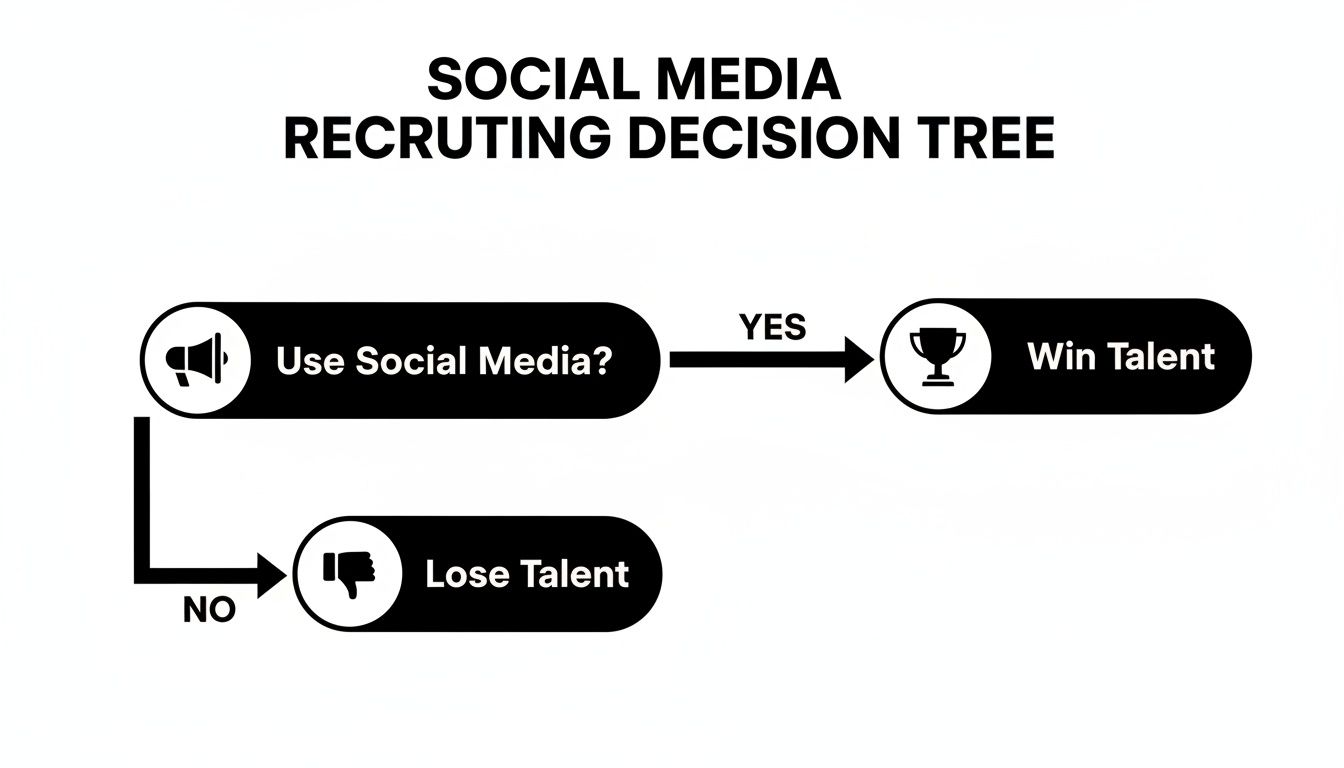
This decision tree breaks it down to its simplest form. Engaging with social media is how you win.
As you can see, the path is clear. Being active on social is no longer optional if you want to attract the best people. Ignoring it means you’re already falling behind.
Aligning Platforms with Recruitment Goals
Think of social platforms as tools in a toolbox. You wouldn’t use a sledgehammer to hang a picture frame, right? The same logic applies here. A much smarter approach is to assign a specific job to each channel you decide to use.
LinkedIn for Authority and Precision Sourcing: This is your digital headquarters. It’s where you share deep industry insights, build your professional network, and run laser-focused ad campaigns for those hard-to-fill senior roles. For a deep dive into its more advanced tools, check out guides like this one on 7 Ways Recruitment Firms And Large Organizations Can Use Linkedin Recruiter To Hire The Best Talents.
Facebook for Community and Employer Branding: This is your chance to build genuine talent pools. Find or create specialized groups (like “Java Developers of Austin”) where you can offer advice and build real relationships. It’s also the perfect place to show off a client’s amazing company culture with photo albums or employee testimonials.
Instagram for Visual Storytelling: If you recruit for creative, lifestyle, or consumer-focused brands, Instagram is non-negotiable. Use Reels and Stories to give behind-the-scenes glimpses of client offices, share “day in the life” content from candidates you’ve placed, and post visually striking job alerts that pop.
X (Twitter) for Real-Time Engagement: This is the spot for jumping into trending conversations, sharing breaking industry news, and promoting urgent roles. Its fast, bite-sized format is perfect for connecting with professionals in fast-moving fields like tech, media, and marketing.
To help you visualize this, here’s a quick comparison of the major players.
Social Media Platform Feature Comparison for Recruiters
Each platform offers a unique advantage. By selecting a primary and secondary channel based on your goals, you can concentrate your fire instead of spraying and praying.
For a masterclass on the most important network of all, don’t miss our complete guide to building a powerful LinkedIn marketing strategy.
When you choose your platforms with purpose, you stop wasting time and start seeing real returns. Your social media presence transforms from a chore into a strategic machine that consistently attracts both top-tier candidates and high-value clients.
How Recruitment Agencies Should Create Content That Attracts Talen
Let’s be blunt: if your agency’s social media feed is just a wall of “We’re hiring!” posts, you’re doing it wrong. That approach is like shouting into a void. The real magic happens when you stop broadcasting and start building a community. Your goal is to become the go-to resource for ambitious candidates and the trusted partner for clients who need real industry insight.
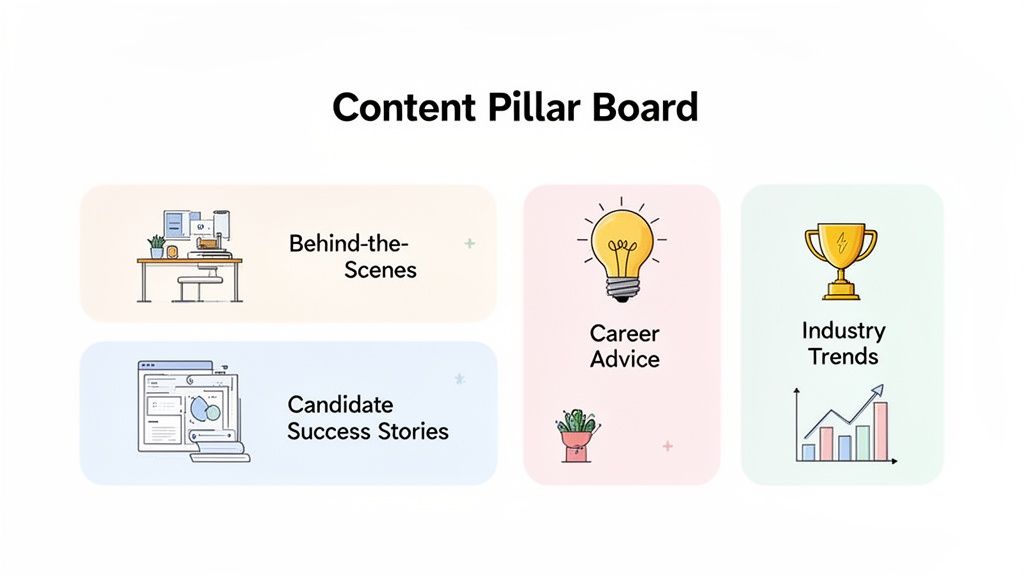
This means you need a content strategy—one built around providing genuine value. The best way to do this is by establishing a few core content pillars. Think of these as the main themes you’ll consistently talk about. They give your content a purpose and ensure you’re always hitting the right notes with your audience.
A visual plan like this helps keep your feed balanced and prevents you from falling back into the job-post-only trap. Each pillar speaks to a different need, creating a well-rounded and authoritative presence that people actually want to follow.
The Core Content Pillars Every Recruitment Agency Needs
So, what should you talk about? For most recruitment agencies, a solid strategy can be built on four powerful pillars. These will become the foundation of your content calendar and keep your messaging on point.
Pillar 1: A Look Behind the Scenes
You have an all-access pass that candidates crave. Use it! Go beyond the sterile job description and show people what it’s really like to work at the companies you represent. This humanizes your clients and helps attract people who will genuinely thrive in that environment.
Try this: Film a quick “day in the life” video with a current employee or a short walking tour of a client’s office.
Why it works: It builds immediate trust and lets candidates picture themselves in the role before they even think about applying.
Pillar 2: Genuinely Useful Career Advice
Shift your mindset from job-filler to career coach. Your team is full of experts, so share that knowledge freely. Offer tips and insights that help professionals grow, whether they’re actively looking for a new role or not.
Try this: Start a weekly “Resume Tip Tuesday” or create a simple carousel post on “How to Crush a Virtual Interview.”
Why it works: You’re providing value to everyone, building a loyal following that will turn to you first when they’re ready for a change.
This is how you transform your social media from a digital job board into a must-follow resource. When you help people with no strings attached, they remember you.
Pillar 3: Celebrating Candidate Success
Nothing sells your agency’s value better than social proof. When you place a fantastic candidate in their dream job, celebrate it! These stories are powerful because they show both candidates and clients that you deliver results.
Try this: With permission, post a branded graphic with a glowing quote from a recently placed candidate. Tag them and their new company to spread the love.
Why it works: It’s tangible proof of your success and shows you know how to make great matches.
Pillar 4: Spotlighting Industry Trends
Demonstrate that you’re not just a recruiter; you’re a market expert. Share and analyze industry news, salary data, or emerging skill sets. This positions you as a strategic partner who understands the bigger picture.
Try this: Write a quick breakdown of a new industry report or host a short LinkedIn Live Q&A on current hiring trends in your niche.
Why it works: This is how you attract top-tier candidates and the clients who are looking for an agency with deep market intelligence.
Bringing Your Content to Life
Once you have your pillars, it’s time to get creative with formats. A multimedia approach isn’t just a nice-to-have anymore; it’s essential. Consider this: job posts with video get 34% more applications than text-only ones. And with over 70% of job seekers now searching on their phones, everything you create has to be mobile-first and visually compelling.
Here are a few ways to turn your pillar ideas into content that stops the scroll:
Short-Form Video: Use Instagram Reels, TikTok, or YouTube Shorts for quick, punchy content. Think 30-second job highlights, quick-fire career tips, or fun behind-the-scenes clips from your team.
Eye-Catching Graphics: You don’t need to be a designer. Tools like Canva or the tools built into a scheduler like Postiz make it easy to create professional-looking graphics for testimonials, key stats, and event announcements.
Conversational Copy: Write like you talk. Ditch the corporate jargon and speak directly to your audience. Ask questions in your captions to spark conversation and get people engaged.
By consistently creating valuable content across these pillars and formats, you build a powerful engine for attracting both top talent and new clients. It’s a long-term strategy that builds your brand, fosters a community, and ultimately, drives more placements.
Need a little more inspiration? Check out these social content ideas to keep your feed fresh.
How to Combine Organic and Paid Social for Better Sourcing
Having a library of great content is a fantastic foundation, but that’s only half the battle. Now it’s time to turn that content into a sourcing machine that actively brings candidates and clients knocking on your door. The key is striking the right balance, blending the slow-burn, trust-building of organic outreach with the immediate, laser-focused impact of paid ads.
Think of it as a one-two punch. Your organic efforts build a community and establish your agency as the go-to expert. Then, paid campaigns come in as a powerful amplifier, letting you zero in on specific candidate profiles for those tough-to-fill roles with speed and precision.
Driving Results with Organic Sourcing
Organic sourcing is all about playing the long game. It’s the art of building real relationships and becoming a staple in the online communities where your ideal candidates hang out. This isn’t about spamming job links—it’s about adding genuine value to the conversation.
Your recruiters need to be active, helpful members of industry-specific groups on platforms like LinkedIn and Facebook. Instead of leading with a job opening, they should start by answering questions, sharing interesting articles, or offering career advice. This approach builds credibility. When you finally do post a relevant opportunity, it lands as a helpful tip from a trusted source, not just another ad.
Mastering hashtags is another powerful organic tactic. You have to think beyond the obvious #hiring or #jobs. A smart mix of broad and niche hashtags is what gets you seen.
Broad Industry Tags:#FinTech, #HealthcareIT, #DigitalMarketing
This layered strategy helps your posts show up in a wide range of searches, connecting you with both active job seekers and passive candidates who just happen to follow those topics.
The most powerful organic marketing comes from your own team. Encourage your recruiters to share their wins, industry thoughts, and open roles on their personal profiles. A post from a real person will always feel more authentic and get more engagement than one from a sterile corporate page.
Executing Targeted Paid Campaigns
When you need to fill a role yesterday or reach a very specific type of professional, paid social media advertising is your best friend. Platforms like LinkedIn and Facebook offer incredibly granular targeting options that put your job ad right in front of the people you need to see it.
Here’s an analogy: organic sourcing is like setting up a market stall in a busy town square, attracting people who happen to wander by. Paid advertising is like sending a personalized invitation directly to the homes of the exact people you want to visit your stall.
Let’s say you need to find a Senior Software Engineer with Python experience, located in Austin, Texas, who has worked at a mid-sized tech company. With LinkedIn Ads, you can build an audience that matches those criteria to a T.
Here’s how a paid campaign might look in a real-world scenario:
Scenario: Your agency needs to find candidates for a “Marketing Manager” role at a B2B SaaS company.
Platform Choice: LinkedIn is the obvious winner here, given the professional context.
Ad Format: A single image ad with the client’s logo and a punchy headline like “Lead a Growing Marketing Team at a Top SaaS Firm” is a solid start. You could also use carousel ads to show off different parts of the company culture.
Targeting: You can target users with job titles like “Marketing Specialist” or “Digital Marketing Manager,” filter for people in the “Computer Software” industry, and then layer on skills like “SEO,” “Content Marketing,” and “HubSpot.”
Budgeting: You don’t have to break the bank. Start with a modest budget, maybe $25-$50 per day, and watch the performance like a hawk. Keep an eye on your Click-Through Rate (CTR) and Cost-Per-Application (CPA). If the numbers look good, you can confidently ramp up the spending.
This level of precision is what makes paid social campaigns a must-have in social media marketing for recruitment agencies. It takes the guesswork out of sourcing and connects you directly with qualified talent, which can dramatically slash your time-to-hire. When you combine this with a steady drumbeat of organic engagement, you create a complete sourcing strategy that just works.
How Recruitment Agencies Can Automate Social Media and Save Time
A killer social media strategy runs on consistency, but that doesn’t mean you should be chained to your desk posting updates all day. The most successful agencies I know have figured this out. They don’t just work hard; they build smart systems to keep a steady stream of high-quality content flowing without taking time away from what really matters—connecting with great candidates and clients.
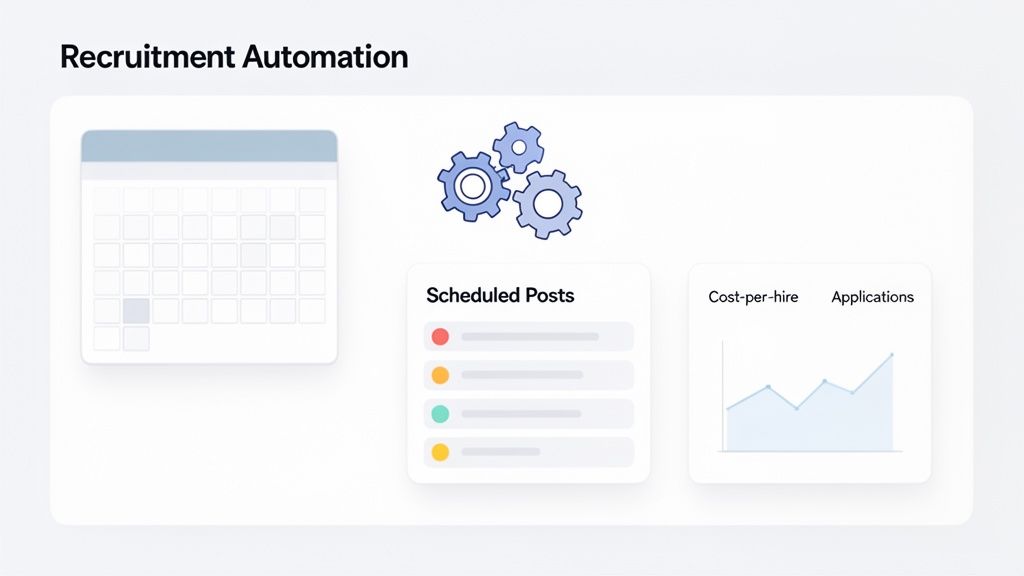
The secret? Ditching the manual, last-minute posts for a streamlined, automated workflow. Think of a social media management tool as your new command center. It allows you to plan, schedule, and push out your content with precision. Instead of scrambling for something to post every morning, you can block off a couple of hours and schedule everything for the week, or even the whole month. Suddenly, social media transforms from a daily chore into a strategic asset that works for you 24/7.
Using a free auto post to social media platform allows recruitment agencies to stay consistent across channels without manually publishing content every day.
Having a tool like this gives you a bird’s-eye view of your content calendar. You can instantly see where the gaps are, make sure you have a good mix of posts, and schedule the same role across different platforms without breaking a sweat.
Putting Your Social Media Operations on Autopilot
Let’s be clear: automation isn’t about being lazy. It’s about being incredibly efficient. It frees up your team to focus on the high-value, human stuff that software can’t do—like having a nuanced conversation with a star candidate or hashing out a search strategy with a new client. For agencies wanting to really level up their efficiency, exploring some of the newer AI lead generation tools can also put client and candidate outreach on autopilot.
Here’s how to build a smarter workflow:
Batch your content creation. Pick a block of time each week—say, Monday morning—to write all your captions, knock out your graphics, and maybe film a few short videos. This “batching” approach is way more productive than trying to create new content from scratch every single day.
Lean on a scheduling platform. A tool like Postiz is perfect for this. You can upload all that content you just batched and schedule it to go live at the best times. Plan out your job posts, your career-tip carousels, and your client spotlights so everything is spaced out perfectly.
Cross-post with a purpose. Don’t just copy and paste the same message everywhere. Use your scheduler to tweak your posts for each platform. You can use a more formal tone for LinkedIn, then switch to something more conversational with different hashtags for Facebook or X.
This system ensures you have a constant, professional presence online. It builds momentum and keeps your agency top-of-mind, even when you’re buried in interviews and client meetings.
Looking Past the Vanity Metrics
Okay, so your workflow is running like a well-oiled machine. Now what? It’s time to figure out if all this activity is actually doing anything for your business. It’s so easy to get caught up in “vanity metrics” like likes, shares, and follower counts. While a growing audience is nice, those numbers don’t pay the bills. They don’t tell you if your social media efforts are actually leading to placements.
To really see your return on investment, you have to track the Key Performance Indicators (KPIs) tied directly to your business goals. These are the stats that prove your social media is a revenue-driver, not just a time-suck.
The single most important question you need to answer is this: “How is our social media activity contributing to our bottom line?” If you can’t answer that with data, you’re flying blind.
Start tracking these metrics that actually matter:
Source of Hire: This is the big one. Make it a non-negotiable part of your process to ask every single candidate how they found you. Knowing how many of your placements started with a social media post is the ultimate measure of success.
Application Conversion Rate: Don’t just celebrate the clicks on your job post links. You need to know how many of those clicks turned into a completed application. A ton of clicks but very few applications is a red flag—it could mean your application process is clunky or the job description doesn’t match the ad.
Cost-Per-Hire (from Social): This is your true ROI. Add up everything you’re spending on social media (ad spend, tool subscriptions, etc.) and divide it by the number of hires you got from those channels. This gives you a hard number you can compare to your other sourcing methods.
Engagement on Job Posts: Look deeper than just the likes. Are people asking smart questions in the comments? Are they tagging friends who might be a good fit? That kind of active engagement is often a sign of much higher-quality interest than a passive “like.”
When you focus on these KPIs, you can start making smart, data-backed decisions. You’ll learn which platforms bring you the best candidates, what type of content drives the most applications, and where to put your ad budget for the biggest bang for your buck. This is how you stop just “doing” social media and start building a machine that delivers real, measurable results.
Common Questions About Social Recruiting
Jumping into social media for your agency can feel like opening a can of worms. You know you should be doing it, but the practical questions start piling up fast. How much time will it really take? Who should we even be talking to?
Let’s cut through the noise. Here are straight-up answers to the questions we hear most often from recruiters trying to make social media work for them.
How Much Time Should Our Agency Dedicate to Social Media Each Week?
There’s no magic number, but a solid, manageable starting point for a smaller agency is 5-7 hours per week. The goal isn’t to be glued to your screen 24/7; it’s about being smart and strategic with the time you invest.
Here’s how that breaks down in the real world: Block out 2-3 hours at the beginning of the week. Use a scheduling tool to get your core content planned and loaded up. The rest of your time? That’s for the human stuff—replying to comments, jumping into relevant group discussions, and actually starting conversations with promising people. It’s about creating a consistent presence, not a constant one.
What Is More Important: Attracting Candidates or New Clients?
This is the classic chicken-or-egg question for recruiters, but on social media, the answer is refreshingly simple. They are two sides of the same coin. A smart social strategy has to serve both at the same time because one fuels the other. After all, your ability to find incredible talent is your best sales pitch to a new client.
Think about it. When you post a “Candidate Success Story,” you’re hitting two targets with one stone. You’re showing other top-tier candidates that you can land them their dream job. Simultaneously, you’re giving potential clients concrete proof that your agency gets results. The trick is to create a content mix that speaks to both, proving your value from every angle.
Think of your social media feed as your agency’s living portfolio. Every great placement you share is a case study that attracts the next great candidate and the next great client.
Can Social Media Actually Work for Highly Specialized Roles?
Absolutely. In fact, for senior-level or super-niche roles, social media becomes less of a megaphone and more of a precision tool. The strategy just shifts from broad appeal to targeted expertise. LinkedIn is your best friend here.
Forget just blasting job ads into the ether. Your time is better spent building a reputation as the expert in that specific field.
Share deep-dive industry analysis that shows you genuinely understand the market’s nuances.
Engage thoughtfully in specialized professional groups where these experts actually hang out.
Run hyper-targeted LinkedIn Ads to reach people with specific job titles at a shortlist of companies.
It’s not about shouting the loudest. It’s about demonstrating your expertise so convincingly that the right people start seeking you out.
How Do We Actually Measure the ROI of Our Social Efforts?
If you can’t measure it, you can’t manage it. To see a real return on investment (ROI), you have to track the metrics that actually tie back to business goals.
First, make “Source of Hire” a mandatory field in your application process. Then, use UTM parameters in your links to see exactly which social posts are driving traffic and applications.
The key performance indicators (KPIs) you should be watching are:
Cost Per Hire that comes directly from your social channels.
Application Rate generated from specific posts or campaigns.
Engagement Rate, especially on your job posts and employer branding content.
Using a platform with clear, built-in analytics makes it way easier to draw a straight line from your social media activity to tangible results like new hires and client inquiries.
Ready to stop guessing and start strategizing? With Postiz, you can schedule your content, analyze what’s working, and manage your entire social presence from one dashboard. Start managing your social media smarter today!
Discover 10 proven Instagram bio ideas with copy-paste examples. Learn how to craft a bio that attracts followers, drives clicks, and boosts conversions.
Learn how financial advisors can use social media to build trust, stay compliant, attract younger investors, and turn online engagement into real clients.