Social media marketing for logistics companies isn’t about viral posts or brand hype. It’s about trust, visibility, and credibility in a complex B2B market.
Today’s shippers, supply chain managers, and e-commerce brands research logistics partners online long before they request a quote. Platforms like LinkedIn and Facebook have become critical touchpoints for proving operational reliability, showcasing expertise, and attracting long-term partners, not just short-term attention.
Building Your Social Media Foundation
Before you post a single update, you need a solid game plan. Just jumping in without a clear strategy is like dispatching a truck without a destination—it’s a waste of fuel and gets you nowhere. The first move is always to lay a strategic foundation that ties every post, video, and tweet back to your core business objectives.
This planning phase is your roadmap.
It ensures every piece of content has a clear purpose, whether that’s:
attracting new freight-forwarding clients
recruiting skilled drivers
positioning your company as a supply chain authority
Without this groundwork, social media efforts feel random and deliver a weak return on investment.
Set Clear and Measurable Business Goals
Your social media goals have to be more than just “getting more followers.” They need to directly support your company’s actual growth. Vague aims like “increase brand awareness” don’t cut it. Instead, you need to focus on specific, measurable outcomes that actually impact your bottom line.
Here are a few examples of goals that truly matter for a logistics company:
Generate Qualified Leads: Instead of just posting, aim to capture a specific number of quote requests each month. For instance, a solid goal would be: “Generate 15 qualified leads for our 3PL services through LinkedIn each quarter.”
Attract Top Talent: Use your platforms to give potential hires a real look at your company culture and fill open roles faster. A clear goal here could be: “Reduce our time-to-hire for new truck drivers by 20% using targeted job posts on Facebook and LinkedIn.”
Build Industry Authority: Position your brand as an expert in a specific niche, like cold chain logistics or last-mile delivery. You can measure this by tracking engagement on your expert content or getting mentioned by industry publications.
Identify and Understand Your Target Audience
So who are you actually trying to reach?
“Everyone” is never the right answer.
In logistics, audiences are highly specific and professional. You need to understand their job roles, daily pressures, and the information they actually care about.
This means creating detailed audience profiles, often called buyer personas.
For a logistics business, you might be targeting:
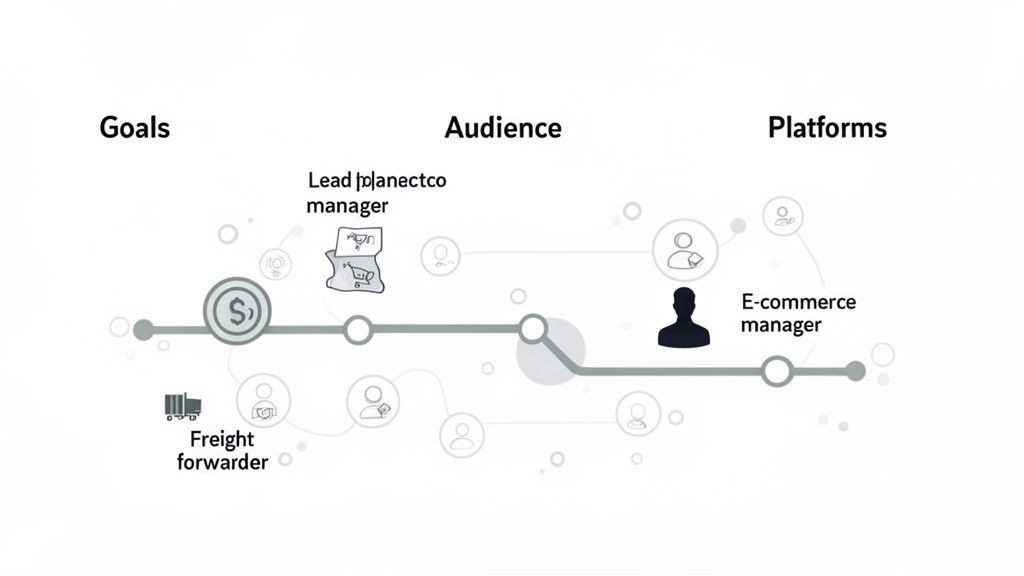
E-commerce Operations Managers: These folks live and breathe fast fulfillment, real-time tracking, and managing those crazy seasonal demand spikes.
Freight Forwarders: They’re looking for reliable partners, competitive rates, and crystal-clear communication about shipment status.
Supply Chain Directors at Manufacturing Firms: Their world revolves around efficiency, cost reduction, and making the supply chain as resilient as possible.
Understanding these different needs is everything. A supply chain director will be drawn to a whitepaper on reducing demurrage fees, while an e-commerce manager is more likely to click on a case study showcasing your order fulfillment accuracy. To dive deeper, you can explore this excellent guide on how to create buyer personas that feel like real people.
Manage all your social media in one place with Postiz
Not all social media platforms are created equal, especially in B2B logistics.
One of the most common mistakes is trying to be everywhere. A far better approach is focusing on the platforms where your audience is already active and paying attention.
Key Takeaway: The goal isn’t to be everywhere. It’s to be where your customers are, delivering value consistently. For most logistics firms, a strong presence on LinkedIn is non-negotiable, while other platforms serve more specialized purposes.
The industry’s shift to digital is impossible to ignore. In fact, a whopping 48% of logistics companies now actively use social media advertising to reach their audiences, a clear sign that the old ways of selling are changing. This data underscores how critical it is to pick the right platform and back it up with a smart ad strategy if you want to stay ahead of the curve.
To help you decide where to focus your efforts, here’s a quick breakdown of the most relevant platforms for logistics companies.
Choosing the Right Social Media Platform for Your Logistics Business
Choosing the right mix of these platforms depends entirely on the goals you set and the audience you defined. Don’t feel pressured to master them all at once. Start with one or two, build a strong presence, and then expand as your resources and strategy evolve.
Creating Content That Actually Connects
Let’s be honest: generic “we ship stuff” posts don’t work in logistics.
Your audience isn’t scrolling for fluff. They’re business professionals trying to solve complex supply chain problems and looking for partners who truly understand their world.
Service-based industries face similar challenges around education and trust, as outlined in this guide on social media marketing for chiropractors, where expertise-led content drives engagement.
To even get on their radar, your social media content has to go deeper than just listing your services. It needs to show you understand their world and can deliver real value. The best way I’ve found to do this is by building your strategy around a few core content pillars—think of them as the main themes you’ll return to again and again. Each one should tackle a key concern for your audience, proving you’re a reliable and forward-thinking partner.
Showcase Your Operational Muscle
Your daily operations may feel routine to you, but to potential clients, they’re proof you can deliver.
Pulling back the curtain on how your operation runs is one of the most powerful ways to build trust.
This kind of content makes your services real. A quick video of a well-organized warehouse or a time-lapse of a container being loaded with precision says more about your efficiency than a hundred words ever could.
Here are a few simple ideas to get started:
Behind-the-scenes tours: Grab your phone and do a short, guided video tour of your warehouse, cross-dock facility, or even your dispatch hub. Highlight specific areas like your quality control checkpoint.
“A day in the life”: Feature one of your team members—an operations manager, a forklift operator, or a customs broker. It puts a human face on your brand and shows off the incredible expertise you have in-house.
Spotlight your gear: Do you use specialized equipment like temperature-controlled units or heavy-lift machinery? Post a photo or a short clip of it in action and explain exactly how it solves a client’s problem.
Build Trust Through Safety and Compliance
In logistics, a single compliance mistake can trigger delays, fines, or damaged goods.
Your commitment to safety isn’t just operational, it’s a major selling point. Social media is the perfect place to prove you’re a low-risk, high-reliability partner.
Content that centers on safety reassures clients that their cargo is in good hands. You’re directly addressing their biggest anxieties about supply chain disruptions and legal headaches.
My Two Cents: Don’t just list your safety protocols—turn them into helpful content. An infographic on proper hazmat labeling or a short post breaking down a new customs rule instantly positions you as a proactive expert, not just another vendor.
Trust-driven industries follow similar principles, as shown in this guide on social media marketing for mental health clinics, where credibility and compliance are central to content strategy.
Show Off Your Tech and Innovation
Logistics is in the middle of a huge digital shift. Clients are actively looking for partners who use technology for better visibility, efficiency, and data. Your social media is the perfect stage to showcase your tech advantage.
This is your chance to talk about how you’re future-proofing your operations, which in turn, future-proofs your clients’ supply chains. Digital tools are no longer a “nice-to-have.” In fact, recent data shows that 65% of logistics companies now use AI-driven solutions. The market expects logistics firms to be tech-forward.
Here’s how to show off your tech without being boring:
Dashboard Sneak Peeks: Share a (blurred, non-sensitive) screenshot or a quick screen recording of your client portal. Point out key features like real-time tracking or inventory reports.
Explainer Videos: A short, animated video can break down how your WMS or TMS works to cut down on errors and speed up fulfillment.
Automation in Action: Nothing beats seeing it live. Post a video of your automated sorting systems or robotic arms at work on the warehouse floor. It’s impressive stuff.
Prove It With Client Success Stories
At the end of the day, nothing is more persuasive than a real-world win. Case studies and testimonials are the ultimate social proof, turning your marketing claims into verified results. It’s where you stop talking about what you can do and start showing what you have done.
But please, skip the generic “They were great!” testimonials. Tell a story. The best ones follow a simple formula: here was the client’s challenge, here’s how we solved it, and here was the measurable result. For more ways to approach this, you can check out our guide on social content ideas that can help you frame these stories perfectly.
A few powerful formats that work every time:
Problem-Solution-Result Infographic: A simple, eye-catching graphic that shows the client’s challenge (e.g., high damage rates), your solution (e.g., a new packaging protocol), and the awesome outcome (e.g., 98% reduction in damaged goods).
Quote Graphics: Pull a powerful line from a client email, put it on a branded background, and post it. It’s fast, effective, and people love to share them.
Video Testimonials: If you have a great relationship with a client, ask if they’d be willing to record a short video. Hearing another business owner praise your work in their own words is incredibly authentic and builds instant trust.
Planning and Automating Your Content Workflow
If you want social media to work, consistency is non-negotiable.
Sporadic posts disappear quickly. A steady, reliable presence builds trust and turns followers into real business opportunities.
This is where a good content calendar becomes your best friend, moving your social media efforts from a chaotic daily task to a smooth, strategic operation.
Think of your content calendar as the blueprint for your brand’s story. It helps you strategically balance your core topics—your operational strengths, safety protocols, tech stack, and client wins—while leaving room for timely industry news or seasonal campaigns. Having this plan in place means you’re never scrambling for what to post next, keeping your message sharp and on-brand, even during the busiest peak seasons.
Building Your Monthly Content Calendar
The best way to start is by planning one month at a time. A simple spreadsheet works just fine, but dedicated platforms can offer more features. The real goal is to create a rhythm and a predictable flow of information that your audience begins to look forward to.
I’ve found that assigning themes to certain days of the week is a practical way to get this done. For example:
Tech Tuesdays: This is your chance to show off a piece of your tech, whether it’s your TMS or a new client-facing tracking portal.
Team Thursdays: Pull back the curtain and feature an employee spotlight or a behind-the-scenes video of your operations team in action.
Success Story Fridays: What better way to end the week than with a powerful client testimonial or a short case study highlighting a big win?
This kind of structure not only makes content creation easier but also ensures you’re consistently hitting all the key pillars that your audience cares about. Plus, it makes it much easier to batch-create content, which is a massive time-saver.
The Power of Content Repurposing
Here’s one of the biggest secrets to staying consistent without burning out: repurposing your content. You don’t need to invent something brand new every single day. Instead, take one solid piece of content and slice it up into multiple smaller posts for different platforms.
A single, well-documented client success story is a goldmine. It’s not just one post; it’s an entire week’s worth of content waiting to be unlocked. Smart repurposing maximizes the value of every story you tell.
Let’s say you have a detailed case study. You can easily turn that one document into:
A long-form LinkedIn article that walks through the entire project.
A sharp, visual infographic that boils down the key results (like a 30% reduction in transit time).
A series of quote graphics for Instagram and Facebook, using the client’s own words.
A short video testimonial with the client sharing their experience for YouTube and LinkedIn.
A quick, punchy post for X that highlights the single most impressive stat from the case study.
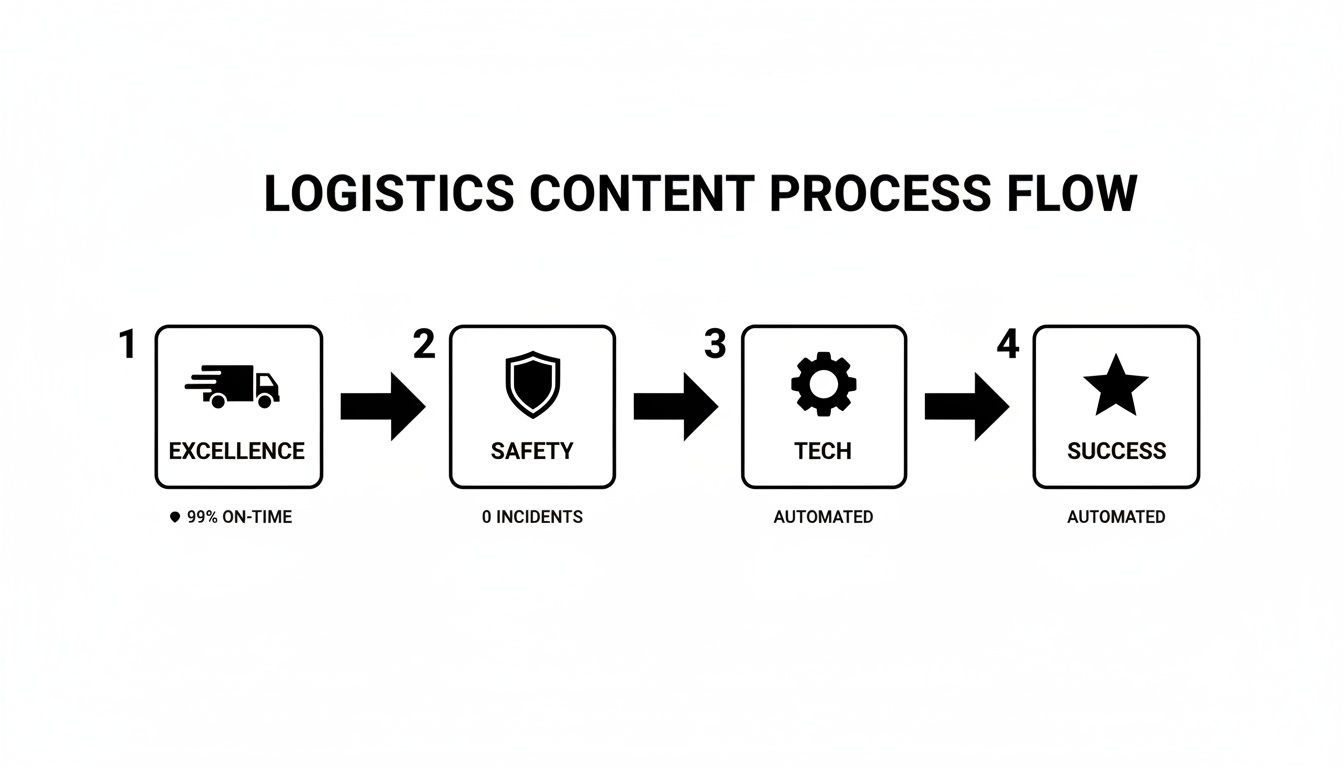
This process flow gives you a visual map for how to turn your company’s core strengths into compelling social media content.
Each step here represents one of those key pillars we talked about, showing how you can translate operational details into stories that connect with your audience. Following a model like this keeps your content strategy balanced and thorough.
Streamlining Your Workflow with Automation
Once your calendar is set and your content is ready, the final piece is scheduling it all. This is where automation tools are no longer a “nice to have”—they’re essential for any serious social media marketing for logistics companies. Platforms like Postiz let you schedule everything in advance, so your content goes live at the perfect time, without you having to be there to hit “publish.”
Using a scheduling tool gives you a few major advantages:
Time Savings: Block out a couple of hours and schedule an entire week or month’s worth of posts in one go.
Consistency: Your content gets published on time, every time, even when you’re busy putting out fires elsewhere.
Team Collaboration: Many tools have approval workflows built-in, so you can make sure every post is reviewed before it goes live.
For a closer look at what these tools can do, our guide on automated social media posting is a great resource. And if you really want to connect your entire marketing stack, exploring Zapier integrations can be a game-changer for your content and lead management workflow.
Automating your workflow buys back your team’s time, freeing them up to focus on what really matters: engaging with your audience, building relationships, and turning your social media followers into genuine partners. It’s the final step that makes a high-quality, consistent social presence something any logistics company can actually achieve.
Turning Followers into Leads and Partners
Publishing great content is only half the job.
The real value comes from building relationships, not just broadcasting messages.
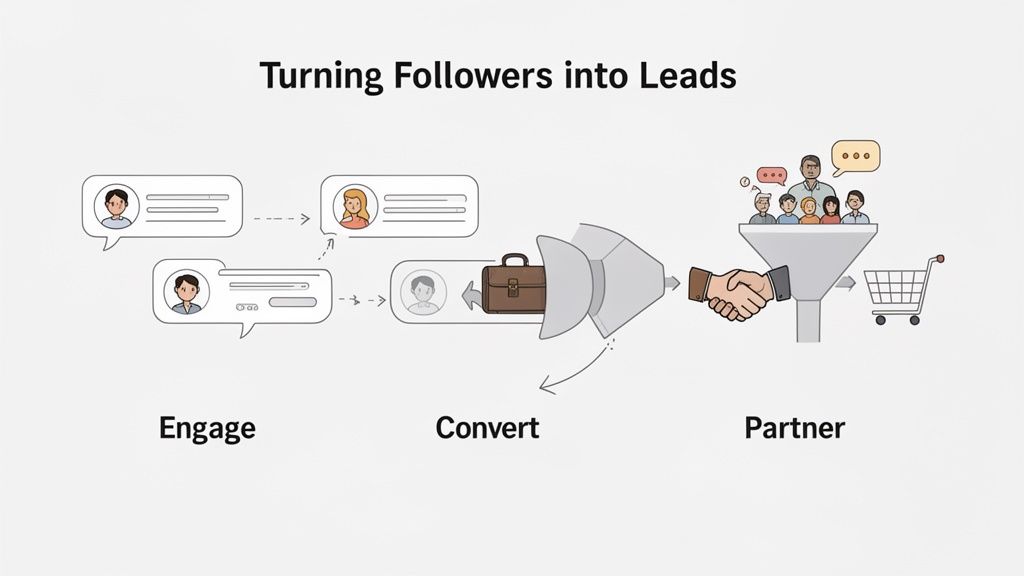
Every comment, share, and direct message is an opening. It’s a chance to turn a casual follower into a solid lead, a loyal client, or even a strategic partner. This is where you’ll find the true ROI of your social media efforts.
This means you have to be proactive. Don’t just sit back and wait for inquiries. Your team should be in the trenches, joining conversations, offering value, and establishing your company as the go-to expert. Think of your social channels less like a digital billboard and more like a bustling networking hub.
Foster Meaningful Engagement
Trust is the currency of B2B relationships, and you build it through genuine interaction. It’s not enough to post and ghost; you need to be an active player where your clients and partners are already talking. This goes way beyond a simple “like.”
Here’s how you can get started:
Respond Thoughtfully: Someone comments on your post? Great. Don’t just say “thanks.” If they ask something, give them a real answer. If they share an opinion, acknowledge it and add to the discussion.
Participate in Niche Groups: LinkedIn is packed with groups for supply chain management, freight forwarding, and e-commerce logistics. Jump in, listen to what people are struggling with, and offer helpful advice—with zero sales pitch.
Acknowledge Your Partners: Give a shout-out to your tech providers, carriers, or even clients (with their okay, of course). Tag them in relevant posts. This strengthens those bonds and gets you in front of their audience.
Key Insight: The goal here isn’t to sell; it’s to help. When you consistently provide expertise and solve small problems for free, you naturally attract the right kind of business opportunities. People remember the company that answered their question in a LinkedIn group way more than the one that just ran another ad.
Tap into the Social Commerce Ecosystem
One of the biggest opportunities for logistics providers right now is the explosion of social commerce. More businesses than ever are selling directly on Instagram, Facebook, and TikTok. These are often fast-growing, digitally-native brands that desperately need a logistics partner who gets their unique fulfillment headaches.
Use your social media to show them you’re the solution. Create content that highlights your:
Rapid Fulfillment Capabilities: Post a quick video of your pick-and-pack operation in action.
E-commerce Integration: Share a graphic showing how your systems plug into platforms like Shopify.
Reliable Delivery Services: Feature a quote or short case study from an e-commerce client you’ve helped scale.
This approach positions you as the essential backbone for a market that’s absolutely booming. The social-commerce logistics market was valued at USD 84.93 billion in 2025 and is projected to hit USD 165.77 billion by 2030—that’s a stunning 95% jump.
This surge shows that being visible and credible on social media is no longer just a marketing tactic; it’s a core business development strategy. To do this effectively, it’s essential to implement proven B2B lead generation best practices.
Proactively Connect with Potential Clients
Finally, use social media as a targeted outreach tool. Something like LinkedIn Sales Navigator is perfect for identifying the exact decision-makers at companies that fit your ideal customer profile.
But don’t just go in cold. Try a warmer, more methodical approach:
Follow the Company Page: Get a feel for their latest news and what they’re focused on.
Engage with Their Content: A thoughtful comment or like on their posts gets you on their radar in a low-pressure way.
Connect with a Personal Message: When you do send that connection request, make it count. Reference a post they shared or a mutual interest. Whatever you do, do not send a generic sales pitch.
This relationship-first approach works so much better in the B2B world. It proves you’ve done your homework and you’re interested in a real partnership, not just a quick transaction. Combine this with your consistent, valuable content, and you’ll have a powerful engine for bringing in high-quality leads and partners for the long haul.
Measuring What Matters for Business Growth
If you’re not tracking performance, you’re flying blind.
Effective social media marketing for logistics companies is built on data, not guesswork.
It’s time to stop chasing vanity metrics like likes and follower counts and start zeroing in on the Key Performance Indicators (KPIs) that actually mean something for your business.
Other high-stakes industries track social media ROI just as closely, as seen in this breakdown of social media marketing for law firms, where lead quality matters more than vanity metrics.
These are the numbers that connect what you do on social media directly to your bottom line. They answer the big questions: Is this actually generating leads? Is it sending people to our service pages? Are we building a reputation as the go-to expert in the industry?
Go Beyond Vanity Metrics
It’s tempting to get excited when a post gets hundreds of likes, but let’s be honest—for a logistics business, that number often doesn’t mean much. A “like” doesn’t pay for fuel or keep the lights on in the warehouse.
Your focus has to shift to metrics that signal genuine business interest from your real audience—the supply chain managers, freight forwarders, and e-commerce owners you want to work with.
Instead of just watching your follower count tick up, look deeper. A far more powerful metric is the follower growth ratewithin your target personas. Gaining ten new followers who are all qualified supply chain directors is infinitely better than gaining a hundred random accounts.
Key Performance Indicators for Logistics
To measure what really moves the needle, you need to track KPIs that tie back to the business goals you set from the start. These are the metrics that paint a clear picture of how social media is helping with sales, recruitment, and brand authority.
Here are the most critical KPIs every logistics company should have on their radar:
Website Traffic from Social: Use Google Analytics to see exactly how many people are coming to your site from LinkedIn, X, or Facebook. Even better, dig in to see which specific posts are sending them there.
Lead Quality and Conversion Rate: Don’t just count leads. Track how many of those social media leads turn into actual quote requests and, ultimately, new clients. This is your true measure of ROI.
Engagement on Service-Focused Posts: Pay very close attention to how your audience interacts with content about your core services, like 3PL solutions or freight brokerage. High engagement here is a massive indicator of interest from potential customers.
Cost Per Lead (CPL): If you’re running paid ads, this is non-negotiable. It tells you exactly how much you’re spending to get each new lead, which is crucial for optimizing your ad budget.
Building a Simple Analytics Dashboard
You don’t need a crazy-expensive or complicated system to get started. A simple dashboard, even one you build in a spreadsheet or a free tool like Google Data Studio, can give you a clean, at-a-glance view of what’s working and what isn’t.
Your dashboard should pull in data from your social platforms and your website analytics. The whole point is to see the entire journey, from someone clicking your social post all the way to them filling out a form on your website.
A good analytics dashboard tells a story. It should quickly show you which platforms are driving the most valuable traffic and which content pillars are generating the most qualified leads, allowing you to make smarter decisions fast.
For example, your dashboard might reveal that your LinkedIn articles on “supply chain optimization” are bringing high-quality traffic to your services page, while your Facebook posts about company culture are crushing it for attracting new driver applications. That kind of insight is pure gold.
Interpreting the Data and Taking Action
Collecting data is useless if you don’t do anything with it. This is where you create a powerful feedback loop: analyze the results, learn from them, and then tweak your plan for the next month.
Here’s a classic scenario: you share a post about your new warehouse automation tech, and it gets tons of engagement—likes, shares, comments. But almost no one clicks the link to learn more about your warehousing services. What does that tell you?
The data suggests your audience is fascinated by the tech, but your call-to-action didn’t give them a strong enough reason to take the next step.
So, your action plan could be:
Adjust the Content: Create a follow-up post that talks less about the tech specs and more about the direct client benefit, like “How Our New Automation Slashed Order Fulfillment Time by 40%.”
Refine the CTA: Swap out the generic “Learn More” for something more specific and compelling, like “See How We Can Speed Up Your Deliveries.”
By constantly analyzing and adjusting, you turn your social media from a shot in the dark into a precise, data-driven engine for growing your business.
Answering Your Top Questions About Logistics Social Media
Even the best-laid plans run into real-world questions. It’s totally normal. Think of this as your field guide for tackling the common hurdles that pop up when you’re getting serious about social media in the logistics world.
Let’s cut through the noise and get you some straight answers.
“How Much Should We Actually Budget for This?”
There’s no single, magic number here. But the biggest mistake I see is companies treating social media as a “free” activity. While the profiles don’t cost anything, getting real business results takes a dedicated investment in time, tools, and advertising.
Your budget really needs to cover three bases:
Content Creation: This could be as simple as an employee’s time dedicated to taking photos or as involved as hiring a pro to shoot a facility tour video.
Management & Tools: You’ll want to account for scheduling platforms and analytics software. These tools make your life easier and your efforts measurable.
Paid Advertising: This is non-negotiable for growth. It’s how you get your message in front of new, highly-targeted audiences, especially on a platform like LinkedIn.
For a mid-sized logistics company just getting started, a practical monthly budget might be somewhere in the $1,000 to $3,000 range. This gives you enough runway for some quality content support and a decent ad spend. The key is to watch your Cost Per Lead (CPL) like a hawk and scale up once you see a clear return.
“We’re a Logistics Company. What Could We Possibly Post That’s Interesting?”
I hear this all the time, and it’s one of the biggest myths out there. Your day-to-day operations are fascinating to the people who need to trust you with their cargo.
You’re not trying to go viral with dancing videos. You’re trying to build trust and demonstrate competence. A potential client isn’t looking for entertainment; they’re looking for reassurance.
They want to see proof of your operational expertise.
They want to see the real people who will be managing their shipments.
They need to understand how your tech gives them the visibility they crave.
Go back to your content pillars—operations, safety, tech, and client success stories. The well of content there is practically bottomless. A quick, well-lit photo of a perfectly secured flat-rack container says more about your skill than any stock photo ever could.
“How Do We Prove This is Actually Working? What’s the ROI?”
This is the million-dollar question. To measure the Return on Investment (ROI) from social media, you have to look past vanity metrics like likes and follows. You need to connect the dots between your social media activity and actual business goals, like qualified leads and new clients.
The trick is to track the customer’s entire journey. For instance, set up conversion tracking on your website so you can see exactly how many people who clicked a link on your LinkedIn page ended up filling out your “Request a Quote” form.
Here’s a straightforward way to think about calculating ROI:
Tally Your Investment: Add up all the costs—ad spend, tool subscriptions, and the hourly cost of your team’s time. Don’t forget anything.
Track Your Returns: You need to assign a real dollar value to each lead you get from social media. For example, if you know that 1 in every 10 leads becomes a client, and the average lifetime value of a client is $50,000, then you can say each lead is worth $5,000.
Do the Math: Use the classic formula: (Return – Investment) / Investment x 100%.
When you approach it this way, social media stops being a fuzzy marketing expense and becomes a measurable engine for growth. This is how you justify the budget and make smarter decisions on where to put your time and money.
Ready to put these strategies into motion and get a handle on your social media workflow? Postiz gives you the scheduling, automation, and analytics tools needed to build a powerful, consistent presence. Start planning, publishing, and measuring your success with ease.
Learn how mental health clinics can use social media ethically to build trust, reduce stigma, and attract patients without violating privacy or compliance rules.