Social media marketing for law firms is no longer optional or experimental. It has become a critical part of how potential clients discover, evaluate, and decide which firm to trust. Long before someone fills out a contact form or picks up the phone, they are researching lawyers on LinkedIn, Facebook, Instagram, and beyond, looking for expertise, credibility, and reassurance.
For modern law firms, a strong social media presence is not about chasing trends or posting generic promotions. It’s about educating prospective clients, demonstrating authority in your practice areas, and building trust within strict ethical boundaries. When done correctly, social media becomes a powerful engine for visibility, reputation building, and qualified lead generation.
This guide is designed to show law firms how to use social media strategically and compliantly. You’ll learn how to overcome skepticism, choose the right platforms, create content that attracts the right clients, navigate advertising ethics, and measure results that actually matter to your firm’s growth.
Why Social Media Is Essential for Modern Law Firms
Let’s be real—a lot of firms are still skeptical about social media. The old playbook of handshakes, referrals, and a local ad worked for a long time. But your clients today aren’t thumbing through the Yellow Pages. They’re scrolling through LinkedIn, Facebook, and even TikTok, looking for answers and experts they can trust.
Having no social media presence—or worse, a dormant one—is like having an empty reception desk in your office. It subtly tells potential clients you might not be keeping up with the times. The first step is to change how you think about it. Social media isn’t just a fluffy branding exercise; it’s a direct line to potential clients and a powerful engine for bringing in new business.
This shift in how people discover and evaluate services is happening across industries, especially at the local level, where visibility and trust are built online first, as explored in our guide to social media marketing for local businesses.
Moving Beyond Skepticism to Strategy
That initial hesitation is completely understandable. You’ve got ethical rules to worry about, a billable-hour clock that never stops ticking, and the very real need to see a return on your investment. But these aren’t dead ends. They’re just the guardrails that shape your strategy.
A smart social media plan for a law firm isn’t about jumping on the latest dance trend or posting generic “Happy Holidays” graphics. It’s about methodically building your firm’s authority where it counts.
When done right, a solid social media marketing plan for your law firm can do several things at once:
Build Authority and Trust: When you consistently share genuinely helpful content, you establish your attorneys as go-to experts in their field.
Generate Qualified Leads: Smart content and targeted ads attract people who are already looking for information about your legal services. That means better-quality inquiries.
Humanize Your Firm: Showing a bit of your firm’s personality, whether it’s a team volunteer day or a new associate introduction, makes you more approachable.
Drive Website Traffic: Every post is a chance to lead people back to your website, where they can dig deeper and officially reach out.
The core idea is simple: Educate, don’t sell. The most successful firms use their social media to answer the exact questions their ideal clients are asking. This builds trust naturally, so when someone finally needs legal help, your firm is the first one they think of.
This guide will walk you through the whole process, step by step. We’ll tackle everything from navigating those tricky ethics rules and picking the right platforms to creating content that actually connects with people. Most importantly, we’ll show you how to track results that matter to your bottom line, turning online conversations into tangible growth.
This trust-first approach isn’t unique to law firms. Other regulated professional services face similar challenges, particularly accountants, where compliance, authority, and education are just as critical, as explained in our guide to social media marketing for accountants.
Manage all your social media in one place with Postiz
Building an Ethical and Compliant Social Media Foundation
For law firms, the biggest hurdle in social media isn’t figuring out what to post. It’s knowing what you absolutely can’t. The web of attorney advertising rules from the American Bar Association (ABA) and state bars can feel like a minefield, but it doesn’t have to stop you in your tracks.
Think of these regulations less as roadblocks and more as the essential foundation for a sturdy building. A house built on shaky ground will eventually crack. In the same way, a social media program built without a solid understanding of your ethical duties is just a liability waiting to happen.
These compliance considerations closely mirror those in healthcare marketing, where strict ethical rules govern how professionals communicate online, as we outline in our guide to social media marketing for doctors.
Translating Legalese Into Actionable Rules
At their core, most attorney advertising rules exist to protect the public from being misled. This means your social media content must be truthful, non-deceptive, and never create unrealistic expectations about the results you can get for a client.
This is a common thread in professional services. We cover similar ethical ground in our guide on social media marketing for mental health clinics, where trust and confidentiality are just as critical. The key is to shift your entire mindset from “selling” to “educating.”
So, what does this look like in a real-world post?
Non-Compliant Post: “We’re the best personal injury firm in the city and we guarantee a win!” This is a clear foul. It makes a comparative claim you can’t objectively prove and guarantees an outcome, which is impossible.
Compliant Post: “Our firm has deep experience in personal injury cases. We’re focused on giving our clients dedicated representation to help them through a tough process.” This is a perfect example of describing your services accurately without making wild promises.
This difference is everything. You need to demonstrate your expertise through genuinely helpful content, not by making bold (and unethical) claims.
Key Takeaway: Ethical social media for law firms is built on a simple premise—prove your expertise, don’t just proclaim it. Share valuable insights that help people understand complex legal issues. You’ll build trust and authority naturally, without ever crossing an ethical line.
Avoiding Accidental Attorney-Client Relationships
One of the sneakiest risks on social media is unintentionally creating an attorney-client relationship. Someone sends you a direct message asking for specific legal advice, an attorney on your team gives a direct answer, and—boom—you might have just created a professional duty.
To avoid this, you have to set crystal-clear boundaries from the start. Your public posts and private messages should only ever offer general information, not personalized legal counsel.
Communication Guardrails Checklist:
Use a Disclaimer: Your profile bio and occasional posts need a clear disclaimer. Something simple like, “This account provides general information only and does not constitute legal advice or create an attorney-client relationship,” is non-negotiable.
Redirect Specific Inquiries: If someone DMs you with a detailed legal problem, your only response should be a polite redirection. For instance: “Thanks for reaching out. To discuss the details of your situation and see how we can help, please schedule a formal consultation using the link in our bio.”
Maintain Confidentiality: Never, ever discuss case specifics—not even hypothetically—if they contain details that could identify a client. Client confidentiality applies everywhere, including social media.
As you build out your social media presence, it’s also smart to keep an eye on the broader ethical landscape. This includes emerging guidelines for things like responsible AI use in the legal sector, which is becoming increasingly important for maintaining client trust. Staying informed on all fronts is just part of running a modern, compliant practice.
The old idea that law firms are shy about social media is officially dead. In fact, a whopping 89% of firms are now active on at least one social platform. LinkedIn is the undisputed king, with 87% of firms using it to network and share their expertise, while Facebook isn’t far behind at 62%. These numbers prove that social media is no longer an experiment; it’s a core function of modern legal marketing.
Choosing the Right Platforms to Reach Your Ideal Clients
Trying to be everywhere on social media is a surefire way to burn out and get mediocre results. A classic mistake I see law firms make is spraying the same message across every platform, hoping something sticks.
Think of it this way: you wouldn’t host a corporate law seminar at a rock concert. You go where your ideal audience—your future clients—is already gathered and ready to listen.
The same rule applies online. Instead of spreading your firm thin, focus your energy on one or two platforms where your clients actually spend their time. This choice should flow directly from your practice areas and the people you want to attract.
Platform Comparison for Law Firm Marketing
To cut through the noise, it helps to see how the major platforms stack up against each other for different legal practices. This table breaks down where you should be spending your time based on who you’re trying to reach and what kind of law you practice.
Ultimately, your platform choice isn’t just about demographics; it’s about user intent. Are they looking for a business solution or a personal one? Aligning your platform with that intent is half the battle.
LinkedIn: The Professional Networking Hub
For any firm with a B2B focus, LinkedIn is non-negotiable. It’s the digital headquarters for corporate law, employment law, IP, and commercial litigation practices. Why? Because the entire environment is primed for professional conversations.
This is where you’ll find the C-suite executives, in-house counsel, and HR directors you want as clients. It’s also a goldmine for attorney referrals. Sharing a sharp analysis of new legislation or a common contractual mistake immediately positions you as an expert. For a deep dive, our guide to building a powerful LinkedIn marketing strategy will get you on the right track.
Here’s how to win on LinkedIn:
Publish In-Depth Articles: Go beyond a simple post. Use LinkedIn’s article feature to publish thoughtful analysis that showcases your expertise.
Engage in Niche Groups: Don’t just lurk. Actively participate in groups for your target industries. Answer questions, offer insights, and become a trusted voice.
Connect Strategically: Use the search tools to find and connect with the exact decision-makers you want to reach.
Facebook: The Community Connection Tool
While LinkedIn is all business, Facebook is the undisputed champ for B2C law firms. If you practice family law, estate planning, personal injury, or criminal defense, this is your playground. The platform’s real magic is its ability to build community and target users based on hyper-specific local demographics and life events.
A family lawyer can connect with people in their city who just got engaged. A personal injury firm can build trust by sharing safety tips in local community groups. It’s about becoming a familiar, helpful resource, not just another billboard.
The core difference is intent. On LinkedIn, users are in a business mindset, seeking professional solutions. On Facebook, they are in a personal mindset, connecting with their community, which makes it ideal for practices that address personal legal needs.
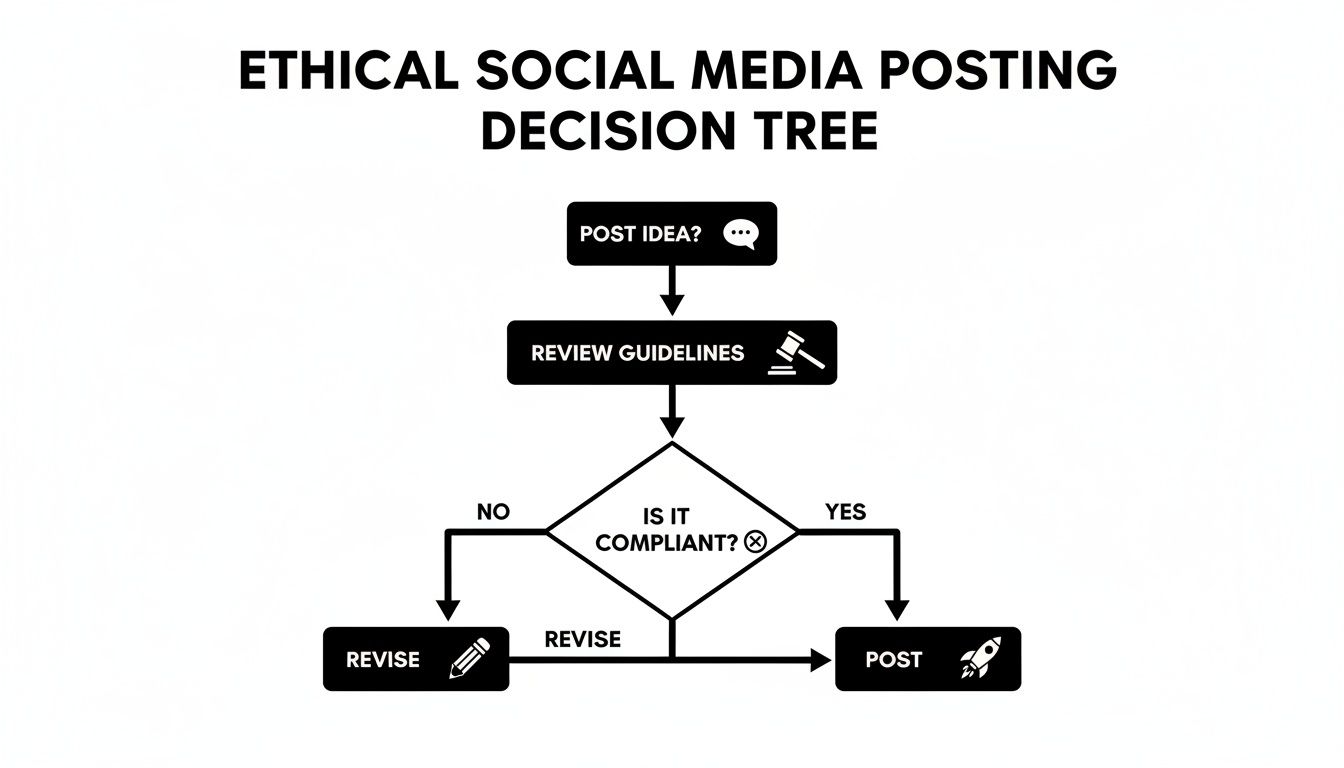
Before any post goes live, it has to pass an ethics check. This decision tree offers a simple framework to keep your content compliant.
Running every idea through this kind of ethical filter isn’t just a good idea—it’s a foundational part of a sustainable social media program.
Other Platforms to Consider
LinkedIn and Facebook are the heavyweights, but other platforms have their place for specific goals.
Twitter (now X) is fantastic for lawyers who want to engage with journalists, track legal news as it breaks, and offer quick, authoritative commentary. Just be warned: its fast pace demands a real-time commitment to be truly effective.
For firms wanting to show their human side, Instagram can be surprisingly powerful. Sharing photos of your team at a charity event or creating simple graphics that demystify a complex legal topic makes your firm feel more approachable. It’s a great fit for practices like family or immigration law, where that personal connection can make all the difference.
Creating Content That Educates, Builds Trust, and Attracts Cases
The most effective social media for law firms runs on a simple but powerful idea: educate, don’t sell. Let’s be honest, nobody is scrolling through their Facebook feed hoping to find a sales pitch from a lawyer. They’re looking for answers, clarity, and an expert they can actually trust.
Think of your content as the bridge connecting someone’s legal questions to your firm’s expertise. Instead of just shouting, “Call us for a free consultation!”, your goal should be to become the go-to resource in your specific practice area. This approach builds your authority and establishes a genuine relationship long before a potential client ever thinks about signing a retainer.
The Content Pillar Strategy Explained
Staring at a blank calendar and trying to come up with fresh content ideas every single day is a recipe for burnout. A much smarter way to work is the content pillar method. It’s all about creating one big, foundational piece of content—like an in-depth blog post or a guide—and then slicing it up into smaller, snackable pieces for social media.
For example, say you write a comprehensive blog post called “The Complete Guide to Navigating a Personal Injury Claim in California.” That single asset can fuel your social media for an entire month. Seriously.
Here’s how that one blog post can be repurposed:
LinkedIn Article: Publish a condensed version that focuses on the professional and procedural angles.
Facebook Posts: Create a series of five posts, with each one tackling a key step from your guide, like “What to Do Immediately After an Accident.”
Instagram Reel/TikTok: Film a quick, 60-second video debunking a common myth about insurance company settlement offers.
Twitter Thread: Break down the personal injury claim timeline into a 10-part thread of bite-sized, easy-to-follow steps.
Instagram Carousel: Design a visually engaging slide deck explaining the “5 Documents You Must Keep After a Car Accident.”
This strategy saves a massive amount of time and keeps your messaging consistent everywhere. You work smarter, not harder, by making one core asset do all the heavy lifting for your content calendar.
Proven Content Ideas That Build Authority
To get rolling, you need a toolbox of reliable content formats that resonate with people looking for legal information. Remember, the goal is to be helpful and show off your problem-solving skills without crossing the line into giving direct legal advice online.
Here are a few proven content ideas that consistently work wonders for law firms.
1. Myth vs. Fact Posts
The legal world is filled with bad information and “I heard from a friend” misconceptions. Use your platform to set the record straight. For instance, a family law firm could create a post: “Myth: Common law marriage is automatic after 7 years. Fact: California does not recognize common law marriage.” These posts are incredibly shareable and instantly position you as the expert.
2. Anonymized Case Studies
Show, don’t just tell. Share simplified, anonymous stories of past cases that highlight your firm’s approach. Focus on the client’s challenge, your strategy, and the positive outcome you achieved. A business litigation firm could post something like: “A client faced a contract dispute threatening their supply chain. Our team found a critical clause and negotiated a resolution that saved the partnership. #BusinessLaw #ContractDispute”
3. Simple “How-To” Guides
Break down complicated legal processes into simple, easy-to-follow steps. An estate planning attorney could create a carousel post on “How to Choose a Guardian for Your Children in 3 Easy Steps.” This kind of practical, actionable content provides real value and builds a ton of trust.
As you’re crafting this content, don’t forget about search engine optimization (SEO). A solid strategy involves finding low-competition keywords that your ideal clients are actually typing into Google. This helps drive the right kind of traffic straight to your firm.
Using the Right Tools for Content Creation
Putting all this content together doesn’t have to be a daily grind. Modern tools are built to make this whole process way more efficient. Using a social media scheduler lets your team plan, create, and schedule out weeks of content in just one sitting.
This screenshot from Postiz shows what a typical scheduling dashboard looks like, where you can manage all your accounts and see your content calendar laid out visually.
Platforms like this allow you to organize your content pillars and ensure you have a balanced mix of educational, engaging, and firm-related posts without scrambling to post something every day.
The data shows this effort really pays off. Social media marketing delivers nearly double the leads of old-school tactics like trade shows, with a whopping 84% of firms securing leads from organic traffic alone. When you pair that with a 4% average conversion rate from those organic efforts, it becomes a seriously cost-effective way to find new clients.
The Big Picture: Your social media content isn’t an advertisement; it’s a demonstration of your firm’s value. Every helpful post, every myth you debunk, and every process you simplify is a deposit into a bank of trust. When a follower finally faces a legal challenge, your firm will be the first one they think of.
Measuring Success and Proving ROI to Partners
Likes, shares, and a growing follower count feel good, but they won’t convince a skeptical managing partner. If you want to justify your marketing budget and prove social media is worth the effort, you have to connect your online activity to tangible business results. That means shifting your focus from “vanity metrics” to the key performance indicators (KPIs) that actually affect the firm’s bottom line.
Think of it like building a case in court. Likes and followers are circumstantial evidence—they look good, but they won’t win the argument on their own. The hard evidence is the data showing your social media posts are generating real client inquiries and consultations. The whole goal is to draw a clear, data-backed line from a LinkedIn post all the way to a new client retainer.
Moving Beyond Vanity Metrics
The first step is to redefine what “success” actually looks like for your firm. While a big following can certainly expand your reach, it doesn’t automatically translate into new business. Instead, you need to track the metrics that measure genuine interest and action from potential clients.
These are the numbers that partners truly care about:
Website Clicks from Social: How many people are actually leaving the social platform to check out your firm’s website? This is a huge indicator of real interest.
Consultation Form Submissions: Are people who click through from social media filling out your “Contact Us” or “Request a Consultation” form? This is a direct lead.
Direct Inquiries via Social DMs: Keep a simple tally of how many legitimate new case inquiries you receive in direct messages on platforms like Facebook or LinkedIn.
Phone Calls from Social Profiles: Use a trackable phone number on your profiles to see exactly how many calls come straight from your social media presence.
The Core Shift: Stop reporting on audience size and start reporting on audience action. The real question isn’t “How many people saw our post?” It’s “How many people took the next step toward becoming a client because of our post?”
Setting Up Your Measurement Tools
To actually capture this data, you need the right tools in your corner. Google Analytics is your most powerful ally here. By setting up conversion goals, you can see exactly which social media channels are sending the most valuable traffic to your website. For instance, you can create a goal that tracks every time a visitor lands on your “Thank You” page after submitting a contact form.
The data is clear: social media is a powerful way to find new clients. In fact, 71% of lawyers report that they’ve generated new leads directly from social media. With an average 4% conversion rate from organic efforts, it’s proof that real revenue can come straight from your online activity.
For even more detailed insights, start using UTM parameters—they’re just special codes you add to your links. You can create unique links for every campaign or even every post to see precisely what content is most effective at driving both traffic and conversions. For a deeper dive into this, check out this great guide on tracking social media ROI, which lays out a fantastic framework.
Calculating Your Cost-Per-Lead
Once you start tracking conversions, you can calculate one of the most persuasive metrics of all: the cost-per-lead (CPL). This simple calculation gives you a clear dollar figure showing exactly how much it costs to acquire a potential new client through your social media channels.
The formula is refreshingly straightforward: Total Monthly Social Media Spend / Total Number of Leads Generated = Cost-Per-Lead
Your “spend” here should include everything—ad costs, tool subscriptions, and even a portion of the salary for staff working on social media. When you can walk into a partner meeting and say, “Last month, we spent $500 on LinkedIn and generated 10 qualified leads, giving us a CPL of $50,” you completely change the conversation. You’re no longer talking about fuzzy brand awareness; you’re talking about predictable, cost-effective client acquisition.
Answering Your Top Social Media Questions
Even with a perfect plan on paper, a few lingering questions can keep you from diving in. And that’s completely normal. Committing your firm’s time and resources to social media is a big step, so let’s tackle the most common questions we hear from firms just like yours.
Think of this as the final check-in before you go live. We’ll clear up any doubts about time, compliance, and what really works, so you can move forward with confidence.
How Much Time Should a Small Firm Really Dedicate Each Week?
For a small law firm, consistency will always beat frequency. The goal isn’t to be online 24/7; it’s to maintain a steady, professional presence that builds trust over time. A great starting point that’s both manageable and effective is 3-4 hours per week.
The trick is to be smart about how you use that time. You don’t need to be glued to your phone every day to make a real impact.
Here’s what that looks like in practice:
Content Planning & Scheduling (1-2 hours): This is your power block. Set aside a couple of hours once a week to plan, write, and schedule all of your posts. Batching your content like this is the single best way to stay consistent without the daily scramble.
Engagement (1 hour): Break this up into tiny 15-minute chunks throughout the week. Use this time to reply to comments, interact with posts from referral sources, or chime in on a relevant LinkedIn group discussion.
Review & Analysis (1 hour): At the end of the week, take an hour to see what’s working. Which posts got people talking or clicking? This quick look-back is how you refine your approach and make sure your efforts are getting smarter over time.
It all comes down to working smarter, not harder. When you batch your content creation, your firm stays visible and active even when you’re completely buried in client work.
Crucial Insight: The most successful small firms don’t magically find more time for social media; they make their limited time more productive. A scheduling tool is what turns social media from a daily chore into a manageable weekly task.
Can We Talk About Our Case Wins on Social Media?
Yes, but you have to walk a very fine line. Sharing a successful outcome is a fantastic way to showcase your expertise, but it’s also a minefield of ethical risks. Everything comes down to two key principles: confidentiality and avoiding guarantees.
First, you can never violate client confidentiality. This is non-negotiable. It means you need explicit, written permission from your client before you share anything about their case. It doesn’t matter how anonymous you think you’ve made it.
Second, your wording can never, ever imply a guarantee of similar results for future clients. State bars are incredibly strict on this. Instead of shouting about dollar amounts, frame the story as an anonymized case study that highlights your firm’s skill and strategic thinking.
Here’s what NOT to do:
“Another huge win! We just secured a $1.5 million settlement for our client in a car accident case. If you’ve been injured, call us now to get the money you deserve!”
And here’s the compliant, effective way:
“We recently represented a client injured in a complex multi-vehicle accident. By meticulously reconstructing the event and negotiating firmly with the insurers, we were able to secure a favorable outcome that provided for their long-term care. #PersonalInjury #LegalStrategy”
See the difference? The second version demonstrates competence and process without making promises or revealing confidential information.
What Is the Biggest Mistake Law Firms Make?
The single biggest mistake is treating social media like a digital billboard.
Firms that just blast out ads like “Call us for a free consultation!” or “Hurt in an accident? Contact us today!” are the ones who get ignored. People are on social media to connect and learn, not to be sold to. This old-school, interruptive approach just doesn’t work here.
The most effective social media marketing for law firms is built on an “educate, don’t sell” philosophy. Your main goal should be to provide genuine value. Answer common legal questions, explain confusing processes, and share insights that show you know your stuff.
When you consistently give away helpful information, you build trust. Then, when someone in your network finally does need legal help, your firm is the first one they’ll think of.
Should We Hire an Agency or Manage Social Media In-House?
This really boils down to your firm’s resources—specifically your time, budget, and internal know-how. There’s no single right answer, but for many firms, a hybrid approach hits the sweet spot.
Let’s break down the options:
Hiring an Agency: This route gets you specialized expertise and saves you a ton of time. The downside? It can be pricey, and you run the risk of an agency not truly understanding the nuances of your firm’s voice or, more importantly, legal marketing ethics.
Managing In-House: Doing it yourself gives you total control over your message and ensures you stay compliant. The major trade-off is the huge time commitment it takes, pulling you or your team away from billable hours.
A great middle ground is the hybrid model. Keep the big-picture strategy, content ideas, and final approvals in-house. This ensures you maintain control over your brand and compliance. Then, use tools and maybe even a freelance writer or designer to handle the day-to-day execution—the scheduling, graphic creation, and community management.
This way, you get the efficiency of an outside team without the high cost or the risk of losing control.
Ready to take control of your firm’s social media with a powerful, intuitive tool? Postiz offers a unified platform for scheduling, content creation, and analytics, helping you build a professional online presence efficiently. Streamline your workflow and turn your social media strategy into a client-generation machine at https://postiz.com.