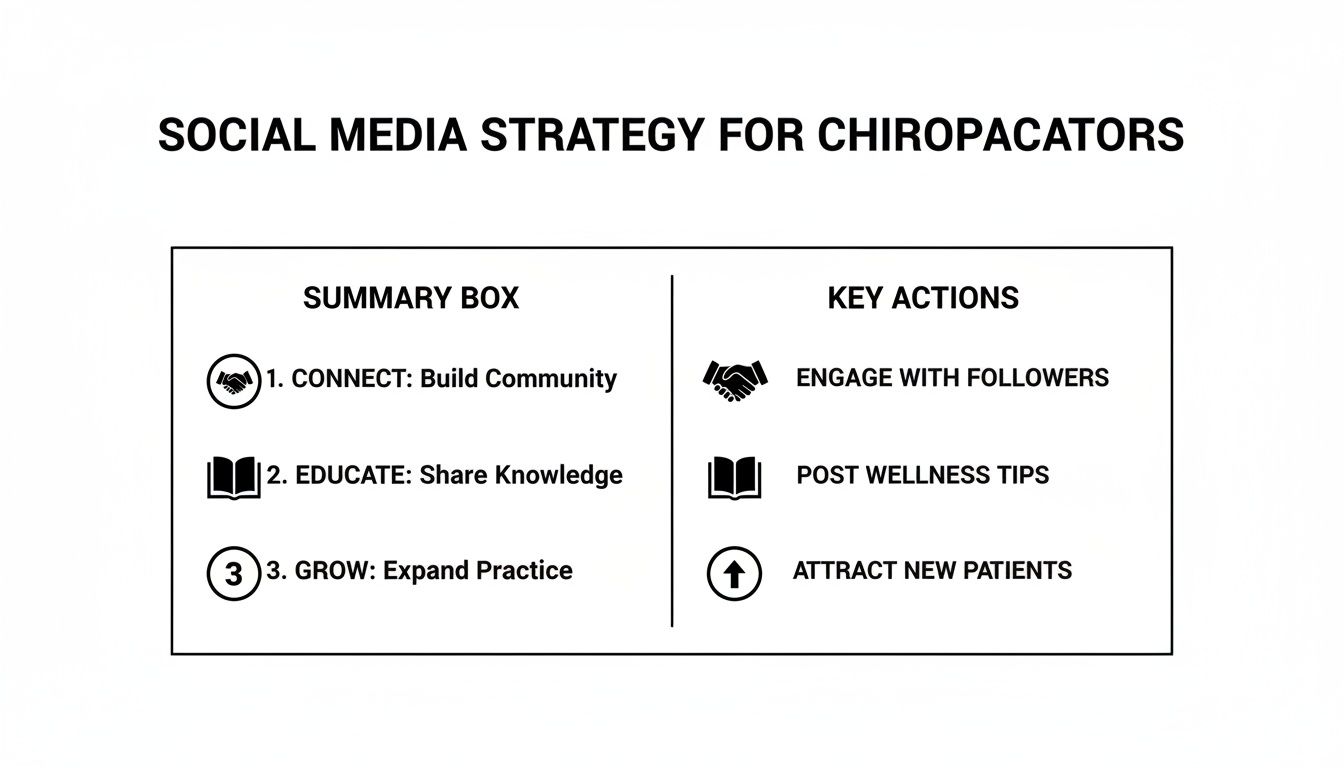
Social media marketing for chiropractors is not about chasing viral trends. It’s about becoming a trusted local resource before a patient ever books an appointment.
Most people don’t search for a chiropractor until they’re already in pain. When that moment comes, they choose the provider they recognize, trust, and feel comfortable with. Social media gives you the chance to build that trust early by educating your community, addressing real pain points, and showing the human side of your practice.
This guide breaks down how chiropractors can use social media to attract local patients, build authority, and turn online engagement into booked appointments without relying on gimmicks or constant promotions.
Why Social Media Is a Game Changer for Your Practice
Social media is now one of the primary ways patients discover and evaluate local healthcare providers. Instead of relying on ads or directories alone, chiropractors can use platforms like Facebook and Instagram to educate their community and stay top-of-mind when pain shows up.
A consistent social presence turns your clinic from just another listing into a familiar, trusted practice. When people see helpful content regularly, they are far more likely to choose you when they’re ready to book.
Many of these principles apply to other location-based companies as well. This approach closely mirrors what we see working in social media marketing for local businesses, where trust and proximity drive conversions.
More Than Likes and Follows
It’s easy to fall into the trap of thinking social media is just a popularity contest. But for a practice, it’s a powerful engine for bringing in new patients and keeping them engaged. Think of it as a digital extension of your practice—one that showcases your expertise and your patient-first philosophy.
A smart social media strategy can do some heavy lifting for your clinic:
Builds Authority and Trust: When you share practical content—like quick videos on proper sitting posture or myth-busting Reels about chiropractic care—you position yourself as the go-to expert in your area.
Increases Local Visibility: With the right targeting, your posts and ads are seen by people who actually live and work near your clinic. No more wasted marketing dollars.
Drives Qualified Leads: Engaging content gets people to send you a direct message or click the link in your bio to book an appointment. These aren’t just random clicks; they’re from people actively looking for a solution you provide.
The best social media strategies feel less like marketing and more like a helpful conversation. Your posts should answer the questions your community is already asking about their health.
Choosing the Right Platforms to Find Local Patients
Trying to be everywhere on social media is a classic mistake. It stretches your resources thin and leads to generic content that doesn’t connect with anyone. The real secret isn’t being on every platform, but on the right platforms—the ones where your local patients are actually spending their time.
For a chiropractor, the game is local. You need to attract people from your neighborhood, your town, and the surrounding communities. Let’s zero in on the platforms that are proven to work for practices just like yours, so you can focus your energy where it counts.
For evergreen educational content like posture tips, stretches, and wellness visuals, Pinterest can also support long-term discovery. Using a Pinterest post scheduler helps keep this content consistent without manual posting.
Platform Comparison for Chiropractic Marketing
Chiropractors do not need to be on every platform. They need to be present where local patients already spend time.
Ultimately, a strong strategy often involves a primary platform like Facebook or Instagram, supported by a foundational presence on Google Business Profile and YouTube. This mix allows you to engage your community daily while building long-term assets that attract new patients over time.
Facebook: The Community Hub
Facebook works especially well for chiropractors because of its strong local and community focus. It’s ideal for patient education, reviews, and hyper-local advertising.
Facebook’s ad tools are also incredibly precise for local targeting. You can run a campaign that shows up only for people within a 5-mile radius of your clinic. Better yet, you can narrow that down by interests like “yoga,” “running,” or “desk job,” making sure every dollar you spend is reaching people who are likely to need your services. That kind of local precision is tough to beat.
If Facebook is the town square, Instagram is your practice’s open house. It’s all about visuals and is the perfect place to show the human side of your clinic. People want to get a feel for you and your space before they even think about booking.
Instagram is your chance to give potential patients a peek behind the curtain.
Go Behind-the-Scenes: Post quick videos of your office, introduce your amazing staff by name, or show your commitment to cleanliness. This builds comfort and trust instantly.
Create Educational Reels: Quick 15-30 second Reels showing a simple stretch for “tech neck” or debunking a common myth are gold. They’re super shareable and instantly position you as the go-to expert.
Share Patient Wins: With their clear written permission, of course, feature a happy patient. Nothing is more powerful than a real person sharing their positive experience.
Your social media should make new patients feel like they already know you. Seeing your team’s friendly faces and a clean, welcoming office on Instagram makes walking through that door for the first time way less intimidating.
Visual storytelling plays a similar role in other trust-based services. We see the same pattern in social media marketing for photographers, where consistent visuals and behind-the-scenes content drive credibility and bookings.
YouTube: The Evergreen Educator
Don’t sleep on YouTube for building serious, long-term authority. Yes, creating videos takes more work upfront, but a good YouTube video can bring in new patients for years. It’s like creating a library of digital assets that work for you around the clock.
Focus on creating helpful, in-depth videos that answer questions people are already searching for, like “Top 3 Stretches for Sciatica Pain” or “How to Set Up Your Home Office to Avoid Back Pain.” Each video is a breadcrumb that leads local searchers right back to your practice.
And remember, your social media presence works best when it’s part of a complete local marketing strategy. That’s why optimizing your Google My Business profile is non-negotiable. It’s the critical first step that ensures people can find you when they’re ready to book.
Creating Content That Connects and Converts
Effective social media for chiropractors isn’t about posting “Happy Friday!” and calling it a day. It’s about building a system that educates, builds real authority, and gently guides followers toward becoming new patients. When done right, your social media stops being a chore and starts becoming a powerful patient acquisition tool.
The goal? Make potential patients feel like they know, like, and trust you before they even set foot in your clinic. This all starts by understanding that people scrolling through their feeds aren’t looking for a sales pitch. They’re looking for solutions to their pain and answers to their health questions. Your content has to deliver that value first.
By consistently sharing helpful, relevant information, you build a genuine relationship with your community, positioning your practice as the go-to wellness resource in town.
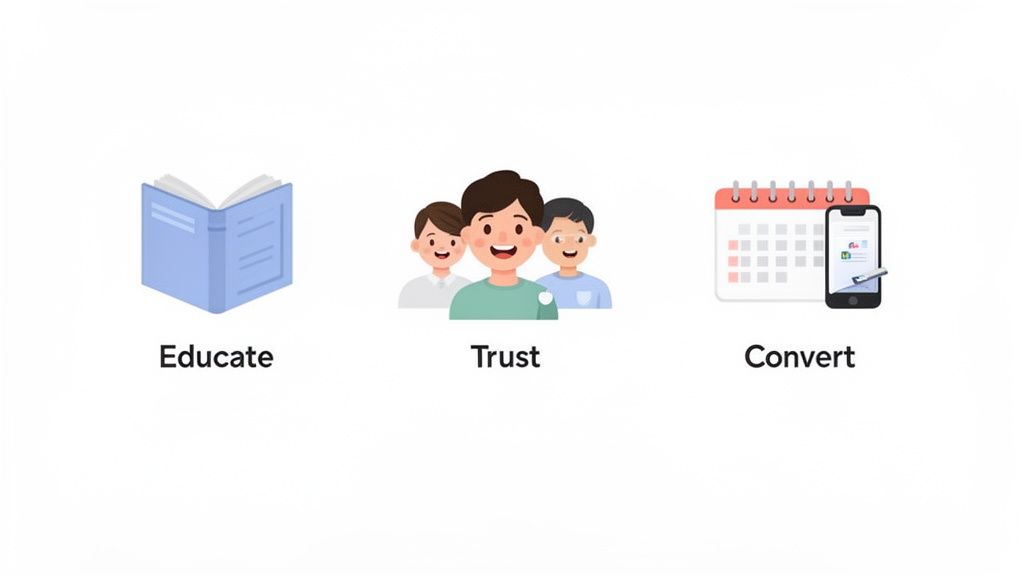
The Three Pillars of Chiropractic Content
I like to think of a solid content strategy as a three-legged stool. If you neglect one leg, the whole thing gets wobbly. To effectively nurture your audience from a casual follower to a booked patient, you need a healthy balance across these three essential pillars.
Educational Content (The Expert Pillar): This is where you build your credibility. These posts answer the questions your patients are already asking, debunk common myths, and offer simple, actionable health tips. This kind of content proves you’re a knowledgeable expert who genuinely cares about their well-being, not just about selling services.
Trust-Building Content (The Human Pillar): At the end of the day, people choose healthcare providers they feel a connection with. This is where you humanize your practice. Showcase your team, give a peek into your office, and share the real stories of people you’ve helped. It’s all about creating that personal touch that makes someone feel welcome.
Conversion-Focused Content (The Action Pillar): Once you’ve earned that expertise and trust, it’s perfectly fine to ask for the appointment. These posts are your direct calls to action, making it incredibly easy for an interested follower to take the next step, whether that’s booking a consultation or grabbing a new patient special.
This balanced approach keeps your feed valuable and engaging, preventing it from feeling too salesy.
Ideas for Your Educational Content Pillar
This is your chance to shine as the local wellness authority. The secret is to take complex topics and make them simple and easy to digest. With 90% of Americans now turning to social media for health info, you have a massive opportunity to share your expertise right where they’re looking.
Here are a few ideas you can put into action this week:
“Posture Tip Tuesdays”: Start a weekly series with a simple graphic or Reel. Show one easy tweak to improve posture at a desk, in the car, or even while sleeping.
Myth-Busting Carousels: Create a multi-slide post tackling a common misconception like, “Cracking your own back is the same as an adjustment.” Use each slide to break it down.
Condition Explainer Videos: Film a quick video (under 60 seconds) explaining a common condition like sciatica or tech neck in simple terms. Show what causes it and how you help.
“Did You Know?” Infographics: Share a surprising stat about spinal health. For example: “Did you know that for every inch your head moves forward, it adds 10 pounds of weight for your spine to support?”
Ideas for Your Trust-Building Content Pillar
This is where you let the personality of your practice come through. You want people to feel like they’re already part of your clinic’s community before they even walk through the door.
Meet the Team Mondays: Post a great photo of a staff member with a few fun facts about them. What’s their favorite weekend activity? Why do they love working in chiropractic?
Office Tour Reels: Give a quick, friendly virtual tour of your practice. Show off the welcoming reception area and adjustment rooms. This helps demystify the first-visit experience for nervous new patients.
Patient Success Stories (with permission!): A short video clip or a quoted graphic from a happy patient is pure gold. Focus on their transformation from pain to relief to show the real-world results you deliver.
Behind-the-Scenes Moments: Did your team celebrate a birthday or have a potluck lunch? Share a quick photo or Story. It shows you have a positive, friendly culture.
A potential patient’s decision often comes down to comfort and trust. Showcasing your friendly team and clean, modern office can be the deciding factor that convinces them to choose your practice over another.
Ideas for Your Conversion-Focused Content Pillar
After consistently providing all that great value, it’s time to ask for the appointment. These posts need to be clear, direct, and make it ridiculously simple for someone to take the next step.
New Patient Specials: Use a clean, professional graphic to detail your introductory offer. Make the call to action impossible to miss: “Click the link in our bio to claim your offer now!”
“Last Chance” Reminders: Create a little urgency for an expiring offer or for the last few appointment slots available before a long weekend.
Service Spotlights: Dedicate a post to a specific service you offer, like spinal decompression or pediatric adjustments. Explain who it’s for, highlight the benefits, and finish with a strong call to action to learn more or book a consult.
We’ve seen that practices posting just two to three times weekly can see their engagement rates jump by up to 30%—consistency is a huge factor for social media algorithms. By creating organized content streams like these, some practices in major markets have even reported a 25% increase in new patient inquiries.
If you ever feel stuck in a creative rut, there are plenty of resources out there. For even more inspiration, check out our guide on social content ideas that can be adapted for any local business. This systematic approach ensures you’re not just posting at random, but actively building a predictable pipeline for patient growth.
Running Local Ads That Bring Patients in the Door
Organic social media is great for building community and trust, but let’s be honest—when you need to predictably fill your schedule, paid advertising is the engine that gets it done. Running targeted ads on platforms like Facebook and Instagram lets you supercharge your patient acquisition by putting your message in front of the right people, in the right place, at exactly the right time.
It’s valuable, but limited. Paid ads are like putting up a billboard on the busiest street in town, but a smart billboard that only appears for people who are already thinking about their neck or back pain. It’s a direct, powerful way to turn a marketing budget into real appointments.
The real beauty of social media marketing for chiropractors is how incredibly local you can get. You aren’t just tossing money at the wall and hoping it sticks. You’re strategically placing your practice in front of potential patients who live and work just a few minutes down the road.
Setting Up Your First Local Campaign
Getting your first ad campaign live on Facebook and Instagram is more straightforward than you might think. The secret is to start small. Focus on one clear objective and a tightly defined audience. Don’t try to be everything to everyone right out of the gate.
Your first goal is simple: get your practice in front of local residents who are likely to need your services. The most powerful tool you have for this is geographic targeting. You can literally draw a virtual circle around your practice, showing your ads only to people within a specific radius, like 3, 5, or 10 miles.
From there, you can layer on other targeting options to get even more specific.
Interests: Think about your ideal patient. What are they into? You can target users who have shown interest in things like “yoga,” “running,” “fitness and wellness,” or even “pain relief.”
Behaviors: You can even target people based on recent life events, like those who have “recently moved.” They’re probably looking for a new local chiropractor.
Demographics: Narrow your focus to an age range that matches your typical patient base, such as 30-55 year olds.
This level of precision is what makes your ad spend so efficient. You’re only paying to reach individuals who are already predisposed to be interested in what you offer.
Crafting Ad Copy That Converts
Once you’ve got your audience dialed in, the message itself is what will make them stop scrolling and click. The best-performing ads speak directly to a specific problem and offer a clear, compelling solution. Ditch the generic “Come visit our practice!” copy. It doesn’t work. Instead, get right to their needs.
A classic, high-converting offer that works time and again is the New Patient Special. This type of ad is so effective because it dramatically lowers the barrier to entry for someone who’s been on the fence about seeing a chiropractor.
Here’s a simple, effective example you can adapt:
Ad Headline: Struggling with Low Back Pain in Anytown? Ad Body: Don’t let back pain keep you from doing what you love. For a limited time, our New Patient Special includes a full consultation, exam, and your first adjustment for just $49. We’ll help you find the cause of your pain and create a personalized plan for relief. Call to Action Button: Book Now
This ad works because it does three things perfectly: it calls out a specific pain point (low back pain), names the local area, presents a low-risk offer, and has a crystal-clear call to action.
Budgeting and Measuring Your Success
I’ve seen practices get real traction starting with as little as $10-$20 per day. The initial goal isn’t to spend a lot of money; it’s to spend it wisely, test what works, and then confidently scale up.
The single most important metric to watch is your Return on Ad Spend (ROAS). If you spend $100 on ads and get two new patients who each pay $49 for the special, you’ve nearly broken even on day one. But the real win is the lifetime value of that patient.
Start by running a small test campaign for a week. At the end of that week, dig into the results. How many people clicked? How many actually booked an appointment? That data is gold.
If an ad is working well, slowly increase the budget. If it’s a dud, don’t be afraid to pause it and try again with a new image, headline, or offer. This constant process of testing and refining is the key to building a profitable ad machine that becomes a reliable source of new patients for your practice.
Navigating HIPAA and Building a Trustworthy Presence
As a chiropractor, you’re not just another local business on social media. You’re a healthcare provider, and that comes with some serious, non-negotiable rules. The big one is the Health Insurance Portability and Accountability Act (HIPAA), which dictates how you handle patient information. One wrong move isn’t just a slap on the wrist; it can lead to massive fines and completely shatter the trust you’ve built with your community.
The golden rule is simple: never, ever post anything that could identify a patient without their explicit, written consent. This is more than just avoiding names. It includes photos, videos, specific details about their condition, or even a seemingly harmless reply to a comment that confirms they’re a patient.
Here’s a classic example: a patient comments, “Thanks, Dr. Smith, my back feels so much better!” If you reply with, “So glad we could help you!” you’ve just committed a HIPAA violation by publicly confirming their status as your patient.
Proactive Risk Management and Disclaimers
Every time you share educational content—whether it’s a video on stretches for sciatica or an infographic about desk posture—you need to add a clear disclaimer. It’s a simple step that protects your practice and sets the right expectations with your followers.
A good disclaimer makes it crystal clear that your posts are for informational purposes only. It’s not medical advice, and it doesn’t create a doctor-patient relationship. This is crucial for stopping people from self-diagnosing based on a Facebook post and reminds them to come in for a proper consultation.
Key Takeaway: Make a disclaimer a standard part of your posts. Something as simple as, “This content is for educational purposes only and is not a substitute for professional medical advice. Please consult a qualified healthcare provider for any health concerns,” can save you a world of trouble.
Handling Online Comments and Reviews
Think of your comments section as an extension of your waiting room—it’s a public space where your professionalism is always on display. The way you handle comments and reviews speaks volumes.
Positive Comments: It’s tempting to jump in and thank a patient by name when they leave a glowing review. Resist the urge. A generic, “Thank you for the kind words!” is the safest, most professional response. It’s appreciative without confirming anything.
Negative Comments: When you get a negative comment, the goal is to take the conversation offline immediately. Post a calm, public reply like, “We take all feedback seriously. Please send us a private message or call our office so we can address your concerns directly.” This shows you’re responsive without getting into a public back-and-forth.
Sticking to these guidelines helps you build a social media presence that not only attracts new patients but also fiercely protects their privacy and your reputation. These aren’t just suggestions; they are foundational principles we cover in more detail in our guide on social media marketing for medical clinics.
At the end of the day, a chiropractor’s social media success is built on a foundation of trust. When you make HIPAA compliance a cornerstone of your strategy, your team can engage confidently, building a brand that patients know they can rely on—both in your office and online.
How Do You Know If Your Social Media Is Actually Working?
To evaluate social media performance, chiropractors should focus on actions that lead to appointments, not vanity metrics.
The whole point of social media marketing for your practice is to turn someone scrolling on their phone into a patient on your table. That’s it. So, the most important metrics are the ones that show how well you’re guiding people from their newsfeed to your booking page. It’s time to stop guessing and start measuring what truly matters.
The Metrics That Really Count for Chiropractors
To get a true read on your social media performance, you need to look beyond the likes. A quick monthly check-in on just a few key numbers will tell you exactly which posts and ads are working, so you can do more of that and less of what isn’t.
Here are the numbers you should be obsessed with:
Website Clicks: This is the first big step. How many people are actually clicking the link in your bio to check out your website? This tells you they’re genuinely interested.
Booking Page Visits: Now we’re getting warmer. Of the people who visited your site, how many made it to your new patient or booking page? That’s a serious sign of intent.
Direct Messages (DMs): Keep a tally of how many DMs you get asking about appointments, services, or your new patient special. Every single one is a hot lead.
Form Fills from Ads: If you’re running ads for a new patient offer, this is your money metric. The number of people who fill out that form is your most direct measure of a return on your ad spend.
When you track these specific actions, social media stops being a chore and becomes a predictable system for bringing in new patients. You’ll finally know exactly what efforts are putting people through your door.
Connecting Your Content to New Patients
The real magic happens when you figure out which types of content are driving these key actions. It’s all about connecting the dots. For example, I’ve seen clinics that promote referral incentives on Facebook get a huge bump in new appointments simply because a recommendation from a happy patient is pure gold.
It’s the same with educational content. Posting a simple infographic about “Tech Neck” not only sends traffic to your blog but also builds your reputation as the go-to expert in your town. For more on this, check out these chiropractic advertising ideas and their impact.
This kind of data-driven mindset helps you spot patterns. You might find that your “Posture Tip Tuesday” Reels get the most website clicks, while patient testimonial videos lead to the most DMs asking to book. By looking at these results every month, you can stop wasting time on content that falls flat and pour your energy into the posts that are proven to generate patients.
Common Questions About Chiropractic Social Media
Even with a great plan, diving into social media can feel a little overwhelming. I get it. Chiropractors I work with often ask the same kinds of questions about the time commitment, what works, and how to stay authentic.
Let’s walk through some of those common hurdles. Getting these answers straight is the final piece of the puzzle, turning social media from a chore into a genuine growth engine for your practice.
How Much Time Should I Really Be Spending on This Each Week?
For a busy practice, a realistic and effective target is 3-5 hours per week. And no, that doesn’t mean you need to be glued to your phone all day. The trick is to work smarter, not harder, by batching your content creation.
Set aside one block of time—say, an hour or two on Monday morning—to write and schedule out your posts for the entire week using a social media management tool. The rest of your time is just for quick check-ins. A little engagement for 15-20 minutes a day to reply to comments and messages is all it takes to keep the conversation going.
What’s the Biggest Mistake I See Chiropractors Making Online?
Hands down, the most common pitfall is being too “salesy.” When every single post is screaming about a new patient special or pushing people to book an appointment, you’ll see your audience tune out fast. People aren’t on social media to be sold to; they’re there to connect and learn.
Stick to the 80/20 rule. 80% of your content should be genuinely helpful, educational, or entertaining. The other 20% can be promotional. Give, give, give… then ask. When you lead with value, the appointments will come.
This is how you build an actual community—a group of local followers who see you as the go-to expert. When they or someone they know needs care, your practice will be top of mind.
Is It Okay to Use Stock Photos for My Practice?
While a professional stock photo can work in a pinch, your feed should really be filled with real, authentic images from your own practice. Think about it from a potential patient’s perspective. They want to see your office, your team’s friendly faces, and the actual environment where they’ll be receiving care.
Real photos and videos create a connection that generic stock images just can’t match. You’re building familiarity and trust before they even step through the door, which is a huge advantage in making new patients feel comfortable and ready to book.
Ready to manage your social media without all the stress? Postiz gives you powerful scheduling and AI-powered tools to help you plan, create, and post great content in a fraction of the time. Simplify your social media workflow with Postiz and start connecting with more patients today.
Most reels die in the first two seconds. After studying a thousand short-form hooks, here's the simple four-question framework for writing opening frames that actually stop the scroll, plus a system for testing hook variants across every platform.
Pedro Pérez built a four-Bot AI marketing team in Grok Bot (Researcher, Creative Director, AI UGC Creator, Publisher) that took six videos past 20M views. Get his Master Prompt, the AI avatar prompt pack, the UGC rules that make assets look real, and the no-API-key Marketplace flow that lets the Publisher Bot fill a Postiz calendar for approval.