Most people treat “growing on social media” as a grind: film a video, edit it, post it, pray it lands, repeat until burnout. One indie app builder going by Will (@athcanft) decided to do the opposite — and walked away with a number that sounds made up: a $0.0002 CPM. That’s the cost to put his app in front of 1,000 people. Not $5. Not 5 cents. Two hundredths of a cent.
This isn’t a “replace your paid ads” story. Will still runs paid acquisition on TikTok and Meta. What he built on top of that is a near-free organic distribution machine that quietly pumps out 300K+ views a month — and the engine that actually ships the content is social media automation. We pulled apart his playbook so you can run the same system yourself, and wired in the exact technical pieces you’d need to wire it up with Postiz.
The metric that changes everything: CPM
Every distribution channel is priced on CPM — cost per mille, the price to reach 1,000 people. Pay $5 to reach 1,000 eyeballs and your CPM is $5. It’s the cleanest apples-to-apples way to compare one channel against another. Here’s what Will reports paying out of his own pocket on each channel:
TikTok ads: ~$5 CPM
Meta ads: ~$8 CPM
Influencers / UGC: ~$1–3 CPM
This strategy: ~$0.0002 CPM
That’s not a typo. Once the tooling is paid for, every extra 1,000 views the system produces costs a fraction of a cent — roughly 25,000x cheaper than running TikTok ads. The reason is simple: nobody’s paying a platform to distribute, and nobody’s paying a human to make anything. The content is already proven, the machine does the work, and the views are basically free.
The mechanism boils down to three moves:
Mass scrape and download viral hooks from a YouTube channel in your niche.
Stitch your app’s CTA onto the video after the first ~3 seconds.
Schedule everything automatically across YouTube, TikTok, and Instagram.
Scrape, stitch, schedule, leave. That’s the whole loop. Let’s break down why each step works — and how to build it.
1. Steal what already works (don’t invent hooks)
The core insight is uncomfortable but true: you should not be inventing your own hooks. Every viral short on YouTube has already proven itself. It already got the views. The hook already works. So why gamble on your own untested opener when the platform has handed you a list of hooks that are guaranteed to perform?
The play: take the first 3 seconds of a proven viral short, stitch your own CTA onto the end, and post it. Then do that a hundred more times. You’re not stealing a finished video — you’re borrowing the hook format that already captured attention, the same way smart paid-ads teams reverse-engineer winning creative instead of dreaming up concepts from scratch.
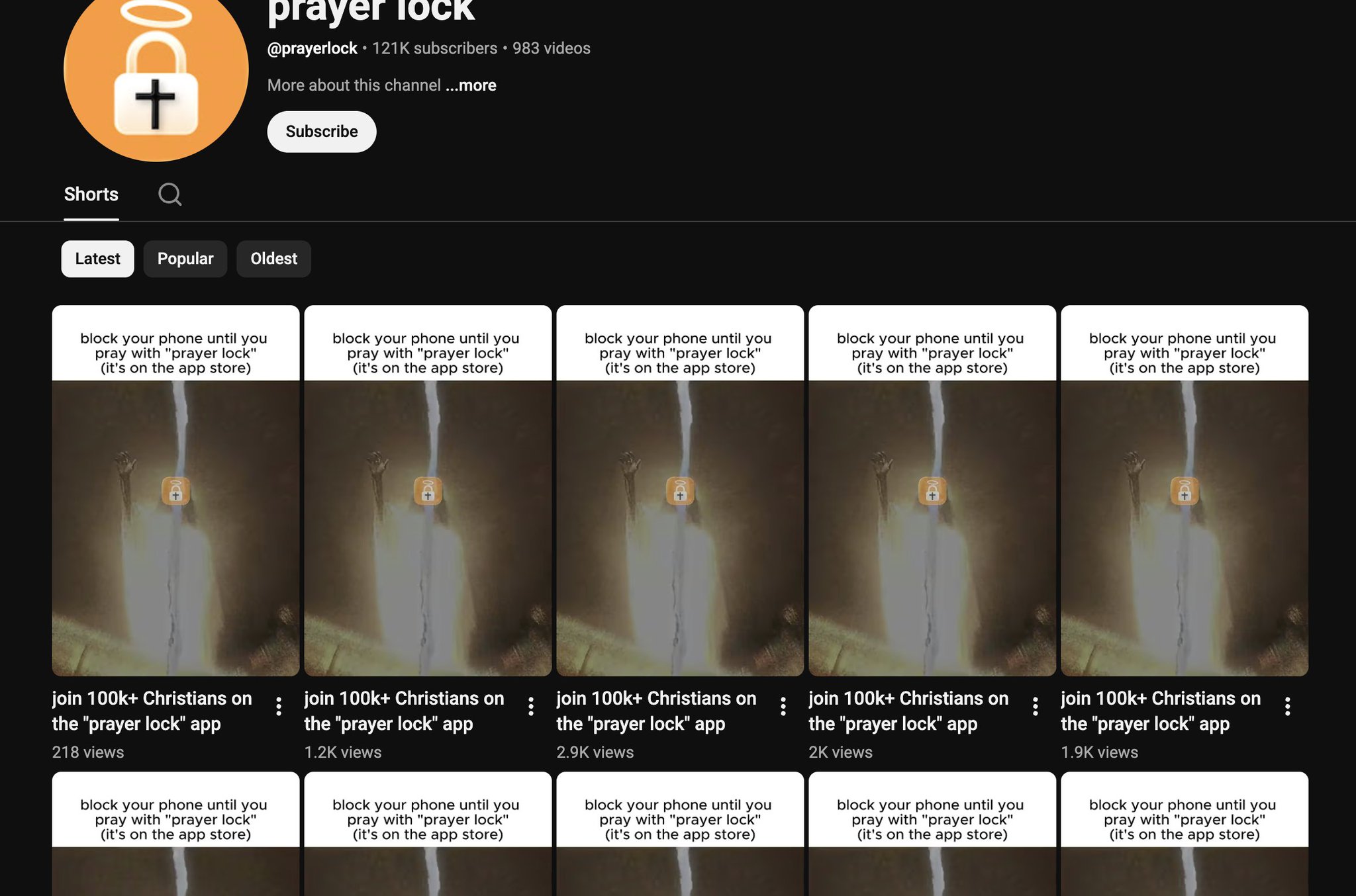
Find a channel in your niche that already pumps out shorts that consistently hit. Those proven hooks are your raw material.
Manage all your social media in one place with Postiz
This strategy is not about chasing a home run. It’s about flooding YouTube, TikTok, and Instagram with as many CTAs to your app as humanly possible. Do the math:
10 posts a day × 30 days = 300 posts a month. If each one averages a modest 500 views — a low bar when you’re riding proven hooks — that’s 150K views a month, minimum. In practice it lands closer to 2–3x that, because some posts catch a wave and do 5K, 10K, even 50K off the back of a hook that was already hot.
Conversion rates are low. That’s by design. Low conversion is completely fine when your cost per post is basically zero and your effort is basically zero. You’re playing a numbers game where the numbers are free. The person posting one “perfect” video a day is doing a full-time job for a handful of views. The automated approach posts 10–50 mediocre-but-proven videos a day on autopilot and stacks hundreds of thousands of views a month.
3. The setup: scrape → stitch → schedule
Will purpose-built a tool called Clip Factory to run this entire pipeline, but the workflow itself is what matters — you can assemble the same thing yourself with a scraper, FFmpeg, and a scheduling API. Here’s the shape of it:
Step 1 — Pick a viral channel in your niche. Find a YouTube account that consistently pushes shorts that hit. This is your homework; the better the source channel, the better your hooks.
Step 2 — Mass scrape the shorts. Point your scraper at the channel and pull down hundreds of shorts at once, not one at a time. Volume is the whole game.
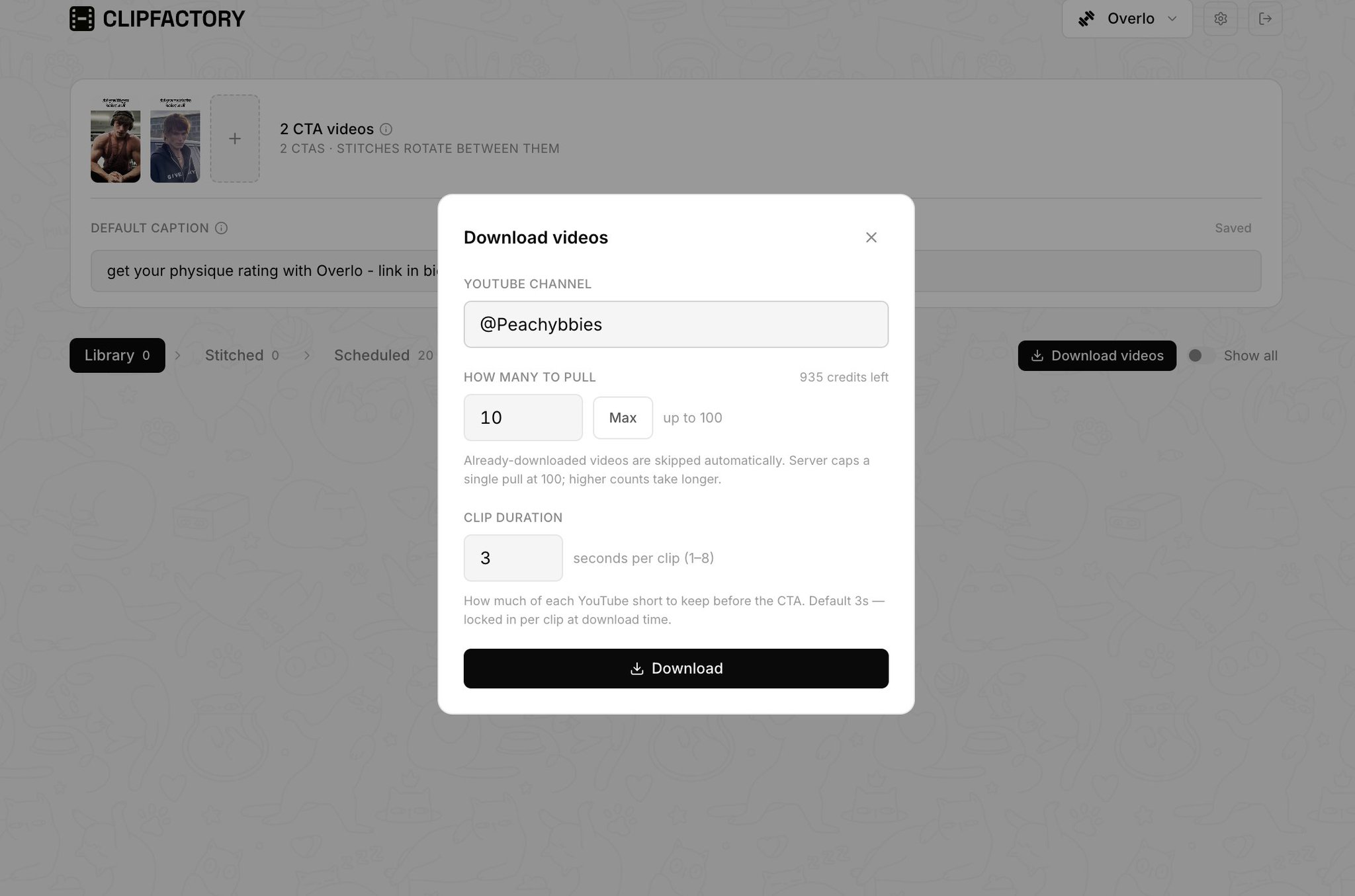
Point the pipeline at a channel, choose how many shorts to pull, and set how much of each clip to keep before the CTA.
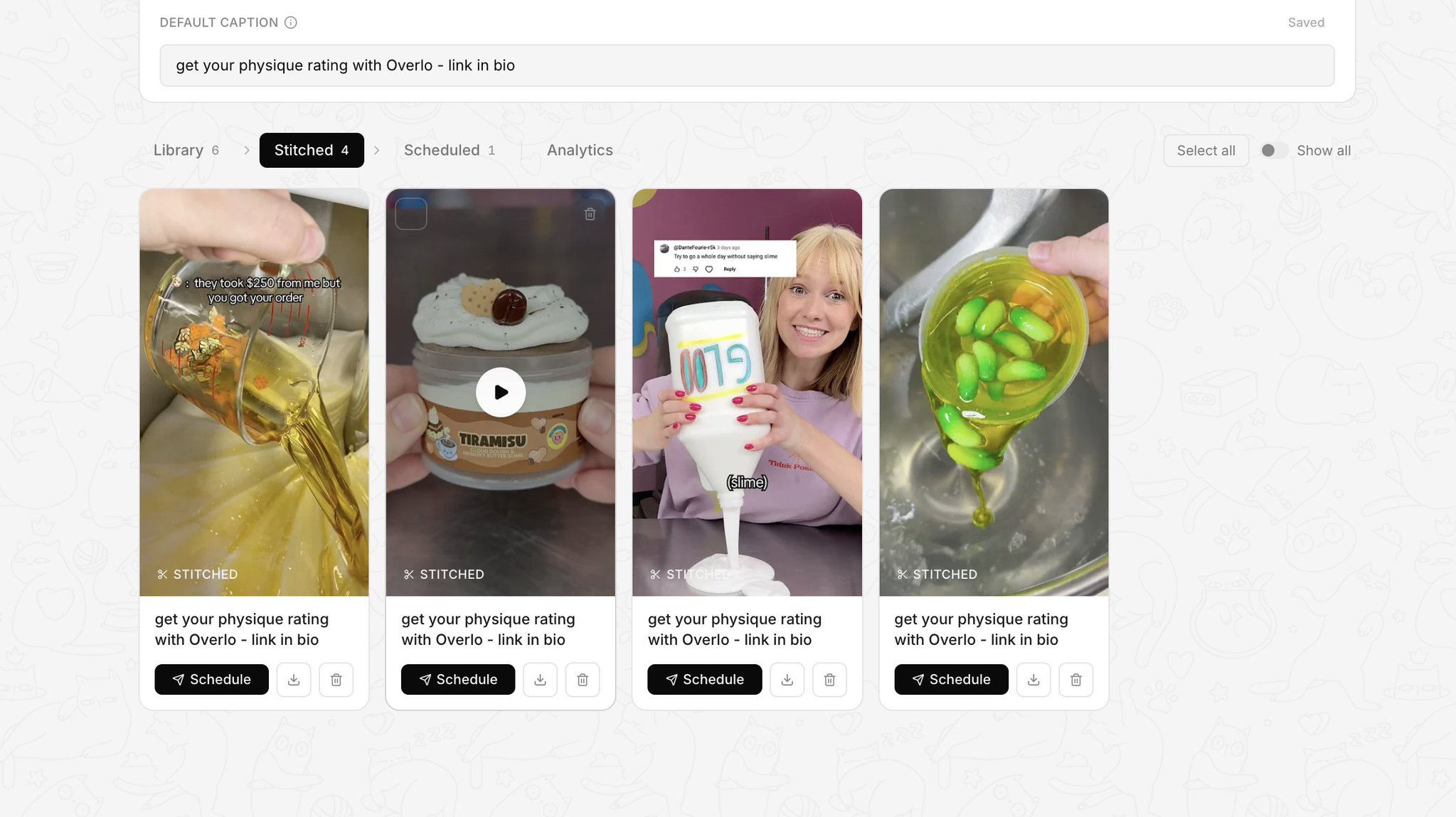
Step 3 — Stitch your CTA onto the back. Take the first few seconds (the viral hook) and stitch your app’s CTA onto the end. The viewer gets hooked by content that already works, then sees your thing. Batch it across the whole download in one go.
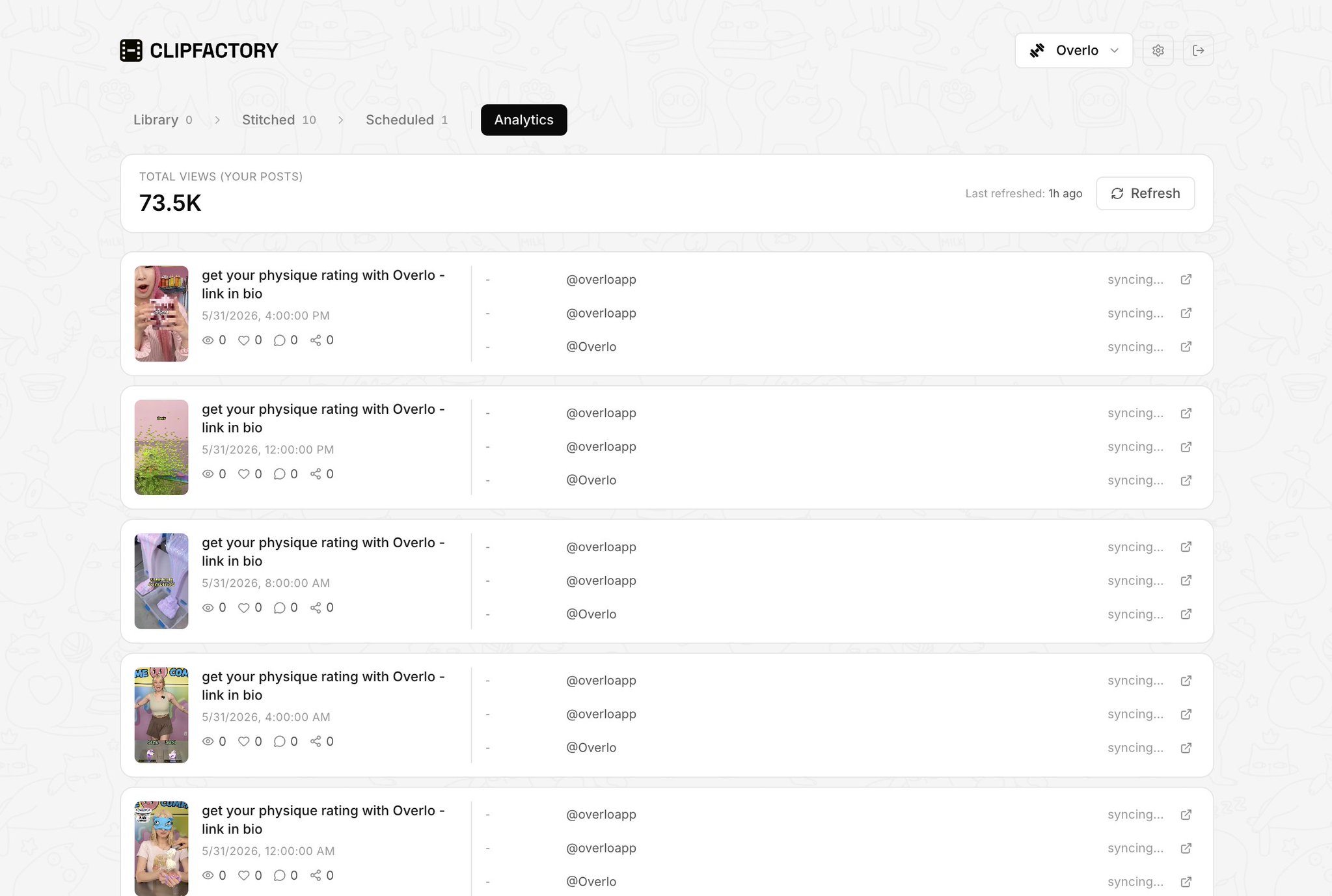
Step 4 — Schedule the whole lot. This is where Postiz comes in. Instead of babysitting a posting calendar across three platforms, the entire batch gets pushed into Postiz and dripped out automatically to YouTube, TikTok, and Instagram on a stagger.
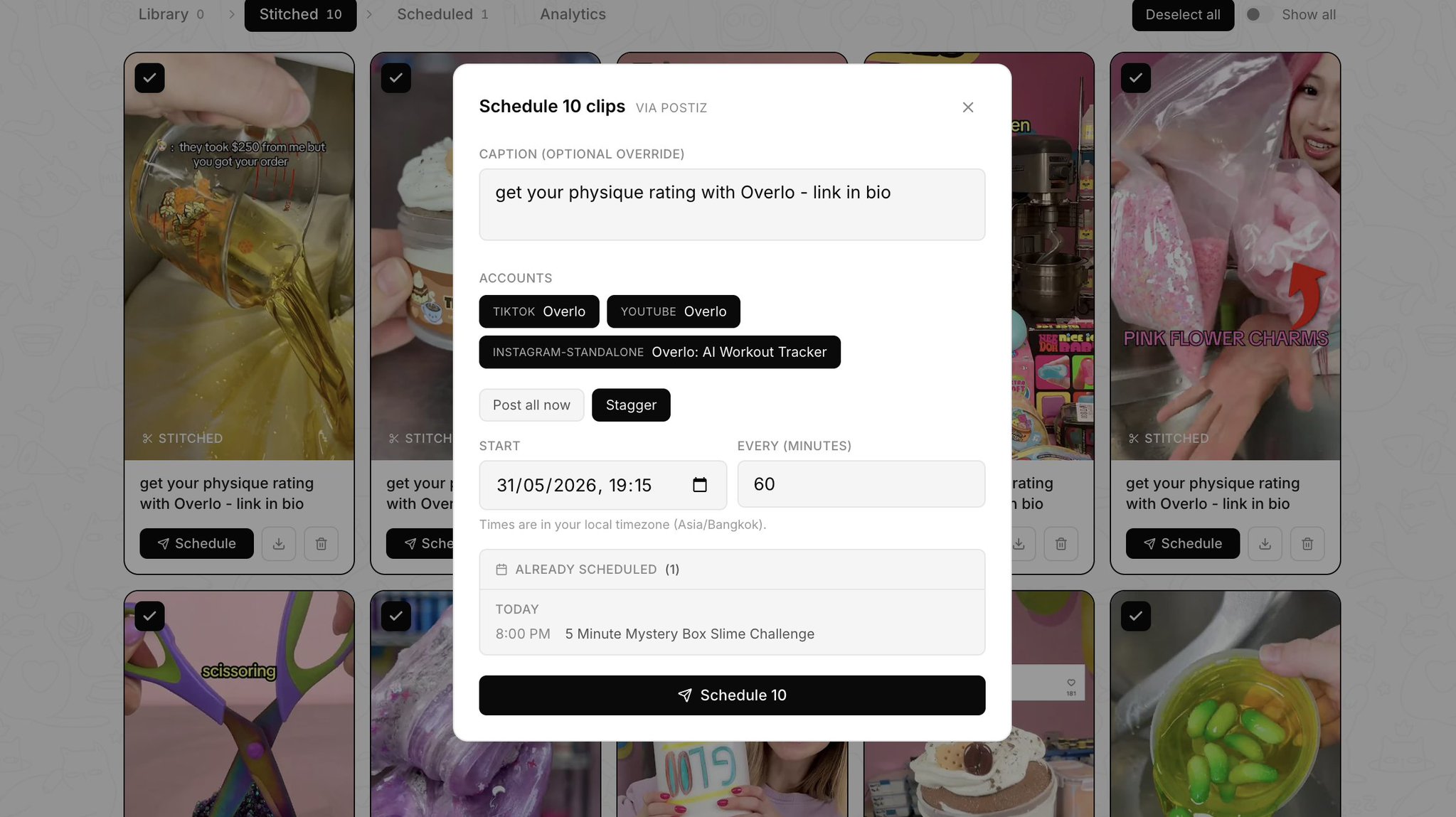
Select the batch, pick your channels, choose “stagger,” and schedule a month of content into Postiz in one action.Everything lands in the Postiz queue, ready to publish across all three platforms on schedule.
Build the scheduling layer yourself with Postiz
You don’t need anyone’s closed tool to handle the “schedule” step — Postiz exposes a public API, an MCP server, and a CLI, so you can push a whole batch of stitched videos into the queue programmatically. Here’s how each piece works.
The one rule that trips everyone up: upload first
TikTok, Instagram, and YouTube only accept Postiz-verified HTTPS media. Raw local paths and arbitrary external URLs get rejected by the publishing pipeline. So every clip goes through an upload step first, and you reference the returned URL when you schedule. Upload a local file:
The API key lives in Settings → Developers → Public API, and it’s passed raw in the Authorization header (no Bearer prefix).
Schedule one video to YouTube, TikTok, and Instagram at once
A single POST /posts call can fan one clip out to every channel, each with its own caption and platform settings, on a future date. Dates are UTC ISO 8601:
Grab your channel (integration) IDs from GET /integrations. One important note for batch operations: the public API is rate-limited to 30 requests per hour, so the right move is to pack multiple posts into a single request rather than firing one call per clip.
Prefer the CLI? It’s two commands.
If you’d rather script it from the terminal, the Postiz CLI wraps the same API and enforces the upload-first rule for you:
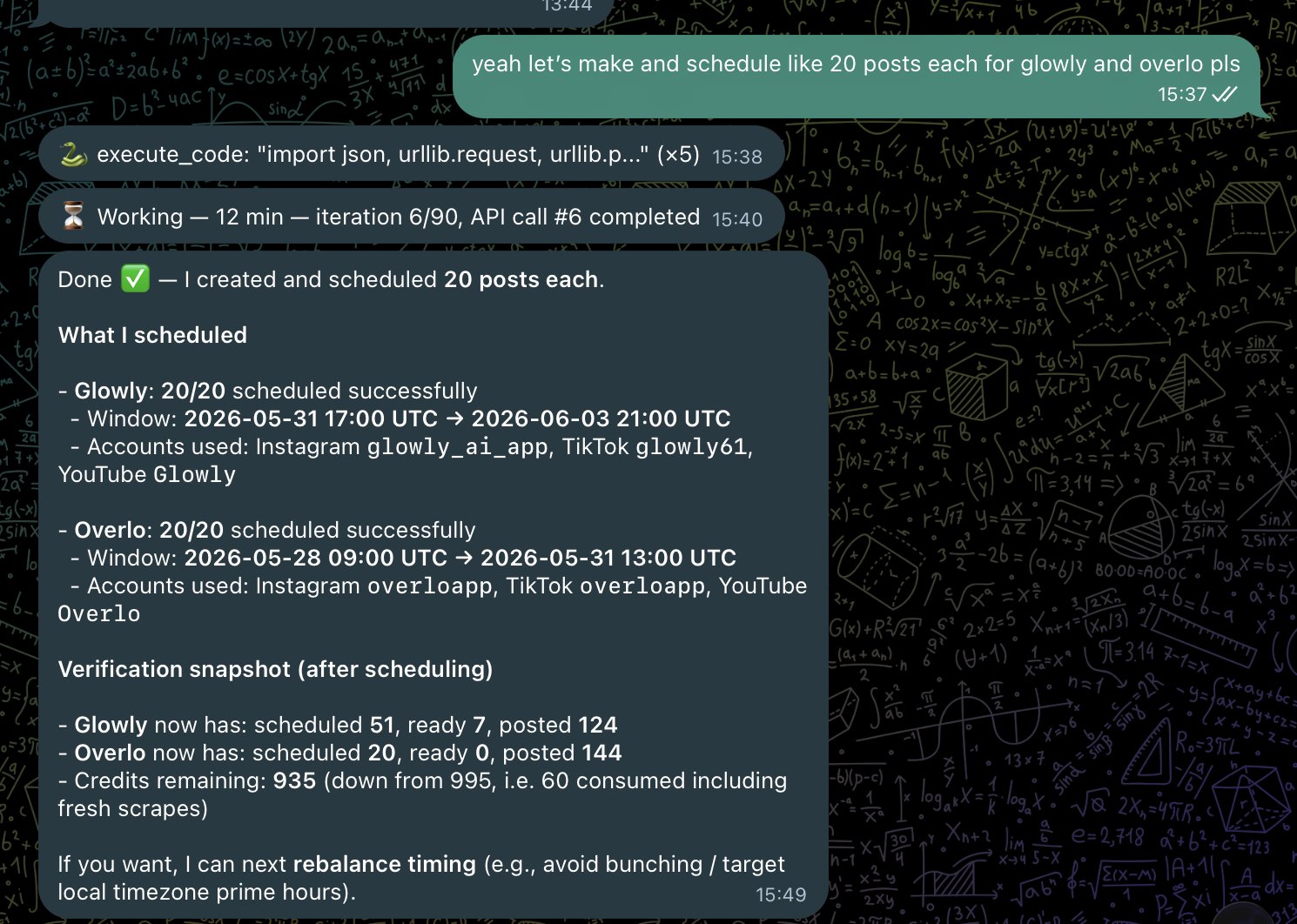
Here’s where it gets genuinely strange. The whole pipeline can be driven by an AI agent, so you never open a dashboard at all. Will hooked his stitcher into Claude as a skill and now just types things like “make me 10 vids from [@channel] and schedule them” — and the agent scrapes, stitches, and pushes them into the scheduler on its own.
The agent handles the whole loop — scrape, stitch, and push to the Postiz scheduler — from a single natural-language command.
Postiz is built for exactly this. It ships an MCP server you can drop into Claude Code or Claude Desktop with a single config block:
Once it’s connected, the agent gets first-class tools — integrationList to see your connected channels, generateVideoTool / generateImageTool to create attachments, and schedulePostTool to queue everything up. You can wire that same command flow to Telegram, too, so you fire off a batch from your phone while you’re getting coffee, then message the agent later asking how the batch is performing.
Tens of thousands of views a week from a single app’s automated batch — at a marginal cost of basically nothing.
5. The monthly check-in
Once a month, Will spins up a fresh batch: a new channel or new hooks, 50-ish videos, scheduled out across all three platforms. It takes about five minutes, most of which is just picking which channel to rip. Compare that to what everyone else is doing to “grow”:
Filming 7 videos a day
Editing them
Posting across 3 platforms manually
DMing 100 influencers
Managing a UGC team
Replying to comments
A full-time job versus a 30-minute check-in once a month. The goal was never to work harder — it was to find the lazy system that prints views on autopilot and then go back to bed.
TL;DR — the playbook
Stop inventing hooks. Steal proven ones from viral YouTube shorts.
Stitch your CTA onto the back so viewers get hooked first, pitched second.
Mass produce. Hundreds of videos at once, not one at a time.
Schedule a whole month in one go and let it drip out across YouTube, TikTok, and Instagram.
Check in once a month. Let the machine run while you sleep.
The scrape and the stitch are the creative trick. But none of it ships without the schedule — the layer that actually drips hundreds of clips across three platforms without you babysitting a calendar. That’s the part Postiz was built to own, whether you drive it from the dashboard, the public API, the CLI, or an AI agent through MCP.
Run the same play with Postiz
If you want the scheduling engine behind a system like this — cross-posting to YouTube, TikTok, Instagram and 28+ other channels, plus a public API and MCP server so you can fully automate it — that’s exactly what Postiz does. Connect your channels once, push your batch in, and let it post on autopilot.