Let's be honest: social media for B2B SaaS isn't about hopping on the latest TikTok trend. It's a calculated game of building trust, educating the right people, and pulling in high-quality leads. It’s about turning a platform like LinkedIn from a place where you just post company updates into a space where you actively connect with decision-makers, long before they're even thinking about talking to sales.
The real secret? Give away value first. Position your company as the go-to resource in your industry, and the leads will follow.
Why Social Media Is Your New Sales Floor
It's time to bust the old myth that social media is just for B2C brands selling sneakers or makeup. The way B2B buyers operate has completely changed. They now research, compare, and vet potential software solutions the same way you’d read reviews for a new TV. They lean on their professional networks and trusted online voices, making social media a non-negotiable part of their buying process.
For a B2B SaaS company, this isn't a challenge; it's a golden opportunity. Instead of relying on cold outreach, you can warm up your entire target market. Your company's LinkedIn or X (formerly Twitter) page isn't a megaphone for shouting about new features. Think of it as your digital sales floor—a place where prospects can wander in, see your expertise in action, and grasp what you're all about, all on their own time.
The Modern B2B Buying Journey
Consider this: nearly 75% of B2B buyers do more than half of their research online before they ever pick up the phone to talk to a salesperson. This new reality of a self-guided journey means your social media presence is often a potential customer's very first real interaction with your brand.
A smart social strategy allows you to:
- Build Trust at Scale: When you consistently share genuinely helpful content, you build a reputation as a credible authority people can rely on.
- Educate and Qualify Leads: By talking about the actual pain points and challenges your audience faces, you naturally attract people who understand the problem your SaaS was built to solve.
- Shorten Those Long Sales Cycles: When a prospect finally reaches out to your sales team, they're not starting from zero. They're already educated and familiar with your solution, which makes for a much smoother and faster conversation.
The point of B2B SaaS social media isn't to rack up likes and follows. It's to build a pipeline of well-informed, high-intent leads by becoming a genuinely useful part of your audience’s professional world.
Turning Presence into Pipeline
At the end of the day, a solid strategy moves your social presence from a passive billboard to an active growth engine. It’s all about starting conversations that lead to demos and turning your followers into paying customers.
This guide will walk you through exactly how to make that happen. We'll break down the strategies you need and show you how a tool like Postiz can help you manage and automate the whole process for consistent, measurable results. This isn't just marketing—it's building relationships at scale.
Building Your Foundation on the Right Channels
Before you write a single post or design an image, you need a solid blueprint. A winning social media strategy for a B2B SaaS company isn't about being everywhere at once; it's about being in the right places with the right message. Just throwing content out there and hoping it sticks is a fast track to wasting time and money.
It all starts with a crystal-clear understanding of your Ideal Customer Profile (ICP). This goes way beyond basic demographics like job titles and company size. You need to get inside their professional world. What challenges keep them up at night? Which industry blogs do they actually read? Where do they hang out online to ask for advice or share insights with their peers? Answering these questions is how you pinpoint the channels where your content will actually get seen and valued.
This groundwork ensures your efforts are focused on the platforms where your future customers are already active and, more importantly, open to professional conversations.
Choosing Your Core Platforms
For most B2B SaaS businesses, one platform is the undisputed champion: LinkedIn. It’s literally built for professional networking, industry discussions, and connecting with decision-makers. It’s where your ICP expects to find solutions to their business problems.
But a strong strategy usually involves more than just one channel. The goal is to pick a primary platform and one or two secondary ones that help you hit specific business goals.
- LinkedIn: This is your essential hub for generating leads, establishing thought leadership, and building brand authority. It's the perfect home for long-form content, deep-dive case studies, and engaging directly with target accounts.
- X (formerly Twitter): Think of X as the place for real-time industry conversations, sharing quick-fire insights, and connecting with journalists or influencers. It’s fantastic for driving traffic to your latest blog post or webinar.
- YouTube: A powerhouse for visual storytelling. Use it for product demos that actually show your software in action, compelling customer testimonials, and educational tutorials that solve a real problem.
This flowchart shows how a focused social media plan connects the dots between building trust and achieving real business outcomes like leads and sales.

The takeaway here is that growth isn't a standalone goal. It's the natural result of a cohesive strategy where trust-building activities directly fuel your sales and lead generation funnel.
Why LinkedIn Dominates B2B SaaS Marketing
The data backs this up time and time again. By 2025, it’s projected that a staggering 89% of B2B marketers will use LinkedIn for lead generation. Not only that, but 62% report it produces leads effectively. The most telling statistic? An overwhelming 85% of B2B marketers name LinkedIn their highest ROI channel, leaving other platforms in the dust.
This success boils down to professional context. People are on LinkedIn to work, learn, and find solutions. Your educational content isn't an annoying interruption—it’s exactly what they're looking for. A company that has absolutely mastered this is HubSpot.
HubSpot's approach shows how to build a real community by consistently offering helpful guides, valuable data, and sharp insights. They’ve successfully positioned themselves as a go-to resource, not just another software vendor. If you want to dive deeper into platform-specific tactics, check out our guide on building a powerful LinkedIn marketing strategy.
Choosing the Right Social Media Channel for Your B2B SaaS
Selecting the right mix of platforms is crucial. Each has its own strengths and is best suited for different types of content and audiences. The table below breaks down the top contenders for B2B SaaS to help you make an informed choice.
| Platform | Primary Use Case | Best Content Formats | Target Audience Focus |
|---|---|---|---|
| Lead Gen & Thought Leadership | In-depth articles, case studies, videos, text posts | Decision-makers, industry professionals, potential hires | |
| X (Twitter) | Real-Time News & Community | Quick tips, links to articles, polls, threads | Tech journalists, industry influencers, engaged users |
| YouTube | Education & Product Showcase | Demos, tutorials, webinars, customer testimonials | Users seeking "how-to" solutions and visual learners |
| Brand Storytelling & Community | Behind-the-scenes content, employee spotlights, events | Broader audiences, community building, retargeting ads |
By carefully considering where your ICP spends their time and what kind of content they value, you can build a multi-channel presence that works together, rather than just duplicating efforts.
Aligning Channels with Business Goals
Once you've picked your platforms, the final piece of the puzzle is to assign a clear job to each one. This simple step prevents your channels from becoming redundant and ensures every single post serves a strategic purpose. Your goals will dictate the kind of content you create and, just as importantly, the metrics you track.
Don't measure your B2B social media success by follower count alone. Instead, focus on metrics that align with business objectives, like demo requests from LinkedIn or webinar sign-ups driven by a post on X.
Think of it like this:
- LinkedIn's Goal: Generate qualified leads and build our brand's authority. We'll measure this with gated content downloads and demo requests.
- X's Goal: Drive brand awareness and traffic to our content hub. We'll track website clicks and the volume of brand mentions.
- YouTube's Goal: Educate prospects and help convert them. We'll look at video view duration and clicks on our calls-to-action.
By clearly defining the "why" behind each channel, you create a focused and effective strategy. This foundational work ensures every piece of content you publish has a purpose and contributes directly to your company's growth.
Creating Content That Educates and Converts
In the B2B SaaS world, your social media feed is much more than a billboard for new features. Think of it as an educational hub—a place where potential customers come to learn and, ultimately, decide if you're the expert they can trust with their business. The goal isn't just to be seen; it's to be seen as indispensable.
This requires a fundamental shift in mindset from selling to serving. Instead of just shouting about your product's benefits, create content that genuinely solves a smaller version of the problem your SaaS is built to fix. This is how you build authority and create a natural path for a prospect to become a customer.

Building Your Content Pillars
A scattered, "post-whatever-comes-to-mind" approach will only get you scattered results. The most effective social media marketing for B2B SaaS companies is built on a solid foundation of content pillars.
Think of these as the three to five core themes your brand will own. These themes should live at the intersection of your audience's biggest frustrations and your product's core strengths.
For a project management SaaS, for instance, your pillars might look like this:
- Team Productivity: Sharing frameworks, hacks, and tips for getting more done.
- Project Scoping: Educating on how to plan projects to avoid painful scope creep.
- Remote Collaboration: Offering up best practices for distributed and hybrid teams.
These pillars become the wellspring for all your content. That single "Team Productivity" pillar can fuel dozens of posts, from a video on running effective meetings to an infographic on the Pomodoro Technique. This structure keeps you on-message and ends the daily "what should we post?" panic.
The Anatomy of High-Performing B2B Content
Not all content is created equal. While blog posts are a great long-form staple, you have to diversify to capture attention on busy social feeds. It’s true that companies with blogs generate 67% more monthly leads, but on social media, visual and bite-sized content often wins the day.
The data backs this up. A staggering 74% of marketers report generating more leads through their social content. The top-performing formats? Short-form video (with a 29.18% engagement rate) and images (a close second at 28.95%). Even a simple multi-image post on LinkedIn can hit a 6.6% engagement rate, proving that a little variety goes a long way.
The core principle is simple: provide genuine value before you ever ask for the sale. Your content should be so helpful that prospects feel like they're already getting a return on their investment—just by following you.
To put this into practice, your content mix should blend different formats that speak to people at different stages of their buying journey.
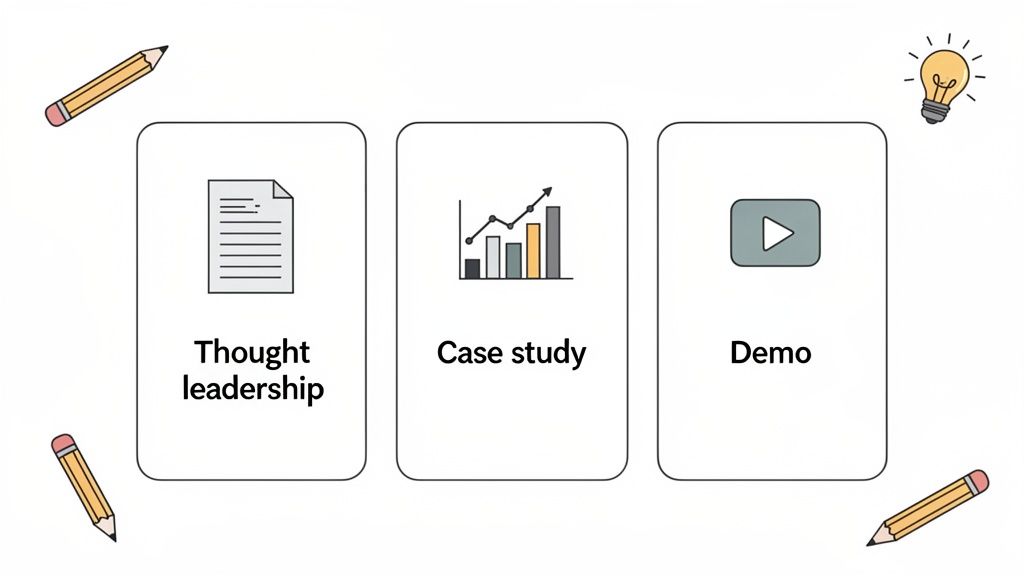
- Thought Leadership (Top of Funnel): Share insightful articles, analyze industry trends, and offer expert opinions. This is how you establish your authority.

- Case Studies (Middle of Funnel): Use data-backed success stories to show, not just tell, how your software solves real-world problems for customers like them.
- Product Demos (Bottom of Funnel): Create short, focused videos that highlight one specific feature and its direct benefit. Make your solution tangible and irresistible.
To make sure your visual content really connects, you can use ad creative analysis tools to see what’s working best.
Planning Your Content Calendar for Consistency
Great ideas are worthless without consistent execution. This is where a content calendar becomes your strategic roadmap, turning your pillars and formats into a reliable publishing schedule. A tool like Postiz is built for this.
Instead of scrambling every morning, you can batch-create your posts and schedule them weeks in advance. Postiz’s AI assistants can help you brainstorm ideas based on your core pillars, while the built-in design tools let you create professional visuals that stop the scroll.
A practical workflow might look like this:
- Monthly Pillar Focus: Assign each week of the month to a different content pillar.
- Weekly Format Mix: For each week, plan a mix of videos, text posts, and graphics to keep the feed interesting.
- Batch and Schedule: Block out a single day to write and design all the content for the next two weeks, then load it all into Postiz.
This system takes the emotion and inconsistency out of social media. It transforms your strategy from a reactive, daily chore into a proactive, scalable engine for growth. If you ever hit a creative wall, you can explore our list of social content ideas for fresh inspiration.
Amplifying Your Reach with Paid Social and ABM
Your organic content is great for building trust over time, but let's be realistic—it can be a slow burn. If you want to get your best assets in front of the right people right now, you need a smart paid strategy.
For B2B SaaS, paid social isn't about blasting generic ads to the masses. Think of it as a precision instrument. It’s the difference between your new whitepaper getting a few organic likes versus landing directly in the feeds of 500 VPs of Engineering at Series B tech companies. That’s not just spending money; it's a strategic investment in getting seen by people who can actually buy from you.
The Power of Hyper-Targeting on LinkedIn
When it comes to B2B, LinkedIn is in a league of its own for paid campaigns. Why? Because its targeting capabilities are incredibly granular, letting you zero in on audiences based on criteria that actually matter for a complex SaaS sale.
You can build laser-focused audiences using filters like:
- Company Name: Target employees from your specific list of high-value accounts.
- Job Title: Reach the exact decision-makers, like a "Chief Information Security Officer."
- Industry: Put your budget where it counts by focusing on sectors that get the most from your software.
- Company Size: Isolate startups, mid-market businesses, or enterprise giants.
- Seniority Level: Make sure your message hits the right altitude, whether that's managers, directors, or the C-suite.
This level of precision is the secret sauce for effective social media marketing for B2B SaaS companies. It ensures every dollar is spent trying to reach someone who has the authority and the problem your solution solves, which naturally improves your return.
Connecting Paid Social to Account-Based Marketing
This is where things get really powerful. You can take all that targeting capability and plug it directly into an Account-Based Marketing (ABM) strategy. If you're not familiar with ABM, it essentially flips the old marketing funnel upside down. Instead of casting a wide net, you hand-pick a list of high-value "dream" accounts and market to them like they're a market of one.
Paid social is the perfect channel to bring this to life. Imagine creating an ad campaign that only runs for the key decision-makers at your top 50 target accounts. You can serve them content that speaks directly to their company's challenges, maybe even mentioning their industry or role in the ad copy.
ABM on social media is like having a private conversation in a crowded room. You cut through all the noise to deliver a highly relevant message directly to the people who can champion and purchase your product.
This approach generates leads that are miles ahead in quality. Your sales team can stop sifting through hundreds of unqualified demo requests and instead start having conversations with people from companies they were already targeting. This doesn't just make them happier; it seriously shortens the sales cycle.
Launching a Mini-ABM Campaign
Diving into ABM doesn't have to be a massive, six-month project. You can start small and see results quickly.
Here’s a simple way to launch your first mini-campaign:
- Build Your Target List: Grab your sales team and identify 20-30 high-priority companies you’d love to have as customers.
- Identify Key Personas: For each company, figure out the 3-5 key job titles involved in the buying decision.
- Create a Custom Audience: Head over to LinkedIn Ads and use the company names and job titles from your list to build a super-specific audience.
- Craft a Relevant Ad: Promote a genuinely valuable piece of content, like a case study from their industry or a webinar that solves one of their known pain points.
- Measure and Nurture: Keep an eye on which accounts are engaging. Pass that intel straight to your sales team so they can tailor their outreach.
This isn’t just a niche tactic; it’s becoming the standard. Social media ad spending is on track to blow past $256 billion in 2025. And for good reason—83% of B2B marketers are now advertising on social media, tapping into a global user base of 5.24 billion people.
When you combine proven social media advertising strategies with the pinpoint accuracy of ABM, you create a predictable engine for generating a high-quality pipeline.
Streamlining Your Workflow for Consistent Results
If there's one non-negotiable principle in social media, it's consistency. Showing up sporadically or vanishing for weeks sends a message of unreliability—the absolute last impression a B2B SaaS company wants to make. But trying to stay consistent by posting manually every single day is a surefire recipe for burnout.
This is where you need to think like an operations manager. A smart workflow, powered by the right scheduling and automation tools, can turn social media from a reactive, daily grind into a proactive, strategic powerhouse. That shift is what really drives sustainable growth.
The Power of Planning and Automation
Think about it this way: trying to post on the fly every day is like building a house by going to the hardware store for one brick at a time. It’s slow, inefficient, and utterly exhausting. The smarter approach is content batching—sitting down and creating a whole bunch of posts in one focused session.
By blocking out just a few hours to write and schedule content for the next week or even month, you free up your team for what really matters: engaging with your audience and digging into performance data. This method brings a few huge wins:
- Maintains a Consistent Brand Voice: When you write everything in one go, your tone and messaging naturally stay on point.
- Prevents Content Gaps: A full calendar means you’ll never have one of those "oops, we forgot to post today" moments again.
- Increases Efficiency: You stop wasting time constantly switching gears between creative work, strategic planning, and administrative tasks.
For B2B SaaS, a well-oiled workflow isn't just about saving time. It's a competitive edge. It ensures you're a steady, authoritative voice in your audience's feed, building trust one scheduled post at a time.
Using the Right Tools for the Job
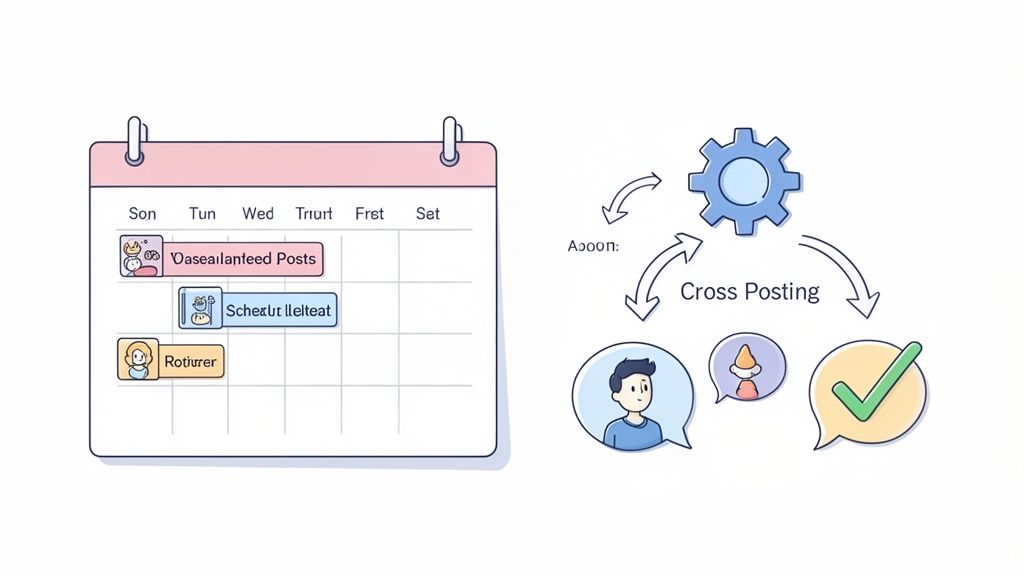
This is exactly why a social media management platform like Postiz becomes your best friend. It’s built to solve the operational headaches B2B teams know all too well. A centralized calendar gives you a complete, bird's-eye view of your schedule, making it simple to spot gaps and ensure you're hitting all your content pillars.
For instance, a feature like cross-posting lets you take one core idea and quickly adapt it for LinkedIn, X (formerly Twitter), and other channels in minutes. For a small team trying to get the most mileage out of their best content, that’s a game-changer.

A unified dashboard like this takes a complex strategy and makes it a manageable, actionable plan. It's the key to preventing missed posts and keeping your brand presence solid.
Collaboration and Security in a B2B Context
Let's be real: social media marketing for B2B SaaS companies is rarely a one-person job. You've got product marketers, sales folks, and leadership who all need to weigh in. Trying to manage feedback through messy email chains or endless Slack threads is a recipe for missed deadlines and watered-down messages.
Modern tools fix this with built-in collaboration features. Inside a platform like Postiz, your team can:
- Assign Roles: Give people specific permissions, whether they’re a content creator or the final approver.
- Leave Comments: Provide feedback directly on the post drafts, right where the work is happening.
- Create Approval Workflows: Set up a clear, step-by-step process so every post gets the green light before it goes live, ensuring quality and compliance.
And for tech companies, security is everything. The ability to control your own data is huge. Features like self-hosting give your organization total authority over its information, a massive advantage over cloud-only platforms. It means you can build an efficient workflow without ever having to compromise on your security protocols. By systemizing how you work, you create a reliable engine that delivers consistent results.
Measuring the Metrics That Actually Matter
Let’s be honest. Chasing likes and watching your follower count climb feels great, but those numbers won’t move the needle with your leadership team. To prove that social media is a real growth engine, you have to connect your activity to actual business outcomes. It’s all about cutting through the noise and focusing on the KPIs that show a tangible return on investment.
A smart measurement strategy doesn't just fixate on the final sale. It tracks performance across the entire buyer's journey, painting a clear picture of how social media guides a prospect from their very first interaction to the moment they book a demo. Think of it as mapping out the customer’s entire road trip, not just showing a picture of their final destination.
Moving Beyond Vanity Metrics
The first step is to organize your metrics into three distinct stages. This simple framework helps you see not just what's happening, but why it's happening and how each stage fuels the next.
Awareness Metrics: This tells you how many people are seeing your content and how much space your brand occupies in the market. Key indicators here are impressions (the total number of times your post was shown) and share of voice (how your brand's mentions stack up against competitors).
Engagement Metrics: This is where you find out if your content is actually landing with your audience. You're looking at comments, shares, and click-through rate (CTR). When engagement is high, you know you're building a real community, not just shouting into the void.
Conversion Metrics: This is the bottom line. These are the actions that directly feed your sales pipeline, like demo requests, free trial sign-ups, and gated content downloads (think whitepapers and ebooks).
Your goal is to tell a story with your data. A spike in awareness should lead to more engagement, which in turn should drive more conversions. If there’s a bottleneck at one stage, you know exactly where to direct your energy.
Connecting Social Activity to Your CRM
So, how do you prove that a specific LinkedIn post brought in a new lead? The magic lies in UTM parameters. These are just little snippets of code added to the end of a URL that act like tracking tags, telling your analytics tools precisely where each visitor came from.
For instance, a link to a new case study might look like this: yourwebsite.com/case-study?utm_source=linkedin&utm_medium=social&utm_campaign=q3-casestudy
This tag tells you the visitor came from LinkedIn (the source), via a social post (the medium), as part of your Q3 case study campaign. When that person fills out a demo form on your site, that UTM data gets captured in your CRM. Now you have concrete proof of social media's impact. For a deeper dive, our guide on calculating social media ROI breaks this down step-by-step.
Using a Unified Dashboard for Clarity
Trying to track all this data across different platforms is a surefire way to get lost in a sea of spreadsheets. This is where a unified dashboard, like the one inside Postiz, becomes a game-changer for any B2B SaaS team that's serious about social media. It pulls everything together into one clean view of what’s working and what isn’t.
With a central analytics hub, you can instantly compare campaign performance, pinpoint your best content, and pull reports that clearly show your wins. This isn't just about collecting data; it's about getting insights you can actually use. You can finally stop guessing and start making informed decisions that prove your value and optimize your strategy.
Frequently Asked Questions
Even the best-laid plans run into questions. Let's tackle two of the most common ones we hear from B2B SaaS teams trying to get their social media engine running.
How Much Should We Budget for Social Media?
There's no magic number here. The smartest way to think about your budget is to tie it directly to your business goals, rather than just carving out a random percentage of revenue.
A simple way to start is by splitting your budget into two main piles: content creation (think design tools, freelance writers, or video editors) and paid amplification (your actual ad spend).
If you're an early-stage company, you'll likely pour more resources into creating great organic content. As you grow, you'll probably want to ramp up the paid side. We've seen that high-growth companies tend to invest around 40% more on marketing—including paid social—than their competitors who are growing more slowly.
If you're looking for a practical starting point, set aside enough budget to consistently boost your best-performing organic posts to your ideal customers on LinkedIn. It’s a simple way to make sure your most valuable content actually gets seen.
How Do We Get Buy-In from Leadership?
Here's the truth: leadership cares about results, not retweets. To get them on board, you need to speak their language—the language of business impact. Stop talking about followers and start talking about pipeline.
Walk into that meeting with a solid plan that connects every social media action to a real business outcome.
- Show the "Why": Pull some data on how your direct competitors are successfully using social media. A little competitive pressure never hurts.
- Present the "How": Give them a clear snapshot of your plan. Show them your content pillars and maybe a small-scale ABM campaign you want to run against a few dream accounts.
- Define the "What": Lay out clear, business-focused KPIs. Think in terms of demo requests sourced from social or the cost-per-qualified-lead from your LinkedIn campaigns.
When you frame social media as a measurable growth channel instead of a fuzzy "brand awareness" play, it suddenly becomes an investment they can't afford not to make.
Ready to put all this into action without the chaos? Postiz gives you the scheduling, collaboration, and analytics tools to build a powerful B2B social presence and actually prove it’s working. Start managing your social media smarter today.