Gary Vaynerchuk dropped a line recently that stopped the scroll for a lot of people: social media is dead, and interest media has taken over. He argued the shift happened four years ago and most of us are still operating with a playbook written for a different era. I’ve been watching this play out from inside a social scheduling platform, and I think he’s right. But the implication for creators and brands is even bigger than the headline suggests.
If you’re still chasing followers in 2026, you’re chasing the wrong number. The feed isn’t about who you follow anymore. It’s about what a machine thinks you want to see next. Here’s what that really means, what’s changed, and how to actually build a content engine that benefits from it.

Social Media Stopped Being Social. It Became a Recommendation Engine.
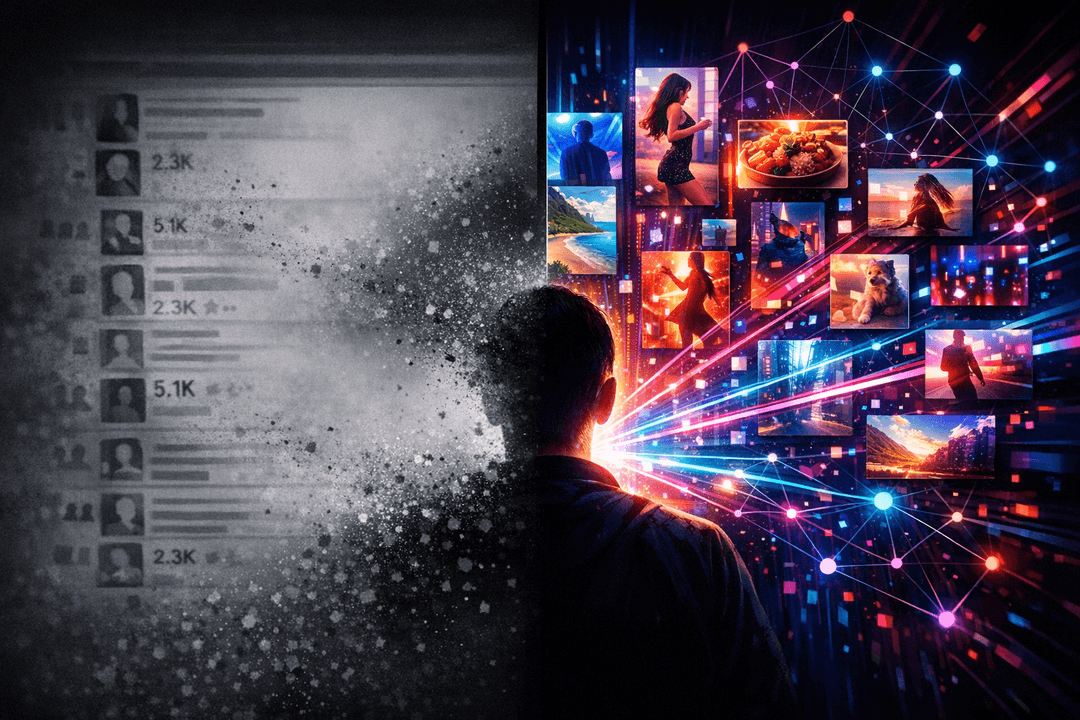
The old promise of social media was simple. You picked the people you wanted to hear from, and your feed showed you what they posted. Your cousin’s vacation photos. Your college friend’s new job. That version of the internet has been gone for years — it just didn’t have an obituary.
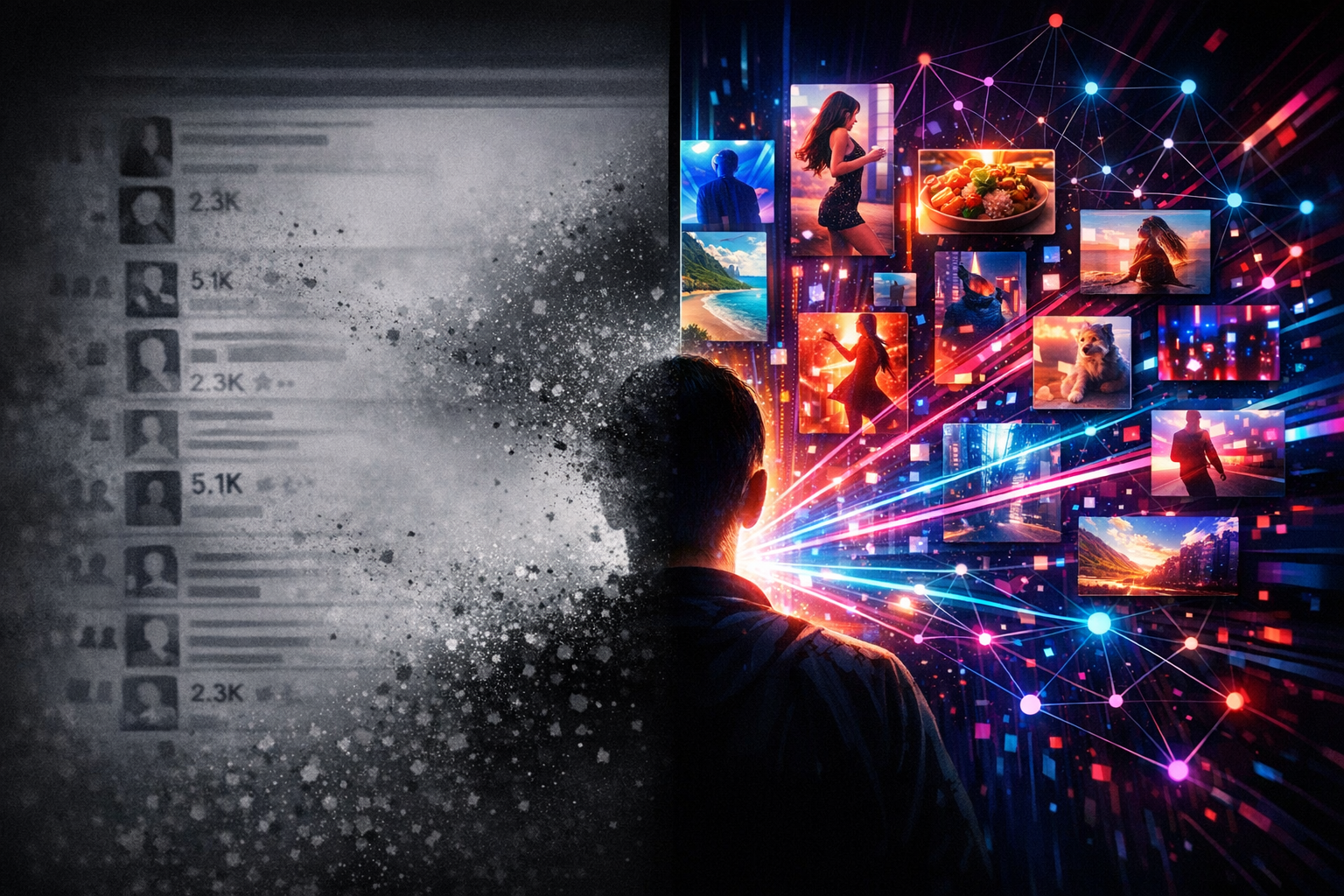
The new model is what Gary calls interest media. Your feed is assembled by an algorithm that watches what you watch, measures how long you stop, and feeds you more of whatever your attention confessed to wanting. The people you follow are almost incidental. If you love spicy chicken recipes, your feed will be 80% food creators you’ve never heard of and 20% people you actually know.
Why did platforms make this trade? Because keeping you watching is worth more than keeping you connected. An algorithmic feed holds attention longer than a friends-only feed ever could. Every major platform — TikTok first, then Instagram Reels, YouTube Shorts, LinkedIn, even X — quietly switched the steering wheel from the follow graph to the interest graph.
One small thing is changing your feed: the search bar and the “not interested” button. Search a topic you want more of, engage with a few posts, and the algorithm shifts within days. Tap “not interested” on anything you’re tired of and it stops appearing. Your feed is more editable than people realize.
Gary’s prediction for where this lands: platforms will eventually offer a double feed — one tab for interest media, one tab for the friends and creators you actually want to keep up with. That’s the compromise coming. But we’re not there yet, and until then, the interest-driven feed is the only one most brands are optimizing for.
Breaking Through Is Easier Than Ever — If You Can Stomach the Volume
Here’s the paradox of interest media: it’s the most democratic era of content distribution that has ever existed, and it’s also the hardest to stand out in. Those aren’t contradictions. They’re the same coin.
In the follower era, you needed a head start. If you didn’t amass an audience early on Facebook, Twitter, or Instagram, you were trying to catch a train that left the station. The people who moved fast in 2009–2015 captured attention that’s still compounding today. Anyone starting cold was running uphill.
That’s over. Every feed now scores posts by performance, not pedigree. A brand-new TikTok account can outperform a 15M follower account on the exact same content. Gary illustrated this with a stat I keep coming back to. He reposted one of his own clips from a new, empty account called youaresomebodynow. It got 9.4 million organic views. The same clip, posted three weeks earlier from his account with 15 million followers, got 300,000. Same creator. Same footage. Roughly 31x difference — with zero followers beating the mega account.
This isn’t anecdotal. It’s how every platform scores now. Your third post, if it lands, can do more for your career than your previous 300. That’s terrifying and liberating in equal measure. It means the barrier to entry is almost zero. It also means the barrier to consistency is enormous, because one hit doesn’t buy you a permanent seat. You have to keep showing up.
You Don’t Have to Be on Camera. But You Have to Be Somewhere.
A common objection I hear: “I don’t like how I look on video.” Fine. The real mistake isn’t being camera-shy. It’s being stuck on one or two platforms because those are the ones you’re used to.
Interest media rewards platform diversity. TikTok and Instagram are the obvious surfaces, but Substack, YouTube Shorts, LinkedIn, Threads, X, and even Pinterest and Reddit have become legitimate distribution layers for written, short-form, long-form, and visual content. If you write well, Substack might be the single most under-used platform of this era. Information has become a commodity — but people will absolutely pay for information from a person they connect with.
The part most creators get wrong is thinking of “platform diversity” as a tactic for later. It’s not. The person on three platforms with mediocre content will out-distribute the person on one platform with great content, because interest media rewards surface area. You don’t know which platform is going to mint you. You only know it probably isn’t the one you’ve been stuck on for five years.
The Real Battleground Is Attention — And It’s Finally Fair
Attention has always been the asset. What’s changed is who’s allowed to compete for it. Until recently, the companies that could afford to buy attention at scale were a handful of advertisers with nine-figure budgets. Interest media rearranged that table. An individual with a phone and a point of view can now outscale a Fortune 500 brand on the same feed. That’s not a marketing slogan. That’s what the leaderboard looks like on most days.
The only durable edge in this environment is brand — either the personal brand you build by showing up publicly, or the brand equity you put into a business you’re building quietly. Everything else is arbitrage that closes within a year or two. New platforms get saturated. New formats get copied. Paid ads get more expensive every quarter. Brand is the only compounding asset left.
The Psycho Discipline: Make More Different Stuff
The biggest mistake I see brands make right now is the obsession with being “on-brand.” Niche ownership was a pre-2020 concept. No niche is ownable anymore because the sheer volume of creators has flooded every category. Brand consistency isn’t dead — but forcing one tone, one format, and one content pillar across every platform is leaving most of your audience unreachable.
The counter-move is volume plus variety. Make organic social content repeatedly in as many styles as you can tolerate. Different thumbnails. Different hooks. Different framings of the same idea. Different tones for different platforms. Every feed has different audiences, different appetites, and different algorithmic preferences. What bombs on LinkedIn can explode on TikTok, and what got ignored on Instagram can earn a Reddit front page.
Gary put it bluntly: go outside, film yourself eating a banana while drinking a rum and coke, post it, and the algorithm will find the people who have a high propensity of interest in bananas and rum and coke. It sounds absurd because it is absurd — and that’s the point. The feed doesn’t care what you intended. It cares about what lands.
How Teams Actually Ship This Kind of Volume
Here’s the part most “create more content” advice skips: at the volume interest media requires, you cannot log into each platform every day, upload files, rewrite captions, and schedule posts one by one. That’s how people burn out by month two. The teams that keep up are the ones who treat publishing as an API problem, not a manual one.
This is where modern social scheduling has shifted. A content operation in 2026 usually looks something like this:
- Generate assets (text, images, short-form video) in a batch, often with AI tools.
- Upload once to a single media library that returns verified URLs.
- Fan-out one source post to 8–12 platforms with platform-specific variants — different thumbnails, different captions, different lengths.
- Schedule across time zones so your content doesn’t all land in one window.
- Let an AI agent handle the repetitive part: recomposing captions, rewriting hooks, rebuilding Twitter threads from a LinkedIn post.
At Postiz, this is the workflow the platform is built around. A single scheduled post can target 28+ channels — X, LinkedIn, LinkedIn Page, Reddit, Instagram, Facebook Page, Threads, YouTube, Google My Business, TikTok, Pinterest, Dribbble, Discord, Slack, Kick, Twitch, Mastodon, Bluesky, Lemmy, Farcaster, Telegram, Nostr, VK, Medium, Dev.to, Hashnode, WordPress, Listmonk — with provider-specific settings negotiated in one payload.
Example: Scheduling a Post via the Postiz Public API
If you’re building this into your own stack, the Postiz Public API follows a clear pattern. Grab an API key from Settings → Developers → Public API and you can schedule posts with a simple request:
curl -X POST https://api.postiz.com/public/v1/posts \
  -H "Authorization: your-api-key" \
  -H "Content-Type: application/json" \
  -d '{
    "type": "schedule",
    "date": "2026-05-01T09:00:00Z",
    "posts": [{
      "integration": { "id": "your-x-integration-id" },
      "value": [{ "content": "Interest media rewarded us today.", "image": [] }],
      "settings": { "__type": "x", "who_can_reply_post": "everyone" }
    }]
  }'
Each platform has its own __type discriminator and its own settings schema (YouTube needs a title and type, Reddit needs a subreddit array, TikTok needs privacy level and duet/stitch flags, and so on). The API returns a post ID you can use to track status, query analytics, or connect missing release IDs on platforms like TikTok that don’t always return one immediately.
Example: The Same Workflow via CLI or AI Agent
If you’d rather script it than hit the REST API directly, the Postiz CLI wraps the same endpoints:
# Authenticate once
postiz auth:login

# Upload media (platforms like TikTok/Instagram require verified URLs)
postiz upload banana-rum-coke.mp4

# List your connected channels
postiz integrations:list

# Schedule a multi-platform post
postiz posts:create \
  -c "New experiment. Let's see who shows up." \
  -m "https://uploads.postiz.com/abc123.mp4" \
  -s "2026-05-01T09:00:00Z" \
  -i "twitter-id,linkedin-id,tiktok-id"
And if you’re building on top of an AI agent — Claude, ChatGPT, Cursor — Postiz exposes an MCP (Model Context Protocol) server so the agent can list your integrations, read platform rules, and schedule posts on your behalf through natural language. The connection is a single line:
URL: https://api.postiz.com/mcp
Authorization: Bearer your-api-key
From there, the agent has access to tools like integrationList, integrationSchema, schedulePostTool, generateImageTool, and generateVideoTool. You can say “schedule this to X and LinkedIn for tomorrow at 10am” and the agent handles the character limits, formatting, and platform-specific settings in the background.
The reason this matters: when the game is make more different stuff, the bottleneck isn’t creativity. It’s the operational tax of posting. API-first scheduling is how teams remove that tax.
Brand Becomes the Only Moat When AI Does the Shopping
The other thing interest media is quietly training us for is the next shift — AI agents doing the choosing on our behalf. Every piece of content you publish today is being indexed into the knowledge layer that voice assistants, AI search, and personal agents will draw from in four or five years.
Imagine walking into your kitchen in 2029 and saying: “Alexa, my son is having a sleepover. Three friends. One’s lactose-intolerant, one’s gluten-free, two love spicy food, one kid is Persian and I’d love for him to feel at home. Order dinner for 7:30.” When the assistant places four separate orders and delivers a coordinated meal, the interesting question is: which brands get picked?
If the request is generic — “order me a pizza” — the agent picks on price, convenience, availability. The platform owns the decision. If the request is specific — “order me a Pizza Hut” — the brand wins. Brand is the one variable the agent can’t substitute away.
This is why every post you make now is a deposit into the long-horizon brand account. Interest media is training the humans today. The AI agents are training on the same signals. In five years, the brands with consistent, distinctive, repeatedly-seen content will be the defaults. The ones without it get collapsed into a generic product description.
Make 2026 an Action Year, Not a Thinking Year
You can read every essay about interest media, follower inflation, AI-native distribution, and brand compounding. None of it matters if you don’t ship. The people winning this era aren’t the ones with the best strategy decks. They’re the ones who posted today, posted tomorrow, and kept posting when nothing hit for six straight weeks.
The moment is here. Interest media isn’t a prediction — it’s the feed you scrolled this morning. AI-mediated discovery isn’t a theory — it’s what your customers will use next year. The only question is whether you’re going to spend this year training for the marathon or thinking about training.
Turning the Interest Media Era Into a Publishing Habit
If you want to compete in interest media, you need three things: a steady flow of content, a way to distribute it across every platform that might surface it, and a feedback loop tight enough to learn what’s landing. That’s the whole game.
Postiz is built for exactly that workflow — schedule posts across 28+ channels, generate assets with AI, repurpose one idea into platform-native variants, run analytics across everything, and collaborate with your team without juggling eight logins. You can try Postiz for free, connect your accounts in a few minutes, and have your next week of content scheduled before lunch.
Interest media rewards the people who show up the most times with the most variety. Make this the year you become one of them.