A content marketing strategy is much more than just a plan to post on social media. Think of it as your blueprint for turning strangers into customers and customers into fans, all by sharing content they genuinely find helpful or interesting. It’s the difference between shouting into the void and having a meaningful conversation that builds real trust and, ultimately, grows your business.
Build a Foundation for Your Content Strategy
Diving into content creation without a solid plan is a recipe for wasted time and money. I’ve seen it happen countless times: businesses create a flurry of activity but see no real impact. Before you write a single blog post or schedule a tweet, you need to lay the groundwork. This initial phase connects your content directly to what matters most—your business results.
Let's break down the core components that will form the bedrock of your strategy.
Table: Core Components of a Practical Content Strategy
To get started, it helps to see the big picture. Here are the essential pillars you need to build a small business content strategy that actually works, not one that just sits in a folder.
Pillar
What It Means for You
Actionable Example
Business Goals
Connecting content to a measurable business outcome.
Goal: Increase qualified leads by 20% in the next quarter.
Buyer Personas
Deeply understanding the person you're trying to reach.
Persona: "Marketing Manager Mary," who is 35, struggles with time management, and looks for tools to automate her workflow.
Competitor Gaps
Finding opportunities your competitors have missed.
Gap: Competitors write about social media scheduling, but no one offers a free, downloadable calendar template.
This table isn't just a checklist; it's a framework for thinking strategically about every piece of content you create.
Define Your Business Goals
First things first: what do you actually want your content to accomplish? Vague ambitions like "get more followers" won't cut it. You need specific, measurable goals that tie directly back to your bottom line. Getting this right from the start will guide every decision you make down the line.
Most small business content goals fall into one of these buckets:
Generate More Leads: This is about capturing contact info. You can offer a helpful guide in exchange for an email, host a webinar, or get people to sign up for your newsletter.
Increase Brand Awareness: The aim here is simple: get your name in front of the right people. You want to become a familiar, trusted voice in your industry.
Build a Loyal Community: Great content starts conversations. It provides so much value that people stick around, turning one-time buyers into brand advocates who do the selling for you.
Drive Direct Sales: For e-commerce stores, this is key. Content can directly lead to a sale through product tutorials, customer reviews, or case studies that show your product in action.
A strong strategy aligns every piece of content with one of these core objectives. If you can't connect an idea to a goal, it's a sign to shelve it.
Manage all your social media in one place with Postiz
You can't create content that connects if you don't know who you're talking to. And I mean really know them. This goes way beyond basic demographics. You need to develop buyer personas—detailed, semi-fictional profiles of your ideal customers based on real data and a bit of market research.
What are their biggest professional frustrations? What questions are they typing into Google at 10 PM? What social media platforms do they actually use? For a complete walkthrough, our guide on how to create buyer personas breaks down the entire process.
When you understand your audience on this level, your content changes. You stop selling a service and start solving a specific problem for a real person. That’s how you build a connection.
Analyze Your Competitors and Find Gaps
Your business doesn't exist in a bubble, and neither does your content. A quick look at what your competitors are doing can be incredibly revealing. Pay attention to the topics they cover well, but more importantly, look for what they’re not talking about. These content gaps are golden opportunities.
This analysis, which is covered well in What Is a Content Marketing Strategy: A Practical Guide, isn't about copying anyone. It’s about spotting the open lane where you can become the go-to expert. Maybe everyone is writing beginner-level articles, but no one is creating content for the advanced user. That's your opening.
Where Should You Actually Post Your Content?
Let’s be honest: trying to be everywhere online is the fastest way to burn out. I've seen so many small business owners stretch themselves thin trying to master every single platform, only to find their efforts feel diluted and ineffective.
A successful small business content marketing strategy isn't about being on every channel. It's about being on the right ones—the places where your ideal customers already are. You’ll get far better results by going deep and building a real presence on one or two key platforms than by spreading yourself thin across five.
Find the Right Fit for Your Business
Different channels are built for different things and attract different crowds. Your job is to find that sweet spot where your audience hangs out and the platform’s format makes your business shine.
Think about it this way: a neighborhood bakery is all about visual appeal. Their best bet is Instagram, where they can post drool-worthy photos of their croissants, behind-the-scenes Reels of the bakers at work, and daily specials that get people in the door.
But a B2B software consultant needs to project expertise and trust. Their time is much better spent on LinkedIn, sharing deep-dive articles on industry problems, commenting with valuable insights on others' posts, and connecting with potential clients.
Here’s a quick cheat sheet to get you started:
Instagram & TikTok: The go-to for highly visual, B2C brands. If you're in retail, food, beauty, or a local service, this is your playground for brand storytelling and building a community.
LinkedIn: Absolutely essential for B2B. If you sell to other businesses as a consultant, agency, or service provider, this is where you build authority and generate professional leads.
Blogs & SEO: A must for any business built on expertise. This is your content home base, a powerful tool for answering customer questions and showing up in Google search results.
Facebook: Still a fantastic all-rounder, especially for connecting with local communities through Groups or targeting specific demographics with its powerful advertising tools.
Picking platforms that genuinely align with your business model is half the battle. If you want to go even deeper on this, check out our guide to building a small business social media strategy.
Don't Build Your Business on Rented Land
Social media platforms are incredible for getting discovered, but you're ultimately playing in someone else's sandbox. They operate on "rented land." An algorithm can change without warning, and your ability to reach the audience you worked so hard to build can vanish.
That's why owning your content channels is non-negotiable.
Your owned media are the digital assets you have complete control over. For most small businesses, the two most critical are:
Your Website Blog: This is your content hub. Every article you publish is a long-term asset that boosts your SEO, establishes your expertise, and can bring in traffic and leads for years to come.
Your Email List: This is a direct line to your biggest fans. You aren't fighting an algorithm to get into their inbox; you have a direct, personal channel to people who asked to hear from you.
Building an email list gives you a direct, unfiltered communication channel with people who have explicitly raised their hand to hear from you. It's one of the most valuable assets your small business can ever own.
The smartest play is to use social media as a gateway to your owned platforms. Use a stunning Instagram post to tease a new blog article, or share a key insight on LinkedIn that encourages people to join your newsletter for more. This creates a sustainable system where your "rented" channels consistently feed your "owned" assets, giving you true stability and control.
Alright, you've picked your channels. Now for the part that often feels the most intimidating: creating content that actually does something. We're not just chasing likes here. We want to create content that turns a casual follower into a loyal customer.
For a lot of small business owners, this is where the pressure hits. But it doesn't have to be a huge, complicated thing. The best content isn't necessarily the flashiest—it's the most helpful. It simply answers your customers' biggest questions.
Find Your Best Ideas by Eavesdropping
Seriously. Your customers are handing you amazing content ideas every single day. The questions they ask in your DMs, send via email, or bring up in your shop are the exact topics you should be talking about. Every question is a signal, a little flag showing you exactly what they need help with.
Just think about the last five questions you were asked about what you do. If you're a home organizer, you've probably heard things like:
"What's the best way to get a small pantry under control?"
"How do I decide what I should keep versus what to toss?"
"Are those expensive plastic containers actually worth the money?"
Boom. Each one of those is a blog post, a quick video tutorial, or a series of Instagram tips just waiting to be made. You're not selling; you're solving. And that's how you build trust fast.
Your hands-on expertise is your biggest competitive advantage. You're on the front lines every day, which means you have authentic insights that a large corporation's marketing team could only dream of.
See? This flips the script entirely. Instead of staring at a blank screen, you're just documenting the solutions you're already giving out.
Pick Your Content Style (and Stick to It)
As a busy entrepreneur, you don't have time to become a master video editor, blogger, and podcast host all at once. The secret is to pick a few formats that play to your strengths and that your audience actually enjoys. It's better to do one or two things really well than to do five things poorly.
Here are a few content types that pack a punch for small businesses:
Educational Blog Posts: These are the workhorses of content marketing. A solid post that answers a real question can pull in traffic from Google for years, establishing you as the go-to expert in your field.
How-To Videos or Reels: It’s one thing to explain how to do something, but it's another to show it. Quick, engaging videos are perfect for demonstrating a product or walking through a process. They’re gold on platforms like Instagram and TikTok.
Behind-the-Scenes Glimpses: People do business with people, not logos. Show them the real stuff—your workspace, how a product gets made, or a day in your life. This is how you build a genuine connection.
Customer Stories and Wins: Nothing sells for you like a happy customer. Sharing testimonials or case studies provides powerful social proof and shows potential buyers exactly what you can do for them.
And don't be afraid to have a little fun to get noticed. You can jump on trends or even use playful things like marketing memes to create content that’s relatable and easy to share.
Write Like a Human
You are not a giant, faceless company, so your content shouldn't sound like it came from one. The goal is to write the way you talk. Use the words your customers use. That authenticity is what makes people feel connected to you and your brand.
It turns out, this DIY approach is a secret weapon for small businesses. Recent research found that a staggering 80% of small business owners write their own content. This isn't just about saving money; it’s a huge strategic advantage. In fact, small businesses are 23% more likely than average to see a strong return from their blogs, proving this owner-led, authentic approach really works. You can dive deeper into these numbers by reading the full research on content marketing stats.
At the end of the day, you want to be seen as a trusted guide. Whether you're a baker sharing your favorite frosting recipe or a consultant breaking down a tough concept, let your passion shine through. That’s what will attract the right people. And when you're ready to scale, smart tools like Postiz can help you polish your drafts or create visuals with AI, so you can keep that authentic voice without needing a huge team.
Develop a Sustainable Content Workflow
Even the best content ideas fall flat if you can't get them out the door consistently. For many small business owners, this is where a great strategy starts to wobble. You post when you can, things feel sporadic, and the results are unpredictable. Before you know it, content feels more like a source of stress than a business-builder.
The answer isn’t to work longer hours—it’s to work smarter. Building a solid, repeatable workflow is what separates the businesses that thrive with content from those that burn out. It's the secret to showing up consistently without losing your mind.
The whole process is a simple loop: you plan, you create, and you repurpose.
Think of it this way: the effort you put into one stage feeds directly into the next, saving you a massive amount of time down the line.
Plan Ahead with a Content Calendar
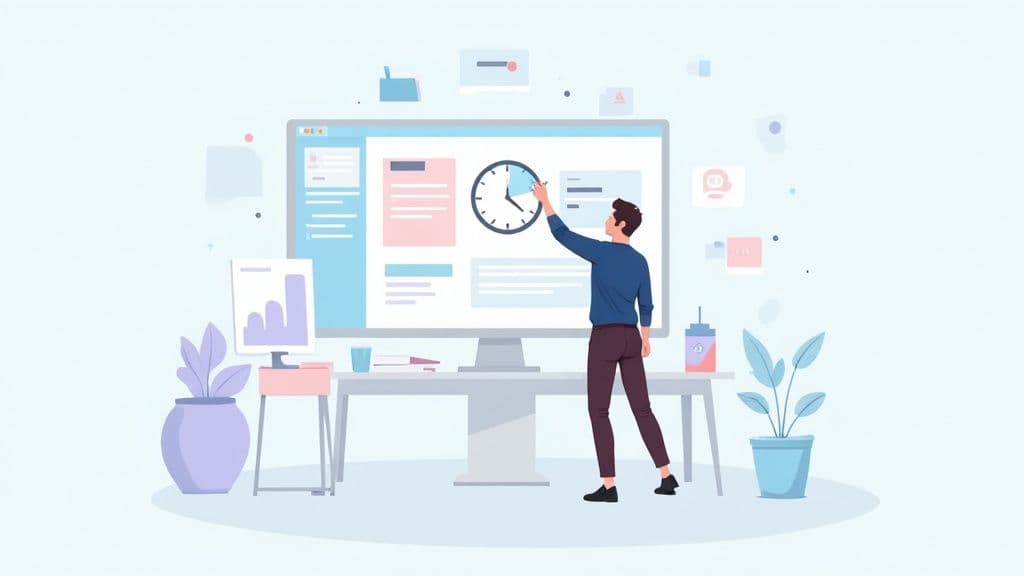
A content calendar is your single best defense against that last-minute "what on earth do I post today?" panic. This doesn't need to be some intimidating, color-coded masterpiece. A simple spreadsheet or a dedicated tool is all you need to map out what you're posting, where, and when.
At a minimum, your calendar should track:
The Topic/Angle: What's the main point of this piece of content?
The Format: Is it a blog post, a Reel, a LinkedIn update, or an email?
The Channel: Where is this going to be published?
The Publish Date: When is it scheduled to go live?
Just by planning one or two weeks ahead, you lift the daily weight off your shoulders. This foresight lets you think more strategically, making sure every post actually connects back to your goals. For a more detailed look, check out our guide on how to create a content calendar for social media.
Master the Art of Batching Content
Once you have a plan, you can tap into one of the most powerful productivity hacks for content: batching. Instead of trying to create a new post from scratch every single day, you carve out a dedicated block of time—say, three hours on a Monday afternoon—to create everything for the week.
In one focused session, you could:
Write all the captions for your upcoming social media posts.
Film several short-form videos in one sitting.
Design all the graphics you'll need for the week.
This method is so effective because you aren't constantly switching gears. You stay in "writing mode" or "video mode," which makes you faster and often produces better, more cohesive work.
Batching transforms content creation from a nagging daily chore into a scheduled, focused project. It’s the difference between feeling constantly behind and feeling completely in control.
Repurpose Everything to Maximize Your Effort
This is the real force multiplier for any small business content marketing strategy. Repurposing is the art of taking one big piece of content and slicing it into smaller, distinct assets for different channels. It’s not about being lazy—it’s about being incredibly resourceful with the time and energy you've already invested.
Here’s what this looks like in the real world:
Pillar Content: You write a detailed, 1,200-word blog post on "5 Common Mistakes First-Time Homebuyers Make."
Social Media Posts: You pull each of the 5 mistakes and turn them into five separate Instagram posts with snappy captions.
Video Content: You film a quick Reel or TikTok summarizing the top three mistakes, using on-screen text to highlight each point.
LinkedIn Update: You post a text-only update diving into just one of the mistakes, then ask your professional network to share their own experiences.
Email Newsletter: You send a short, engaging email to your subscribers that teases the topic and links back to the full blog post on your site.
From that one blog post, you just generated an entire week’s worth of content across multiple platforms. This approach gets your best ideas in front of more people in the formats they actually prefer, all while saving you hours of work. And when you use a scheduling platform like Postiz, you can automate the distribution of all these repurposed pieces, letting your content work for you 24/7.
Measure What Matters and Optimize Your Strategy
Let's be honest, creating all this great content is a ton of work. The last thing you want is for it to disappear into the void. This is where tracking your performance comes in. Without it, you’re just guessing. With it, you have a clear feedback loop that tells you exactly what’s working and what’s not, so you can steer your small business content marketing strategy in the right direction.
And don't worry, you don't need a degree in data science or expensive tools for this. It's about getting into the simple habit of checking the numbers that truly impact your business.
Look Past Vanity Metrics
It's so tempting to get fixated on "vanity metrics" — the likes, the follower counts, the video views. They feel good, right? They show people are seeing you. But they don't tell the whole story, and they certainly don't pay the bills.
While high engagement is great, you have to dig a little deeper. The real magic happens when you focus on the metrics that show people are taking the next step and moving closer to becoming a customer.
Your goal isn't just to be seen; it's to inspire action. A post with 100 likes is nice, but a post with five clicks to your lead magnet and one resulting sale is what truly builds your business.
Once you make this mindset shift, you stop seeing content as an expense and start treating it like the powerful, measurable investment it is.
Identify the Key Performance Indicators That Matter
So, what should you actually track? Your most important Key Performance Indicators (KPIs) tie directly back to the business goals you set earlier.
Think of it this way:
Goal: Generate leads? Then you need to watch your landing page conversion rates, how many email sign-ups a blog post generates, or the number of form submissions you get for a free quote.
Goal: Drive sales? Keep a close eye on the click-through rate (CTR) from a social media post to a product page. Track the number of sales you can attribute to a specific piece of content, and monitor your cart abandonment rate.
Goal: Increase brand awareness? This one feels a bit softer, but it's still measurable. Look at your website traffic from new visitors, the share count on your articles (a sign of real resonance), and mentions of your brand name online.
You can find almost all of this data for free right inside the analytics dashboards of platforms like Instagram, Facebook, and LinkedIn, or in Google Analytics for your website.
Use Data to Inform Your Content Budget
Your performance data does more than just tell you if you're on the right track—it helps you make smarter decisions with your money. When you know which content formats or topics are driving actual results, you can confidently invest more into what's working instead of spreading your budget thin.
This quality-over-quantity approach is a game-changer. For example, recent data shows a clear link between spending and success. Businesses that invest $4,000 or more per post are 2.6 times more likely to call their content strategy 'very successful'. On the flip side, about 20% of businesses spending under $500 per post say they're underperforming. You can dig into more of these numbers in Reboot Online's content marketing statistics breakdown.
Create a Simple Monthly Review Process
You don’t need to obsess over your analytics dashboard every single day. For most small businesses, a focused monthly review is more than enough to stay on course.
Just block out an hour at the end of each month. Sit down with your data and ask yourself three straightforward questions:
What worked? Find your top-performing content. Was it a specific blog post that drove tons of traffic? A social media update that got a surprising number of leads?
What didn’t work? Be honest about what fell flat. Did a new video format get almost no views? Did a certain topic get zero engagement? That’s okay—it’s valuable information.
What will we do differently next month? Use your answers to make a plan. Maybe you’ll double down on what worked, stop doing what didn't, or try a new spin on an old idea.
This simple routine creates a cycle of continuous improvement. It ensures your strategy gets smarter and more effective over time, turning your content from a hopeful shot in the dark into a reliable engine for growth. Using a tool like Postiz can help streamline this, as it pulls your performance data into one place so you get a clear picture of what’s happening across all your channels.
Got Questions? Let's Get Them Answered
Even the best-laid plans run into real-world questions. Once you start putting your content strategy into action, you're bound to hit a few roadblocks or wonder if you're on the right track. That's completely normal.
Let's clear up some of the most common questions I hear from small business owners just like you.
How Much Should a Small Business Actually Budget for Content?
Let's talk money. While there isn't a single magic number that fits everyone, the winning strategy is clear: invest in quality, not just quantity.
A solid benchmark to start with is dedicating 25-30% of your total marketing budget to your content efforts. It might feel like a lot, but think about the return. One incredibly helpful, well-researched blog post that costs $1,000 to create will keep paying you back in traffic and leads for years. On the other hand, ten generic, $100 social posts will be forgotten by tomorrow.
And don't forget to value your own time! If you're spending 10 hours a week creating content, that's a significant business expense. Using smart tools isn't just a convenience; it's a way to maximize the return on every minute and dollar you invest.
How Often Do I Really Need to Post?
The biggest mistake I see is a business owner going all-out for two weeks, posting daily, and then completely disappearing for a month. Your audience craves reliability, not a flash in the pan. Consistency will always beat frequency.
Find a rhythm you can stick with for the long haul. Burnout is your real enemy here.
Social Media (like Instagram or Facebook): Start with a manageable goal of posting 3-5 times a week.
Professional Networks (like LinkedIn): Here, thoughtfulness wins. Aim for 2-3 high-quality posts per week that share real insight.
Your Blog: This is your long-term SEO engine. One powerful, in-depth post every week or even every two weeks is a fantastic pace.
Use your content calendar to get ahead of schedule. As you gather data, you'll learn exactly what cadence your audience prefers, and you can adjust from there.
Your most frequently asked questions are a goldmine for content. Stop trying to invent ideas and start answering what people are already asking. Every question is a potential blog post, social media tip, or short video.
I Have Zero Experience. What's the Easiest Way to Start?
If you're feeling overwhelmed, I want you to do one thing: listen. The easiest and most effective way to start is by simply paying attention to the questions your customers and potential customers ask you every single day.
Forget about trying to be a "content creator." Just be a problem-solver. Each question is a topic handed to you on a silver platter.
Pick just one channel to start—the one where you're most certain your audience hangs out. Get comfortable there, see what works, and build your confidence. You can always expand later. The goal isn't to be perfect; it's to be helpful.
How Long Until I See Real Results from All This?
Content marketing is a long game. Think of it like planting a tree, not flipping a switch. While you might get some early encouragement—a few new followers, a nice comment—the real, business-changing results take time to cultivate.
Honestly, you should plan for 6 to 12 months of consistent, high-quality effort before you start seeing a significant impact, like a steady stream of leads from your blog or a noticeable jump in sales from your content.
In the meantime, keep an eye on the leading indicators that prove you're moving in the right direction:
A steady climb in follower counts.
Higher engagement (more shares and comments, not just likes).
More website traffic from your social channels or blog.
The beautiful thing is that content compounds. The article you write today can continue bringing in traffic and building trust for your business for years to come.
Discover creative social media content ideas to elevate your strategy in 2025. Get inspired with fresh ideas to captivate your audience and increase engagement.






![Top 10 Hopper Hq Alternatives [2024 update]](/_next/image?url=https%3A%2F%2Fcms.postiz.com%2Fwp-content%2Fuploads%2F2024%2F09%2FBlog-Post-27.png&w=1080&q=75)