A solid Facebook content strategy isn't just about posting whenever you feel like it. It's a real plan—a roadmap for creating, publishing, and analyzing content that actually hits your business goals. We've moved way past chasing likes. The goal now is to build a genuine community, drive people to your website, and bring in new leads.
To do that, you have to really know your audience, nail down your brand's voice, and pick the right mix of content that stops people from scrolling past.
Why Your Old Facebook Playbook Is Broken
If your Facebook page feels like a ghost town lately, you're not imagining things. A lot of businesses are seeing their engagement drop and feel like organic reach is dead. But it’s not dead—it’s just different. Facebook has completely changed from a place to see what your friends are up to into a powerful content discovery engine.
This shift is a huge opportunity, but only if you're willing to adapt. Throwing up random sales posts just doesn't cut it anymore. What works now is a thoughtful, data-driven strategy that lines up with how people use Facebook today. Before you get too deep into Facebook specifics, it's smart to have a solid foundation; understanding a comprehensive social media strategy for small businesses is a great place to start.
Welcome to the Discovery Engine
Facebook is still the giant in the room, with an incredible 3.07 billion monthly active users. It’s pretty much an essential channel for any business. The real game-changer, though, is how the algorithm works now. It's no longer just a feed of your friends' posts; it’s an interest-based discovery engine.
This means a big chunk of what users see can come from accounts they don't even follow. Suddenly, your potential to reach new audiences is massive.
Your content isn't just up against what your followers' friends are posting. It’s competing for attention based on how relevant and engaging it is. If you create truly valuable stuff, it has a better shot than ever of reaching thousands of potential customers, all without spending a dime on ads.
The platform is literally built to help your content find the right people, far beyond your current follower list.
How the Facebook Algorithm Has Evolved
To really get why this matters, it helps to see the before-and-after. The old algorithm was all about who you knew. The new one is all about what you might like.
Old Algorithm Focus (Friend-Based)
New Algorithm Focus (Discovery Engine)
Primarily showed content from friends, family, and pages you followed.
Heavily features recommended content from creators and pages you don't follow.
Reach was limited mostly to your existing audience.
Potential for viral reach to new audiences based on engagement and relevance.
Prioritized direct interactions and personal updates.
Prioritizes high-engagement formats like Reels and valuable, shareable content.
Success was measured by growing your follower count.
Success is now driven by creating content that resonates with specific interests.
This evolution from a social graph to an interest graph is everything. It's a fundamental change that requires a new approach to content creation.
Manage all your social media in one place with Postiz
A well-thought-out Facebook content strategy is what separates random activity from predictable growth. It’s the blueprint for everything you do on the platform.
“Posting without a plan is like sailing without a compass—you might move, but you won’t get far. A solid social media strategy turns chaos into results.”
By getting organized and building a real plan, you can:
Be Consistent: A regular posting schedule keeps your brand visible and tells the algorithm you're a reliable source of content.
Create Better Stuff: When you're not scrambling for last-minute ideas, you can focus on making high-quality posts that your audience actually cares about.
Measure What Matters: Track your performance against clear goals. This lets you make smart changes based on real data, not just hunches.
Tools like Postiz can make this whole process much smoother, helping you manage everything from brainstorming ideas to scheduling posts and analyzing what worked. This guide will walk you through exactly how to build that winning strategy and turn your Facebook page into a dependable asset for your business.
Setting Goals and Defining Your Audience
Before you even think about what to post on Facebook, you need a destination and a map. Without them, you're just adding to the noise online. A truly effective strategy starts with two things: crystal-clear goals and a deep, almost personal, understanding of who you're talking to.
It's tempting to jump right into creating content, but that's a classic mistake. It leads to generic posts that nobody engages with and a frustrating feeling that you're getting no real results. Let’s build that foundation first.
Go Beyond Vanity Metrics with SMART Goals
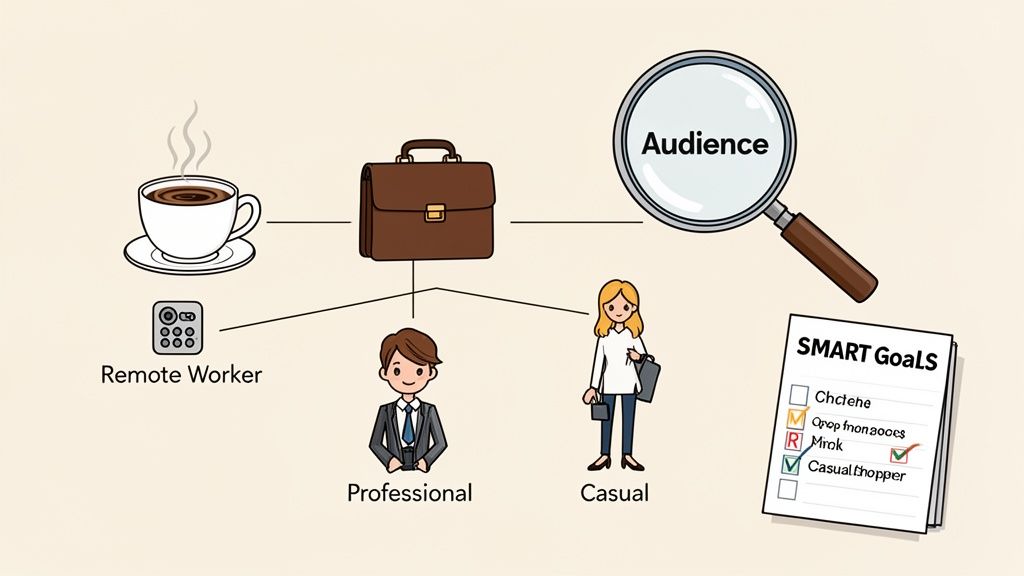
Likes and follower counts feel good, but they don't directly pay the bills. Your Facebook goals need to be tied to actual business outcomes. This is where the SMART framework comes in handy, forcing you to make your objectives Specific, Measurable, Achievable, Relevant, and Time-bound.
So, instead of a vague goal like "get more engagement," a SMART goal sounds more like this: "Increase our average post engagement rate by 2% over the next 90 days by focusing on interactive Reels and polls." See the difference? Now you have a clear target and a deadline.
Here are a few other examples of real business goals for Facebook:
Lead Generation: Drive 50 qualified leads through a Facebook lead form campaign for our new webinar within the next month.
Website Traffic: Increase referral traffic from Facebook to our blog by 15% in Q3 by promoting two new articles per week.
Community Building: Grow our Facebook Group membership by 200 new, engaged members in the next 60 days.
A goal without a measurement is just a wish. By defining specific KPIs like click-through rate (CTR) or cost per lead, you transform your Facebook page from a social experiment into a predictable business driver.
Uncover Who You Are Really Talking To
Once you know what you want to achieve, you have to figure out who you're talking to. Guessing about your audience's interests is a surefire way to create content that falls flat. You need to get your hands dirty with data to build a clear picture of your ideal customer.
Facebook's own tools are a goldmine here. Audience Insights gives you a ton of demographic data about your current followers—their age, where they live, even other pages they follow. This is your ground zero for building out detailed customer profiles.
This research helps you swap broad assumptions for sharp, actionable insights. For instance, a local coffee shop might assume its audience is just "people who like coffee." But after digging into their insights, they might discover their most engaged followers are remote workers aged 25-40 who also follow productivity gurus and tech blogs.
Creating Actionable Buyer Personas
That single insight is where the magic happens. The coffee shop’s content can now pivot from generic "buy our coffee" posts to content that actually serves this specific group. They could start posting:
Productivity Tips: "Your morning focus-booster: pairing our cold brew with these 3 productivity hacks."
Remote Work Humor: A funny Reel about the struggles of Zoom meetings that their audience can totally relate to.
Community Spotlights: Featuring local entrepreneurs who use their shop as a workspace.
All of a sudden, their content feels relevant and valuable. It speaks directly to the lifestyle and pain points of their core audience. Building these detailed profiles, often called buyer personas, is a game-changer. If you want to go deeper, we have a complete guide on how to create buyer personas that will walk you through it.
By rooting your strategy in clear goals and a precise audience, every post you create has a purpose. You’re no longer just posting for the sake of it; you’re strategically communicating with the people most likely to become your best customers.
Figuring Out What to Actually Post: Your Content Pillars and Formats
You know your goals and you know who you’re talking to. Now for the million-dollar question: what do you actually post every day? This is where so many businesses get tripped up, posting random updates and wondering why nothing sticks.
The secret is to build your strategy around content pillars.
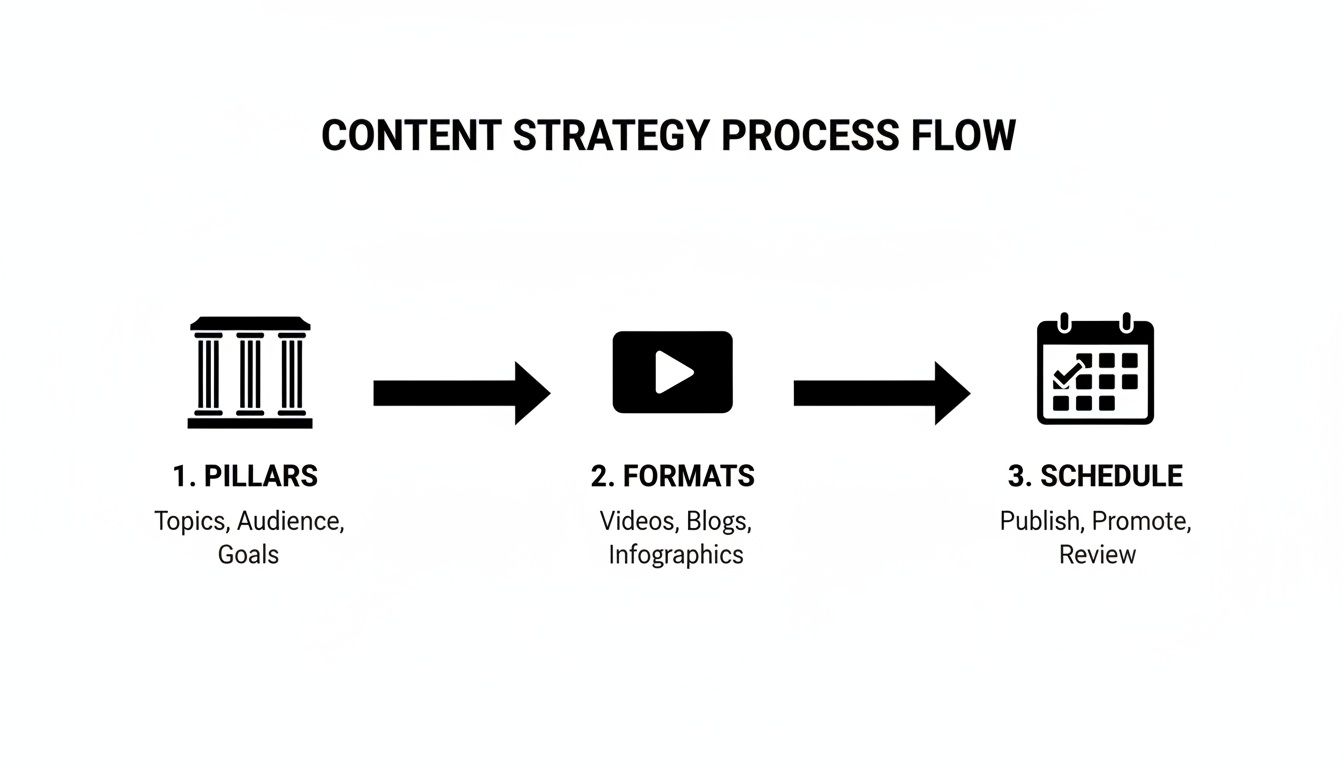
Think of these as the 3-5 core topics you’ll own. These are the big themes your brand will talk about again and again. They’re not random; they live at the sweet spot where what you do meets what your audience desperately wants to know. Having pillars stops the daily scramble for ideas and ensures every single post builds toward a bigger story.
How to Pinpoint Your Pillars
Let’s be real, a financial advisor can’t just post about "money." That's way too broad. Their pillars need to be specific, valuable, and directly tied to the problems they solve for their clients.
Imagine that advisor is trying to reach millennials who feel lost about their finances. Their pillars might look something like this:
Pillar 1: Investing Without the Jargon. This hits a huge pain point. Under this pillar, they could create posts breaking down what a "stock" is, myth-busting crypto fears, or sharing a simple 3-step guide to opening a first investment account.
Pillar 2: Future-Proofing Your 30s. This makes a scary, long-term topic feel manageable. They could post about the magic of compound interest (using a fun visual), demystify 401(k) matching, or share quick tips on saving for a down payment.
Pillar 3: Real Wins from Real Clients. Nothing builds trust like proof. Here, they can share anonymized stories of clients hitting their goals—paying off debt, buying a home, etc. It shows their advice actually works.
Suddenly, that advisor isn't staring at a blank calendar anymore. They have a proven framework for brainstorming content that they know will connect.
Picking the Right Format for the Job
Once your pillars are set, you need to decide how to present the information. A huge mistake I see is businesses using the same format for every post—usually just a link or a static image. You have to mix it up. Different formats do different things.
And right now, Facebook Reels are an absolute monster for getting attention. We're talking about a format that reaches an estimated 616.8 million people and gets reshared 3.5 billion times a day. The data doesn't lie: Reels also pull in 22% higher engagement than regular video posts. If you're not using them, you're leaving a ton of reach on the table. You can dive deeper into the latest numbers by checking out these recent Facebook statistics and findings.
Choosing the right format isn't about what's trendy; it's about what you want to achieve with that specific post. To make it easier, here’s a quick guide to help you match your goal to the best format.
Content Format Decision Guide
This table breaks down which format to lean on depending on what you're trying to accomplish with a particular post.
Marketing Goal
Recommended Primary Format
Why It Works
Maximize Reach & Discovery
Reels
The algorithm loves short-form video and actively shows it to people who don't even follow you yet. It's your best shot at going viral.
Build Community & Trust
Facebook Live
Going live is raw and real. It lets you answer questions on the spot and have genuine conversations that build a loyal following.
Drive Website Traffic
Link Posts with Images
It’s a classic for a reason. A great photo stops the scroll, and a clear call-to-action gets the click. Still incredibly reliable for traffic.
Nurture Relationships
Facebook Stories
Perfect for the casual, behind-the-scenes stuff. Use polls, Q&As, and quick updates to create a more personal, insider feel.
The main idea here is to be intentional. Don't just make a Reel because someone told you to.
Ask yourself: "What is the single most important thing I want this post to do?" Your answer will almost always point you to the perfect format.
Making Content Creation Less of a Grind
Okay, brainstorming ideas for all these pillars and formats can feel like a full-time job. The good news is that you don't have to do it all from scratch. This is where tools can make a huge difference.
Platforms like Postiz are built for this. They don't just schedule your posts; they can help you come up with the ideas in the first place.
As you can see, you can pop in one of your pillar topics, and the tool will spit out a bunch of different angles—a Reel script, a carousel idea, a few text posts. This is a game-changer for speeding up your workflow and getting ahead.
This lets you plan out your content in batches. You can line up a high-reach Reel for Monday, a fun Story poll to get engagement on Wednesday, and a blog post link to drive traffic on Friday. It's a system that gives you both structure and flexibility—the engine that keeps a great Facebook strategy running smoothly without burning you out.
Crafting Your Content Calendar: The Key to Consistency
Let's be honest, even the most brilliant strategy falls apart without a plan. You can have amazing content pillars and creative ideas, but if you're posting sporadically, you’re just creating noise. It confuses your audience and, just as importantly, tells the Facebook algorithm your page isn't a reliable source of value.
The secret to avoiding the "what do I post today?" panic is a solid, sustainable content calendar. Think of it as your command center—the single source of truth for what gets posted and when. This isn't about creating a rigid, soul-crushing schedule. It’s about building a calm, structured workflow that keeps your feed fresh, engaging, and consistently on-brand.
Finding Your Weekly Rhythm
So, what does this actually look like day-to-day? The whole point is to establish a rhythm. Instead of scrambling for ideas every morning, you'll already have a plan that’s directly tied to your strategy.
This approach is perfect for batching your content. You can set aside a couple of hours on a Monday to knock out the week’s captions, create the visuals, and get everything scheduled. Trust me, it’s a total game-changer for saving time and maintaining quality when life gets busy.
Consistency doesn't mean you have to post 10 times a day. It means showing up reliably with valuable content your audience can actually count on. Quality and predictability will always win against sheer volume.
Let's make this real. Imagine you're a local real estate agent, and your content pillars are "Market Updates," "Homeowner Tips," and "Community Spotlight." A simple, effective weekly calendar might look like this:
Day
Pillar
Format
Goal
Monday
Market Updates
Carousel Post
Educate followers on local housing trends and build authority.
Tuesday
Homeowner Tips
Reel
Share a quick tip on "3 Easy Curb Appeal Hacks" for high reach.
Wednesday
Community Spotlight
Facebook Live
Interview a local coffee shop owner to build community connections.
Thursday
Homeowner Tips
Link to Blog
Drive traffic to a new article on "First-Time Homebuyer Mistakes."
Friday
Market Updates
"Just Listed" Photo Post
Generate leads for a new property listing.
See how that works? The schedule is balanced and every single post is intentional. It uses different formats to keep the feed interesting while tying everything back to a core pillar and a business goal. It’s a simple system that delivers powerful results.
Using Tools to Put Your Workflow on Autopilot
Trying to post manually every day is a recipe for disaster. You’ll get busy, you’ll forget, and that hard-earned consistency will vanish. This is exactly why scheduling tools are non-negotiable for executing a serious Facebook content strategy.
A platform like Postiz lets you put your calendar into action without the daily grind. You can:
Schedule Ahead: Load up your content for the entire week or month and let it publish automatically at the best times.
Visualize Your Feed: See your whole calendar laid out, making it easy to spot gaps or make sure you have a healthy mix of content.
Work with Your Team: If you’re not a one-person show, everyone can see the plan, contribute content, and stay on the same page.
By batching your work and leaning on a scheduler, you reclaim so much mental energy. Instead of being stuck in constant creation mode, you can focus on engaging with your audience and analyzing your results—which is where the real growth happens. Your content plan goes from being a static document to the living, breathing engine of your Facebook presence.
Measuring What Matters: How to Know If Your Facebook Strategy Is Actually Working
You can have the most creative, well-planned content in the world, but if you're not tracking what works—and what doesn't—you're just guessing. A strategy without measurement is just a bunch of posts. This is where we close the loop and turn your Facebook efforts from random marketing acts into a predictable growth engine.
It's so easy to get caught up in metrics like Page Likes, but honestly, they're often just vanity numbers. Real optimization comes from zeroing in on the key performance indicators (KPIs) that tie directly back to the SMART goals you set earlier. These are the numbers that tell you the real story.
Look Beyond the Vanity Metrics
To build a strategy that delivers an actual return on your investment, you have to look at metrics that show genuine audience interest and, more importantly, action. It's time to forget the surface-level stuff and start tracking what truly moves the needle.
Here are the KPIs that should be front and center on your dashboard:
Engagement Rate: This is the holy grail. It’s the percentage of people who saw your post and actually did something—liked, commented, or shared it. A strong engagement rate signals to the algorithm that your content is valuable, which helps boost its reach for free.
Reach vs. Impressions: Think of it this way: Reach is the number of unique people who saw your content, while impressions are the total number of times it was seen. I always focus on reach because it tells me if I’m successfully expanding my audience or just showing the same post to the same people over and over.
Click-Through Rate (CTR): For any post with a link, this is your bottom line. It measures how many people who saw the post cared enough to click through to your website or landing page. It’s a direct measure of how persuasive your content and call-to-action are.
Your goal isn't just to be seen; it's to inspire action. A post with 10,000 views but only 10 clicks is far less valuable than one with 1,000 views and 100 clicks. Actionable metrics are the only ones that count.
To make sure your Facebook efforts are making a real impact, it's essential to understand how to effectively measure content performance and not just chase empty numbers.
Using Dashboards to Track Your Progress
Facebook's own Meta Business Suite is a great place to start. It gives you a solid overview of these core metrics, showing you which posts hit the mark, who your audience is, and how you’re growing. It's perfectly fine for getting your feet wet.
But as your strategy grows, you’ll probably want something more powerful. A dedicated tool like Postiz can pull all your analytics into one central dashboard. This makes it so much easier to compare performance across different content pillars and formats. A unified view helps you spot trends you might otherwise miss in the noise. For more on this, check out our practical guide on how to measure social media success.
The Simple Power of A/B Testing
Optimization isn't just about looking backward; it's about actively making your future content better. The easiest way to do this is with A/B testing, where you test one small variable to see which version connects better with your audience.
You don't need fancy software to get started. It can be as simple as running two similar posts a week apart, changing just one thing.
Let’s imagine a small e-commerce brand that wants to drive more traffic to a new product page. They've got a great product shot but can't decide on the best headline.
Version A (Benefit-Focused): "Tired of restless nights? Our new weighted blanket helps you fall asleep faster."
Version B (Curiosity-Focused): "The secret to a perfect night's sleep is finally here."
They post Version A on a Tuesday and watch the CTR. The following Tuesday, at the exact same time, they post Version B. When they compare the numbers, they see that Version A got a 45% higher click-through rate.
Boom. That one simple test delivered an incredibly valuable insight: their audience responds better to clear benefits than to vague curiosity. This little piece of data now informs all their future headlines and ad copy, creating a cycle of continuous improvement. This data-driven loop of creating, measuring, and optimizing is the true heartbeat of any successful Facebook strategy.
Frequently Asked Questions
Even with the best-laid plans, questions always pop up when you start putting a new Facebook strategy into practice. Let's tackle some of the most common ones I hear from businesses trying to get their footing.
How Long Until I Actually See Results?
I get it, you want to see results, and you want them now. But with social media, patience is key. While you might get a lucky viral hit early on, a solid strategy really needs three to six months to start showing real, measurable success.
Think of the first month as your testing ground. You're establishing your content pillars and just getting into a consistent rhythm. By month three, you'll have a good pile of data to see which content formats and topics are actually connecting with people. The real magic—that steady climb in followers and leads—usually starts to happen after the six-month mark. That's when Facebook's algorithm really starts to see your page as a reliable source of good content.
Should I Be Boosting Every Post?
Absolutely not. Boosting every post is a fast way to burn through your budget without a clear return. A much smarter approach is to be selective and strategic.
Let your organic content, especially things like Reels and interactive posts, do the heavy lifting of building your community and keeping your current audience engaged. Save your ad spend for the posts that can really move the needle for your business.
A post is a good candidate for a boost when it:
Is already doing well on its own. If it’s a hit organically, a little money can turn it into a home run.
Ties directly to a business goal, like a product launch, a big sale, or an event registration.
Is meant to reach a brand-new, super-specific audience that you’d have a hard time reaching otherwise.
Relying only on organic reach is a slow burn, but boosting everything is just wasteful. Find that sweet spot.
What Are the Most Common Mistakes to Avoid?
Over the years, I've seen businesses make the same few mistakes over and over. If you can steer clear of these common pitfalls, you'll be way ahead of the game.
The biggest blunders I see are:
Going Silent: Disappearing for days or weeks at a time is a killer. It confuses your audience and tells the algorithm your page isn't active. A simple scheduling tool is the best way to stay consistent.
The Constant Sales Pitch: If your feed is just one big ad, people will tune you out. Stick to the 80/20 rule: 80% of your content should be helpful, entertaining, or interesting, and only 20% should be directly selling something.
Flying Blind: Not looking at your analytics is like driving with your eyes closed. You have to know what's working so you can do more of it and stop wasting time on what isn't.
Ignoring Your Community: Social media is a conversation. When you ignore comments and messages, you're missing a huge opportunity to build real relationships with your followers.
I'm Not a Designer. How Can I Create Good Content?
You don't need a design degree to create great-looking content for Facebook anymore. The tools we have today make it incredibly simple.
Get familiar with platforms like Canva or the built-in design features you'll find in scheduling tools like Postiz. They're packed with user-friendly templates. Just focus on using clean layouts, good-quality photos (your own or stock), and text that's easy to read.
Here's a pro tip: Authenticity often beats high-production value. A well-lit video you shoot on your phone for a Reel or Story can feel more genuine and relatable, often outperforming a super polished, expensive video.
And don't forget about user-generated content (UGC). When a happy customer posts about you, ask if you can share it! It's a fantastic way to get authentic content that also acts as a powerful testimonial.
Ready to put all this into action without the chaos? With Postiz, you can map out your content, schedule everything in advance, and track what’s working, all from one dashboard. It's time to stop the daily content scramble and start building a Facebook presence that actually works. Get started with Postiz today.
Turn your Instagram into a real income source, even with small followers. Discover 8 proven strategies & the beginner's roadmap for 2025. Start earning!
Learn how to make Discord bots from the ground up with this practical guide. Covers everything from initial setup to coding your first commands and hosting.
Master the correct profile image size for every major platform. Our 2026 guide covers dimensions, formats, and optimization tips to make your brand stand out.