A solid social media plan for startups isn’t a rigid 50-page document. It’s a flexible framework that helps early-stage companies define goals, reach the right audience, and grow traction without wasting time or budget.
How to Create a Social Media Plan for a Startup (7 Steps)
Define one business-driven goal (leads, signups, demos)
Identify your primary audience persona
Choose 1–2 core platforms only
Define 3–5 content pillars
Create a simple 30-day content calendar
Engage daily through comments and DMs
Track engagement, CTR, and conversions weekly
For founders who prefer a real-world reference, this sample social media marketing plan shows how a lean strategy looks when applied in practice.
Why Most Startup Social Media Plans Fail
Let’s be real—most social media advice out there is written for big corporations with even bigger budgets. As a startup, you’re playing a completely different game. You’re juggling limited cash, a million competing priorities, and the constant pressure to get traction yesterday.
This is exactly why a complex, corporate-style plan is doomed to fail. It’s too slow, too rigid, and totally disconnected from the scrappy reality of building a business from the ground up.
Your secret weapon? An agile, founder-led approach. Instead of getting bogged down in endless documentation, you need to focus on rapid testing, authentic conversations, and only measuring what actually moves the needle. For a startup, a winning plan is less about perfectly polished campaigns and more about creating genuine connections that build a loyal, vocal community.
How to Create a Social Media Plan for a Startup (Step-by-Step)
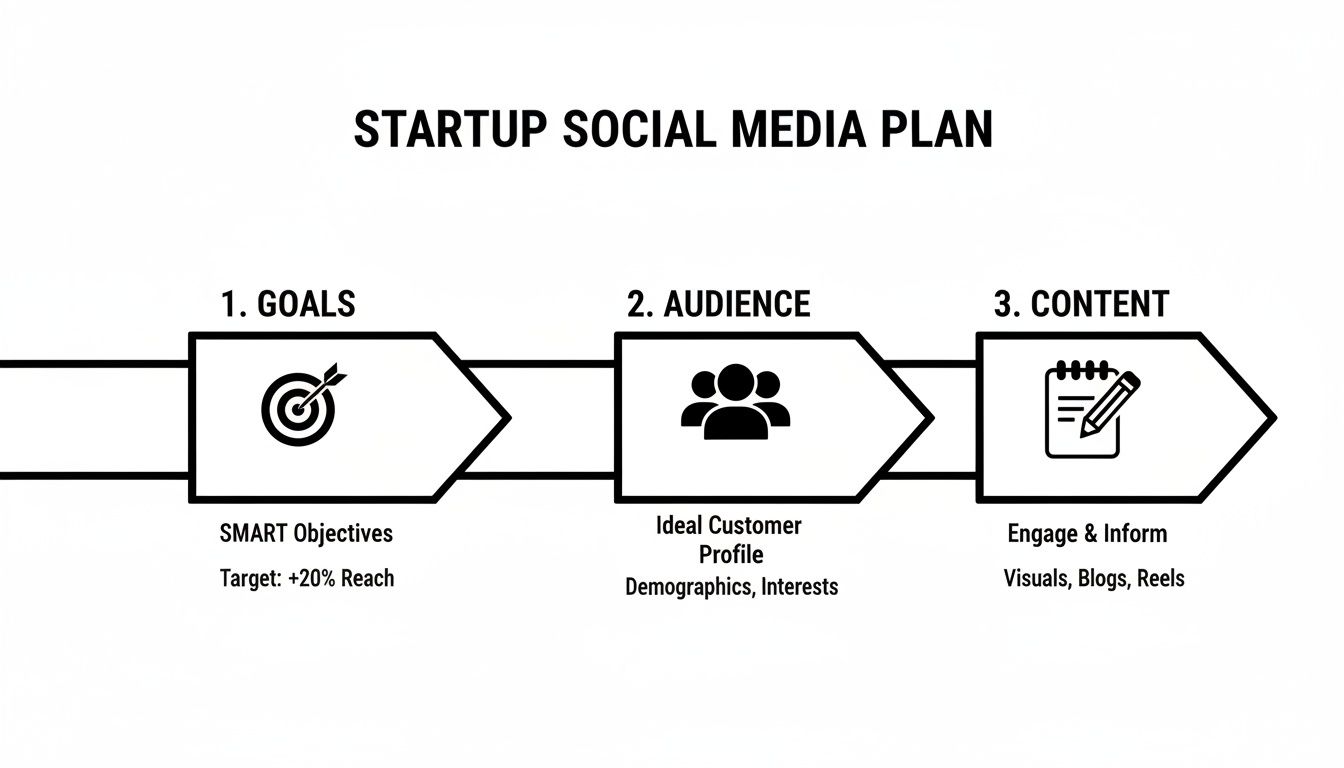
Building an effective social media plan boils down to a clear, logical flow: first, define your goals, then deeply understand your audience, and finally, create content they’ll actually care about.
This simple roadmap keeps you from wasting effort. When you start with a clear “why,” you can laser-focus your audience research and content strategy for maximum impact. A great first move is to figure out where you’re starting from. You can get a quick baseline by following a simple guide for conducting a social media audit.
The opportunity here is massive. There are over 5.4 billion social media users worldwide, and that number is expected to hit 6 billion by 2028. Better yet, social media marketing delivers an average ROI of $5.20 for every $1 spent, proving just how powerful this channel can be for scrappy, growing businesses.
A common mistake I see startups make is trying to be everywhere at once. A lean plan prioritizes depth over breadth. Master one or two channels where your ideal customers actually hang out before even thinking about expanding.
For startups that need to scale fast, learning the ropes of influencer marketing for startups can be a game-changer for your social media plan. It’s a powerful way to tap into existing communities and build credibility almost overnight, turning even a small budget into a serious growth engine.
To get started, here’s a quick breakdown of the core components we’ll be building out. Think of this as your strategic blueprint.
Manage all your social media in one place with Postiz
Move beyond vanity metrics. Focus on business goals like leads, sign-ups, or first sales.
A clear, measurable objective that guides all your social media activities.
Audience & Competitors
Get hyper-specific. Create detailed personas and see what’s working for others in your niche.
A deep understanding of who you’re talking to and how to stand out.
Channel & Content Mix
Don’t be everywhere. Pick 1-2 platforms and define 3-5 core content pillars.
A focused content strategy that resonates with your audience on the right channels.
Launch Calendar
Plan for action. Build a simple 30/90-day calendar to build momentum.
A realistic timeline that turns your strategy into a day-to-day reality.
Growth & Engagement
Be proactive, not passive. Outline tactics for community building and audience growth.
A set of repeatable actions to build a loyal following.
Budget & Resources
Be scrappy but smart. Allocate your limited time and money where it counts most.
A lean budget that maximizes your ROI without unnecessary waste.
Measurement & KPIs
Track what matters. Create a simple dashboard to monitor progress against your goals.
A clear view of what’s working so you can double down or pivot quickly.
Each of these pieces builds on the last, creating a cohesive and powerful plan that’s tailor-made for the unique challenges and opportunities a startup faces.
Setting Social Media Goals for Startups
Before you write a single post, we need to get two things straight: what are you trying to achieve, and who are you as a brand? If you skip this step, you’re basically just shouting into the wind. For a startup, that’s a quick way to burn through your most valuable resources: time and cash.
Big, established companies can get away with fluffy goals like “increase brand awareness.” You can’t. Every social media goal you set has to be directly tied to your startup’s immediate needs. Forget chasing vanity metrics like follower counts for a while—let’s focus on actions that actually move the needle.
This means getting super specific. Instead of just hoping for more followers, set a tangible target that matters to your business right now.
Pre-Launch? Your main job is building an audience that’s ready to go on day one. A great goal would be: “Get 200 email sign-ups for our waitlist from the Instagram bio link this quarter.”
Just Launched? Now it’s all about building a community and getting feedback. Try something like: “Hit a 5% average engagement rate on LinkedIn and book 10 user interviews from our posts this month.”
In Growth Mode? Time to turn that engagement into revenue. A solid goal is: “Generate 25 qualified demo requests from our social media campaigns in the next 90 days.”
See the difference? These goals are measurable, have a deadline, and directly contribute to your startup’s survival. They give every single post a real purpose.
Defining Brand Voice for Startup Social Media
Once you know what you’re doing, you need to figure out how you’re going to say it. For most startups, your biggest weapon is you—the founder, the founding team, the unique story. People connect with real people, not stuffy, faceless brands. Don’t hide behind corporate jargon. Lean into what makes you, you.
Your brand voice is simply your personality, expressed in words. It’s the tone and style you use in every tweet, comment, and DM.
Here’s a simple way to think about it: if your brand walked into a party, what would it sound like?
Would it be the clever, sarcastic one, like Wendy’s?
The super helpful, knowledgeable one, like the HubSpot blog?
Your authentic voice is the filter for everything you create. It builds consistency and trust, making your brand memorable. It’s what turns a passive follower into a true fan who feels like they actually know the people behind the logo.
Documenting Brand Voice for Consistent Social Media Messaging
As you start to define this voice, write it down. Seriously. It doesn’t need to be a 50-page brand bible—a simple one-pager is perfect. The easiest way to start is with a simple “we are” and “we are not” list.
A Quick Brand Voice Example (for a FinTech Startup):
We Are
We Are Not
Clear & Simple
Full of Jargon & Complicated
Empathetic & Supportive
Condescending & Elitist
A Little Playful
Unprofessional or Silly
Backed by Data
Vague or Speculative
This simple chart is a lifesaver. As your team grows, anyone who creates content can instantly get a feel for the brand’s personality. It keeps your message tight and consistent, which is absolutely critical when you’re trying to stand out.
Of course, nailing this voice starts with knowing exactly who you’re talking to. To really dig into that, our guide on how to create buyer personas is the perfect next step. Understanding your audience is the foundation for a voice that doesn’t just speak, but connects.
Finding Your Target Audience on Social Media
Forget expensive enterprise software. For a startup, figuring out who you’re selling to is all about being scrappy and observant. It starts with getting past generic demographics and building a user persona that feels like a real person you could have a conversation with.
The real goal here is to get to the core of their pain points. What really keeps them up at night? What have they tried before that just didn’t work? Answering these questions is how you create content that actually connects instead of just becoming more noise on their feed.
Where Startups Should Research Their Social Media Audience
Once you have a rough sketch of your ideal customer, you need to find out where they actually hang out online. Often, it’s not where you’d expect. Ditch the idea of broadcasting on every major platform and instead, become a fly on the wall in their natural digital habitats.
These are the places where they ask for real advice, vent their frustrations, and share their wins. By joining these communities, you get a direct line into the exact language they use and the problems they’re actively trying to solve right now.
Niche Subreddits: Search for communities related to your industry or your customer’s job. If you’re building a B2B SaaS for project managers, you’ll strike gold in places like r/projectmanagement.
Specific Slack/Discord Communities: Many industries have private, high-value communities where professionals connect. These are incredible for understanding real-world challenges away from the public noise.
Influencer Comment Sections: Pinpoint 5-10 key influencers your audience already follows on LinkedIn, X, or Instagram. The questions and comments on their posts are a goldmine of raw audience sentiment.
This kind of “digital ethnography” is one of the most powerful, low-cost moves you can make. You’ll walk away with priceless insights for your content strategy, all from just listening.
Don’t just look for what people say, look for how they say it. The specific slang, acronyms, and in-jokes they use are your cheat codes for creating content that feels like it was written by an insider.
Startup Competitor Analysis for Social Media
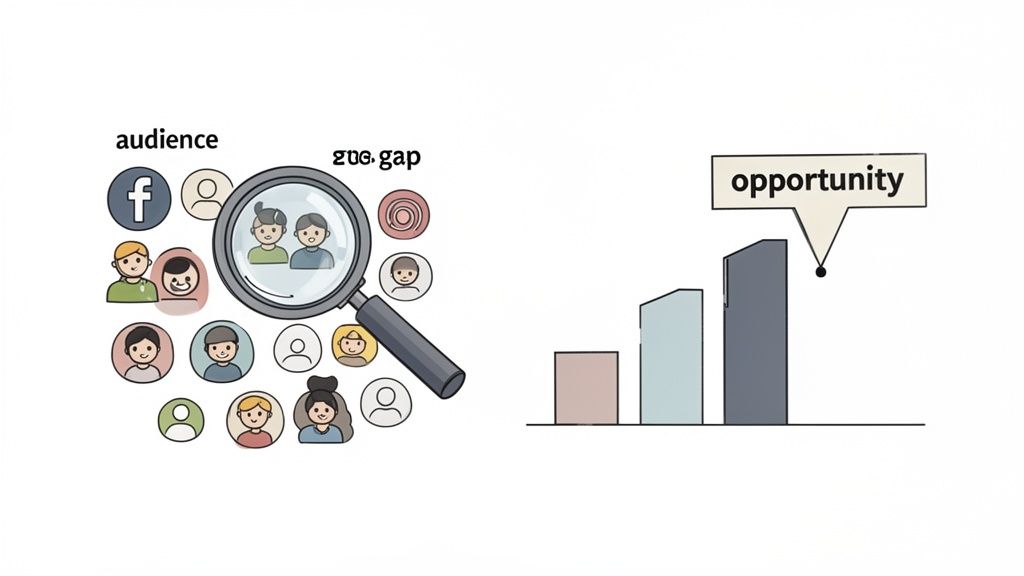
With a much sharper picture of your audience, it’s time to see what the competition is up to. For a startup, a competitive analysis isn’t about creating a 50-page report. It’s a quick, focused mission to find the gap in the market that you can completely own.
Start by identifying 3 to 5 competitors, both direct and indirect. A direct competitor solves the exact same problem for the same audience. An indirect one might solve the same problem for a different audience, or a different problem for your audience.
How to Analyze Competitors’ Social Media Content
Now, set a timer for 30 minutes and just scroll through each competitor’s main social media channel. Your goal is to spot patterns and, more importantly, opportunities. Don’t just glance at what they post; dive deep into how their audience actually responds.
Here’s what you’re looking for:
Top-Performing Content: What kind of posts are getting the most likes, comments, and shares? Are they educational carousels, behind-the-scenes videos, or polished customer stories? This shows you what the market has already voted for with its attention.
Engagement Patterns: Are they actually talking to their audience in the comments? A competitor with a great product but awful community management leaves a massive door open for you to win on personality and service.
Customer Comments: This is free market research. Read the comments on their posts and ads. What questions pop up over and over? What features are people begging for? What are they complaining about?
The “Gap”: What are they not talking about? Maybe they’re all hyper-focused on technical features, but no one is touching on the human impact of the problem you solve. That’s your angle.
By the end of this quick-and-dirty analysis, you should have a solid feel for what’s standard in your industry and, crucially, where you can be different. This isn’t just about your content—it informs your entire brand positioning. You’re not here to copy what works; you’re looking for the open lane where your startup can uniquely shine.
Content Strategy and Scheduling for Startups
Okay, you know who you’re talking to. Now it’s time to build the engine that will actually run your social media. This is where the rubber meets the road, turning your big-picture strategy into a daily, manageable reality.
For a startup, the single biggest mistake is trying to be everywhere at once. Seriously, resist that temptation. Your mission is to absolutely dominate on one or two key platforms, not spread yourself thin with a mediocre presence on five.
Stick to the platforms where your audience research showed they’re most active. From there, focus on creating content that feels native—like it belongs there. A formal, data-heavy post that kills it on LinkedIn will feel out of place and probably flop on Instagram. Likewise, a funny Reel using a trending sound won’t hit the same on a professional network.
Strong execution starts with solid content planning for social media, ensuring your ideas, formats, and posting cadence stay aligned with your goals.
Content Pillars for Startup Social Media
Instead of waking up every morning wondering, “What should I post today?”, build your entire content strategy around a few core themes. These are your content pillars.
If you need a starting point, this social media content planning template helps startups structure ideas around clear content pillars without overcomplicating the process.
Think of them as 3-5 broad topics your brand will own and talk about consistently. This approach keeps your messaging sharp, establishes you as an authority, and makes coming up with ideas a whole lot easier.
A B2B SaaS startup, for instance, might have pillars like these:
Industry Insights & Trends: Sharing data and predictions to show you know your stuff.
Product Education & Use Cases: Actually showing people how your product solves real problems. Think mini-tutorials and case studies.
Customer Wins: Highlighting real-world results from your customers to build trust.
Behind the Scenes & Culture: Humanizing your brand by showing the actual people behind the logo.
These pillars form the backbone of your content calendar. Every single post should tie back to one of them. This ensures your feed tells a consistent, compelling story about who you are and why people should care.
Choosing the Best Social Media Platforms for Startups
Your choice of platform has a direct line to the results you’ll see. While the average post engagement rate is about 1.8%, certain formats and platforms can blow that number out of the water. Short-form video is a perfect example, with TikTok leading the charge at a 4.86-5.7% average engagement rate. For B2B, LinkedIn is a beast, boasting a 6.50% engagement rate.
And here’s a pro tip for lean teams: with 48% of marketers repurposing content, cross-posting becomes your secret weapon for efficiency.
Your first platform should be where your ideal customers are most concentrated. Your second should be one that lets you repurpose content easily. For instance, a detailed LinkedIn article can be sliced into a punchy Instagram carousel or a quick video.
Deciding where to focus your limited time and energy can be tough. This table breaks down the top contenders to help you make a smart choice for your startup.
Platform Selection for Startups
Platform
Best For
Key Content Type
Startup Use Case
LinkedIn
B2B networking, thought leadership, and lead generation.
In-depth articles, text posts, carousels, and professional video.
A FinTech startup sharing market analysis to attract investors and early adopters.
Instagram
B2C brand building, visual storytelling, and community engagement.
High-quality Reels, Stories, carousels, and user-generated content.
A direct-to-consumer fashion brand showcasing its products and company culture.
X (Twitter)
Real-time conversations, industry news, and customer service.
Short text updates, threads, polls, and quick video clips.
A SaaS company engaging in tech conversations and providing rapid support.
TikTok
Brand awareness, reaching Gen Z, and viral marketing.
Short, entertaining, and educational videos using trending audio.
A mobile app startup creating relatable skits about the problems their app solves.
Ultimately, the “best” platform is simply the one where you can consistently connect with the right people. Start with one, master it, and then expand.
Creating a Social Media Content Calendar for Startups
Your content calendar is your command center. It doesn’t need to be some complex, expensive software—a simple spreadsheet is perfect when you’re starting out. This tool turns your pillars and platform choices into an actionable schedule, saving you from the daily panic of what to post.
At a minimum, your calendar should track:
Date and Time: When the post goes live.
Platform: Which channel it’s for.
Content Pillar: The core theme it connects to.
Post Format: (e.g., Carousel, Reel, Text Post, Link).
Copy: The exact text for the post.
Visuals: A link to the image or video file.
Status: (e.g., Draft, Scheduled, Published).
Just planning content one or two weeks ahead can be a game-changer. It lets you batch your work—write all your captions on Monday, design your visuals on Tuesday. For a founder or a tiny team, that kind of efficiency is gold. If you need a template, check out this guide on https://postiz.com/blog/how-to-create-a-content-calendar-for-social-media.
This structured process shifts your content from a reactive chore to a proactive growth strategy. To truly understand how to build from the ground up, you should learn how to make millions from social media even with zero followers. By pairing strong pillars with a smart schedule, you create the consistency needed to turn followers into loyal customers.
Social Media Budget Tips for Startups
A brilliant social media plan is worthless if you can’t actually afford to run it. But here’s the good news: you don’t need a massive budget to make a real impact. For a startup, it’s all about being scrappy, smart, and consistent. The right mix of clever tactics and small, targeted investments can build serious momentum.
This is where the rubber meets the road. We’re shifting from planning to doing. Forget one-off viral moments; the goal is to build sustainable habits that create real value over time. Big results on a small budget come from focused, consistent effort.
Punch Above Your Weight with Sweat Equity
When cash is tight, your time and creativity are your most valuable currency. Instead of paying for reach, you have to earn it. How? By showing up where your audience already hangs out and providing genuine value.
Join Ten Conversations a Day: Make this a non-negotiable habit. Every single day, find 10 relevant posts on LinkedIn, X, or in niche communities. Leave a thoughtful comment that adds to the conversation—ask a question, offer a different perspective, or share a related insight. Don’t just say, “Great post!” This simple action makes you visible and positions you as a helpful expert, not just another brand trying to sell something.
Lean Into the Founder’s Brand: People trust people far more than they trust logos. As a founder, your story, your passion, and your expertise are your startup’s secret weapons. Document the journey, share what you’re learning (the good and the bad), and engage from your personal profile. This human-first approach forges an authentic connection that bigger, more corporate brands just can’t replicate.
Systematize User-Generated Content (UGC): Your first happy customers are your most powerful marketers. Create a simple system to encourage them to share their experiences. It could be a branded hashtag, a monthly giveaway for the best customer photo, or just reaching out personally to ask permission to share a great comment they left. Featuring UGC provides powerful social proof and makes your community feel seen, which builds incredible loyalty.
Don’t just post and ghost. The real magic happens in the DMs and the comment threads. Community isn’t built by broadcasting; it’s built by connecting one-on-one and making every follower feel like they’re part of something special.
How to Smartly Invest Your First $500
When you finally have a small budget to play with, every dollar has to pull its weight. Forget about vague “awareness” campaigns. Your first $500 should be treated like a series of strategic experiments designed to learn what works and pour a little fuel on what’s already catching fire.
Here’s a practical way you could slice up that initial budget for maximum impact.
Investment Area
Amount
Startup Goal
Boost a High-Performing Post
$150
Drive targeted traffic to your best organic content.
Micro-Influencer Collaboration
$250
Tap into a trusted voice to build credibility and reach a new, relevant audience.
Lead Generation Ad
$100
Test a small campaign to capture emails for a webinar or a valuable download.
The key here is not to spend it all at once. Run small, focused tests. Find the organic post that already has your best engagement rate and put $150 behind it to show it to more people just like those who already loved it. Find a micro-influencer (usually under 10k followers) whose audience is a perfect match for your ideal customer—their partnerships are often more authentic and affordable. The goal with this first $500 is pure data collection: see which message, audience, and offer truly connects.
Outreach That Doesn’t Sound Robotic
Whether you’re reaching out to potential partners or early customers, a personal touch is everything. Generic, copy-pasted messages are a one-way ticket to the trash folder. Instead, create simple, customizable templates that leave room for genuine personalization.
A Micro-Influencer Outreach Example That Works:
“Hey [Name], I’ve been following your content on [topic] for a while and loved your recent post about [specific detail]. The way you explained [concept] was so clear.
We just launched [Your Startup], a tool that helps [target audience] with [problem you solve]. Since you’re an expert in this space, I thought you might find it interesting. Would you be open to trying it out? No strings attached.
Keep up the great work!”
See why this works? It’s specific, it’s complimentary (and genuine!), and it offers value without a hard ask. It opens the door for a real conversation, which is the foundation of any strong community and a critical part of a successful social media marketing plan for any startup.
Social Media KPIs and Metrics Startups Should Track
So, you’ve built your plan. Now, how do you know if it’s actually working? Data. Without it, you’re just throwing content at the wall and hoping something sticks. A simple KPI dashboard is your command center—it’s how you make smart decisions that actually move the needle.
This doesn’t mean you need to get lost in a sea of complicated spreadsheets. It’s about zeroing in on the few metrics that tie your social media activity back to real business results. It’s time to stop obsessing over vanity metrics like follower count, because likes don’t pay the bills.
Moving Beyond Vanity Metrics
Your dashboard should tell you a clear story: are you connecting with your audience and are they taking the actions you want them to take? For a startup, that’s everything. You need to track the numbers that show real interest and business impact.
Here are the core KPIs I always tell founders to build their initial dashboard around:
Engagement Rate: Think of this as your content’s pulse. It bundles up likes, comments, shares, and saves to show what percentage of people who saw your post actually cared enough to do something. A high engagement rate is the clearest sign that your message is hitting home.
Click-Through Rate (CTR): This is the bridge between your social media and your website. It tracks how many people clicked the link in your post, bio, or ad, connecting your content directly to your lead generation or sales funnel.
Conversion Rate: This is the big one—the ultimate bottom-line metric. It tells you how many of those clicks turned into a meaningful action, like a newsletter sign-up, a demo request, or a sale. This is what proves the ROI of your social media efforts.
As a startup, your goal isn’t just to be seen; it’s to be effective. An engagement rate of 8% on a post that reaches 500 people is far more valuable than a 1% rate on a post seen by 5,000. Quality of interaction trumps quantity of eyeballs every time.
Building Your Dashboard with Free Tools
You don’t need to spend a dime on fancy software to get started. Honestly, the free, built-in analytics on every major platform are more than powerful enough for a startup. Dive into LinkedIn Analytics, Instagram Insights, and Facebook’s Meta Business Suite—they have a treasure trove of data waiting for you.
Here’s a simple routine to get into. Set a recurring reminder for the same time every week. I like Monday mornings. Spend just 30 minutes pulling these three core metrics for your best-performing posts from the week before.
This simple habit creates an incredibly powerful feedback loop. You’ll start seeing patterns almost immediately. “Huh, our behind-the-scenes videos get double the engagement,” or “Wow, that text-only LinkedIn post drove a 5% CTR to our new blog.” This isn’t just data; it’s a road map. It tells you exactly what’s working, where to focus your limited time, and which ideas to ditch, making sure every ounce of effort is spent wisely.
Social Media Plan for Startups FAQs
Even with a solid plan in hand, a few questions always pop up. Let’s tackle some of the most common ones I hear from founders trying to get their social media off the ground.
So, What’s the Real Budget for a Startup?
Honestly, there’s no single right answer. If you’re a pre-seed startup running on fumes, your budget is exactly $0. Period. Your time is your currency, so you’ll be putting in the sweat equity—think daily founder-led content and jumping into relevant online conversations.
Once you’ve got a little cash to play with, a common rule of thumb is to set aside 5-10% of your total marketing budget for social.
A small ad spend of $200-$500 a month can make a surprising difference. You can use it to give your best-performing organic posts a boost to a super-specific audience or run a small-scale lead gen campaign on a platform like LinkedIn where intent is high.
How Long Until I Actually See Results?
This is where you need to be patient. Building a real community doesn’t happen overnight. You’ll likely see some early signs of life—a slow and steady climb in followers and engagement—within the first 30-60 days if you’re consistent.
But when it comes to seeing a real business impact, like quality leads or actual sales, you should brace for a 3-6 month runway of dedicated, consistent effort. Paid ads can definitely shorten that timeline, but don’t skip the organic work. It’s the foundation of your brand.
What Metrics Actually Matter for a Startup?
In the beginning, forget about the vanity metric of follower count. It doesn’t mean much. Instead, focus on the numbers that tell you if your content is truly hitting the mark and helping your business.
Engagement Rate: Are people commenting, sharing, and saving your posts? This tells you if you’re actually connecting with them.
Click-Through Rate (CTR): This is your bridge from social media to your product. It shows how many people are interested enough to click the links back to your site.
Conversion Rate: This is the big one. It tracks how many of those clicks turn into something meaningful, like a demo request or a newsletter signup.
Do startups need a social media plan?
Yes. Even a simple framework helps. This social media marketing plan template gives startups a lightweight structure without the complexity of enterprise strategies.
A successful social media plan for startups is lean, focused, and built around real business outcomes. By choosing the right platforms, defining clear goals, and tracking meaningful KPIs, startups can turn social media into a reliable growth channel instead of a time sink.
A practical guide to using AI agents with Postiz CLI and API to automate social media distribution across 28+ platforms. Includes code examples, platform-specific settings, and the key difference between blasting and smart distribution.