Social media for a SaaS company isn’t just about racking up likes and followers. It’s a powerful tool for building awareness, pulling in high-quality leads, and even keeping the customers you already have happy.
Building a SaaS Social Media Strategy That Works
Jumping onto social media without a plan is like trying to build software without a roadmap—a surefire way to get lost. For any SaaS business, a solid strategy starts long before you ever schedule a single post. You need a foundation that ties every tweet, post, and video back to a real business outcome, whether that’s boosting trial sign-ups or increasing user retention.
This means moving beyond vague, surface-level goals. Instead of just aiming for “more followers,” a sharp SaaS marketer sets specific targets like, “increase demo requests from LinkedIn by 15%” or “cut down support tickets by 10% with proactive how-to content on Twitter.” This is how you turn social media from a simple broadcast channel into a serious engine for business growth.
Social media as a demand capture channel (not just demand generation)
For SaaS companies, social media is not only about creating demand, it’s about capturing it at the right moment. Many buyers already know they need a solution, but they’re comparing tools, reading opinions, and validating choices on platforms like LinkedIn and Twitter. Showing up consistently with clear positioning, feature comparisons, customer proof, and direct CTAs allows SaaS brands to intercept in-market buyers before they ever reach a search engine or pricing page. This is especially powerful for mid-funnel prospects who are already problem-aware and looking for the “best tool” rather than learning from scratch.
Defining Your Ideal Customer Profile
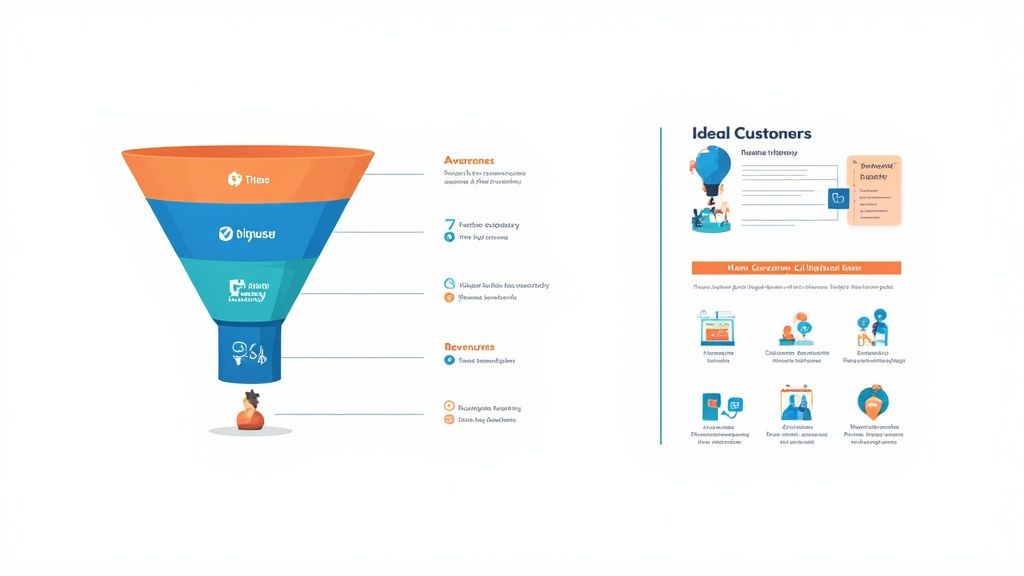
First things first: you have to know exactly who you’re talking to. A generic buyer persona just won’t cut it. You need a deeply researched Ideal Customer Profile (ICP) that truly captures the details of your best, most successful users.
A good example of how ICP shapes social strategy is social media marketing for lawyers. Legal audiences care about trust, credibility, and compliance more than trends or entertainment. Content focuses on education, authority, and reputation rather than volume or virality, showing how audience context directly changes platform choice, tone, and content formats.
What does that actually look like? Well, instead of a vague job title like “Marketing Manager,” a detailed ICP for a project management tool might look something like this:
Daily Frustrations: They’re constantly fighting to track project progress across different teams, which leads to missed deadlines and messy communication.
Software Stack: They live in Slack for chat, Google Drive for files, and HubSpot for their CRM. Any new tool has to play nicely with what they already use.
Information Sources: They trust advice from a handful of industry leaders on LinkedIn, hang out in subreddits like r/projectmanagement, and listen to productivity podcasts on their commute.
Buying Triggers: The catalyst for them to start looking for a solution is usually a big project that went off the rails, a new company-wide push for efficiency, or just pure frustration with clunky spreadsheets.
Getting this granular ensures your content speaks directly to their real-world headaches and makes your solution feel like the perfect answer.
Manage all your social media in one place with Postiz
Once you have a crystal-clear ICP, you can stop wasting time and money on platforms where your audience simply isn’t hanging out. Not every social network makes sense for every SaaS business. The goal is to show up where your customers are already talking about the problems your software solves.
I see so many SaaS startups make the classic mistake of spreading themselves too thin across every platform. You’ll get much better results by dominating one or two channels where your ICP lives than by maintaining a weak, mediocre presence on five.
To build a social media plan that truly works, you need to understand how it fits into your company’s bigger picture. Seeing it as one piece of the puzzle alongside other Top SaaS Marketing Strategies helps align your social efforts with the company’s main objectives, giving you a much bigger impact.
In contrast, social media marketing for restaurants prioritizes speed, visuals, and local discovery. Platforms like Instagram and TikTok outperform LinkedIn because buying decisions are impulsive and location-driven. This highlights why SaaS brands must avoid copying consumer strategies and instead choose platforms based on how and when their buyers make decisions.
Platform Selection Matrix for SaaS Companies
Choosing where to focus can be tough. This quick-reference table is designed to help you decide where to invest your time and budget to get the best possible return.
Platform
Primary SaaS Audience
Best For (Goal)
Key Content Formats
LinkedIn
B2B decision-makers, industry professionals
Lead generation, thought leadership, brand building
Carousels, text posts, data insights, case studies
Twitter/X
Tech community, industry experts, journalists
Real-time engagement, community building, news
Threads, quick tips, polls, sharing articles
YouTube
Users seeking tutorials and in-depth explanations
Product education, customer onboarding, tutorials
Demos, how-to videos, webinar recordings
Reddit
Niche communities, technical users
Answering questions, gathering feedback, research
Text-based posts, engaging in relevant subreddits
Facebook
Specific interest groups, retargeting audiences
Community building (Groups), targeted paid ads
Video ads, event promotion, customer success stories
By focusing your energy on the platforms that make the most sense for your ICP and business goals, you’re setting the stage for a social media strategy that actually delivers results. This targeted approach ensures that every single piece of content you create serves a real purpose.
Another useful comparison is social media marketing for real estate agents, where trust-building, personal branding, and long-term relationships matter more than product features. Unlike SaaS, where education and demos drive conversion, real estate content focuses on visibility, credibility, and ongoing presence, reinforcing how platform strategy depends on sales cycles and buying behavior.
The Three Content Pillars of a High-Growth SaaS Brand
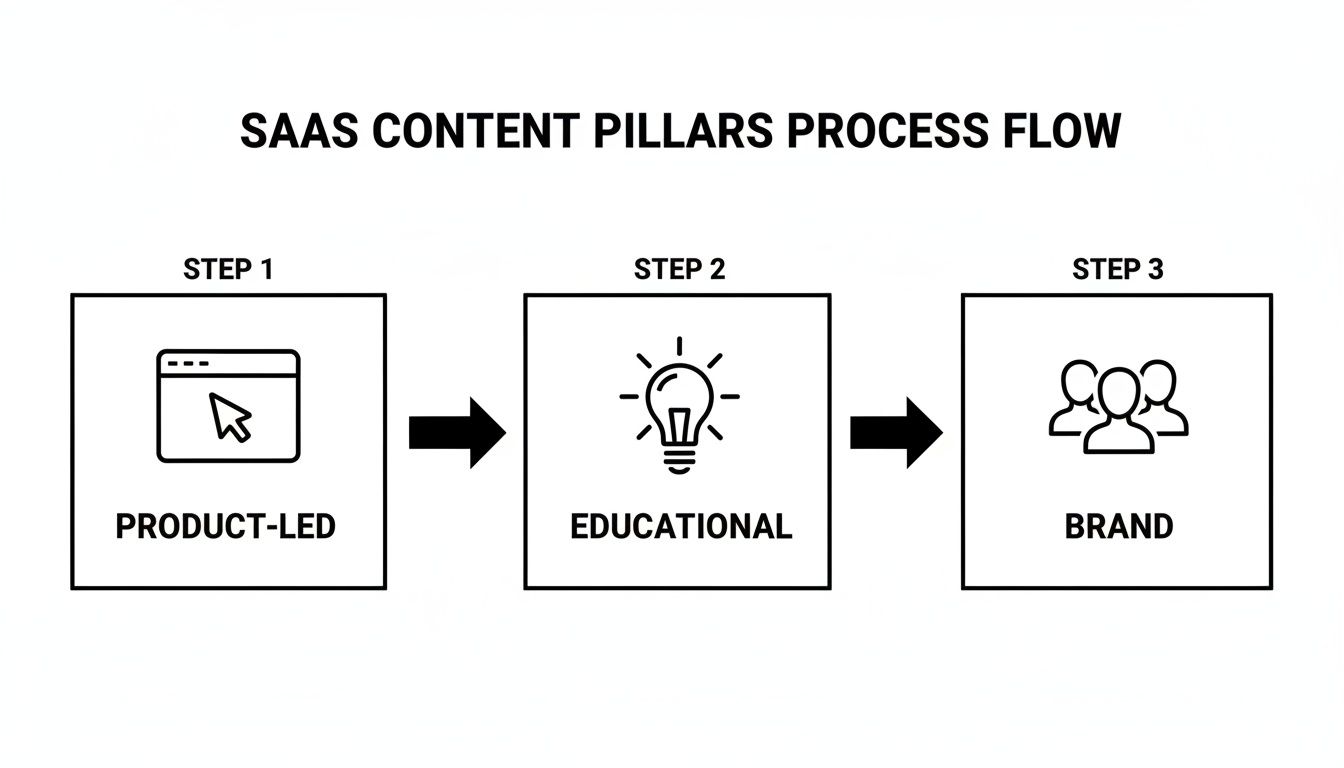
A killer social media presence for a SaaS company isn’t just luck. It’s the result of a smart, disciplined strategy built on three distinct content pillars. When you get these working together, you create a balanced feed that pulls in new prospects, helps current users get more value, and builds a genuine community around your software.
Think of it like a three-legged stool. If one leg is missing, the whole thing wobbles. By mixing product-focused, educational, and brand-building content, you stop sounding like you’re constantly selling and start consistently providing value. That balance is the secret sauce for great social media marketing for SaaS.
Pillar 1: Product-Led Content
This is all about putting your software in the spotlight, but in a way that shows instead of just tells. Product-led content is your chance to demonstrate how your features solve real-world problems, without the hard sales pitch. The goal is to make your product feel tangible and irresistible by showing off its power.
Forget boring feature lists. Instead, create content that answers the user’s biggest question: “How is this going to make my life easier?”
Short Video Demos: Quick screen recordings that show a single feature solving one specific problem are gold. For a project management tool, think of a 30-second clip showing how to set up a task dependency. It’s simple, direct, and incredibly effective.
GIFs of UI Updates: Rolling out a small tweak or a fresh look? A simple GIF is often way more effective at communicating the change than a long-winded text post.
“Tip of the Week” Graphics: Share a bite-sized piece of advice on using a lesser-known feature. This is how you turn regular users into super-fans who know all the tricks.
This type of content creates a direct line between your social media and your product, giving potential customers a low-stakes peek at what it’s actually like to use your tool.
Pillar 2: Educational Content
While product content shows what your tool does, educational content shows what your team knows. This is how you build authority and earn trust. This pillar is all about giving away valuable knowledge with no strings attached, positioning you as the go-to resource in your space, not just another vendor.
Your audience is trying to solve professional challenges, and your product is only one piece of that puzzle. Teach them how to be better at their jobs, and you’ll earn their attention long before they even think about buying.
Here, you zoom out from your product’s features and tackle the broader pains and goals of your ideal customer. For instance, if you sell an email outreach tool, you could create:
Data-Backed Insights: Turn a compelling industry statistic into a sharp-looking graphic. Something like, “Teams that personalize their first outreach email see a 32% higher reply rate.” It’s shareable and positions you as an expert.
Free Templates: Offer something genuinely useful that your audience can download and use right away, like a content calendar spreadsheet or a set of proven cold email outlines.
LinkedIn Carousels: Break down a meaty topic like “5 Steps to Building a Successful Sales Cadence” into a series of digestible, swipeable slides. It’s a fantastic format for teaching complex ideas simply.
This content makes your brand the helpful expert in the room. When the time comes for them to invest in a software solution, you’ll be the first one they think of.
Pillar 3: Brand and Community Content
This final pillar is what makes your company human. SaaS can feel pretty impersonal, but brand and community content reminds everyone that there are real people behind the code. This is where you build relationships, foster loyalty, and show off your company culture.
High-performing SaaS brands treat social proof as a system, not occasional testimonials. Instead of posting customer wins randomly, they build repeatable loops: customers sharing results, employees amplifying product updates, partners validating integrations, and founders reinforcing positioning. This steady stream of proof reduces buyer hesitation, supports sales conversations, and shortens evaluation time, especially for higher-ticket or longer-cycle SaaS products. Social media becomes an always-on credibility layer that supports every stage of the funnel.
This stuff isn’t about driving immediate leads; it’s about building a brand that people actually like and want to be associated with. It’s also your chance to unleash the power of social proof and user-generated content (UGC). The impact of authentic voices is massive. Research shows that about 74% of shoppers have bought something based on an influencer’s post, and UGC can sway up to 90% of buying decisions. This is why you’re seeing more SaaS marketers working with creators and customer advocates to shorten their sales cycles. You can dig deeper into how social media trends impact shoppers on inbeat.agency.
Here are a few ways to bring this pillar to life:
Behind-the-Scenes Moments: Share photos from a team offsite, a “day in the life” of an employee, or a quick video celebrating a company milestone. It pulls back the curtain.
Celebrate Customer Wins: Did a customer achieve something awesome with your tool? Get their permission, then share their story and celebrate them publicly. It’s the most powerful social proof you can get.
Ask Engaging Questions: Spark a conversation by asking your audience something they’ll want to answer. A simple “What’s the one tool you can’t live without in your marketing stack?” can get the whole community talking.
By weaving these three pillars together, you create a social media presence that’s dynamic, valuable, and genuinely interesting. You’ll serve your audience at every stage of their journey and build a foundation for sustainable growth.
Designing Your Content Creation and Repurposing Engine
A great social media idea is just that—an idea. Without a system to bring it to life consistently, you’re just throwing content at the wall and hoping something sticks. Random posts lead to burnout and messy results. To really win at SaaS social media, you need a repeatable process, an engine that turns your ideas into scheduled posts without all the chaos.
This whole engine runs on a strategic content calendar. And I don’t just mean a spreadsheet with a list of post ideas. It should be a living document that mirrors the pulse of your entire company. Before you plan anything, map out your key dates—product updates, big feature releases, and upcoming marketing campaigns. Your social content should be there to back up every major move your company makes.
Executing a consistent strategy requires reliable publishing workflows. Using a Facebook post scheduler allows SaaS teams to plan campaigns, product updates, and educational content in advance, ensuring steady visibility without manual posting or last-minute execution issues.
Building Your Content Calendar
A solid calendar is your best defense against the last-minute scramble for content. It’s the single source of truth for what goes live and when, making sure you’re giving all your content pillars the attention they deserve. This is how your team can finally get ahead and keep the quality high.
To make your calendar really work for you, be sure to plug in these key events:
Product Roadmap Milestones: Got a new integration launching next month? Plan a whole series of posts around it—a few “sneak peeks,” some quick tutorials, and maybe a customer testimonial to build buzz.
Marketing Campaigns: If a webinar is on the horizon, your calendar should have it all mapped out. You’ll want promotional posts leading up to the event, a plan for live-tweeting during, and a strategy for chopping up the recording into new content afterward.
Industry Events & Awareness Days: Don’t forget to mark down relevant industry conferences or even fun social media holidays. This lets you join in on timely conversations without sounding forced.
Honestly, trying to manage this on a spreadsheet is a nightmare. A collaborative tool like Postiz makes a world of difference. Your team can dump ideas, assign tasks, and pull approved assets from one central library. It’s the easiest way to keep everyone on the same page with brand voice and visuals, smoothing out the whole workflow from concept to publish.
This flowchart gives you a good look at how your different content types—product-led, educational, and brand-focused—should feed into each other.
As you can see, a balanced strategy is all about moving between showing off your product, teaching your audience something valuable, and just building a genuine, human connection with your brand.
The Magic of Content Repurposing
Let’s be real: creating brand-new, amazing content every single day is a fast track to burnout. The real secret to scaling your social media output without hiring an army is content repurposing. It’s the art of taking one big piece of content and slicing and dicing it into dozens of smaller assets for different platforms.
Think about that one-hour webinar you hosted. It’s an absolute goldmine. Don’t just upload the recording and move on. You can spin that single asset into:
Quote Graphics: Pull the most impactful lines and turn them into sharp, shareable images for LinkedIn and Twitter/X.
Short Video Clips: Find the best 30-60 second moments and edit them into bite-sized tips for TikTok or Instagram Reels.
LinkedIn Carousel: Summarize the key takeaways into a slick, multi-slide presentation that’s perfect for your professional audience.
Audiograms: Grab a compelling audio snippet, add a simple waveform animation, and you’ve got a great clip for people scrolling with their sound on.
By repurposing, you’re not just saving time; you’re meeting your audience where they are. The person who won’t sit through an hour-long video might love a 30-second tip or a quick-read carousel.
This approach squeezes every drop of value out of the content you work so hard to create. If you want to go deeper, check out our guide on building a powerful content repurposing strategy that will seriously multiply your reach.
Here’s a sample weekly calendar to show you how this all comes together. Notice how a single blog post can fuel content for the entire week across different channels.
Sample Weekly SaaS Content Calendar
Day
LinkedIn Focus
Twitter/X Focus
Video Focus (TikTok/Reels)
Repurposed From
Monday
Announce new blog post with a key insight & link.
Thread summarizing the 3 key takeaways from the blog post.
“Teaser” video clip announcing the new blog topic.
New Blog Post
Tuesday
Carousel post breaking down one major concept from the blog.
Post a surprising statistic from the blog as a quote graphic.
Quick tip video explaining one of the concepts.
New Blog Post
Wednesday
Text-only post posing a question related to the blog’s topic.
Run a poll related to the blog topic to drive engagement.
“Behind the scenes” of how we researched the blog post.
New Blog Post
Thursday
Share a customer success story that illustrates the blog’s main point.
Share a quote from a team expert related to the topic.
“Myth vs. Fact” video debunking a common misconception.
New Blog Post
Friday
“ICYMI” post resharing the blog link with a different hook.
Ask followers for their biggest challenge related to the topic.
“Ask Me Anything” based on questions from the week.
New Blog Post
A system like this turns one piece of content into a full week of strategic, multi-platform engagement. It’s about working smarter, not just harder.
Amplifying Your Message with Ads and Community
Even the most brilliant organic content can only take you so far. If you’re only relying on your existing followers to find you, you’re signing up for a slow, frustrating crawl toward growth. The real magic happens when you pair great content with smart amplification—using paid ads and community engagement to get your message in front of the right people, right when they need to see it.
This isn’t about just clicking “boost post” and hoping for the best. It’s about a deliberate strategy where paid social supercharges your sales funnel and a thriving community creates a legion of loyal fans who do your marketing for you.
Running Paid Social Campaigns That Actually Convert
For a SaaS company, paid social ads aren’t about getting fuzzy brand awareness metrics. They’re about precision. The goal is to drive high-value actions, like trial sign-ups or demo requests, by finding users who are already in the market for a solution like yours.
Forget basic demographic targeting. The real power comes from using the platform’s data to zero in on people who have already shown they’re interested.
Paid social is the ultimate shortcut to your Ideal Customer Profile. Instead of waiting for them to find you, you can place your solution directly in their feed right when they’re evaluating options.
Here are a few of the most effective targeting strategies I’ve seen work for SaaS:
Retargeting Website Visitors: This is your lowest-hanging fruit, hands down. Set up custom audiences for people who checked out your pricing page or feature list but bailed before signing up. A simple, well-timed ad reminding them of a key benefit can be all it takes to bring them back.
Lookalike Audiences: Take a list of your best customers—the ones with the highest lifetime value or who are most engaged—and upload it to a platform like LinkedIn or Facebook. Their algorithms will go out and find new users with eerily similar profiles, giving you a pre-qualified audience to work with.
Job Title and Company Targeting: This is where LinkedIn really shines. You can get hyper-specific, targeting people by their exact job title, company size, industry, or even specific skills listed on their profile. It’s the most direct way to get your message in front of decision-makers.
These tactics make sure every dollar you spend is focused on prospects who have a high probability of becoming paying customers. If you want to dive deeper, our complete guide to building a LinkedIn marketing strategy will walk you through mastering this kind of platform-specific targeting.
Ad Formats That Drive SaaS Sign-Ups
Let’s be honest: not all ad formats work for SaaS. Your ads need to cut through the noise, communicate value instantly, and guide someone toward a clear action. Generic stock photos and vague copy just won’t cut it.
You need formats that either show your product in action or build that all-important social proof.
Video Testimonials: There is almost nothing more persuasive than a short clip of a happy customer explaining exactly how your software solved their headache. Keep it tight—under 60 seconds is ideal—and always include clear captions for people watching with the sound off.
Interactive Polls or Quizzes: Use ad formats that invite people to engage. A simple poll can grab someone’s attention in a crowded feed, give you valuable insights, and subtly introduce your product as the solution.
Lead Gen Forms: Make it as easy as possible for people to say yes. Native lead gen forms on platforms like LinkedIn and Facebook let users request a demo or download a whitepaper without ever leaving the app. This simple trick drastically reduces friction and can skyrocket your conversion rates.
There’s no getting around it: social advertising is a core part of SaaS growth now. Global social media ad spending is projected to hit $276.7 billion in 2025. And with forecasts showing that by 2030, about 83% of that spend will be on mobile, your landing pages and sign-up flows have to be flawless on a phone. You can dig into more of these social media marketing statistics on dreamgrow.com.
Fostering Community and Empowering Your Advocates
Beyond paid ads, there’s another growth engine that’s even more powerful and sustainable: your community. A strong community doesn’t just keep customers around longer; it transforms your most passionate users into a volunteer marketing force.
Building a community means creating a space for genuine connection, not just another channel to blast promotions. It’s about listening, helping, and empowering your users to succeed.
The best way to start is by showing up where your audience already hangs out. Join relevant LinkedIn Groups, find your niche on Reddit, or participate in industry Slack channels. Focus on answering questions and offering real help, without ever pitching your product. This is how you build trust and become known as a valuable resource.
Once you have some momentum, you can create your own “owned” community, like a private Slack channel or a Facebook Group for your power users. This gives you a direct feedback loop, a place to share sneak peeks, and a forum where users can help each other out.
Finally, empower your biggest fans. Identify the people who are always singing your praises and treat them like VIPs. Give them early access to new features, send them some exclusive swag, or set up a direct line to your product team. When you make your customers feel like insiders, they’ll shout your name from the rooftops, creating an authentic growth loop that no amount of ad money can buy.
How to Measure SaaS Social Media Performance
In SaaS social media marketing, if you’re not measuring, you’re just guessing. Likes and follower counts might feel good on a surface level, but they don’t keep the lights on. The real acid test for your social strategy is whether it connects directly to revenue and becomes a predictable growth engine for the business.
This means you have to look past the vanity metrics. The goal is to build a clear, data-driven picture of what’s actually moving the needle. A huge part of this is knowing how to measure social media engagement and understanding its real-world impact on your bottom line.
Moving Beyond Vanity Metrics to Business KPIs
The first, and most important, shift you need to make is from “awareness” metrics to “action” metrics. Sure, a post getting a ton of impressions is nice, but a high number of trial sign-ups is what actually matters to a SaaS company. To do this, you need to track key performance indicators (KPIs) that have a direct line to your sales funnel.
Instead of obsessing over follower growth, start zeroing in on metrics that tell the real story:
Cost Per Trial Sign-Up: How much are you spending on social ads to get one new person to try your product? This is a fundamental efficiency metric.
Demo Request Conversion Rate: Of all the people who clicked a link to your demo page from social, what percentage actually filled out the form?
Social-Sourced Pipeline: How many qualified leads sitting in your sales pipeline originally found you through a social media channel?
These are the kinds of numbers that get your leadership team to lean in. They prove that your social media efforts aren’t just a cost center but a valuable pipeline for new business.
Setting Up Your Measurement Dashboard
To get a crystal-clear view of your performance, you absolutely need a centralized dashboard. Trying to stitch together data from the native analytics of each platform is a massive time sink and almost always gives you an incomplete picture. This is where a good integrated tool becomes non-negotiable.
A platform like Postiz can pull all your crucial metrics under one roof. This lets you see exactly which channels, campaigns, and even individual pieces of content are driving the most valuable actions. You get a clean, apples-to-apples comparison of your efforts, which makes it obvious where to double down and where to pull back.
Your dashboard should be your single source of truth. It needs to answer one simple question at a glance: “Is our social media strategy contributing to revenue?” If it can’t do that, it’s not working hard enough for you.
Setting this up correctly means using UTM parameters on every single link you share. These little bits of code are what allow your analytics software to track exactly where your traffic is coming from, giving you undeniable proof of social media’s impact. If you want to go deeper on this, we’ve got a complete guide on how to calculate your social media ROI that you should definitely check out.
The Power of Social Listening
Measurement isn’t just about tracking what you’re putting out there; it’s also about listening to what your audience and competitors are saying. Social listening is simply the process of monitoring social channels for any mentions of your brand, your competitors, and important keywords. Think of it as a real-time stream of unfiltered, invaluable feedback.
By tuning in, you can uncover gold:
Direct Product Feedback: Spotting users complaining about a bug or asking for a new feature gives your product team a direct line to what customers actually want.
Competitor Strategies: You can see what campaigns your rivals are pushing, how people are reacting, and where their weaknesses might be.
Customer Pain Points: Listening helps you understand the real-world problems your audience is dealing with, which is an endless source of inspiration for new content and product ideas.
This entire feedback loop is being supercharged by new tech. The adoption of AI and sophisticated social listening tools is changing how SaaS companies measure what works. By 2025, AI adoption in marketing workflows hit about 88%, and the social listening market is projected to grow from $9.61 billion in 2025 to $18.43 billion by 2030. It’s no surprise that brands using these tools report up to 10% faster revenue growth—they can adjust their messaging and improve onboarding based on what’s happening right now. You can find more insights about social marketing performance on sprinklr.com.
When you combine hard conversion data with the qualitative insights from social listening, you create a powerful cycle of continuous improvement. This is how you refine your content, optimize your ad spend, and confidently report on the tangible value your SaaS social media marketing is delivering.
Your SaaS Social Media Questions, Answered
Getting into the weeds of social media for a SaaS company always brings up a few tricky questions. I’ve been there. Let’s walk through some of the most common ones I hear from marketers and founders, with some straightforward advice to get you on the right track.
Which Social Media Platform Is Best for a B2B SaaS Company?
If you’re in B2B SaaS, LinkedIn is almost always your ground zero. It’s where business professionals live online, making it the most direct path to decision-makers, industry experts, and potential high-value customers. It’s built for sharing deep insights and is fantastic for lead generation.
But don’t put all your eggs in one basket. I’ve seen brands do amazing things on other platforms. Twitter/X is unbeatable for jumping into real-time conversations and connecting with a more tech-savvy crowd. And if you have a product that needs explaining, YouTube is a goldmine for tutorials and demos that help new users get that “aha!” moment.
The real answer? The “best” platform is simply where your ideal customers hang out the most. Go there.
What Kind of Content Actually Works for SaaS?
Forget the fluff. The content that moves the needle for SaaS brands is the stuff that genuinely helps people. Your primary job on social media isn’t to talk about your company culture; it’s to solve problems for your audience.
Here are a few formats that consistently get results in the SaaS world:
Quick-Win Video Tutorials: A simple screen recording that shows one specific feature solving a nagging problem can be more powerful than a hundred sales pitches.
Customer Soundbites: Pull a great quote from a customer review, slap it on a simple graphic, and you’ve got instant social proof. Video testimonials are even better.
Digestible Data Carousels: Got a big industry report or a cool case study? Break down the key stats and findings into a swipeable carousel for LinkedIn. It positions you as an expert without asking for a huge time commitment.
A Peek Behind the Curtain: Sharing a bit of the process or the people behind the software helps humanize your brand and builds a real connection.
The secret is to give away value freely. Teach, help, and inform before you ever ask for their email address.
“The most successful SaaS brands on social media don’t just sell software; they sell expertise. Their content educates, empowers, and solves problems for their audience, building trust long before a purchase is ever considered.”
How Much Should a SaaS Startup Budget for Social Media?
There’s no magic number here. A good rule of thumb is to set aside 10-25% of your total marketing budget for social media, which should cover both creating content and running ads.
But for an early-stage startup, I’d suggest a more goal-oriented approach. Start with the end in mind. Figure out what you’re willing to pay for a new trial user—your target Cost Per Acquisition (CPA). From there, you can work backward and set a small, experimental budget for a paid campaign on a platform like LinkedIn.
The key is to start small, measure everything, and then double down on what’s actually bringing in sign-ups, not just likes and comments.
How Can I Actually Measure the ROI of Social Media?
If you can’t measure it, you can’t improve it. To prove the value of your social media efforts, you have to connect the dots between a post and a paying customer. This means getting serious about tracking conversions, not vanity metrics.
Your best friend here is the UTM parameter. Attach them to every single link you share on social media. This tags the traffic so you can see in your analytics tool (like Google Analytics) exactly which posts and platforms are sending you valuable visitors.
Next, define what a “conversion” means for you. Set up goals in your analytics for key actions like:
Signing up for a free trial
Requesting a demo
Downloading an ebook or template
Once you’re tracking these events, you can see which channels are driving them. This lets you calculate your cost per lead and prove that your social media spend is directly fueling customer growth.
Ready to stop juggling tabs and start building a real SaaS social media engine? Postiz brings your entire workflow—from brainstorming and scheduling to collaboration and measurement—into one intuitive platform. Get a handle on your content and start driving results you can actually see at https://postiz.com.
Alex Hormozi published 35,000 posts and reached 7.8M followers in forty months. Here is the six-shift playbook, the SPCL influence framework, the agency script, and how to run it all at Hormozi-grade volume with Postiz.