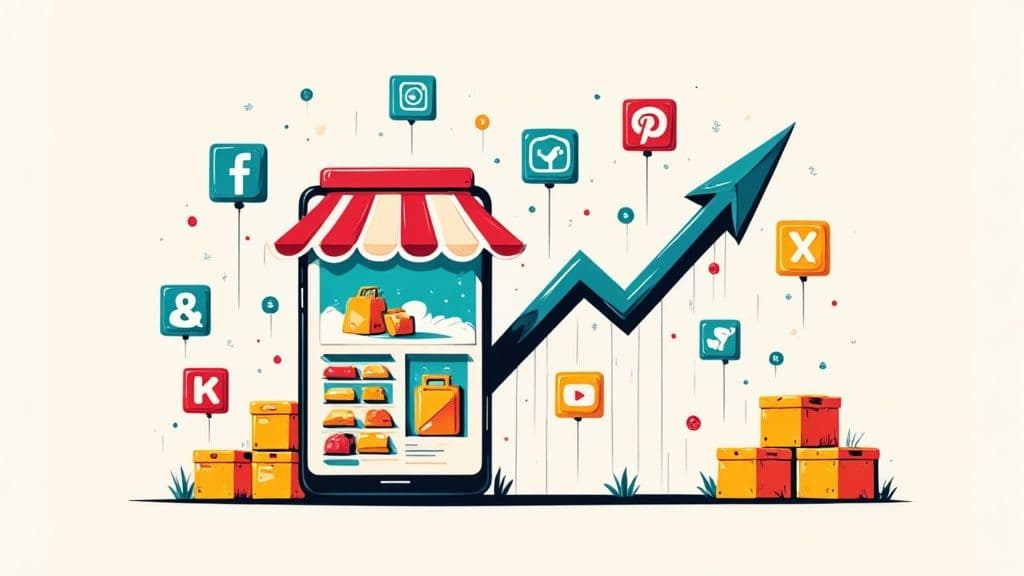
For an ecommerce brand, social media marketing isn’t just about posting pretty pictures. It’s about using platforms like Instagram, TikTok, and Facebook to actually sell your products and build a real community around your brand.
It’s where people don’t just see your products; they discover them, engage with them, and can often buy them without ever leaving the app.
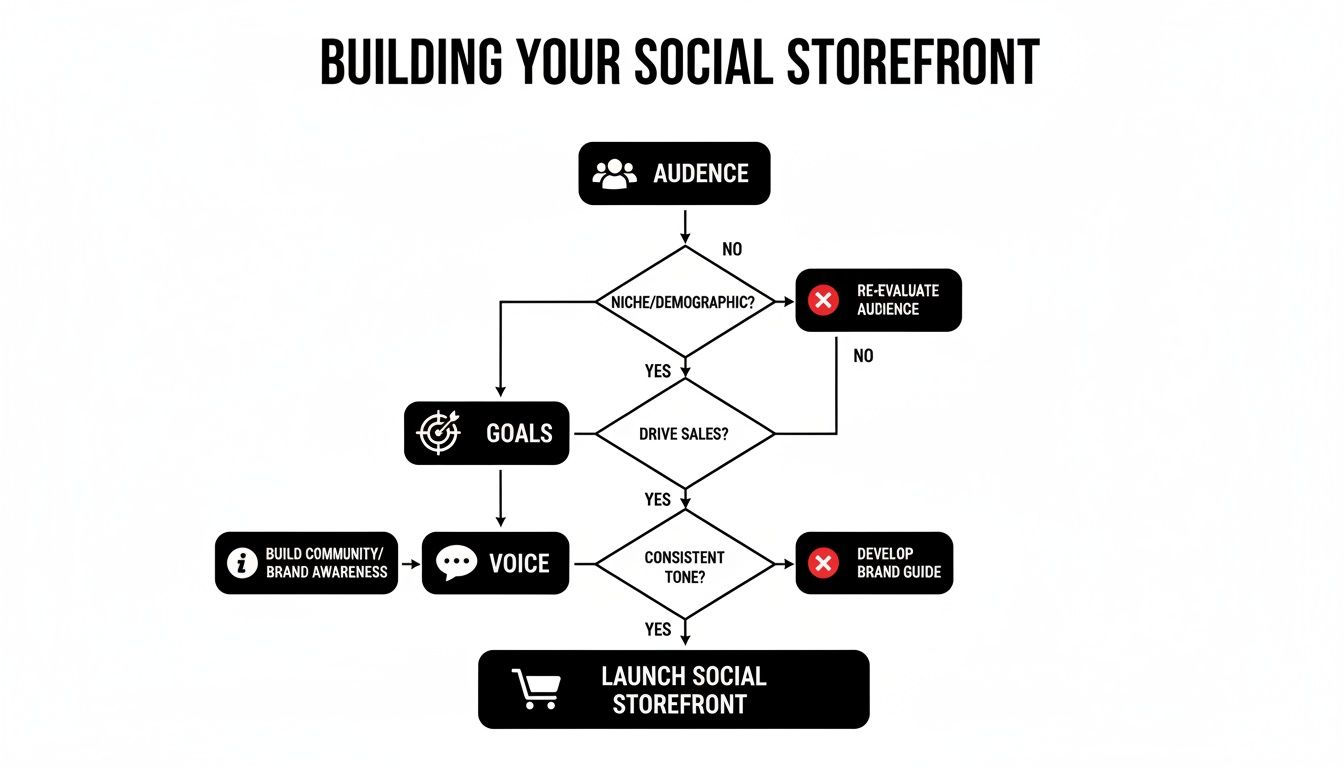
Building Your Social Storefront Foundation
Define Your Core Pillars
To build a social presence that actually converts browsers into buyers, you have to nail down three core pillars from the very beginning.
Deep Audience Understanding: Who are you really talking to? It’s more than just age and gender. Where do they hang out online? What time of day do they scroll? What kind of content—funny, educational, inspiring—genuinely grabs their attention and makes them pause?
Clear Business Goals: What’s the point of all this? Are you trying to get your name out there and build brand awareness? Or are you laser-focused on driving immediate sales and getting a great return on ad spend (ROAS)? Your goals will shape every single decision you make.
A Unique Brand Voice: In a sea of sameness, a generic brand is an invisible one. Your brand’s personality—whether it’s witty, sophisticated, or fun and playful—needs to shine through in every post, comment, and DM. This is what makes people remember you.
A strong foundation ensures every piece of content, every ad, and every interaction serves a clear purpose, moving your business closer to its objectives.
To get your piece of the pie, you need a structured plan. A good social media marketing plan template can help you map everything out. And if you want to dig deeper, you can learn more about how these trends are shaping the future from recent social media statistics.
Choosing the Right Platforms to Maximize Sales
Spreading your brand too thin across every social media channel is a classic mistake. It’s a surefire way to get mediocre results everywhere.
Instead of a scattergun approach, pour your energy into the one or two platforms where your ideal customers are already hanging out and are most open to what you’re selling.
To help you decide where to focus your efforts, let’s break down the top contenders. This table gives you a high-level overview of where each platform shines.
Ecommerce Social Platform Strategy Comparison
This table compares the top social media platforms for ecommerce brands, highlighting their primary strengths, ideal product types, and core user demographics to aid in strategic channel selection.
Platform
Primary Strength for Ecommerce
Ideal Product Categories
Key Demographics
Instagram
Visual lifestyle marketing & seamless shopping
Fashion, Beauty, Home Decor, Wellness, Food
Millennials, Gen Z
TikTok
Viral discovery & impulse purchases
Gadgets, Unique Beauty, Novelty Items, DIY
Gen Z, younger Millennials
Facebook
Community building & targeted conversions
Broad appeal; Electronics, Hobbies, Apparel
Gen X, Millennials, Boomers
Pinterest
Product discovery & purchase planning
Home Decor, DIY, Weddings, Fashion, Recipes
Predominantly female, Millennials, Gen X
Each platform has its own flavor and audience. Choosing the right one means aligning its strengths with your products and your customers’ habits. Let’s dig a little deeper into what makes each of them tick.
Manage all your social media in one place with Postiz
For brands in fashion, beauty, home decor, and wellness, Instagram is still king. It’s a highly visual world, making it the perfect stage to build an aspirational lifestyle around what you sell.
A skincare brand isn’t just pushing a bottle of serum—it’s selling confidence and self-care.
A few things make it so effective:
Instagram Shopping: This is huge. It creates a nearly frictionless path from discovery to checkout with features like product tags and in-app purchasing.
Visual Storytelling: Formats like Reels and Stories are practically built for product demos, behind-the-scenes glimpses, and showcasing user-generated content (UGC).
Influencer Marketing: This is the native home of influencers, who can give your brand powerful social proof. It’s no surprise that 61% of consumers use Instagram to find new products.
It’s not about curated perfection; it’s about raw, entertaining, and trend-driven content. For ecommerce brands, this platform is a powerful engine for discovery and impulse buys, all fueled by its legendary algorithm.
To win on TikTok, you have to play by its rules. That means jumping on trends, using popular sounds, and making content that feels like it belongs there—not like a polished corporate ad. It’s a space that rewards creativity and personality.
A single clever video showing off a cool kitchen gadget or a game-changing makeup hack can trigger a sales avalanche almost instantly.
The platform works wonders for products with a clear “wow” factor or a benefit you can show in seconds. Think unique gadgets, clever home solutions, or quirky beauty products. And with 77% of Gen Z users turning to TikTok to discover new things, it’s an essential channel for connecting with younger shoppers.
This is especially true for food and beverage brands, where strategies from social media marketing for restaurants translate directly to ecommerce sales through short-form video and shoppable posts.
Facebook: The Community and Conversion Hub
Don’t write off Facebook as the “older” platform. When it comes to pure conversion power for ecommerce, it’s a heavyweight. Its ad-targeting capabilities are second to none, letting you zero in on incredibly specific audiences based on their interests, demographics, and even past buying habits.
Facebook is where community and commerce meet. Facebook Groups are amazing for building a loyal tribe of brand advocates, gathering feedback, and driving repeat business. On top of that, Facebook Shops lets you set up a dedicated storefront right on your page.
It remains a go-to platform for making a direct purchase, with 39% of consumers using it when they’re ready to pull out their wallets. This makes it an absolute must for bottom-of-the-funnel strategies, like retargeting campaigns to win back warm leads and abandoned carts.
Using a Facebook post scheduler makes it easier to stay consistent with community posts, promotions, and retargeting campaigns without manual publishing.
Pinterest: The Visual Discovery and Planning Tool
This platform is a goldmine for categories like:
Home decor and furniture
Fashion and accessories
DIY and craft supplies
Wedding and event products
The audience here is also incredibly valuable. On average, Pinners spend twice as much as users on other platforms. By creating beautiful, eye-catching Pins that link directly to your product pages, you can capture high-intent traffic and become a part of someone’s inspiration board long before they make a final decision.
What they really crave is authenticity and a genuine connection. This is exactly why User-Generated Content (UGC) is such a game-changer. UGC is any content—photos, videos, reviews—that your actual customers create.
When you spotlight real people using and loving what you sell, you build a kind of trust that polished, branded content simply can’t achieve on its own. It’s undeniable social proof that your products live up to the hype. You can dig deeper into making this work for you by exploring different user-generated content strategies.
This same principle applies to influencer collaborations. It’s a goldmine for e-commerce, with 74% of US shoppers saying they’re more likely to buy something recommended by an influencer. The trick is to partner with creators who genuinely fit your brand, especially micro-influencers, who delivered the best results for marketers in 2024. Combining UGC with the right influencers is a powerful one-two punch for driving real sales.
Mastering Short-Form Video Content
It’s no secret that platforms like TikTok and Instagram Reels have completely changed the content game. Short-form video isn’t just a fleeting trend; it’s how a huge number of people discover and research products now. One great video can cause a massive spike in sales, sometimes literally overnight.
To get it right, just follow a simple framework:
The Hook (First 3 Seconds): Your opening is everything. You have to grab their attention immediately with a bold claim, a surprising visual, or a problem they can relate to.
The Value (Middle Section): Now it’s time to deliver. Show the product in action, offer a quick tutorial, or share a genuinely useful tip. Always focus on the benefits—how does this make their life better?
The Call-to-Action (Final Seconds): Don’t leave them hanging. Tell them exactly what you want them to do next. A clear “Shop the link in bio,” “Comment your favorite feature,” or “Follow for more” is crucial for turning that view into an action.
A skincare brand, for instance, could hook viewers with “The one product that saved my dry skin,” then show a quick demo, and end with a clear CTA to shop their winter collection.
Creating Scroll-Stopping Visuals
In a feed crowded with content, your visuals are your first, and sometimes only, impression. High-quality, eye-catching images and graphics are simply non-negotiable. This doesn’t mean every photo needs a professional studio budget, but they absolutely must be clear, well-lit, and consistent with your brand.
It’s also worth getting into the nitty-gritty of how to optimize your visuals for platforms like Instagram, because technical details like export settings can make a surprising difference in how people perceive your products.
Your product photos should do more than just show what you sell; they should sell the lifestyle your brand represents. A high-quality image can communicate value, quality, and brand identity in a single glance.
Beyond photos, think about simple graphics. You can use a tool like Canva to whip up quote cards, infographics, or sale announcements that use your brand’s fonts and colors. Visual consistency is key to building brand recognition and making your feed look polished and professional.
Product Demos That Actually Sell
A classic e-commerce mistake is getting bogged down in product features instead of focusing on the benefits. A customer doesn’t just want to know your backpack has “reinforced nylon straps”; they want to know it’s tough enough for their weekend hikes and won’t let them down.
An effective product demo is all about translating those features into real-world benefits.
Feature: Water-resistant fabric.
Benefit: Your laptop and books stay safe during a surprise downpour.
Feature: Multiple compartments.
Benefit: You can find your keys without digging around for five minutes.
Use short videos or image carousels to show these benefits in action. Let them see someone pulling their keys from that perfect pocket or walking through the rain while their bag’s contents stay dry. When you focus on the “so what?”, you connect with what the customer actually needs and wants, making the decision to buy that much easier.
Making Paid and Organic Social Work Together
Relying purely on organic social media to grow your store is like trying to fill a stadium by inviting people one by one. Sure, you’ll get there eventually, but it’s painfully slow and you have no real control over the outcome. To actually scale and see consistent sales, you have to pair the community-building magic of organic content with the laser-focused reach of paid ads.
Your paid strategy is the turbo booster. It takes what’s already working and blasts it out to thousands—or even millions—of potential new customers who look just like your best ones.
Even in trust-heavy industries like social media marketing for lawyers, brands test organic content first before scaling winning messages with paid ads.
Social media customer support as a revenue driver (DMs, comments, SLAs)
Social media is also your fastest customer support channel, and in ecommerce it directly affects conversions. Many shoppers treat Instagram DMs and Facebook comments like live chat. If they ask about sizing, shipping time, returns, or stock availability and you respond late (or not at all), they buy from someone else. Set a simple support system: saved replies for common questions, a daily inbox routine (even 2 short check-ins), and a clear escalation path for refunds or damaged items. Over time, fast, helpful responses increase trust, reduce cart abandonment, and turn customer questions into sales opportunities
Use Organic as Your Creative Lab
Before you even think about putting money behind an ad, your organic feed is the perfect place to see what actually connects with people. It’s a low-risk playground for your creative ideas. When an organic post gets way more shares, saves, or glowing comments than usual, that’s your audience telling you you’ve struck gold.
This is a fundamental shift in social media marketing for ecommerce brands. Instead of guessing which ad will work, you let your audience tell you.
Spot the Hits: Post different types of content—product demos, customer photos (UGC), behind-the-scenes clips—and watch your analytics like a hawk.
Read the Comments: What are people saying? Are they asking about a specific feature? Tagging their friends? This is qualitative data you can’t buy.
Promote with Proof: That video that took off organically? It’s your prime candidate for a paid ad. You’re no longer hoping it will perform; you have real data showing it already does.
How to Structure Your Funnel
A solid funnel matches your content with where a customer is in their buying journey. Each stage has a different job, and both your paid and organic efforts have a role to play.
Your goal isn’t just to make a sale today. It’s to build a system where organic community-building and paid amplification feed each other, creating a sustainable growth loop for your brand.
Let’s break down how this looks in practice:
Funnel Stage
Organic Social Goal
Paid Social Tactic
Top of Funnel (ToFu)
Build awareness and entertain with fun, shareable content like Reels or trending TikToks.
Run brand awareness campaigns to reach new, broad audiences who haven’t heard of you yet.
Middle of Funnel (MoFu)
Nurture interest with detailed product carousels, customer testimonials, and how-to guides.
Retarget website visitors or people who engaged with your posts with more product-focused ads.
Bottom of Funnel (BoFu)
Drive the sale with clear calls-to-action, limited-time offers, and direct links in shoppable posts.
Use Dynamic Product Ads to retarget cart abandoners, reminding them of the exact items they left behind.
The Magic of Retargeting
They’re curious, so they tap over to your profile, maybe even browse your site for a minute… but then they get distracted and leave.
Without a paid strategy, that person is probably gone for good.
But with a smart retargeting campaign, you can automatically show them an ad the next day featuring the exact product they looked at. Maybe you even throw in a small discount to seal the deal (Bottom of Funnel). This simple move is one of the highest-impact things you can do in ecommerce because you’re marketing to a warm audience that’s already raised their hand.
When you use organic content to attract and engage, then use paid ads to follow up and convert, you build an incredibly efficient machine that turns casual scrollers into loyal customers.
Turning Social Feeds into Seamless Shopping Experiences
The biggest challenge in e-commerce has always been closing the gap between someone seeing a product they love and actually buying it. Social commerce is bridging that gap. It turns your social feed from a simple discovery channel into a direct, interactive storefront where people can buy on the spot.
The whole point is to make the path to purchase so short that a user can go from “I want that!” to checkout without ever leaving the app. This kind of frictionless experience is how you capture motivated buyers the moment inspiration hits.
Social commerce is expected to blow past $90 billion in sales by 2025 and rocket to an eye-watering $150 billion by 2028. Platforms like Instagram Shops and TikTok Shop are at the forefront, especially with younger shoppers. In fact, nearly 54% of Gen Z now use TikTok Shop when looking for holiday gifts. You can dig deeper into this explosive growth with these social commerce statistics.
Setting Up Your Social Storefronts
The first step is to flip the switch on the native shopping features built into platforms like Instagram and TikTok. These tools are specifically designed to make buying as easy as double-tapping a post.
Instagram Shops: This feature lets you build a custom digital storefront right on your profile. You can group products into curated collections, tag items directly in your posts and Stories, and even enable in-app checkout so customers never have to leave Instagram.
TikTok Shop: While newer to the game, TikTok Shop is a powerhouse. It allows you to link products directly in your short-form videos and during live streams. A viewer can simply tap a product icon and buy it right then and there, perfectly matching the platform’s viral, impulse-buy energy.
Think of your social shop as a well-curated boutique. It should be visually stunning, a breeze to browse, and stocked with your best stuff, ready for someone to grab at a moment’s notice.
Getting started usually means syncing your product catalog from an e-commerce platform like Shopify or BigCommerce. Once you’re connected, your inventory, pricing, and product info update automatically, which keeps the shopping experience consistent and reliable for your followers.
Strategies to Drive Traffic and Sales
With your social storefront up and running, it’s time to send people to it. Your content is what fuels the engine, guiding followers from just scrolling to actively shopping. Here are a few battle-tested strategies that work:
Effective Product Tagging: This is the most straightforward way to generate sales. Any time you feature a product in a photo, video, or Story, tag it. A little shopping bag icon will pop up, letting users tap to see details and a direct link to purchase.
Hosting Live Shopping Events: Live streams create a sense of urgency and community that’s tough to beat. Use them to launch new products, host exclusive flash sales, or run interactive Q&As. During the broadcast, you can spotlight products that viewers can buy in real time.
Optimizing Your ‘Link in Bio’: Even with in-app shops, your bio link is still incredibly valuable. Tools like Linktree or Later’s Linkin.bio let you create a simple landing page that can showcase multiple products, best-sellers, or current promotions all at once.
When you pair a well-designed social shop with content that constantly points customers toward it, you build a powerful, self-contained sales machine. You’re meeting customers exactly where they are, making it easier than ever for them to discover a product and make it theirs.
Convert followers into owned audiences (email/SMS capture + retention loop)
Top ecommerce brands use social media to build an owned audience, not just a follower count. Algorithms change, reach drops, and platform accounts can be limited, but email and SMS lists stay with you. Add list-building hooks inside your content: a “VIP drop list,” early access to launches, back-in-stock alerts, and giveaway entries that require an email or SMS opt-in. Then connect social to retention: post-purchase flows that request UGC, review prompts, and VIP offers for repeat buyers. This turns social from a traffic channel into a sustainable growth loop that keeps generating revenue even when reach fluctuates.
Measuring Performance to Fuel Continuous Growth
You can’t improve what you don’t measure. In social media, it’s incredibly easy to get lost in numbers that feel good but don’t actually move the needle for your business. A truly effective social media marketing for ecommerce brands strategy hinges on tracking the right data to make smarter decisions and drive real growth.
This means you have to look past the vanity metrics. Sure, seeing your follower count climb or a post rack up likes is a nice ego boost, but those numbers don’t pay the bills. Your focus needs to shift to action metrics—the data points that tie what you do on social directly to your sales.
Distinguishing Vanity from Value
The simplest way to cut through the noise is to ask one question: “Does this number directly lead to a sale or a potential sale?” This is how you separate the fluff from the stuff that matters.
Vanity Metrics: This is your follower count, post likes, and even reach. They signal that people see you, but not that they’re buying from you.
Action Metrics: These are the numbers that hit your bottom line. We’re talking about Conversion Rate, Return on Ad Spend (ROAS), Click-Through Rate (CTR), and Cost Per Acquisition (CPA).
Think of your analytics as a compass, not a scorecard. Its job isn’t just to tell you how you did, but to guide your next move. Action metrics point you toward profitable strategies, while vanity metrics can send you chasing your own tail.
Building Your Performance Dashboard
To track what’s working, you need a system. Start by picking out the Key Performance Indicators (KPIs) that actually line up with your business goals. For most ecommerce brands, the important ones are pretty clear.
Your main goal here is to figure out the financial return on your time and money. For a more detailed look, you can explore specific methods for calculating your social media ROI to make sure every dollar is pulling its weight.
Of course, none of this works without proper attribution. You need to use UTM parameters—little snippets of code you add to your links—to tell tools like Google Analytics exactly where your website visitors are coming from. A UTM tag can pinpoint the platform, the campaign, and even the specific post that sent someone your way.
This level of detail is what allows you to calculate a game-changing metric: your Customer Acquisition Cost (CAC) for each channel. When you know it costs $15 to land a customer from an Instagram ad but $40 from a Facebook campaign, you can start moving your budget around with confidence. By checking these core numbers regularly, you build a feedback loop that turns your performance data into a roadmap for profitable growth.
Frequently Asked Questions
Let’s be honest, figuring out social media can feel like you’re trying to solve a puzzle. You’re not alone. Here are some straightforward answers to the questions I hear most often from e-commerce store owners.
Getting these fundamentals right is what separates a social media account that just exists from one that actually makes you money.
How Much Should an Ecommerce Brand Budget for Social Media?
There’s no magic number here, but a good rule of thumb is to set aside 5-15% of your total marketing budget for your social channels.
When it comes to ads, don’t just throw money at the wall to see what sticks. Start small. A test budget of $10-$20 per day is plenty to get your feet wet. Focus that spend on a single, high-impact goal, like retargeting people who visited your site but didn’t buy. Once you see what’s working and what’s not, you can confidently increase your ad spend based on real data and a solid return. If you want to dive deeper into the basics, you can learn more about social media marketing.
Which Social Media Platform Is Best for Beginners?
If you’re just starting out and feeling overwhelmed by all the options, my advice is almost always the same: start with Instagram.
It’s built for visual products, which is perfect for e-commerce. Plus, features like Instagram Shop and product tagging let you turn your profile into a legitimate sales channel. You can build a real community there using a mix of Reels, Stories, and classic posts, making it the perfect all-in-one platform to get started and see results.
How Long Does It Take to See Sales from Social Media?
With paid ads, you can start seeing sales roll in almost immediately—sometimes within just a few days. But organic social media is a different beast entirely. It’s a long game.
Think of it like planting a tree. You need to put in the work upfront. Expect to invest a solid 3-6 months of consistent posting, engaging with followers, and building real trust before your organic content starts generating predictable sales. Consistency is everything.
Ready to streamline your entire social media workflow? With Postiz, you can schedule posts, collaborate with your team, and track your performance—all in one place. Start growing your ecommerce brand with Postiz today.