The Content Distribution Problem Nobody Talks About
Most creators don’t have a content problem. They have a distribution problem. They spend 90% of their energy on creation, then manually upload everything one platform at a time. That’s where the whole system breaks down.
A creator recently shared a breakdown of how they built an AI-powered pipeline that writes, distributes, and scales content across every major social platform without touching it daily. The approach flips the traditional content workflow on its head: instead of creating one piece at a time and manually distributing it, the entire process gets automated end-to-end using AI agents and open-source social media automation tools.
This isn’t about posting more. It’s about building once and deploying everywhere.
Where Most Social Media Automation Systems Actually Fail
The typical creator workflow looks something like this: get an idea, write a script, edit the video, upload to TikTok, log into YouTube, open Instagram, repeat on X, and do it all again tomorrow. That’s not a system. That’s five jobs duct-taped together.
Content creation is the part that gets automated first. Everyone talks about using AI to generate scripts and videos. But nobody talks about what happens after the content is finished. That’s where scale dies — in the upload screen.
The bottleneck isn’t making content. It’s getting that content distributed across six, ten, or twenty platforms simultaneously, each with its own format requirements, character limits, and scheduling quirks. Manual multi-platform publishing is a time sink that kills consistency, which is the single most important factor in growing a social media presence.
Building the AI Content Distribution Stack
The stack that makes this work has two core layers: an AI orchestration layer for content creation and an automation-ready distribution engine for multi-platform publishing.
AI Orchestration: Batch Content Creation
The first layer handles content generation at scale. Using AI agents, you move from producing one piece of content per session to generating dozens. The AI runs batched prompts, moves scripts into production, triggers editing workflows, and pushes finished assets forward to the next stage. Same effort, dramatically more output.
The key insight here is batching. Instead of the daily grind of creating one post, you dedicate focused sprint sessions to producing content in bulk. The AI handles the heavy lifting of script generation, and you audit a percentage of the output for quality control.
Postiz: The Distribution Engine
Calling Postiz a scheduler undersells it completely. It’s an agent-ready, automation-first platform built for serious multi-channel publishing. It covers platforms most social media automation tools don’t bother with — not just the obvious ones like TikTok, Instagram, YouTube, and X, but also Discord, Telegram, Slack, Reddit, Bluesky, Mastodon, LinkedIn, Facebook, Threads, Pinterest, Medium, Dev.to, Hashnode, WordPress, and more. Over 28 channels in total.
Postiz supports over 28 social media and messaging channels from a single dashboard.
The bigger deal is that Postiz is built for automation pipelines. Traditional schedulers assume a human is sitting there planning week by week. Postiz assumes you might be queuing 50 videos in one session and need them distributed across six platforms automatically. Your AI agent hands off to Postiz. Postiz handles the rest.
You load content once. Every platform, every time zone, every schedule runs on its own.
The Postiz calendar view shows all scheduled posts across every connected channel.
Manage all your social media in one place with Postiz
How to Automate Social Media Posting with the Postiz API
What makes Postiz different from typical social media automation software is its developer-first approach. It exposes a full public API, a CLI tool, and an MCP (Model Context Protocol) integration — all designed for programmatic control.
The Postiz Public API
The API lets you create, schedule, and manage posts programmatically. Here’s what a basic post creation looks like:
Each post supports multiple comments or thread items. For platforms like X and Threads, each item in the array becomes a separate post in the thread. For LinkedIn and Facebook, subsequent items get added as comments. You can also attach images, set platform-specific settings (like subreddit targeting for Reddit), and batch multiple posts in a single API call with different dates and platforms.
The Postiz CLI
For command-line workflows, the Postiz CLI makes it even simpler to automate social media posting:
# List your connected channels
postiz integrations:list

# Create and schedule a post
postiz posts:create -c "Your content" -i "integration-id" -s "2026-05-01T12:00:00Z"

# Create a complex post from JSON
postiz posts:create --json post.json
The CLI is built on Node.js 18+ and connects directly to the Postiz API using your API key. You can get your key from Settings > Developers > Public API in the Postiz dashboard.
MCP Integration: Let AI Agents Control Everything
This is where it gets really powerful. Postiz supports the Model Context Protocol (MCP), which means AI agents like Claude, ChatGPT, and Cursor can directly control your social media publishing through standardized tool-calling.
Connect your AI agent to Postiz MCP at:
https://api.postiz.com/mcp/your-api-key
The MCP exposes 8 tools that an AI agent can use: listing your connected channels, getting platform-specific rules and schemas, scheduling posts with text and media, generating AI images, and even creating AI-generated videos. The workflow is straightforward:
The agent calls integrationList to discover your connected social accounts
It calls integrationSchema to understand each platform’s rules (character limits, media requirements, etc.)
It calls schedulePostTool to create and schedule the post across multiple platforms
Optionally, it uses generateImageTool or generateVideoTool to create visual assets
This means your AI content pipeline doesn’t just stop at generating scripts. It can go all the way through to publishing across every platform, hands-free.
Postiz’s post creation interface supports AI image generation, AI video, media uploads, and multi-platform scheduling.
Why Multi-Platform Distribution Is Non-Negotiable
One platform is fragile. Algorithms change, accounts get restricted, audiences migrate. A pipeline that only posts to TikTok is one algorithm update away from collapse.
Building presence across multiple platforms simultaneously is the distribution moat most creators never build. It feels too complicated to manage manually. But with the right social media automation tools and infrastructure, it’s not complicated — it’s a calendar setting.
Same content. Wider footprint. One place to manage it all. When you’re distributing to 10+ platforms, you’re building redundancy into your audience. If one platform tanks, you have nine others still growing.
The Production Sprint Model: 300 Posts in Two Weeks
Most people build the pipeline and then post one video and wait. That’s not how this works.
The pipeline isn’t built to post one video. It’s built to produce hundreds. Here’s the sprint model that makes social media auto posting sustainable long-term:
Weeks one and two: Get your AI scripting dialed in, refine your prompts, connect your editing workflow, set up your distribution across every platform you’re targeting via the Postiz API, and stress-test the full chain end-to-end.
Weeks three and four: Produce aggressively. Aim for 200 to 300 finished pieces loaded and queued. This sprint is intense on purpose.
Then let it run. One post per day per platform for months. Consistency becomes an engineering outcome, not a motivation problem. You’re not fighting willpower to post every day — the machine handles it whether you’re at your desk or not.
Setting Up the Automated Queue
With the Postiz API, queuing 300 posts is a scripting exercise. Here’s the pattern:
// Node.js example: batch schedule posts
const API_KEY = process.env.POSTIZ_API_KEY;
const integrations = await fetch('https://api.postiz.com/public/v1/integrations', {
  headers: { 'Authorization': `Bearer ${API_KEY}` }
}).then(r => r.json());

// Schedule one post per day across platforms
for (let day = 0; day < 300; day++) {
  const date = new Date();
  date.setDate(date.getDate() + day);

  await fetch('https://api.postiz.com/public/v1/posts', {
    method: 'POST',
    headers: {
      'Authorization': `Bearer ${API_KEY}`,
      'Content-Type': 'application/json'
    },
    body: JSON.stringify({
      type: 'schedule',
      date: date.toISOString(),
      posts: integrations.map(integration => ({
        integration: { id: integration.id },
        value: [{ content: `<p>${contentLibrary[day]}</p>` }]
      }))
    })
  });
}
This script schedules one piece of content per day across all your connected platforms for nearly a year. The marginal cost of adding another 100 items to the queue is nearly zero.
Once the pipeline is live, revenue flows from the audiences building across every channel. The same content that builds your organic presence can also serve brand partnerships and sponsored content. The key difference is that you’re not manually managing any of it — the pipeline feeds everything.
One system. Compounding outputs. The same videos, the same distribution. Different monetization layers on top, whether that’s platform ad revenue, affiliate marketing, sponsored content, or selling your own products.
What Still Needs a Human
Being honest: this isn’t fully hands-off yet. You still need to:
Audit 10 to 20 percent of AI-generated scripts before production
Review quarterly to catch quality drift
Adjust your content strategy based on analytics
Respond to audience engagement and comments
What you’re not doing is logging into five platforms every day, manually uploading the same video six times, or burning out and going dark for three weeks because the process got exhausting.
You’re steering a machine. Not operating one by hand.
Why Open-Source Social Media Automation Wins Long Term
Most creators compete on effort. More hours, more hustle, more manual output. This approach competes on systems.
Postiz exposes a public API, a CLI, and an MCP server on every plan, which means you can extend it and integrate it into any workflow. The API, CLI, and MCP integrations give you full programmatic control — something closed-source schedulers simply can’t match.
AI handles content generation. Postiz handles distribution. Your analytics dashboard shows you what’s working across all 28+ channels in one place.
Raw ideas flow into structured scripts, into finished content, into multi-platform distribution, into growing audiences. And it runs whether you’re at your desk or not.
Get Started with Postiz
The tools exist. The platforms are waiting. The format works across every niche. The only question is whether you build the machine or keep uploading manually forever.
Ready to automate your social media posting?Try Postiz free and start building your AI-powered content distribution pipeline today. Connect your channels, set up the API, and let your content reach every platform automatically.
Whop clipping pays $2–$3 per 1,000 views — and AI clippers plus a social media scheduler turn it from a side hustle into a real system. Here's the full workflow.
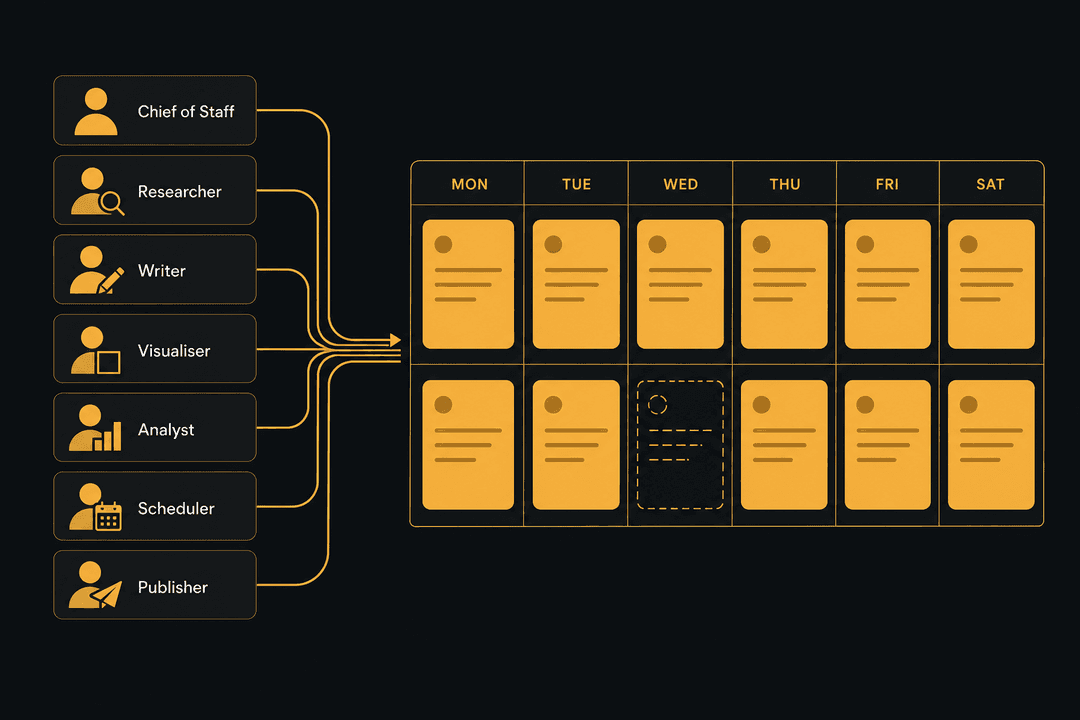
Scotty Beam built a seven-agent content team with Grok Bot and connected it to the Postiz API. Get the exact system prompts for each AI agent, how the Bots hand work to each other, and how the Publisher Bot fills a social media calendar with drafts in about forty minutes a week.
AI slop SEO content was killing my traffic. Here's the two Claude Code skills I built to replace it — turning X long-form posts and YouTube videos into polished, SEO-optimized blog articles, end to end.