Social media for financial advisors is no longer optional or experimental. It’s the first place potential clients go to evaluate your credibility, values, and expertise before they ever consider reaching out. In many cases, your LinkedIn profile, Instagram feed, or X presence matters just as much as your website, if not more.
Today’s investors, especially Millennials and Gen Z, expect financial professionals to be visible, approachable, and educational online. A weak or inactive social presence can quietly undermine trust, while a clear, consistent digital footprint can position you as a credible expert long before the first conversation happens.
This guide breaks down how financial advisors can use social media strategically, compliantly, and effectively. You’ll learn how to choose the right platforms, create content that builds trust without selling, engage prospects the right way, and measure what actually drives new client relationships.
Why Social Media Is Now a Dealbreaker for Advisors
The path clients take to find an advisor has fundamentally changed. The days of relying solely on referrals and a static website are over. Today, that journey almost always involves a detour through LinkedIn, a quick scroll on Instagram, or even a glance at X (formerly Twitter).
This isn’t just a fleeting trend. It’s a core shift in how trust is established, especially with younger investors. For Millennials and Gen Z, a weak or non-existent digital footprint is a massive red flag. It quietly suggests you might be out of touch with their world and their financial needs.
This shift mirrors what we’ve already seen across other industries, where social platforms have become a primary discovery channel, particularly for community-driven brands, as discussed in our guide to social media marketing for local businesses.
The Generational Shift in Trust and Discovery
The numbers don’t lie. A stunning 79% of Gen Z and Millennial adults are already turning to social media for financial advice. They aren’t just passively scrolling, either; they’re actively looking for investment strategies and insights.
A FINRA study backs this up, revealing that over 60% of adults under 35 actively seek out investment information on these platforms. Perhaps most telling, 23% of Gen Z say they wouldn’t even consider working with a professional who doesn’t have a social media presence.
This reality forces us to stop thinking of social media as just another marketing channel. It’s where you meet your next generation of clients on their home turf. It’s your chance to build credibility long before you ever have a formal conversation. To get it right, you need to understand the nuances and get a handle on industry-specific insights for financial advisors.
Manage all your social media in one place with Postiz
Treating social media as an afterthought is a recipe for being left behind. It has become the front line for building relationships and showing people what you stand for in a very crowded marketplace.
A professional social media presence is no longer just about lead generation; it’s about reputation management, client education, and future-proofing your practice for the next wave of investors who expect digital accessibility.
This guide is designed to give you practical, compliant strategies to make this new reality work for you. We’ll show you how to stop just broadcasting information and start building a real community that turns prospects into loyal clients.
Building a Compliant and Client-Focused Foundation
Every great social media strategy starts long before you post a single thing. It begins with a solid foundation, and that foundation has two critical pillars: knowing exactly who you want to serve and choosing the right places online to connect with them. If you rush this part, your entire strategy will be on shaky ground.
This isn’t about broad, generic labels like “high-net-worth individuals.” You need to get much more specific and create detailed client personas. Really think about the people you’re trying to reach. Are you aiming for ‘early-stage tech founders trying to figure out their complex stock options’? Or maybe you’re focused on ‘physicians nearing retirement who need to get their practice’s finances in order’?
Each of these groups has completely different worries, goals, and online habits. The tech founder is probably scrolling through LinkedIn for industry news, while the doctor might be more active in a private Facebook group for medical professionals. Understanding these nuances is what allows you to create content that actually connects.
This balance between visibility and compliance is not unique to financial advisors. Similar challenges exist in healthcare, where strict regulations shape content strategy, as outlined in our guide to social media marketing for doctors.
Define Your Niche to Cut Through the Noise
One of the biggest mistakes I see advisors make is trying to be everything to everyone. When you take that broad approach, your message becomes so generic that it gets lost in the noise. By concentrating on a specific niche, you position yourself as the go-to expert in that space.
This niche-first approach is especially important in regulated professional services. For example, many of the same principles apply to accountants, where trust, compliance, and education play a central role, as we explain in our guide to social media marketing for accountants.
Think about it: an advisor who specializes in finances for military families will use a very different tone and share different articles than one who works with freelance artists. The whole point is to make your ideal client feel like you get them from the moment they land on your profile. This targeted strategy is a core principle in professional services, a concept we also explore in our guide to social media marketing for accounting professionals.
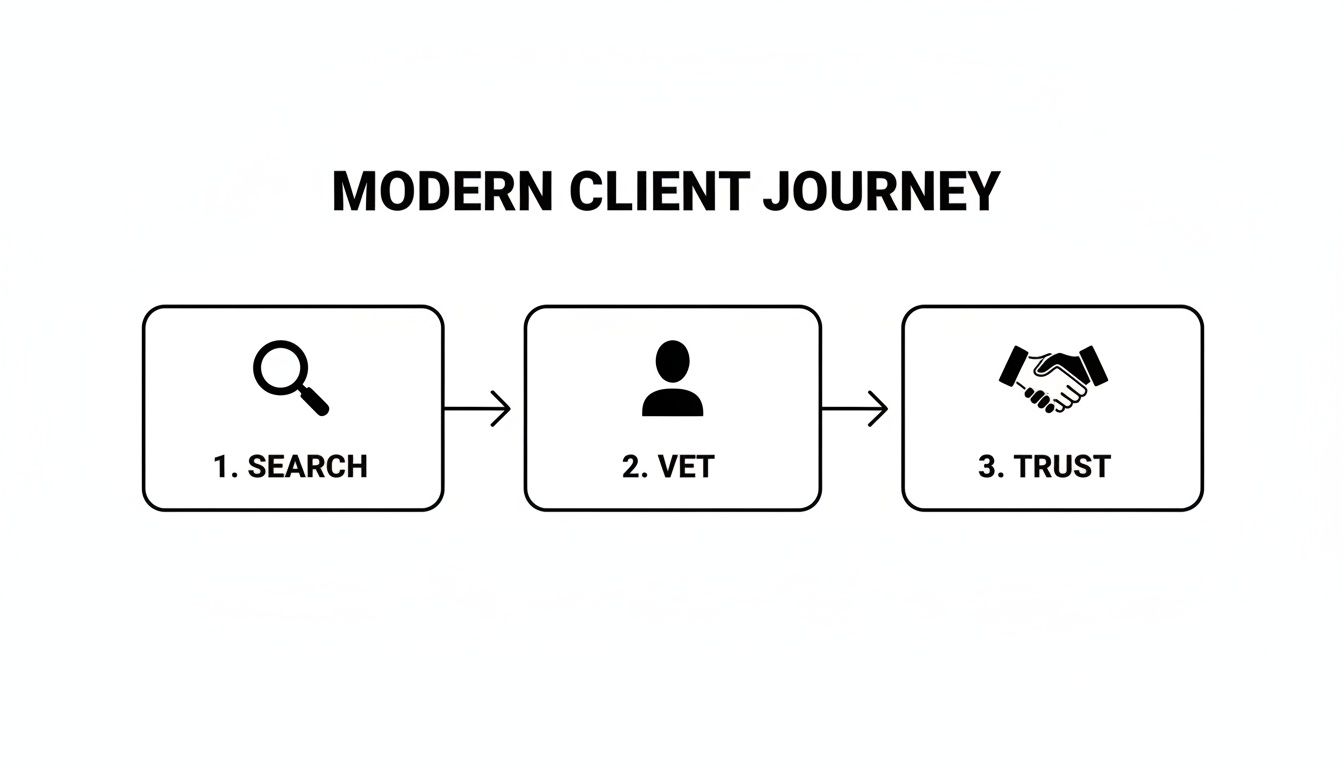
The modern client journey almost always starts online, well before they ever pick up the phone.
As you can see, people search for information first. Then, they vet the advisors they find by looking at their digital presence. Trust is built—or lost—right there. Your social media profiles are a massive part of that crucial “vetting” stage.
Choose Your Platforms with Purpose
Once you’ve figured out who you’re talking to, the next step is to determine where to talk to them. Don’t fall into the trap of thinking you need to be on every single platform. A strong, focused presence on one or two channels will always beat a weak, scattered effort across five.
For most financial advisors, some platforms just make more sense than others. This table breaks down the top contenders and how you can think about using them strategically.
Choosing the Right Social Media Platform for Your Firm
While you don’t need to be everywhere, a solid presence on the right platforms is non-negotiable. By 2026, social media is projected to be a major source of leads, with 22% of high-income Americans beginning their search for an advisor on platforms just like these.
Setting Up a Professional and Compliant Profile
Your social media profile is your new digital storefront. It needs to look professional, be crystal clear about what you do, and—most importantly—be compliant from the get-go.
Think of your bio as your 3-second elevator pitch. It has to instantly tell people who you help, what problem you solve, and what they should do next. Vague bios get scrolled right past.
Here are the essential things to get right from the start:
A Professional Headshot: This is non-negotiable. Use a clear, high-quality photo where you look approachable and trustworthy. No vacation pics or blurry crops. Consistency across platforms builds recognition.
A Client-Focused Bio: Ditch the jargon. Instead of “CFP with 15 years of experience in asset management,” try something like, “Helping tech professionals turn their stock options into long-term wealth.” See the difference? It’s all about them, not you.
A Compliant Call-to-Action (CTA): Give visitors a clear next step. This could be a link to your approved firm blog, a downloadable guide (that’s been through compliance!), or your official scheduling page. Always get your CTA language cleared by compliance first.
A Pinned High-Value Post: Most platforms let you “pin” a post to the top of your profile. Use this valuable real estate! Pin a short introductory video, a link to your most popular educational article, or an important firm announcement.
Getting these foundational pieces right ensures that when potential clients find you, they see a credible, helpful, and professional advisor they want to learn more about.
Creating Content That Attracts Without Selling
Alright, you’ve got your profiles set up, you know exactly who you’re talking to, and you’ve picked your platforms. Now for the part that trips up most advisors: what in the world do you actually post?
The biggest mistake I see advisors make is treating social media like a digital billboard. Aggressive sales pitches and “Call me now!” posts fall flat every single time. Your goal isn’t to sell; it’s to educate, build trust, and prove your value. When prospects are finally ready to talk to an advisor, you want to be the only person they think of.
So, shift your mindset from “seller” to “generous expert.” Your job is to answer your ideal client’s biggest questions, calm their deepest financial fears, and show them you know the way forward.
It really comes down to offering value first. The business will follow.
Your Core Content Pillars
To avoid that “what do I post today?” panic, you need a simple framework. I call them content pillars—a few core themes you can return to over and over. They keep your messaging consistent and relevant to your niche.
Think of these as the foundation of your content strategy. Here are three that work incredibly well for financial advisors.
Pillar 1: Educational Content That Empowers
This is your bread and butter. Your number one job on social media is to be a teacher. Simplify the complex financial world into bite-sized, easy-to-understand pieces. This is how you build true authority and trust.
Explainer Posts: Break down a single concept. Think a carousel post on “The 3 Types of IRAs and Who They’re For” or a quick video explaining tax-loss harvesting.
Myth-Busting: Call out common financial misconceptions. A post like, “Fact vs. Fiction: Will a Market Dip Really Wreck Your Retirement?” will always get people talking.
Checklists & Guides: Give people actionable steps. Something like “Your Year-End Financial Planning Checklist” is immediately useful and shareable.
The more value you give away for free, the more people will want to know what it’s like to actually work with you.
Pillar 2: Behind-the-Scenes Content That Humanizes
Let’s be honest: people hire people, not faceless corporations. Behind-the-scenes (BTS) content is your chance to show the real person behind the practice. It’s what makes you relatable and, more importantly, memorable.
Authenticity is your greatest asset. In a digital world saturated with generic content, personal and authentic stories stand out. Clients want to connect with a real person.
Share a photo from your team’s volunteer day. Post a short video about why you became an advisor in the first place. Even talking about a non-finance book you’re reading can build a powerful connection that a glossy corporate brochure never could.
Pillar 3: Compliant Client Stories That Resonate
Testimonials are a compliance nightmare, we all know that. But you can still tell powerful stories that demonstrate your value—you just have to be smart about it. Focus on the problem and your process, not the results or client identity. Frame them as compliant case studies.
Here’s how that looks in practice:
Don’t say: “My client, Jane Doe, was thrilled when we grew her portfolio by 15%!” (Non-compliant and a huge red flag.)
Instead, try: “A common challenge for physicians nearing retirement is unwinding complex partnership agreements. Our process involves a three-step review of their operating agreements, tax implications, and succession plan to create a clear path forward.” (Compliant and highlights your specific expertise.)
This approach works because it signals to your ideal clients that you understand their unique problems and have a repeatable process for solving them.
Planning Your Content for Consistency
Amazing content ideas don’t mean much if they never get posted. Consistency is everything, and the only way to achieve it is with a plan. This is where a simple content calendar becomes your best friend.
You don’t need fancy software—a Google Sheet or a simple spreadsheet works perfectly. Just map out your posts a week or two in advance, assigning a content pillar to each day.
For example:
Monday: Educational post
Wednesday: Behind-the-scenes story
Friday: Market commentary (compliant and non-promissory, of course)
Tools like Postiz can help you schedule everything in one go, so your profiles stay active even when you’re buried in client meetings. If you need some inspiration to get started, check out these excellent social content ideas for professionals that are easy to adapt for your practice.
By batching your content creation—writing a few posts at once—and scheduling it ahead of time, social media becomes a manageable, strategic part of your week, not a frantic daily chore.
From Broadcasting to Building Relationships
Getting your content created and scheduled is a fantastic start, but it’s really only half the battle. The true power of social media isn’t just shouting into the void; it’s about starting conversations and building real, two-way relationships. This is how you stop being another talking head in the newsfeed and become a trusted resource people actively seek out.
Just posting and walking away is like setting up a booth at a trade show and then hiding behind the curtain. The real value comes when you step out and engage. Shifting your mindset from broadcasting to conversation is what turns a passive follower into an engaged prospect and, eventually, a loyal client.
Master the Art of Compliant Engagement
For a financial advisor, engaging online requires a delicate balance. You want to be conversational and helpful without ever crossing the line into giving specific financial advice or making guarantees.
Here’s how I handle the most common types of interactions:
Positive Comments: Someone leaves a comment like, “Great explanation!” Don’t just hit the ‘like’ button and move on. Acknowledge them with a thoughtful reply. Something as simple as, “So glad you found it helpful!” or “Thanks for reading, it’s a topic I love to clarify,” goes a long way in encouraging more interaction.
Neutral Questions: A follower might ask something related to your post, like, “Does this apply to self-employed individuals too?” Your best bet is to give a general, educational response. Try this: “That’s an excellent question. The rules often have unique considerations for the self-employed. I’ll add that to my list for a future post!” You’ve compliantly answered their question and just found a new content idea.
Negative Comments: They’re going to happen. If a comment is negative but constructive, address it professionally. A calm, “I appreciate your perspective on this,” can de-escalate things. If it’s just baseless or unprofessional, your best move is often to hide or delete it. Never, ever get into a public back-and-forth.
My golden rule of engagement is this: always take specific financial conversations offline. A simple, compliant, and effective script is, “Thanks for your question. For privacy and compliance reasons, I can’t get into personal situations here, but you’re welcome to schedule a private chat through the link in my bio.”
Proactive Reputation Management
Building relationships isn’t just about responding; it’s about proactively managing your online reputation. Don’t wait for people to talk about you—be part of the conversation. This means keeping an eye out for mentions of your name or firm and encouraging positive feedback where regulations allow.
A non-negotiable part of this is setting up alerts. Use free tools like Google Alerts or the monitoring features within platforms to get an email whenever you or your firm is mentioned online. This gives you the chance to thank someone for a kind word or get ahead of a concern before it snowballs. This is critical, especially since 82% of prospects are looking you up online before they ever reach out.
The platforms themselves are evolving, too. By 2026, TikTok is expected to be a major channel for finance content. The brands seeing success won’t be the ones with the flashiest ads, but those who deliver structured, actionable content that builds credibility first. You can find more insights on how brands are connecting with the next generation of investors.
The 15-Minute Daily Engagement Routine
Look, you don’t need to live on social media to build a thriving community. A focused, 15-minute routine each day is all it takes to stay on your network’s radar and build real rapport.
Here’s a simple plan you can start today:
First 5 Minutes: Respond and React. Open your main platform and clear your notifications. Respond to all legitimate comments on your posts and answer any direct messages that have come in.
Next 5 Minutes: Proactive Outreach. Pick 3-5 ideal prospects or strategic partners (think CPAs, attorneys) you follow. Go to their profiles and leave a thoughtful, non-salesy comment on one of their recent posts. Add value to their conversation.
Final 5 Minutes: Industry Engagement. Pop over to a relevant industry hashtag (like #financialplanning or #womeninbusiness) or a key LinkedIn Group. Find a popular post and drop your unique, compliant perspective in the comments.
This simple habit makes sure you’re seen as an active, helpful member of your online community, not just a broadcaster. It’s this consistent, daily effort that turns your social media profile from a static page into a dynamic relationship-building machine.
How to Measure What Actually Matters
Getting content out there consistently is a great start, but it’s only half the battle. If you aren’t measuring what’s working, you’re flying blind. It’s time to pull back the curtain on social media analytics and figure out how to connect your efforts to real business results.
The biggest trap I see advisors fall into is chasing vanity metrics. These are the numbers that feel good but don’t pay the bills—think follower counts or the number of likes on a post. Sure, they might signal a bit of brand awareness, but they won’t tell you if your strategy is actually bringing new clients through the door.
Moving Past Likes to Leads
You have to shift your focus to the key performance indicators (KPIs) that directly map to your bottom line. We need to track the metrics that show people are taking the next step, moving from a passive scroller to an active prospect.
Here’s what you should be paying attention to instead:
Website Clicks: How many people are actually clicking the link in your bio to check out your website? This is a huge indicator of genuine interest.
Inbound DMs: Are people sliding into your DMs with real questions about your services? Keep a running tally of these high-intent messages each month.
Lead Form Submissions: If you’re sending people to a landing page with a contact form or a downloadable guide, how many are filling it out? This is a direct measure of new leads.
Consultation Bookings: This is the ultimate prize. How many first-time meetings can you trace directly back to your social media activity?
Focusing on these action-based numbers gives you a much clearer, more honest picture of what’s really moving the needle for your firm.
Using Built-In Analytics
You don’t need to shell out for expensive software to get started. Every major social media platform has a free, built-in analytics dashboard that’s packed with useful info. LinkedIn, for instance, gives you detailed breakdowns of your audience demographics, post impressions, and the click-through rates on your links.
The point of analytics isn’t just to hoard data; it’s to answer critical business questions. You should be able to look at your monthly report and say, “That video series on estate planning drove 25% more website traffic than my written market updates.”
That kind of insight is pure gold. It tells you exactly what your audience wants and where you should double down on your efforts next month.
Your Monthly Performance Review Framework
Block out just one hour at the end of each month to go over your performance. Don’t get bogged down in every single number. Just focus on answering a few simple questions to steer your strategy.
Here’s a quick framework to get you started:
Which posts drove the most website clicks? Find your top performers and look for patterns. Was it a video? A carousel post? A particular client pain point you addressed?
How did our audience grow? While not a primary KPI, steady growth shows your content is reaching new, relevant people.
How many qualified leads did we generate? Add up the DMs, form submissions, and direct calls that came from social. This is your most important number.
This simple review will keep your strategy sharp and effective. Beyond just engagement, understanding the return on investment (ROI) is crucial. For a deeper dive into measuring the financial impact, check out this great resource on mastering marketing automation ROI for growth.
Start Simple A/B Testing
Once you have a couple of months of data, you can start running simple experiments to see what works best. This is often called A/B testing—you just change one small thing between two otherwise identical posts to see which one gets a better response.
For example, you could test:
Different Headlines: Share the same blog post link twice, but write two completely different captions.
Different Images: Use the same text but pair it with a professional headshot versus a relevant stock photo.
Different Calls-to-Action (CTAs): Try out “Book a discovery call” versus “Learn more on our website.”
Track the results. Over time, these little tests add up to big insights about what grabs your audience’s attention and makes them act. This process of testing and tweaking is essential to truly understanding your performance, a topic we cover in our guide on how to measure marketing ROI. By consistently measuring what matters and making small, informed changes, you’ll ensure your time on social media generates a real, tangible return.
Your Top Social Media Questions Answered
If you’re a financial advisor, you’ve probably got some big questions about social media—especially when it comes to staying compliant and finding the time. These are the two biggest hurdles I see advisors face. Let’s break them down with some straightforward answers so you can get started with confidence.
How Can I Use Social Media While Staying Compliant?
This is the big one, and it’s simpler than you might think. The golden rule is to educate, don’t promise. Your content needs to be fair, balanced, and never, ever misleading.
So, instead of pushing a specific product, focus on explaining financial concepts. Think less “buy this fund” and more “here’s how to think about asset allocation.”
Client testimonials are a definite no-go, and you have to steer clear of any language that sounds like a guarantee of future returns. Before anything goes live, your compliance department must review and sign off on all static content (like your bio) and any ads. And remember, having a solid system to archive all your social media activity isn’t just a good idea—it’s a regulatory must-have.
How Much Time Should I Realistically Spend Weekly?
With a smart plan, you can make a real impact in just 2-3 hours per week. The trick is to batch your work and stick to a routine.
Consistency beats intensity every time. A focused, regular effort is far more powerful than occasional, time-consuming bursts of activity. A little bit every day builds momentum that sporadic posting never can.
Block out an hour at the beginning of the week to plan and schedule all your posts. After that, it’s just about maintenance. Spend 15-20 minutes each day engaging with people—replying to comments, starting conversations, and connecting with potential clients. That’s it.
What Are the Best Types of Content to Post?
The content that works best is the kind that builds trust by demonstrating your expertise, not by making a sales pitch. I’ve found that focusing on three key areas gets the best results:
Educational Posts: Break down tricky topics like tax-loss harvesting or the nuances of 401(k) rollovers. Make the complex simple.
Behind-the-Scenes Content: Let people see the human side of your practice. Share something about your firm’s values or a bit about your own professional journey. It makes you relatable.
Market Commentary: Provide your take on current economic news, always keeping it general and compliant. You’re the guide, not the crystal ball.
Don’t forget about short-form video, either. It’s an incredibly effective way to explain ideas quickly and build a real connection with your audience.
Ready to streamline your content creation and scheduling? Postiz is an all-in-one platform that helps financial advisors plan, publish, and analyze their social media performance with ease. See how you can save time and stay consistent by checking out Postiz today.
Create high-quality content faster with AI. Learn how AI-powered content creation simplifies your workflow, boosts productivity, and helps you plan, write, and design smarter.