You've likely seen the infographics declaring Wednesday at 11 AM as the ultimate, universal key to Instagram success. The reality is, a one-size-fits-all schedule is a direct path to low engagement. The platform's algorithm has evolved, prioritizing recency and individual user behavior, which means your ideal posting time is as unique as your audience. Relying on generic advice is like shouting into a crowded room and hoping the right person hears you.
This guide moves beyond those outdated, broad recommendations. We will provide eight specific, actionable strategies to help you discover the precise moments your followers are most active, scrolling, and ready to engage. Forget the guesswork; it's time to build a data-driven approach.
We'll cover how to leverage your own Instagram Insights, understand key industry-specific nuances, and use strategic A/B testing to refine your schedule. By following this framework, you will develop a repeatable process to find your unique best time to post to Instagram. This ensures your content doesn't just get published, it gets seen by the people who matter most, maximizing your reach and impact with every post.
1. Post During Peak Engagement Hours (11 AM – 1 PM and 7 PM – 9 PM)
If you're looking for a reliable, data-backed starting point, general peak engagement hours are your best bet. These time windows represent when the largest cross-section of Instagram users are actively scrolling, liking, and commenting. This approach works by targeting broad user behavior patterns that transcend most industries and niches.
The logic is simple: post when most people are already on the app.
The Midday Window (11 AM – 1 PM): This block captures the lunchtime crowd. Users take a break from work or school, using this downtime to catch up on their feeds.
The Evening Window (7 PM – 9 PM): This period aligns with post-dinner relaxation. Users have finished their day and have more leisure time to deeply engage with content, watch Stories, and explore new accounts.
Why This Works
Posting during these times maximizes your content's initial visibility. The Instagram algorithm often prioritizes fresh content that quickly gains traction. By launching your post into a sea of active users, you increase the chances of getting that crucial early engagement, which can boost its reach for hours to come.
For example, a food blogger might post a lunch recipe at 12 PM to catch users looking for meal inspiration. Similarly, a fashion brand can showcase a new collection at 8 PM when followers are relaxing and more likely to browse and shop.
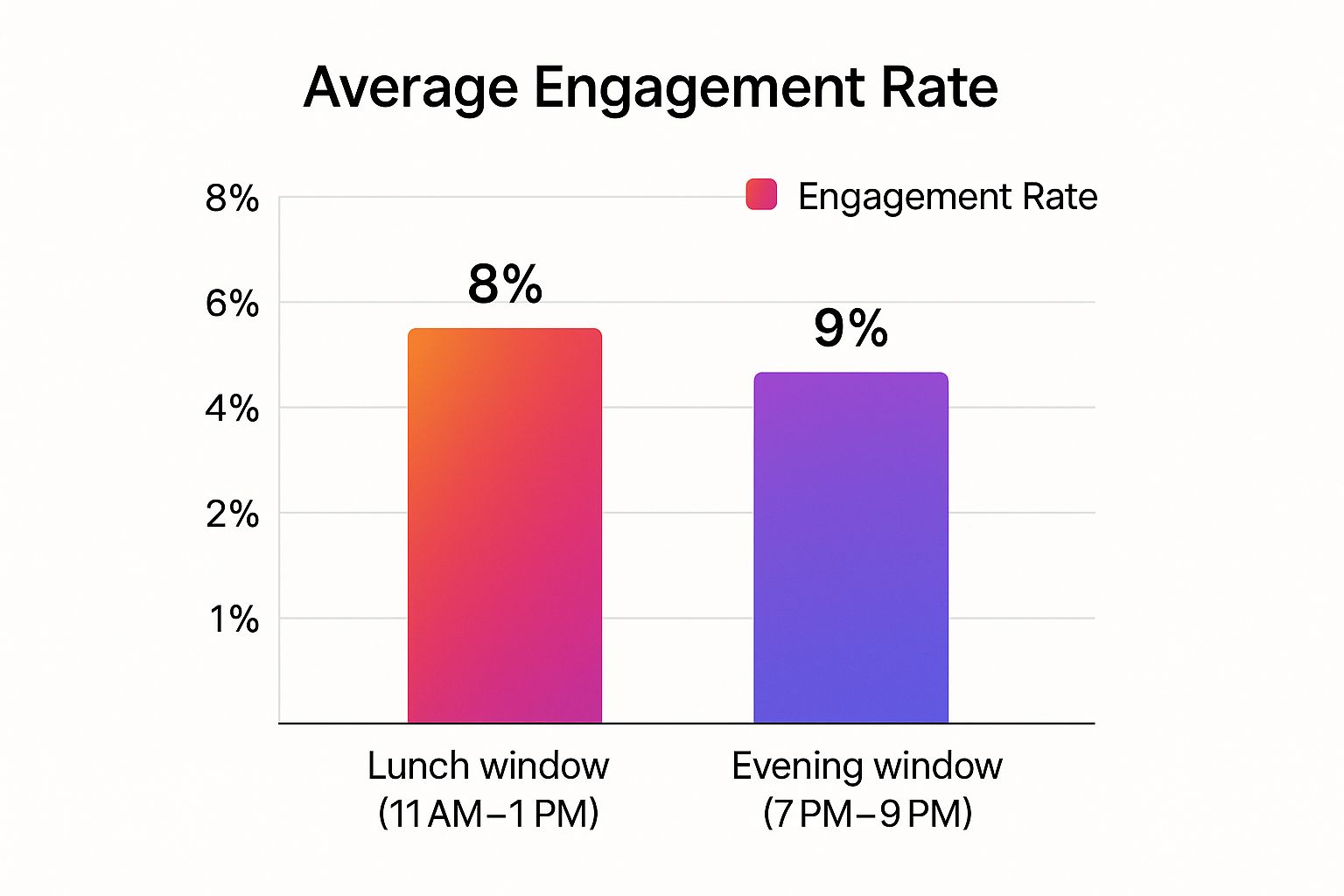
The following bar chart compares the average engagement rates for these two peak windows, showing a slight but significant advantage for evening posts.
As the data shows, the evening window often yields slightly higher engagement, likely because users have more uninterrupted time to interact with content.
Manage all your social media in one place with Postiz
To find the best time to post to Instagram for your specific account, use these peak hours as your foundation and test rigorously.
Split-Test Both Windows: Dedicate one week to posting exclusively between 11 AM and 1 PM, and the next week to posting only between 7 PM and 9 PM. Compare the results to see which window your audience responds to better.
Use Instagram Insights: Don't just guess. Navigate to your Professional Dashboard, tap "Account Insights," and select "Total Followers." Scroll down to "Most Active Times" to see a visual breakdown of when your audience is online. This data will confirm or adjust these general peak hours.
Schedule in Advance: Use a scheduling tool like Meta Business Suite, Later, or Buffer to prepare your posts. This ensures you never miss a peak window, even if you're busy.
Monitor Early Engagement: The first 30-60 minutes after posting are critical. Be active during this time to respond to comments and DMs, which signals to the algorithm that your post is sparking conversation.
2. Leverage Your Audience's Time Zone and Geographic Location
Generic peak hours are a great starting point, but the single most effective way to determine the best time to post to Instagram is to cater to your specific audience's location. Posting at 8 PM in New York does you no good if most of your followers are just waking up in Sydney. This approach involves diving into your analytics to post when your unique followers are most likely to be online.
The logic is precise: post when your audience is active, not when the global audience is.
This strategy is crucial for accounts with a concentrated following in a specific region or a widely distributed international audience. It shifts the focus from general best practices to personalized, data-driven scheduling.
Why This Works
The Instagram algorithm favors recency and quick engagement. By posting in your audience's dominant time zone, you ensure your content appears at the top of their feeds when they log on. This maximizes initial visibility and interaction, signaling to the algorithm that your post is valuable and worth showing to more people.
For example, an NYC-based restaurant account should post between 5 PM and 7 PM EST to catch users planning their dinner. Similarly, a European fashion brand with a strong U.S. following might post around 2 PM CET, which is early morning on the U.S. East Coast, catching two key markets simultaneously.
This tailored approach almost always outperforms generic time slots because it's based on your account's actual follower behavior.
Actionable Tips for Implementation
Use your own data to build a custom posting schedule that aligns with where your followers live.
Check Your Instagram Insights: Go to your Professional Dashboard > Account Insights > Total Followers. Scroll to the bottom to find "Top Locations," which shows breakdowns by both cities and countries. This is your primary source of truth.
Identify Your Dominant Time Zone: If over 50% of your audience is in one country or time zone, prioritize that for your posting schedule. For instance, if most of your followers are in the UK, base your schedule on GMT/BST.
Create Schedules for Multiple Time Zones: If your audience is split globally, for example, 40% in North America and 40% in Europe, consider creating two posts or scheduling one post to hit a "sweet spot" that covers both, like late afternoon in Europe and morning in the U.S.
Factor in Daylight Saving Time: Remember that time zones change. Be mindful of daylight saving adjustments in spring and autumn to keep your schedule accurate.
3. Post on Weekdays for Higher Professional Engagement
While general peak hours offer a great starting point, the specific day you post matters immensely, especially for B2B, educational, or professional content. Data consistently shows that weekdays, particularly Tuesday through Thursday, generate significantly higher engagement rates than weekends. This strategy targets users during their routine work-week mindset when they are often more focused and receptive to informative content.
The logic is rooted in user behavior: people use Instagram differently on weekdays.
Mid-week Focus (Tuesday – Thursday): These days are the core of the work week. Users often check Instagram during commutes, lunch breaks, and other structured downtime, making them more likely to engage with content that is educational, industry-related, or career-focused.
The Wind-Down Effect (Friday): Engagement can start to dip as people shift into a weekend mindset, prioritizing entertainment and social plans.
Why This Works
Focusing your key posts on weekdays aligns your content with the audience's professional rhythm. The algorithm rewards content that receives quick, meaningful engagement, and by posting when users are in a "learning" or "business" mode, you increase the likelihood of thoughtful comments and shares.
For example, a B2B software company will see far better lead generation from a post on a Tuesday morning than on a Saturday afternoon. Similarly, educational accounts like @theskimm see their highest interaction on Wednesday mornings when followers are catching up on news to start their day. This targeted approach helps find the best time to post to Instagram for content that requires more than a passing glance.
Actionable Tips for Implementation
Use the weekday principle to strategically schedule your most valuable content for maximum impact.
Schedule Key Content Mid-Week: Plan your most important announcements, product launches, or educational carousels for Tuesday, Wednesday, or Thursday. These are your prime days for driving conversions and serious engagement. For more information on this strategy, you can learn more about the best days to post on Postiz.com.
Save Casual Content for Weekends: Use weekends for lighter, more personal, or behind-the-scenes content. This helps build community without competing for the focused attention your primary content needs.
Monitor Industry-Specific Patterns: While this is a strong general rule, some industries (like hospitality or entertainment) may see different patterns. Use your Instagram Insights to confirm if your audience follows this weekday-heavy trend.
Test Morning vs. Afternoon: Within the Tuesday-Thursday window, test morning slots (9 AM – 11 AM) against afternoon slots (1 PM – 3 PM) to pinpoint the exact time your professional audience is most active and engaged.
4. Use Instagram Insights for Data-Driven Timing Decisions
Instead of relying on general advice, the most powerful strategy involves using data from your own audience. Instagram's built-in analytics, available for Business and Creator accounts, removes the guesswork by showing you exactly when your followers are most active on the platform. This approach is about tailoring your schedule to your unique community.
The logic is precise: post when your audience is ready and waiting to engage.
Accessing Your Data: Navigate to your Professional Dashboard, tap "Account Insights," and select "Total Followers."
Finding Peak Times: Scroll to the bottom to find the "Most Active Times" section. Here, you can view activity by hour and by day, providing a clear map of your audience's behavior.
Why This Works
This method is the gold standard for finding the best time to post to Instagram because it's hyper-personalized. Generic peak hours are a great start, but they don't account for the unique demographics, time zones, and daily routines of your specific followers. Using your own Insights ensures your content lands in front of the maximum number of your followers the moment it goes live.
For instance, a fitness coach might discover their audience is most active at 5 AM before work and 6 PM for evening workouts. A food blogger could see engagement spikes around 11 AM (lunch planning), 2 PM (afternoon snack), and 7 PM (dinner inspiration), allowing them to align posts with mealtimes. This level of precision is impossible with generalized data.
Actionable Tips for Implementation
Use Instagram Insights not just as a one-time check but as an ongoing tool for refining your posting strategy.
Check Insights Weekly: Follower behavior can shift. Make it a weekly habit to review your "Most Active Times" to catch new trends or changes in your audience's daily routines.
Look for 30-Day Patterns: Avoid making drastic changes based on a single day's data. Analyze the patterns over a 30-day period to get a more reliable picture of consistent audience activity.
Cross-Reference with Performance: Compare your most active times with the initial engagement on your best-performing posts. Do they align? This cross-check validates your timing and helps you build a custom posting calendar.
Document and Schedule: Keep a simple log of your findings. Once you identify consistent peak windows, use a scheduling tool to ensure you hit those times perfectly. For a deeper dive into scheduling, you can learn more about how to schedule Instagram posts on postiz.com.
5. Consider Industry-Specific Peak Times
Moving beyond general advice, one of the most effective strategies is to align your posting schedule with the specific rhythms of your industry. Different niches attract audiences with unique daily habits and content consumption patterns. This approach works by targeting users precisely when your product or service is most relevant to them.
The logic is about context: post when your audience is already in the mindset to engage with your type of content.
Food & Beverage: This industry peaks around mealtimes. Users look for recipes or dining inspiration just before they eat. Ideal times are often 10 AM (lunch planning), 3 PM (dinner prep), and 8 PM (browsing for the next day).
Fitness & Wellness: Content performs best when users are planning or doing workouts. This creates two key windows: early mornings (around 6 AM) for motivation and evenings (around 5 PM) for post-work exercise routines.
Fashion & Beauty: Engagement spikes when people are planning outfits or winding down. This makes evenings (around 8 PM) ideal, as users browse for inspiration for the next day or upcoming events.
Why This Works
Posting during industry-specific peak times ensures your content is not just seen, but seen at a moment of high relevance. The Instagram algorithm favors content that resonates quickly and deeply. By aligning with your audience's lifestyle, you increase the likelihood of meaningful interactions like saves, shares, and thoughtful comments, which are powerful signals to the algorithm.
For instance, a fitness influencer like @massy.arias might post a morning workout at 6 AM to catch the early risers. A business-to-business (B2B) tech company would find more success posting at 12 PM on a Tuesday when professionals are on their lunch break, rather than 9 PM on a Saturday.
Actionable Tips for Implementation
To pinpoint the best time to post to Instagram for your industry, use these targeted tactics to refine your schedule.
Study Competitor Patterns: Analyze 5-10 successful accounts in your niche. Use a spreadsheet to track when they post and which posts get the most engagement. Look for consistent timing patterns.
Align Content Themes with Time: Don't just post at the right time; post the right content. Schedule "morning motivation" posts for early hours, "lunch break tips" for midday, and "evening relaxation" content for later.
Research Your Audience's Day: Think critically about your ideal follower. When do they use your product or service? A coffee brand's audience is most active in the morning, while a sleep-aid brand's audience is online late at night.
Leverage Industry Reports: Look for studies from platforms like Later.com or Hootsuite that analyze social media data by sector. These reports provide a data-backed foundation for your initial tests.
6. Test and Analyze Your Specific Audience Through A/B Testing
While general data provides a great starting point, the ultimate best time to post to Instagram is unique to your audience. A/B testing, or split testing, is a scientific method to pinpoint these precise windows by comparing the performance of similar posts at different times. This approach removes guesswork and relies on hard data from your own followers.
The logic is straightforward: pit different posting times against each other and let the engagement data declare the winner.
Variable Testing: You isolate one variable, such as the time of day, and keep everything else (content type, caption, hashtags) as consistent as possible.
Performance Measurement: You meticulously track key metrics like likes, comments, shares, saves, and reach for each post to identify which time slot delivered superior results.
Why This Works
A/B testing is the most accurate way to understand your audience's unique behavior. Your followers might be night owls, early risers, or weekend scrollers. Instead of relying on broad industry averages, you get concrete evidence of when your community is most active and receptive.
For example, a travel blogger like @doyoutravel might discover through testing that their audience of aspiring travelers engages 40% more with a dreamy destination post on a Tuesday at 11 AM (when they're daydreaming at work) than on a Friday. Similarly, a fitness coach could find that 6 AM workout videos drive three times more app downloads than 6 PM posts, catching users before their day gets busy.
Actionable Tips for Implementation
To properly implement A/B testing and find the best time to post on Instagram for your account, follow a structured process.
Test One Variable at a Time: Start by testing different times on the same day (e.g., 9 AM vs. 6 PM on Wednesdays). Once you find the optimal time, test different days of the week (e.g., Wednesday at 6 PM vs. Sunday at 6 PM).
Run Tests Long Enough: Test for at least two to four weeks to gather enough data and account for random fluctuations. A single test isn't statistically significant.
Use Consistent Content: Compare apples to apples. When testing times, use similar types of content (e.g., two similar-style carousels or two similar Reels) to ensure a fair comparison.
Document Everything: Create a simple spreadsheet to track the post, day, time, and key engagement metrics. This makes it easy to spot patterns over time.
Retest Quarterly: Audience habits can change. Re-run your A/B tests every few months to ensure your posting schedule remains optimized.
7. Avoid Peak Competition Windows (Monday Morning, Friday Evening)
While posting during high-traffic hours is a popular strategy, it often means competing with a massive volume of content. An alternative approach is to post during "shoulder times" when user activity is still high but content saturation is lower. This strategy works by finding a sweet spot where your post has a better chance to stand out.
The logic is simple: avoid posting when everyone else is.
Monday Morning (8 AM – 10 AM): This window is flooded with "new week" motivation, weekend recaps, and business-focused content. Your post can easily get lost in the noise.
Friday Evening (5 PM onwards): As the work week ends, feeds are saturated with weekend plans, promotions, and celebratory posts. This intense competition can suppress your reach.
Why This Works
Posting during less competitive times gives your content a fighting chance to capture initial engagement. When the algorithm sees fewer posts vying for attention, it may give yours more visibility among your followers. This can lead to a stronger initial performance, which then helps extend its reach over time.
For example, a B2B brand might find their Tuesday 9 AM post outperforms their Monday 8 AM post by 45% simply because there's less competition. Similarly, a lifestyle creator might discover a Thursday 4 PM post gets significantly better reach than a Friday 7 PM post because it isn’t fighting against the tide of "weekend" content.
This method is about being strategic rather than just following the crowd. By sidestepping the content deluge, you give your posts the breathing room they need to perform well.
Actionable Tips for Implementation
To find the best time to post to Instagram for your account, use these low-competition windows to your advantage.
Test Shoulder Hours: Experiment by posting 1-2 hours before or after the most competitive peak times. For instance, try posting at 7 AM on Monday instead of 9 AM, or at 3 PM on Friday instead of 6 PM.
Monitor Your Competitors: Pay close attention to when other accounts in your niche are most active. Make a note of their posting schedules and identify gaps where you can post with less direct competition.
Track Organic Reach: Don't just look at likes and comments. Use Instagram Insights to monitor your post's reach and impressions during different times. A post with lower engagement but higher reach can still be a strategic win.
Use Scheduling Tools Intelligently: When using a tool like Meta Business Suite or Later, don't just schedule for peak hours. Purposefully schedule some content for these quieter "shoulder" periods and compare the performance data.
8. Adapt Timing Strategy Based on Content Type and Format
Not all content is created equal, and your audience doesn't consume different formats in the same way. A successful timing strategy goes beyond general peak hours and adapts to the specific type of content you're posting, from quick Stories to in-depth carousels. This approach works by matching your content format to your audience’s mindset at different times of the day.
The logic is straightforward: align the format with user attention spans.
Stories (Commute Times: 7 AM – 9 AM & 5 PM – 7 PM): These short, tappable posts are perfect for users with limited attention, like those on their daily commute. They want quick, easily digestible updates.
Carousel Posts (Midday: 12 PM – 2 PM): This window is ideal for educational or detailed content. Users are on their lunch break and have more time to swipe through a multi-slide post and absorb information.
Reels (Evening Leisure: 8 PM – 10 PM): This is prime time for entertainment. Users are relaxing and actively seeking short-form video content to unwind, making it the perfect time for engaging and fun Reels.
Why This Works
Aligning your content format with user behavior significantly increases engagement potential. You're not just posting when people are online; you're delivering the right kind of content when they are most receptive to it. An educational carousel posted during the evening entertainment window may get overlooked, just as a high-effort Reel might be wasted on a distracted morning commuter.
For instance, a business coach could post quick Q&A Stories in the morning, an in-depth "5 Steps to Success" carousel at lunch, and an entertaining "Day in the Life" Reel at 9 PM. When adapting your strategy, consider specific content formats like Reels. For inspiring creative ideas to align with your optimal posting times, explore these Instagram Reel ideas for barbers.
Actionable Tips for Implementation
To discover the best time to post to Instagram for each format, map out a content-specific schedule and test its effectiveness.
Create a Format-Specific Calendar: Assign different content types to specific time slots throughout the week. For example, Monday at 8 AM for Stories, Wednesday at 1 PM for a carousel, and Friday at 9 PM for a Reel.
Analyze Format-Specific Insights: In your Instagram Insights, filter your content by format (e.g., Reels) and analyze the performance of posts published at different times. Look for patterns in reach and engagement.
Match Complexity to Attention: Reserve your most detailed and complex content, like tutorials or deep-dive carousels, for times when your audience has longer to focus (lunch breaks or evenings).
Optimize Your Reel Timing: Given the format's importance, pay close attention to when your Reels perform best. For a deeper dive into this, you can learn more about the best time to post reels on Instagram.
8-Point Instagram Posting Time Comparison
Strategy
Implementation Complexity 🔄
Resource Requirements ⚡
Expected Outcomes 📊
Ideal Use Cases 💡
Key Advantages ⭐
Post During Peak Engagement Hours
Moderate – requires scheduling consistency
Moderate – content pre-planning needed
High engagement & visibility
Broad audience targeting
Maximize reach and viral potential
Leverage Audience Time Zone & Location
High – requires detailed audience analysis
Moderate – ongoing monitoring
Higher personalized engagement
Accounts with regional/global followers
Tailored timing boosts relevance
Post on Weekdays for Higher Professional Engagement
Moderate – fixed weekday schedule
Moderate – weekday-focused content creation
Stable engagement with professional audience
Business and B2B content
Predictable, higher quality engagement
Use Instagram Insights for Data-Driven Timing
Moderate – requires analytics interpretation
Low – uses built-in free tool
Accurate, audience-specific timing
Business and creator accounts
Removes guesswork, personalized optimization
Consider Industry-Specific Peak Times
High – needs niche research and adaptation
Moderate – continuous industry monitoring
Superior engagement within niche
Industry-focused accounts
Competitive edge with relevant timing
Test and Analyze Your Specific Audience
High – requires systematic A/B testing
High – consistent posting and analysis time
Optimized, evidence-based timing
Accounts seeking tailored timing solutions
Data-driven decisions maximize ROI
Avoid Peak Competition Windows
Low – requires competitor monitoring
Low
Better organic reach in less saturated times
Accounts facing heavy content competition
Less competition, easier engagement growth
Adapt Timing by Content Type and Format
High – complex scheduling per content format
High – diverse content creation effort
Improved engagement by format
Accounts with multi-format content strategies
Maximizes engagement per content type
Turn Your Insights Into an Unbeatable Posting Schedule
Finding the best time to post to Instagram is not about discovering a single, magical hour that works for everyone. As we've explored, it's a dynamic process that blends general best practices with the unique behavior of your specific audience. The true power lies in moving beyond generic advice and building a custom posting strategy that evolves with your followers.
Your journey starts with the foundational knowledge of peak engagement windows, like the midday (11 AM – 1 PM) and evening (7 PM – 9 PM) slots, but it certainly doesn't end there. The key is to treat these as starting points for your own investigation, not as rigid rules. The real breakthroughs will come when you dive into your own data.
From General Rules to Personal Strategy
The most crucial takeaway is this: your Instagram Insights are your most valuable asset. While understanding that weekdays often drive professional engagement or that different industries have unique peak times is helpful, your account's analytics provide the ground truth. This data tells you exactly when your followers are scrolling, engaging, and ready to see your content.
By combining this data-driven approach with strategic A/B testing, you transform guesswork into a predictable system. You can test different content formats, like Reels versus Carousels, at various times to see what resonates most. This continuous cycle of posting, analyzing, and refining is what separates successful accounts from those that struggle to gain traction.
Your Actionable Roadmap to Higher Engagement
To put this all into practice, here is your simple, actionable plan for the next 30 days:
Audit Your Analytics: Go into your Instagram Insights right now. Identify the top three days and times your audience was most active over the last month.
Form a Hypothesis: Based on that data and the general peak times discussed, select two or three new time slots to test for the upcoming week.
Schedule and Execute: Consistently post your content during these selected time slots. Don't forget to consider your audience's primary time zones.
Review and Refine: At the end of the month, compare the engagement metrics (likes, comments, shares, saves) from your test posts against your previous baseline. Keep the winning time slots and replace the ones that underperformed.
Mastering your posting schedule is more than just a technical exercise; it's about respecting your audience's time and maximizing the impact of the incredible content you work so hard to create. A well-timed post ensures your message doesn't just get published, it gets seen. This leads to higher engagement, stronger community growth, and ultimately, greater success in achieving your goals on the platform.
Ready to stop guessing and start scheduling with data-driven precision? Postiz is the all-in-one tool that helps you automate your posting at the optimal times, analyze performance, and manage your entire content strategy effortlessly. Take control of your Instagram growth and try Postiz today to turn your insights into an unstoppable engagement engine.
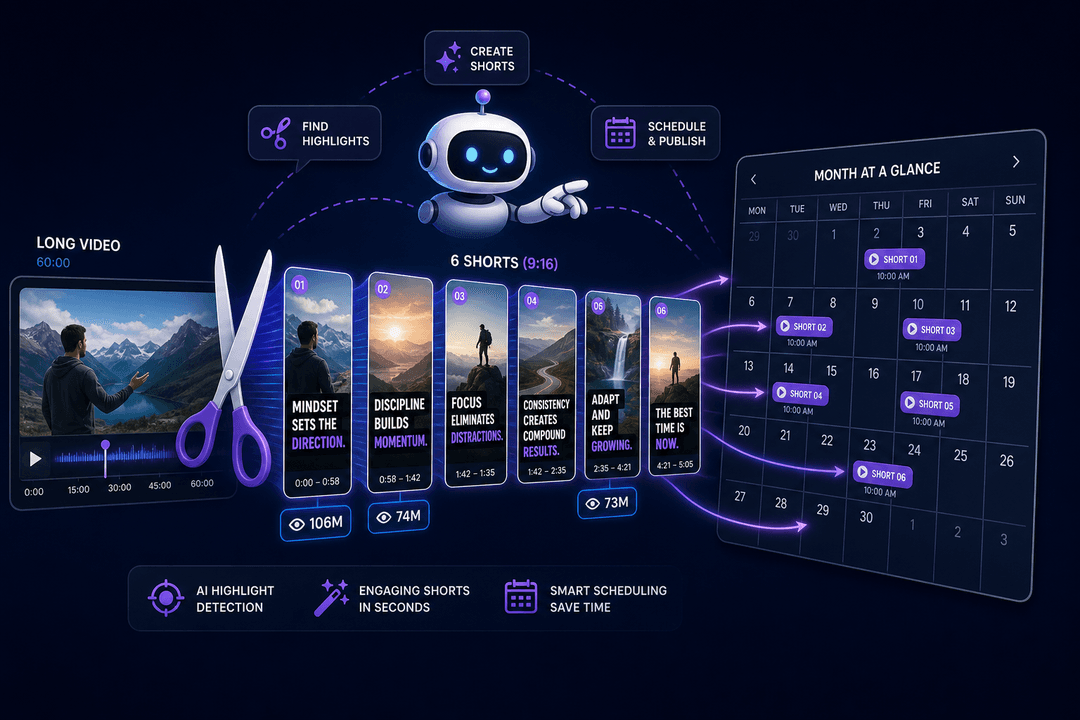
Build a faceless YouTube Shorts and Facebook Reels channel with one Grok Bot and Postiz AI clipping: the exact prompts, skill, and routine that turn a YouTube link into captioned vertical clips, draft posts, and a full 14-day calendar, based on the SpeedKaiClip channel with 410M views from six Shorts.